
 | A request that this article title be changed to Kurabiye is under discussion. Please do not move this article until the discussion is closed. |
 | This article should specify the language of its non-English content using {{lang}} or {{langx}}, {{transliteration}} for transliterated languages, and {{IPA}} for phonetic transcriptions, with an appropriate ISO 639 code. Wikipedia's multilingual support templates may also be used. (December 2025) |
.jpg) A plate of Serbian-style Christmas gurabija | |
| Type | Shortbread |
|---|---|
| Region or state | Maghreb, West Asia, Balkans, Crimea |
| Main ingredients | Almond flour, sugar, egg white, vanilla |

Qurabiya (Arabic: غريبة), also ghorayeba(h), ghoriba, ghraybeh, kurabiye, or kourabiedes (Greek: κουραμπιέδες) and numerous other spellings and pronunciations, is a shortbread-type biscuit, usually made with ground almonds. Versions are found in most Arab, Balkan and Ottoman cuisines, with various different forms and recipes.[1][2] They are similar to polvorones from Andalusia.[3][dead link][4][5]
In the Maghreb and Egypt, they are often served with Libyan tea, Arabic coffee or Maghrebi mint tea.
History
[edit]A recipe for a shortbread cookie similar to ghorayebah but without almonds—called in Arabic khushkanānaj gharīb (“exotic cookie”)—is given in the earliest known Arab cookbook, the 10th-century Kitab al-Ṭabīḫ.[6] The term kurabiye appears in Ottoman cuisine in the 15th century.[7] Proceedings of the 8th International Congress of Orientalists from 1889 describe Syrian ghraybe as a type of ma'amoul, shaped into small rings or hexagonal star-like forms, with no nut filling and a high butter content. They also described Egyptian ghurayba as a white, round biscuit-like cookie.[8]
Etymology
[edit]
There is some debate about the origin of the words. Some give no other origin for the Turkish word kurabiye than Turkish, while others have given Arabic or Persian.[7] Among others, linguist Sevan Nişanyan has given an Arabic origin, in his 2009 book of Turkish etymology, from ġurayb or ğarîb (exotic).[9][10] However, as of 2019, Nişanyan's online dictionary now gives the earliest known recorded use in Turkish as the late 17th century, with an origin from the Persian gulābiya, a cookie made with rose water, from gulāb, related to flowers. He notes that the Syrian Arabic words ġurābiye/ġuraybiye derived from the Turkish.[11] Syrian historian Khayr al-Din al-Asadi attributes a Turkish origin to the word ghraiba used in Syrian Arabic.[12] According to food historian Gil Marks, ghraybeh is of Arabic origin.[2]
Regional variations
[edit] Crescent shaped qurabiya
Crimea
[edit]Crimean Tatars call cookies khurabie (qurabiye, qurabye, къурабье, къурабие).
The Crimean Tatar kurabye has many forms, but basically it looks like a rhombus, or a combination of two or three rhombuses to form a flower, or it is cut in the shape of a crescent.
Crimean Tatars prepare kurabye as follows: powdered sugar is mixed with ghee, and then flour is added.
The finished khurabye is completely sprinkled with powdered sugar on all sides.[13][14]
Albania
[edit]![[icon]](/wiki/File:Wiki_letter_w_cropped.svg) | This section needs expansion. You can help by adding missing information. (December 2025) |
Kurabie.[15]
Algeria
[edit] Ghribia biscuits, Algeria
Ghribia (Algerian Arabic: غريبية)[16][17][18]
- Ghribia with almonds
- Ghribia with peanuts
- Ghribia with walnuts
- Ghribia with pistachios
Armenia
[edit]Khourabia[19] (Armenian: Ղուրաբիա) is the Armenian version sometimes referred to in English as Armenian butter cookie or Armenian shortbread cookie.[20] Khourabia was traditionally made with three ingredients: butter, sugar, and flour and usually shaped like bread, wheat ear, or horse shoe signifying health, wealth, and prosperity. It was mostly eaten during the Easter, Christmas and new year celebrations. Later, more ingredients were added, like eggs, cinnamon, and walnuts.
Bosnia and Herzegovina
[edit]Gurabija in Bosnia is characterized by a sugar cube in the middle. In some regions, sugar is replaced by syrup from boiled indigenous fruits. In Tuzla, they are often prepared with apple molasses.[21] Gurabije are typically served with Bosnian coffee.
While the meal is mostly associated with the Muslim Bosniaks, a variant called Duvanjska gurabija is also made by the Catholic Croats of Bosnia and Herzegovina from the area of Duvno.[21]
Bulgaria
[edit]Kurabii, a Bulgarian variety, is typically shaped into balls and dipped in coarse sugar before baking. It is especially popular during the holiday season. It is often stored in tightly closed containers for later use.[22]
Greece and Cyprus
[edit] Kourabiedes, Greece
The Greek version, called "kourabiedes"[23] or "kourabiethes"[1][2] (Greek: κουραμπιέδες; plural of kourabies κουραμπιές), resembles a light shortbread, typically made with almonds. Kourabiedes are sometimes made with brandy, usually Metaxa, for flavouring, though vanilla, mastika or rose water are also popular.[24] In some regions of Greece, Christmas kourabiedes are adorned with a single whole spice clove embedded in each biscuit.[25] Kourabiedes are shaped either into crescents or balls, then baked till slightly golden. They are usually rolled in icing sugar while still hot, forming a rich butter-sugar coating.[26] Kourabiedes are popular for special occasions, such as Christmas or baptisms.[27]
The Greek word "kourabiedes" comes from the Turkish word kurabiye,[28] which is related to qurabiya, a family of Middle Eastern cookies.[29]
In Cyprus, they are often given as gifts to wedding attendees after the ceremony.
Iran
[edit] Iranian Azerbaijani qurabiye from Tabriz
In Tabriz, Qurabiyas are made of almond flour, sugar, egg white, vanilla, margarine and a topping of coarsely crushed pistachio and almond. It is served by itself or with tea, customarily placed on top of the teacup to make it soft before eating.[30][31][32]
.jpg) A box of qurabiya by Nobari Confectionary (Tehran, Iran)
A box of qurabiya by Nobari Confectionary (Tehran, Iran)
Kuwait
[edit]Levant
[edit] Levantine ghraiba
Levantine ghraybeh is traditionally made for Eid alongside ma'amoul, it is made from flour or semolina flour, sugar, and samneh (clarified butter),[35][12][36] and traditionally flavored with rose water or orange flower water, and garnished with a single piece of pistachio.[12][35][37] A cookbook published in 1885 by Khalil Khattar Sarkis in Beirut titled Ustadh al-Tabbakhin provided several recipes for ghreybe (غريبة), the recipe called for baking a batter of samneh, sugar, rose water, and semolina.[8][38]
Libya
[edit]The cookie is known as ghraïba in Libya (Arabic: غريبة), common Libyan varieties include:
- Ghoriba with peanuts
- Ghoriba with almonds
- Ghoriba with walnuts[citation needed]
Morocco
[edit]Ghoriba (Moroccan Arabic: غْرِيبَة) in Morocco and other parts of the Maghreb, the popular cookies often use semolina instead of white flour, giving a distinctive crunch.[1][2]
The original Ghriba is made from flour and flavored with lemon or orange zest and cinnamon, this sweet is usually served at parties, accompanied by mint tea or coffee.[39] Ghoriba bahla is a Moroccan variation of ghoriba.[40]
- Mlouwza, made with almonds and sugar flavored with orange flower water[citation needed]
- Ghoriba dyal zite[citation needed]
- Ghoriba mramla[citation needed]
Saudi Arabia
[edit]Ghurēba / Ghrēba (Arabic: غريبة), variants include:
- Ghurēba with pistachio
- Ghurēba with almonds
- Ghurēba with cardamom
Serbia
[edit]Gurabija has been a part of Serbian cuisine since medieval times. It is typically sweetened with honey. A variety called Hilandarska gurabija is associated with Eastern Orthodox monasteries.[21]
Turkey
[edit]The word kurabiye is used to refer to a variety of biscuits in Turkey, not necessarily local ones, although various types of local kurabiye are made; including acıbadem kurabiyesi and un kurabiyesi.
The 1844 Ottoman Turkish cookbook Melceü't-Tabbâhîn provided a recipe for bādèm ghurābiyyèssi (translated as "Almond cake" in the English edition), which describes "macaroon" sized almond "cakes" of ground almonds, eggs, sugar and spices.[41]
Flour kurabiya (Turkish: Un kurabiyesi) is a variety of kurabiye made with flour, typically made into an S-shape.[42] Typically served alongside tea or Turkish coffee, during social gatherings, holidays, and family visits. It is also commonly seen in Turkish patisseries.[43] Flour kurabiye are associated with Turkish home baking traditions. They are also known as Turkish Shortbread. They are rolled into logs, sliced, and baked until just barely set.[44][self-published source]
| External videos | |
|---|---|
 https://www.youtube.com/watch?v=cABX4zeQc8s[dead link] https://www.youtube.com/watch?v=cABX4zeQc8s[dead link] |
Savory Kurabiye, also known as "Tuzlu Kurabiye", are made with similar methods in Turkish cuisine. Savory kurabiye are often flavored with vinegar and topped with sesame or nigella seeds.[45][self-published source]
-
 Un kurabiyesi served with salep
 -
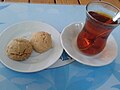 Un kurabiyesi served with tea
 -
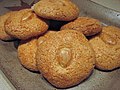 Acıbadem kurabiyesi, Turkey


Tunisia
[edit]Ghraïba (Tunisian Arabic: غريبة)
- Ghraïba bidha, made with wheat flour
- Ghraïba droô, made with sorghum flour
- Ghraïba homs, made with chickpea flour
See also
[edit]

.svg)

.svg)
- Almond cookie
- Hallongrotta
- Kavala Almond Cookies
- Murabbalı mecidiye
- Nankhatai
- Osmania Biscuit
- Panellets
- Polvorón
- İzmir Bomb Kurabiye
- Bethmännchen
- Gujhia
- Şekerpare
- List of almond dishes
- List of shortbread biscuits and cookies
References
[edit]- ^ a b c Davidson, Alan (2014). The Oxford Companion to Food. OUP Oxford. ISBN 9780191040726.
- ^ a b c d Marks, Gil (2010). Encyclopedia of Jewish Food. HMH. ISBN 9780544186316.
- ^ Williams, Stephanie (5 August 2012). "Lost and loving it in Morocco". Herald Sun. Retrieved 1 April 2015.[dead link]
- ^ Kragen, Pam (19 March 2013). "Cookbook a love letter to Morocco". U-T San Diego. Archived from the original on 2 April 2015. Retrieved 1 April 2015.
- ^ Hanger. Catherine (2000). Morocco: World Food. Lonely Planet. p. 98. ISBN 1-86450-024-7.
- ^ Nasrallah, Nawal (2007). Annals of the Caliphs' Kitchens: Ibn Sayyār al-Warrāq's Tenth-Century Baghdadi Cookbook. BRILL. pp. 418, 569. ISBN 9789047423058.
- ^ a b Şirvânî, Muhammed bin Mahmûd-ı (2005). 15. yüzyıl Osmanlı mutfağı. Gökkubbe. p. 259. ISBN 978-975-6223-84-0.
- ^ a b International Congress of Orientalists (1891). Actes du huitième congrès international des orientalistes tenu en 1889 à Stockholm et à Christiania [Proceedings of the Eighth International Congress of Orientalists held in 1889 in Stockholm and Christiania] (in German). Brill. pp. 400–401. Retrieved 25 December 2025.
- ^ Nişanyan, Sevan (2009). Sözlerin soyağacı: çağdaş Türkçenin etimolojik sözlüğü. Everest Yayınları. ISBN 9789752896369.
- ^ Salloum, Habeeb (25 June 2013). Sweet Delights from a Thousand and One Nights: The Story of Traditional Arab Sweets. I.B.Tauris. p. 128. ISBN 9780857733412.
- ^ Nişanyan, Sevan. "Kurabiye". Nişanyan Sözlük. Retrieved 4 January 2019.
- ^ a b c Khayr al-Din al-Asadi (1981). موسوعة حلب المقارنة [Comparative Encyclopedia of Aleppo] (in Arabic). p. 2122. Retrieved 25 December 2025.
- ^ "Кхураб'є". yizhakultura.com. Retrieved 30 June 2023.
- ^ Готовим къурабие, 15 August 2020, retrieved 30 June 2023
- ^ "Albanian Kurabie". My Albanian Food. 27 November 2016. Retrieved 26 September 2025.
- ^ Labourdette, Jean-Paul; Auzias, Dominique (2012). Alger 2012-2013 (in French). Petit Futé. p. 61. ISBN 9782746963771. Retrieved 1 April 2015.
- ^ Bellahsen, Fabien; Rouche, Daniel (2005). Délices de Tunisie (in French). Paris: EDL. ISBN 2-84690-243-7.
- ^ Talhouas, Nathalie; Bonnet, Élodie; Volpatti, Céline; Bizos, Didier (2010). Douceurs du Maghreb; Beyrouth : Albouraq (in French). Editions Albouraq. ISBN 978-2-84161-485-1.
- ^ Rinsky, Glenn; Rinsky, Laura Halpin (28 February 2008). The Pastry Chef's Companion: A Comprehensive Resource Guide for the Baking and Pastry Professional. John Wiley & Sons. ISBN 978-0-470-00955-0.
- ^ Armenians in America. Armenian General Benevolent Union of America, Incorporated. 1977.
- ^ a b c Bulić, Edis (1 April 2018). "Gurabija: Balkan u jednom slatkišu". Al Jazeera Balkans (in Bosnian). Retrieved 25 December 2025.
- ^ "Kurabiiki | Traditional Cookie From Bulgaria | TasteAtlas". www.tasteatlas.com. Retrieved 25 December 2025.
- ^ Zikakou, Ioanna (24 December 2015). "The Etymological Roots of Melomakarona and Kourambiedes". GreekReporter.com. Retrieved 16 February 2023.
- ^ Kiros, Tessa (2010) Food from Many Greek Kitchens, p. 39, ISBN 1741966841
- ^ Sotiropoulos, Sam (23 December 2009). "Greek Food Recipes and Reflections, Toronto, Ontario, Canada". Greekgourmand.blogspot.com. Retrieved 16 March 2014.
- ^ "Irene's Kourabiedes (Kourabiethes) (Greek Butter Cookies)". Thursdayfordinner.com. Retrieved 27 February 2015.
- ^ Sourligas, Christos (2019). My Big Fat Greek Cookbook: Classic Mediterranean Soul Food Recipes. Simon and Schuster. ISBN 9781510749849.
- ^ Georgios Babiniotis, Dictionary of Modern Greek, s.v.
- ^ Antonopoulos, Paul (22 September 2025). ""They are stealing our cuisine": Turks outraged over Greek sweets on Taste Atlas - But what's the truth? Greek City Times". Greek City Times. Retrieved 17 December 2025.
- ^ "GHORABIEH TABRIZ قرابیه تبریز". 16 March 2016. Archived from the original on 27 July 2024. Retrieved 27 July 2024.
- ^ "Qurabiya ( Ghorabiye )". Tishineh. Retrieved 27 July 2024.
- ^ Admin (1 June 2022). "Best Persian Desserts and Sweets to Try in Iran". Legendaryiran. Retrieved 27 July 2024.
- ^ Jacob, Jeanne; Ashkenazi, Michael (2014). The World Cookbook: The Greatest Recipes from Around the Globe (2nd ed.). Abc-Clio. p. 738. ISBN 9781610694698.
- ^ "حوليات الآداب والعلوم الاجتماعية". مجلس النشر العلمي، جامعة الكويت. 317–321: 118.
- ^ a b Tamimi, Sami; Wigley, Tara (16 June 2020). "Ghraybeh". Falastin: A Cookbook. Clarkson Potter/Ten Speed. ISBN 978-0-399-58174-8. Retrieved 20 January 2026.
- ^ "3 طرق لعمل الغريبة السورية" [3 ways to make Syrian Ghraybeh]. Al-Ain News (in Arabic). 11 June 2018. Retrieved 14 January 2026.
- ^ "Tasting Notes: My favorite cookie in Southern California". Los Angeles Times. 16 May 2020. Retrieved 27 January 2026.
- ^ Sarkis, Khalil (1885). كتاب تذكرة الخواتين واستاذ الطباخين (in Arabic). المطبعة الادبية. pp. 492–493. Retrieved 25 December 2025.
- ^ "15 favorite Moroccan culinary specialties". 16 April 2022. Retrieved 19 April 2022.
- ^ "الغلاء يعيد "حلويات زمان" في المغرب" [High prices bring back "old-fashioned sweets" in Morocco]. Independent Arabia (in Arabic). 22 April 2023. Retrieved 25 December 2025.
- ^ Efendi, Turab (1864). Turkish cookery book, a collection of receipts. Retrieved 8 February 2026.
- ^ "Aksaray Un Kurabiyesi / Aksaray Asker Kurabiyesi". Turkish Patent and Trademark Office (in Turkish). Retrieved 14 January 2026.
- ^ "Whispers of Flour: Un Kurabiyesi (Turkish Flour Cookies) – Intrecipes". intrecipes.com. Retrieved 29 March 2025.
- ^ Mimi (14 April 2021). "Turkish Shortbread (Un Kurabiyesi) ⋆ Hand-Shaped Cookies ⋆". Christmas-Cookies.com - 600 of the best Christmas Cookie Recipes of all time. Retrieved 29 March 2025.[self-published source]
- ^ Hahnel, Kate (2 November 2023). "Tuzlu Kurabiye - Turkish Cookies". We Eat At Last. Retrieved 29 March 2025.
| Ingredients |
| ||||||||
|---|---|---|---|---|---|---|---|---|---|
| Breads and nans | |||||||||
| Salads |
| ||||||||
| Cheeses | |||||||||
| Soups and āshes |
| ||||||||
| Dishes |
| ||||||||
| Sauces | |||||||||
| Hors d'oeuvre | |||||||||
| Sweets and desserts | |||||||||
| Beverages | |||||||||
| Instruments | |||||||||
| Related cuisines | |||||||||


