

 Satellite map of Africa
.svg) Location of Africa on the world map
Location of Africa on the world map
Africa is the world's second-largest and second-most populous continent after Asia. At about 30.3 million km2 (11.7 million square miles) including adjacent islands, it covers around 20% of Earth's land area and 6% of its total surface area. With nearly 1.4 billion people as of 2021, it accounts for about 18% of the world's human population. Africa's population is the youngest among all the continents; the median age in 2012 was 19.7, when the worldwide median age was 30.4. Based on 2024 projections, Africa's population will exceed 3.8 billion people by 2100. Africa is the least wealthy inhabited continent per capita and second-least wealthy by total wealth, ahead of Oceania. Scholars have attributed this to different factors including geography, climate, corruption, colonialism, the Cold War, and neocolonialism. Despite this low concentration of wealth, recent economic expansion and a large and young population make Africa an important economic market in the broader global context, and Africa has a large quantity of natural resources.
The continent includes Madagascar and various archipelagos. It contains 54 fully recognised sovereign states, eight cities and islands that are part of non-African states, and two de facto independent states with limited or no recognition. This count does not include Malta and Sicily, which are geologically part of the African continent. Algeria is Africa's largest country by area, and Nigeria is its largest by population. African nations cooperate through the establishment of the African Union, which is headquartered in Addis Ababa.
Africa is highly biodiverse; it is the continent with the largest number of megafauna species, as it was least affected by the extinction of the Pleistocene megafauna. However, Africa is also heavily affected by a wide range of environmental issues, including desertification, deforestation, water scarcity, and pollution. These entrenched environmental concerns are expected to worsen as climate change impacts Africa. The UN Intergovernmental Panel on Climate Change has identified Africa as the continent most vulnerable to climate change.
The history of Africa is long, complex, and varied, and has often been under-appreciated by the global historical community. In African societies the oral word is revered, and they have generally recorded their history via oral tradition, which has led anthropologists to term them "oral civilisations", contrasted with "literate civilisations" which pride the written word. African culture is rich and diverse both within and between the continent's regions, encompassing art, cuisine, music and dance, religion, and dress. (Full article...)
Selected article –

The Congo Crisis (French: Crise congolaise) was a period of political upheaval and conflict between 1960 and 1965 in the Republic of the Congo (today the Democratic Republic of the Congo). The crisis began almost immediately after the Congo became independent from Belgium and ended, unofficially, with the entire country under the rule of Joseph-Désiré Mobutu. Constituting a series of civil wars, the Congo Crisis was also a proxy conflict in the Cold War, in which the Soviet Union and the United States supported opposing factions. Around 100,000 people are believed to have been killed during the crisis.
A nationalist movement in the Belgian Congo demanded the end of colonial rule: this led to the country's independence on 30 June 1960. Minimal preparations had been made and many issues, such as federalism, tribalism, and ethnic nationalism, remained unresolved. In the first week of July, 1960, a mutiny broke out in the army and violence erupted between black and white civilians. Belgium sent troops to protect fleeing white citizens. Katanga and South Kasai seceded with Belgian support. Amid continuing unrest and violence, the United Nations deployed peacekeepers, but UN secretary-general Dag Hammarskjöld refused to use these troops to help the central government in Léopoldville (Kinshasa) fight the secessionists. Prime Minister Patrice Lumumba, the charismatic leader of the largest nationalist faction, reacted by calling for assistance from the Soviet Union, which promptly sent military advisers and other support. (Full article...)
Featured pictures –
-

 A Kirby's Dropwing (Trithemis kirbyi) in Tsumeb, NamibiaPhoto credit: User:Lycaon
Trithemis kirbyi is a species of dragonfly in the family Libellulidae found across most of Africa. Its natural habitats are subtropical or tropical moist lowland forests, dry savanna, moist savanna, subtropical or tropical dry shrubland, subtropical or tropical moist shrubland, rivers, and inland karsts. -
 Chamaeleo jacksoniiPhoto credit: User:Movingsaletoday
Chamaeleo jacksonii (common names Jackson's Chameleon or Three-horned Chameleon) is an African chameleon belonging to the chameleon family (Chamaeleonidae). It is native to the humid, cooler regions of Kenya and Tanzania. -
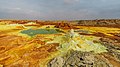 Photograph credit: Alexander SavinDallol is a cinder-cone volcano in the Danakil Depression, northeast of the Erta Ale Range in Ethiopia. The area lies up to 120 m (390 ft) below sea level, and has been repeatedly flooded in the past when waters from the Red Sea have inundated it. The Danakil Depression is one of the hottest places on Earth, and the evaporation of seawater after these flooding episodes produced thick deposits of salt, as seen in this landscape. The deposits at Dallol include significant quantities of the carbonate, sulfate and chloride salts of sodium, potassium, calcium and magnesium. Hot springs discharge brine to form the blueish ponds, and small, temporary geysers produce cones of salt.
 -
 Photograph credit: Charles James SharpThe roan antelope (Hippotragus equinus) is a species of savanna antelope found in western, central and southern Africa. Named for its reddish-brown coat, it has a black face with white patches around the eyes and the mouth, and a short erect mane of greyish brown hair extending from the back of the neck to the rump. This roan antelope, of the subspecies H. e. koba, was photographed in Senegal; the subspecies's range extends from Senegal to Benin in western Africa.
 -
 Photograph: Muhammad Mahdi KarimAdansonia digitata is a sub-Saharan African species of baobab tree. The genus, scientifically known as Adansonia, consists of nine species native to Madagascar, Africa, Arabia and Australia, and can reach heights of 5 to 30 m (16 to 98 ft) with trunk diameters of 7 to 11 m (23 to 36 ft).
 -
 Photo credit: LaitcheThe Rose Geranium (Pelargonium graveolens) is a plant indigenous to various parts of southern Africa, and in particular South Africa. This specific species has great importance in the perfume industry. Its cultivars have a wide variety of smells, including rose, citrus, mint, coconut and nutmeg, as well as various fruits.
 -
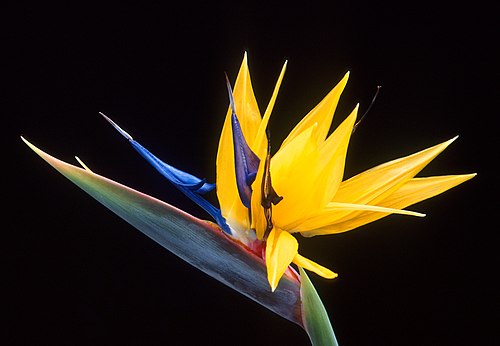 Bird of paradise flowerCredit: USDAStrelitzia is a genus of five species of perennial plants, native to South Africa. It belongs to the plant family Strelitziaceae. The genus is named after Queen Charlotte of the United Kingdom. A common name of the genus is bird of paradise flower, because of a resemblance of its flowers to birds-of-paradise. In South Africa, it is commonly known as a crane flower and is featured on the reverse of the 50 cent coin.
 -
 Photograph: Poco a pocoPanoramic view of the Amphitheatre of El Jem, an archeological site in the city of El Djem, Tunisia. The amphitheatre, one of the best-preserved Roman ruins and a UNESCO World Heritage Site since 1979, was built around 238 AD, when modern Tunisia belonged to the Roman province of Africa. It is the third-biggest amphitheatre in the world, with axes of 148 m (486 ft) and 122 m (400 ft) and a seating capacity of 35,000, unique in Africa.
 -
 Banknote design credit: Deutsch-Ostafrikanische Bank; photographed by Andrew ShivaThe rupie was the unit of currency of German East Africa between 1890 and 1916. During World War I, the colony was cut off from Germany as a result of a wartime blockade and the colonial government needed to create an emergency issue of banknotes. Paper made from linen or jute was initially used, but because of wartime shortages, the notes were later printed on commercial paper in a variety of colours, wrapping paper, and in one instance, wallpaper. This five-rupie banknote was issued in 1915, and is now part of the National Numismatic Collection at the Smithsonian Institution.
Other denominations:
'"`UNIQ--templatestyles-0000001B-QINU`"' -
 Photo: NASAA composite satellite image of the geography of Africa, the Earth's second-largest continent, and its adjacent islands. Separated from Europe by the Mediterranean Sea and from much of Asia by the Red Sea, Africa is joined to Asia at its northeast extremity by the Isthmus of Suez. For geopolitical purposes, the Sinai Peninsula – east of the Suez Canal – is often considered part of Africa, although geographically it belongs in Asia. Africa can be divided into a number of geographic zones: The Atlas Mountains in the north, the Sahara, the coastal plains, and the inner plateaus.
 -
 Hippopotamus skull at Disney's Animal KingdomPhoto credit: Mark Pellegrini
The hippopotamus (Hippopotamus amphibius), from the Greek ‘ιπποπόταμος (hippopotamos, hippos meaning "horse" and potamos meaning "river"), is a large, mostly plant-eating African mammal, one of only two extant and three or four extinct species in the family Hippopotamidae. -
 Photograph credit: Charles J. SharpThe sable antelope (Hippotragus niger) is an antelope which inhabits wooded savanna in eastern and southern Africa, from the south of Kenya to South Africa, with a separate population in Angola. The species is sexually dimorphic, with the male heavier and about one-fifth taller than the female. It has a compact and robust build, characterized by a thick neck and tough skin, and both sexes have ringed horns which arch backward. The sable antelope has four subspecies.
This picture shows an adult male common sable antelope (H. n. niger) in the Tswalu Kalahari Reserve, South Africa. -
 Desert locust (Schistocerca gregaria)Photo credit: User:Alvesgaspar
Plagues of the desert locust ( the scientific name being Schistocerca gregaria) have threatened agricultural production in Africa, the Middle East and Asia for centuries. The livelihood of at least one-tenth of the world’s human population can be affected by this hungry insect. The desert locust is potentially the most dangerous of the locust pests because of the ability of swarms to fly rapidly across great distances. The 2004 desert locust outbreak has caused significant crop losses in West Africa and had a negative impact on food security in the region. -
 Pod of hippos in Luangwa Valley, ZambiaPhoto credit: Paul Maritz
The hippopotamus (Hippopotamus amphibius), from the Greek ‘ιπποπόταμος (hippopotamos, hippos meaning "horse" and potamos meaning "river"), is a large, mostly plant-eating African mammal, one of only two extant and three or four extinct species in the family Hippopotamidae. -
 Banknote: Swakopmund Bookshop (courtesy of the National Numismatic Collection, National Museum of American History)The South West African mark was a temporary currency issued in South West Africa between 1916 and 1918 as part of the South West Africa campaign. Issued after the conquest of German South West Africa by South Africa, notes were denominated in marks and pfennig, as with the withdrawn German South West African Mark. Many institutions issued banknotes; this two-mark note was issued by the Swakopmund Bookshop. The South-West African mark was replaced in 1918 by the South African pound.
 -
 Photograph: Sathyan VelumaniThe Larabanga Mosque was built in the Sudanese architectural style in the village of Larabanga, Ghana. It is the oldest mosque in the country and one of the oldest in West Africa, and has been called the "Mecca of West Africa". It has undergone restoration several times since it was founded. The World Monuments Fund has contributed substantially to its restoration, and lists it as one of the 100 most endangered sites.
 -
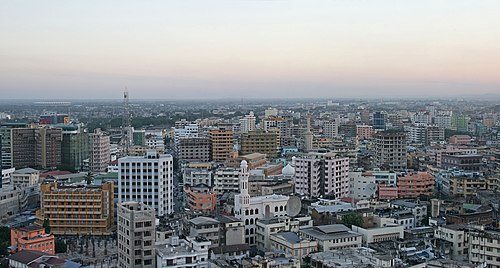 Dar es SalaamCredit: Muhammad Mahdi Karim
Dar es Salaam is the largest city in Tanzania. It is also the country's richest city and a regionally important economic centre. Dar es Salaam is actually an administrative province within Tanzania, and consists of three local government areas or administrative districts: Kinondoni to the north, Ilala in the center of the region, and Temeke to the south. The Dar es Salaam Region had a population of 2,497,940 as of the official 2002 census. Though Dar es Salaam lost its official status as capital city to Dodoma in 1974, it remains the center of the permanent central government bureaucracy and continues to serve as the capital for the Dar es Salaam Region. -
 Photo: William WarbyPortrait of a Maasai woman, with shaved head, stretched earlobes, and beaded adornments, typical of the Maasai culture. The Maasai are a Nilotic ethnic group of semi-nomadic people located in Kenya and northern Tanzania. They are among the best known of African ethnic groups, due to their distinctive customs and dress and residence near the many game parks of East Africa. Their primary language Maa (ɔl Maa) is a member of the Nilo-Saharan language family that is related to Dinka and Nuer.
 -
 Eswatini, formerly known as Swaziland, is a landlocked country in Southern Africa. The government is an absolute monarchy, the last of its kind in Africa, and the country has been ruled by King Mswati III since 1986. One of the country's important cultural events is Umhlanga, the reed-dance festival, held in August or September each year. This photograph shows Princess Sikhanyiso Dlamini, the eldest daughter of Mswati III, at the 2006 festival.


.jpg)


.jpg)
.jpg)

_adult_male.jpg)


.jpg)


Did you know (auto-generated) -

- ... that a 16th-century ethnic term used in Africa is still used today for a Brazilian religion, a Togolese and Beninese ethnic group, and their language?
- ... that an African elephant named Craig had tusks that were so long that they reached the ground?
- ... that people in parts of India, North America, and Africa marry tree trunks?
- ... that goalkeeper Sophie Whitehouse, who has lived in England, Africa and the US, has been chosen to play soccer for the Republic of Ireland?
- ... that the son of an engine fitter from England became Director of Education in part of modern-day South Africa for almost twenty years?
- ... that land for a library built for African Americans in Virginia was donated by Pope Pius XII?
Categories
 Category puzzle
This article is sourced from Wikipedia. Content is available under the Creative Commons Attribution-ShareAlike License.