
| |
|---|---|
| |
 Remains of the former church inside the mausoleum / monument | |
| Religion | |
| Affiliation |
|
| Ecclesiastical or organisational status | |
| Status |
|
| Location | |
| Location | Lezhë |
| Country | Albania |
  Location of the former church-mosque in Albania | |
 Interactive map of
| |
| Coordinates | 41°46′57″N 19°38′35″E / 41.7825°N 19.6431°E |
| Architecture | |
| Completed |
|
| Destroyed | c. 1967 (partial destruction) |
| Specifications | |
| Minaret | 1 (since destroyed) |
| Shrine | 1: (Skanderbeg) |
| Materials | Stone; marble |
| Official name | Skanderbeg Memorial, Lezhë |
| Reference no. | LE012 |
The Church of Saint Nicholas (Albanian: Kisha e Shën Nikollës, Kisha e Shna Kollit), also known as the Selimije Mosque (Albanian: Xhamia e Selimies), the Church-Mosque of Lezhë (Kisha-Xhami), and, since the 1980s, as the Skanderbeg National Memorial, is a former Roman Catholic church and subsequently a former Islamic mosque, and now a mausoleum and monument that contains the remains of Skanderbeg. The structure is located in Lezhë, Albania. Likely to have been established in c. 1st century BC, the church was repurposed as a mosque after 1478, partially destroyed in c. 1967, and again repurposed as a mausoleum in 1981. The structure is in a partial ruinous state.[1] The site was designated as a Cultural Monument of Albania.[when?]
History
[edit]As a church
[edit]Originally built as a church, the stone structure was named after Saint Nicholas. A fresco of the saint is present in the former church apse, although heavily damaged.[2] The church was located in the interior part of an Illyrian city which was later reconstructed by the Romans, in the 1st century BC. The "Gaviarius" (Gaviarivs) Stone in front of the entrance provides evidence of the building's history, unearthed during archaeological excavations by Frano Prendi and Koço Zheku between 1975 and 1980.
The League of Lezhë was formed in the grounds of the then church in 1444.
As a mosque
[edit]When the Ottoman Turks conquered Albania, the church was plundered in 1478,[2][3] and they turned it into a mosque by adding a dikka, a mihrab and a large minaret. The mosque was named after the Ottoman Sultan Selim I. The trouble that Skanderbeg caused to the Ottoman Empire's military forces was such that when the Ottomans found the grave of Skanderbe] in the St. Nicholas they opened it and made amulets of his bones,[2] believing that these would confer bravery on the wearer.[4][dubious – discuss] The St. Nicholas' Church was rebuilt by the Ottomans elsewhere in return as a gesture of tolerance towards Christians.
The Selimiye Mosque was one of the last buildings from the Middle Ages in Lezhë and did not survive during the Communist dictatorship of Enver Hoxha, who destroyed all mosques in Lezhë. The minaret of the Selimie Mosque was torn down.
As a monument
[edit]In 1968, for the 500th anniversary of Skanderbeg's death, a memorial was established around the former church.[2] In 1981, the National Memorial opened on the site and contains relics of his battles.[5] Following significant water damage, restoration of the mausoleum commenced in 2018.[3][6]
Gallery
[edit]-
 The original Selimie mosque in 1917
 -
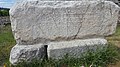 The "Gaviarivs" engraved stone at the entrance of the castle
_(BildID_15573098).jpg)

See also
[edit]


- Roman Catholicism in Albania
- Islam in Albania
- List of mosques in Albania
- List of Religious Cultural Monuments of Albania
References
[edit]- ^ "Zani i Naltë". Issuu. p. 2. Retrieved October 10, 2015.[dead link]
- ^ a b c d "[Cathedral of St. Nicholas]—Skanderbeg National Memorial". St. Nicholas Center. 2025. Retrieved September 5, 2025.
- ^ a b "The Skanderbeg memorial in Lezha is undergoing restoration". KOHA. May 13, 2018. Retrieved September 5, 2025.
- ^ Gibbon, Edward (1901). The decline and fall of the Roman empire. P. F. Collier & Son. p. 466. OCLC 317326240.
- ^ "After rehabilitation, the Skanderbeg Memorial in Lezhë is worth rediscovering". KOHA. December 17, 2018. Retrieved September 5, 2025.
- ^ "The Skanderbeg memorial in Lezha suffers damage". telegrafi.com. 2022. Retrieved September 5, 2025.
External links
[edit] Media related to Skanderbeg Memorial, Lezhë at Wikimedia Commons


| Current | |
|---|---|
| Inactive | |
| Sufi tekkes | |

| Province of Shkodër–Pult |  | |
|---|---|---|
| Province of Tiranë–Durrës | ||
| Churches | ||
| Albanian Byzantine | ||
| Saints | ||
| Blessed | ||
| Orders | ||
| Former dioceses | ||
| See also | ||