
Turda | |
|---|---|
Republicii Square Turda History Museum Roman Catholic Church of Turda Old Reformed Church of Turda with Turda Gorge in the background | |
 Flag  Coat of arms | |
 Location in Cluj County | |
  Turda Location in Romania | |
| Coordinates: 46°34′8″N 23°47′8″E / 46.56889°N 23.78556°E | |
| Country | Romania |
| County | Cluj |
| Government | |
| • Mayor (2024–2028) | Cristian-Octavian Matei[2] (PNL) |
Area | 91.43 km2 (35.30 sq mi) |
| Elevation | 315 m (1,033 ft) |
| Highest elevation | 436 m (1,430 ft) |
| Lowest elevation | 310 m (1,020 ft) |
| Population (2021-12-01)[1] | 43,319 |
| • Density | 473.8/km2 (1,227/sq mi) |
| Time zone | UTC+02:00 (EET) |
| • Summer (DST) | UTC+03:00 (EEST) |
| Postal code | 401001–401189 |
| Area code | +(40) x64 |
| Vehicle reg. | CJ |
| Website | primariaturda.ro |

,_Cluj,_RO.jpg)


Turda (Romanian pronunciation: [ˈturda]; Hungarian: Torda, Hungarian pronunciation: [ˈtorda]; German: Thorenburg; Latin: Potaissa) is a city in Cluj County, Transylvania, Romania. It is located in the southeastern part of the county, 34.2 km (21.3 mi) from the county seat, Cluj-Napoca, to which it is connected by the European route E81, and 6.7 km (4.2 mi) from nearby Câmpia Turzii.
The city consists of four neighborhoods: Turda Veche, Turda Nouă, Oprișani, and Poiana. It is traversed from west to east by the Arieș River and north to south by its tributary, Valea Racilor.
History
[edit]Ancient times
[edit] Milliarium of Aiton, the oldest known epigraphical attestation of Potaissa – a copy erected in June 1993 in front of the Turda Post Office
There is evidence of human settlement in the area dating to the Middle Paleolithic, some 60,000 years ago.[3] The Potaissa salt mines were worked in the area since prehistoric times.
The Dacians established a town that Ptolemy in his Geography calls Patreuissa, which is probably a corruption of Patavissa or Potaissa, the latter being more common. It was conquered by the Romans, who kept the name Potaissa, between AD 101 and 106, during the rule of Trajan, together with parts of Decebal's Dacia.[4] "Potaissa" is first recorded on a Roman milliarium discovered in 1758 in the nearby Aiton commune.[5] The city became a municipium Septimium, and benefited from Ius Italicum, however if it reached the rank of colonia is uncertain. At its height it housed as many as 20,000 people. About 200 inscriptions were recovered from the now entirely overlapped Roman ruins, many showing vulgarisms such as v/b alternation or simplification of the geminates.[6]
 Roman bath at Castra Potaissa
The legionary fortress was established as the basecamp of the Legio V Macedonica from 166 to 274, and was also named Potaissa.
From the reign of Gordian III (238–244) numerous treasures were excavated from Turda, Țaga, Viișoara, and Mărtinești, showing that in this time the defense was breaking under the Carps, Goths, Gepids, and Vandals.[7]
Objects dated to post-Aurelian retreat found at the site (for example an inscribed onyx gem depicting the Good Shepherd, and silver coins of Diocletian) together with a large burial containing sarcophagi and a cremation stone box point at continuous habitation until the early fifth century.[8] The situation changes in the next two centuries when dwellings and cemeteries superpose the Roman site, in a similar manner to Apulum and Sirmium.[9] After conquering the place, the Huns settled down near.[10] From this time three solidus were found from graves. Burying with coins was a Gepid tradition not typical of the Huns, meaning that they settled their vassals in Transylvania too.[7]
Middle Age and Early Modern Era
[edit]The territory changed hands between the Gepids and Langobards multiple times before both were expelled by the Avars.[10]
After the Hungarian conquest, the kindred Kalocsa settled here. Their center was called Tordavár ("castle of Torda"), and another important estate was Tordalaka ("home of Torda") as of 1075.[7][10] The name probably derives from Old Bulgarian *tvьrdъ meaning citadel, fortress.[11]
Saxons settled in the area in the 12th century. Much of the town was destroyed during the Tatar invasion in 1241–1242, however most of its inhabitants survived by hiding in the cave system. King Stephen V ensured its quick revival by giving privileges.[10]
On January 8, 1288, Ladislaus IV attended the first national assembly in Torda and recruited an army of Transylvanians to repel the Cuman invasion. He pursued the Cumans back to the border. During this time the Hungarians were the absolute majority in the city. Numerous meetings were held here afterwards.[10]
 The national assembly of Torda. Painting by Aladár Körösfői-Kriesch
The Hungarian Diet was held in 1467, by Matthias Corvinus. Later, in the 16th century, Turda became the residence of the Transylvanian Diet. After the Battle of Mohács, the city became part of the Eastern Hungarian Kingdom and from 1570, the Principality of Transylvania. The 1558 Diet of Turda declared free practice of both the Catholic and Lutheran religions. In 1563, the Diet also accepted the Calvinist religion, and in 1568, it extended freedom to all religions, declaring that "It is not allowed to anybody to intimidate anybody with captivity or expelling for his religion" – a freedom unusual in early modern Europe. This Edict of Turda is the first attempt at legislating general religious freedom in Christian Europe (though its legal effectiveness was limited).
In 1609, Gabriel Báthori granted new privileges to Turda. These were confirmed later by Gabriel Bethlen.
Modern times
[edit]In 1711, the Grand Principality of Transylvania was formed which in 1804, became part of the Austrian Empire. In 1867, by the Austro-Hungarian Compromise, the city became again part of Hungary. After World War I, following the proclamation of the Union of Transylvania with Romania of December 1918 and the Hungarian–Romanian War of 1918–1919, Turda passed under Romanian administration, and then became part of the Kingdom of Romania by the Treaty of Trianon of 1920.[12] During the interwar period, the city became the seat of Turda County. In 1944, the Battle of Turda took place between German and Hungarian forces on one side and Soviet and Romanian forces on the other. It was the largest battle fought in Transylvania during World War II.
Demographics
[edit]| Year | Pop. | ±% |
|---|---|---|
| 1850 | 8,743 | — |
| 1880 | 10,563 | +20.8% |
| 1890 | 12,370 | +17.1% |
| 1900 | 13,587 | +9.8% |
| 1910 | 15,167 | +11.6% |
| 1920 | 16,692 | +10.1% |
| 1930 | 21,428 | +28.4% |
| 1941 | 32,170 | +50.1% |
| 1948 | 25,905 | −19.5% |
| 1956 | 35,606 | +37.4% |
| 1966 | 44,980 | +26.3% |
| 1977 | 55,294 | +22.9% |
| 1992 | 61,200 | +10.7% |
| 2002 | 55,770 | −8.9% |
| 2011 | 47,744 | −14.4% |
| 2021 | 43,319 | −9.3% |
| Source: Census data | ||
According to the Hungarian census from 1910, the town had 13,455 inhabitants, of which 9,674 were Hungarians, 3,389 Romanians, and 100 Germans.[13]
According to the 2011 Romanian census, there were 47,744 people living within the city. Of this population, 84.7% were ethnic Romanians, while 8.98% were ethnic Hungarians, 6.03% ethnic Roma, and 0.4% others.[14]
At the 2021 census, Turda had a population of 43,319, a decrease of 9.3% from the previous census; of those, 72.46% were Romanians, 5.92% Hungarians, and 4.03% Roma.[15]
Notable people
[edit]- János Abacs
- Ádám Anavi
- Dan Anca
- István Bajusz
- Dezső Baróti
- István Barra
- Eta Boeriu
- Miklós Bogáthi Fazekas
- Andreea Cacovean
- Horia Crișan
- Radu Crișan
- Elek Csetri
- László Darkó
- Emilian Dolha
- Veronica Drăgan
- Moise Dragoș
- Arnold Gross
- Étienne Hajdú
- Miklós Jósika
- Jenő Attila Kessler
- Erzsébet Keszy-Harmath
- Baruch Kimmerling
- Sámuel Köteles
- László Kőváry
- Ottó Kőváry
- Csaba Lászlóffy
- Aladár Lászlóffy
- Andrei Mureșan
- Ionuț Mureșan
- Camil Mureșanu
- Mona Muscă
- Albert Nagy
- Ecaterina Orb-Lazăr
- Cristina Pîrv
- Ion Rațiu
- Alin Rus
- Septimiu Sever
- Júlia Sigmond
- Katalin Simonffy
- Zoltán Tibor Sinka
- Ion Suru
- Etelka Szabó Adorján
- Sándor Szenyei
- Miklós Szigethy Csehi
- Rareș Takács
- Mădălina Tătar
- Zoltán Tatár
- János Thordai
- Cosmin Tilincă
- István Timár-Geng
- Gábor Tőrös
- Samu Tóth
- Luminița Trombițaș
- János Tulogdy
- Mária Újvári
- Béla Varga
- Moise Vass
- Cosmin Vâtcă
- Károly Viski
Tourism
[edit]See also
[edit]
- Decree of Turda
- Universitas Valachorum
- List of Transylvanian Saxon localities
- Ancient history of Transylvania, History of Transylvania
- Franziska Tesaurus
- Edict of Torda
International relations
[edit]Twin towns – sister cities
[edit]Turda is twinned with:


Picture gallery
[edit]-
 City Hall
 -
 Mendel Villa
 -
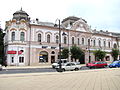 Palace of Finance
 -
 Princely Palace, now the History Museum
 -
 Orthodox Cathedral
 -


References
[edit]- ^ "2021 Romanian census". National Institute of Statistics. December 1, 2021.
- ^ "Results of the 2024 local elections". Central Electoral Bureau. Archived from the original on April 1, 2025. Retrieved December 18, 2025.
- ^ (in Romanian) "Comuna primitivă" Archived March 19, 2014, at the Wayback Machine at the Turda City Hall site; accessed March 21, 2013
- ^ (in Romanian) "Epoca dacică" Archived March 18, 2014, at the Wayback Machine at the Turda City Hall site; accessed March 21, 2013
- ^ Lazarovici et al. 1997, pp. 202–3 (6.2 Cluj in the Old and Ancient Epochs)
- ^ Beu-Dachin, Eugenia (January 1, 2020). "Linguistic Peculiarities in the Latin Inscriptions of Potaissa (DACIA". Acta Classica Univ. Scient. Debrecen. doi:10.22315/ACD/2020/3. Archived from the original on December 20, 2025. Retrieved October 12, 2025.
- ^ a b c Bicsok, Zoltán (2001). Torda város története és statútuma [History and statute of the city of Torda] (PDF). Vol. Erdélyi Turdományos Füzetek 229. Erdélyi Múzem-Egyesület. ISBN 973-99299-9-0. Archived (PDF) from the original on April 20, 2022. Retrieved October 27, 2022.
- ^ Wanner, Rob; De Sena, Eric (2016). "Reflections on the Immediate Post-Roman Phase of Three Dacian Cities: Napoca, Potaissa and Porolissum". academia.edu. Archived from the original on May 3, 2024. Retrieved May 3, 2024.
- ^ Nemeti, Sorin; Barbocz, Beata (2023). "The 5th–6 th Century AD Settlement from the Fortress of legio V Macedonica at Potaissa". Academia.edu. Archived from the original on May 6, 2024. Retrieved May 6, 2024.
- ^ a b c d e "Visszapillantás Torda múltjába" [Flashback in the past of Torda]. Torda (in Hungarian). Archived from the original on October 27, 2022. Retrieved October 27, 2022.
- ^ Nicolae Drăganu: Toponimie și istorie Archived April 29, 2023, at the Wayback Machine, 1928, page 149
- ^ (in Romanian) "Turda în perioada interbelică" Archived March 19, 2014, at the Wayback Machine at the Turda City Hall site; accessed June 3, 2013
- ^ "1910. Évi Népszámlálás 1. A népesség főbb adatai községek és népesebb puszták, telepek szerint (1912) | Könyvtár | Hungaricana". Archived from the original on January 11, 2021. Retrieved January 9, 2021.
- ^ "Structura Etno-demografică a României". www.edrc.ro. Archived from the original on October 9, 2017. Retrieved October 8, 2017.
- ^ "Populația rezidentă după grupa de vârstă, pe județe și municipii, orașe, comune, la 1 decembrie 2021" (in Romanian). INSSE. May 31, 2023. Archived from the original on June 26, 2023. Retrieved October 30, 2023.
- ^ "National Commission for Decentralised cooperation". Délégation pour l’Action Extérieure des Collectivités Territoriales (Ministère des Affaires étrangères) (in French). Archived from the original on August 5, 2013. Retrieved December 26, 2013.
Bibliography
[edit]- "INP - Museums and Collections in Romania". Cimec.ro. Retrieved October 8, 2017.
- "Turda - Romania". Britannica.com. Retrieved October 8, 2017.
External links
[edit]
- (in Romanian) Official site of the city hall
- TurdaTurism.ro
- Fundatia Potaissa


| International | |
|---|---|
| National | |
| Geographic | |
