
 | This article has multiple issues. Please help improve it or discuss these issues on the talk page. (Learn how and when to remove these messages)
|

 | |
| Latin: Universitas Pennsylvaniensis[1][2][3] | |
Former names | |
|---|---|
| Motto | Leges sine moribus vanae (Latin) |
Motto in English | "Laws without morals are useless" |
| Type | Private research university |
| Established | November 14, 1740[note 2] |
| Founder | Benjamin Franklin |
| Accreditation | MSCHE |
Religious affiliation | Nonsectarian |
Academic affiliations | |
| Endowment | $24.8 billion (2025)[8] |
| Budget | $4.4 billion (2024)[9] |
| President | J. Larry Jameson |
| Provost | John L. Jackson Jr. |
Academic staff | 4,793 (2018)[10] |
Total staff | 39,859 (fall 2020; includes health system)[11] |
| Students | 23,374 (fall 2022)[12] |
| Undergraduates | 9,760 (fall 2022)[12] |
| Postgraduates | 13,614 (fall 2022)[12] |
| Location | , Pennsylvania , United States 39°57′01″N 75°11′41″W / 39.95028°N 75.19472°W |
| Campus | Large city,
|
| Newspaper | The Daily Pennsylvanian |
| Colors | Red and blue[13] |
| Nickname | Quakers |
Sporting affiliations | |
| Mascot | The Quaker |
| Website | upenn.edu  |
 | |
 | |
The University of Pennsylvania (Penn[note 3] or UPenn[note 4]) is a private Ivy League research university in Philadelphia, Pennsylvania, United States. One of nine colonial colleges, it was chartered in 1755 through the efforts of founder and first president Benjamin Franklin, who had advocated for an educational institution that trained leaders in academia, commerce, and public service.[16]
The university has 4 undergraduate schools and 12 graduate and professional schools. Schools enrolling undergraduates include the College of Arts and Sciences, the School of Engineering and Applied Science, the Wharton School, and the School of Nursing.[17] Among its graduate schools are its law school, whose first professor, James Wilson, helped write the U.S. Constitution; and its medical school, the first in North America.
In fiscal year 2024, Penn reported $2.172 billion in research expenditures, ranking second among U.S. universities in the National Science Foundation’s Higher Education Research and Development (HERD) survey.[18][19] As of June 30, 2025, Penn’s endowment was $24.808 billion.[20] The University of Pennsylvania’s main campus is in the University City neighborhood of West Philadelphia, centered around College Hall. Campus landmarks include Houston Hall, often described as the first student union building in the United States.[21] Penn’s athletic facilities include Franklin Field, which has hosted college football since 1895 and was expanded into a two-tier stadium in 1922.[22] The university’s athletics program, the Penn Quakers, fields varsity teams in 33 sports as a member of NCAA Division I’s Ivy League conference.
Penn alumni, trustees, and faculty include 8 who signed the Declaration of Independence, 7 who signed the U.S. Constitution,[23] 24 members of the Continental Congress, 3 presidents of the United States,[note 5][24] 38 Nobel laureates, 9 foreign heads of state, 3 United States Supreme Court justices, at least 4 Supreme Court justices of foreign nations,[25] 32 U.S. senators, 163 members of the U.S. House of Representatives, 19 U.S. Cabinet secretaries, 46 governors, 28 State Supreme Court justices, 36 living undergraduate billionaires,[26] 5 recipients of the Medal of Honor,[27][28] and over 200 Olympic athletes (43 of whom earned 81 Olympic medals, 26 of them gold).[29]
History
[edit]18th century
[edit]In 1740, a group of Philadelphians organized to erect a great preaching hall for George Whitefield, a traveling Anglican evangelist,[30] which was designed and constructed by Edmund Woolley. It was the largest building in Philadelphia at the time, and thousands of people attended it to hear Whitefield preach.[31]: 26
In the fall of 1749, Benjamin Franklin, a Founding Father and polymath in Philadelphia, circulated a pamphlet, "Proposals Relating to the Education of Youth in Pensilvania," his vision for what he called a "Public Academy of Philadelphia".[32]
On June 16, 1755, the College of Philadelphia was chartered, paving the way for the addition of undergraduate instruction.[33]
Penn identifies as the fourth-oldest institution of higher education in the United States, though this representation is challenged by Princeton and Columbia since the College of Philadelphia was not chartered or commence classes until 1755 and the first board of trustees was not convened until 1749, arguably making it the sixth or fifth-oldest.[note 2]
In the 1750s, roughly 40 percent of Penn students needed lodging since they came from areas in the British North American colonies that were too far to commute, or were international students.[34] Before the completion of the construction of the first dormitory in 1765, out of town students were typically placed with guardians in the homes of faculty or in suitable boarding houses.[35][36] Jonathan and Philip Gayienquitioga, two brothers of the Mohawk Nation,[37] were recruited by Benjamin Franklin to attend the Academy of Philadelphia,[38] making them the first Native Americans at Penn when they enrolled in 1755.[39]
 A 1765 admission ticket to "A Course of Lectures" given by Dr. John Morgan, the founder and first professor of medicine at Penn's Medical School
The 1765 founding of the first medical school in America[40] made Penn the first institution to offer both "undergraduate" and professional education. Moses Levy, the first Jewish student, enrolled in 1769.[41]
In 1765, the campus was expanded by opening of the newly completed dormitory run by Benjamin Franklin's collaborator on the study of electricity using electrostatic machines and related technology and Penn professor and chief master Ebenezer Kinnersley.[note 6] Kinnersley was designated steward of the students in the dormitory and he and his wife were given disciplinary powers over the students and supervised the cleanliness of the students with respect to personal hygiene and washing of the students' dirty clothing.[42][43]
Even after its construction, however, many students sought living quarters elsewhere, where they would have more personal freedom, resulting in a loss of funds to the university. In the fall of 1775, Penn's trustees voted to advertise to lease the dormitory to a private family who would board the pupils at lesser cost to Penn.[44] In another attempt to control the off-campus activities of the students, the trustees agreed not to admit any out-of-town student unless he was lodged in a place which they and the faculty considered proper.[34]
As of 1779, Penn, through its trustees, owned three houses on Fourth Street, just north of the campus's new building with the largest residence located on the corner of Fourth and Arch Streets.[45][34]
When the British abandoned Philadelphia during the Philadelphia campaign in the American Revolutionary War, College Hall, the college's only building at the time,[note 7] served as the temporary meeting site of the Second Continental Congress from July 7 to 20, 1778,[46] briefly establishing Penn's campus as one of the early capitals of the United States.[47][48]
In 1779, not trusting then provost William Smith's Loyalist tendencies, the revolutionary State Legislature created a university, and in 1785 the legislature changed name to University of the State of Pennsylvania.[49][note 8] The result was a schism, with Smith continuing to operate an attenuated version of the College of Philadelphia. The 1779 charter represented the first American institution of higher learning to take the name of "University".[50][51] In 1791, the legislature issued a new charter, merging the two institutions into a new University of Pennsylvania with twelve men from each institution serving on the new board of trustees.[49]
19th century
[edit].jpg) A c. 1815 illustration of the Ninth Street campus of the University of Pennsylvania, including the medical department (on left) and the college building (on right)
A c. 1815 illustration of the Ninth Street campus of the University of Pennsylvania, including the medical department (on left) and the college building (on right)
In 1802, the university moved to the unused Presidential Mansion at Ninth and Market Streets, a building that both George Washington and John Adams had declined to occupy while Philadelphia was the nation's capital.[33]
 An 1807 admission ticket to a lecture by Penn Professor Dr. Benjamin Rush
Among the classes given in 1807 at this building were those offered by Benjamin Rush, a professor of chemistry, medical theory, and clinical practice who was also a signer of the United States Declaration of Independence, member of the Continental Congress,[52][53] and surgeon general of the Continental Army.[54]
 A c. 1800 engraving of Benjamin Rush, a physician and professor of medicine at the University of Pennsylvania
Classes were held in the mansion until 1829 when it was demolished. Architect William Strickland designed twin buildings on the same site, College Hall[note 9] and Medical Hall (both 1829–1830), which formed the core of the Ninth Street Campus.
 The Ninth Street Campus, located on the west side of Ninth Street between Market and Chestnut Streets, featuring Medical Hall (on left) and College Hall (on right), both built between 1829 and 1830
Joseph M. Urquiola, School of Medicine class of 1829, was the first Latino,[55][56][57] and Auxencio Maria Pena, School of Medicine class of 1836, was the first South American[58] to graduate from Penn.
In 1849, following formation of Penn's Eta chapter[note 10] of Delta Phi by five founders and 15 initiates,[59] Penn students began to establish residential fraternity houses. Since Penn only had limited housing near campus and since students, especially those at the medical school, came from all over the country, the students elected to fend for themselves rather than live in housing owned by Penn trustees. A number chose housing by pledging and living in Penn's first fraternities, which included Delta Phi, Zeta Psi, Phi Kappa Sigma, and Delta Psi.[60] These first fraternities were located within walking distance of 9th and Chestnut Street since the campus was located from 1800 to 1872 on the west side of Ninth Street, from Market Street on the north to Chestnut Street on the south. Zeta Psi Fraternity was located at the southeast corner of 10th Street and Chestnut Street, Delta Phi was located on the south side of 11th Street near Chestnut Street, and Delta Psi was located on the north side of Chestnut Street, west of 10th Street.[61]
_(14776312571).jpg) An illustration of Penn's College Hall from a pocket guide to the Centennial Exhibition in 1876
An illustration of Penn's College Hall from a pocket guide to the Centennial Exhibition in 1876
After being located in downtown Philadelphia for more than a century, the campus was moved across the Schuylkill River to property purchased from the Blockley Almshouse in West Philadelphia in 1872, where it has since remained in an area now known as University City. The new campus and its associated fraternities centered on the intersection of Woodland Avenue, 36th Street, and Locust Street. Among the first fraternities to build near the new campus were Phi Delta Theta in 1883 and Psi Upsilon in 1891. By 1891, there were at least 17 fraternities at the university.[62]
Penn hosted the nation's first university teaching hospital in 1874; the Wharton School, the world's first collegiate business school, in 1881; the first American student union building, Houston Hall, in 1896;[63] and the only school of veterinary medicine in the United States that originated directly from its medical school, in 1884.[64][65]
Tosui Imadate (今立吐酔) was the first person of Asian descent to graduate from Penn (College [66] Class of 1879).[67]
William Adger, James Brister, and Nathan Francis Mossell in 1879 were the first African Americans to enroll at Penn. Adger was the first African American to graduate from the college at Penn (1883),[68] and when Brister graduated from the School of Dental Medicine (Penn Dental) (class of 1881), he was the first African American to earn a degree at Penn.[69]
Lewis Baxter Moore, brother in law of two other Penn alumni who broke the color barrier by being among the first of their race to graduate from Penn degree granting programs, Nathan Francis Mossell (medicine) and Aaron Albert Mossell II (law), was the first African American to earn a PhD in 1896.[70] His doctorate was in classics.[71]
The first women enrolled at Penn were two graduate students at Penn's Towne Scientific School, medical doctors, Gertrude Klein Pierce,MD, Anna Lockhart Flanigen, MD, who were admitted in October 1876 as “special students” to study chemistry. In 1878 they were awarded certificates of proficiency in chemistry (finishing second and third in their class) and continued their postgraduate studies in organic chemistry with professor (who later became Provost) Edgar Fahs Smith.[72] In 1880, Mary Alice Bennett and Anna H. Johnson were the first women to enroll in a Penn degree-granting program and Bennett was the first woman to receive a degree from Penn, which was a PhD.[73][74][55]
.jpg) A c. 1933 postcard showing the area inside the Upper Quad section of The Quad Dormitories looking North to Memorial Tower
A c. 1933 postcard showing the area inside the Upper Quad section of The Quad Dormitories looking North to Memorial Tower
From its founding until construction of the Quadrangle Dormitories, which started construction in 1895, the university largely lacked university-owned housing with the exception of a significant part of the 18th century. A significant portion of the undergraduate population commuted from Delaware Valley locations, and a large number of students resided in the Philadelphia area.[75] The medical school, then with roughly half the students, was a significant exception to this trend as it attracted a more geographically diverse population of students.[76][77]
George Henderson, president of the class of 1889, wrote in his monograph distributed to his classmates at their 20th reunion that Penn's strong growth in acreage and number of buildings it constructed over the prior two decades (along with a near-quadrupling in the size of the student body) was accommodated by building The Quad.[78] Henderson argued that building The Quad was influential in attracting students, and he appealed for it to be expanded:[79]
And the new buildings? First of all there is need of greater dormitory room. Did you ever live in the "dorms?" Then you do not know what "dorm" life means for college spirit. Several hundred men who live in the same big family have a feeling of common fellowship. Life in the "dorms" develops what our sociologists call a "Solidarity of Responsibility." Men who live there learn to care for the associations that brought them together and that keep them related. And this college spirit they never lose or forget. Some parents, living at a distance, do not like to send their sons to live in a general boarding house. But a dormitory, a University institution, appeals to them, and the boys come and live there. You would scarcely believe it, but when College opened last fall not only were the dormitory rooms over subscribed, but there was a long list of anxious ones, ready to snap up the room of any unlucky fellow who might miss his examinations, and be forced to spend another year at preparatory school grind. So we need the new dormitories, and although they are going up steadily, they might well go up faster.[79]
20th century
[edit]During the first decades of the 20th century, Penn made strides and took an active interest in attracting diverse students from around the globe. Two examples of such action occurred in 1910. Penn's first director of publicity, created a recruiting brochure, translated into Spanish, with approximately 10,000 copies circulated throughout Latin America. That same year, the Penn-affiliated organization, the Cosmopolitan Club, started an annual tradition of hosting an opening "smoker," which attracted students from 40 nations who were formally welcomed to the university by then-vice provost Edgar Fahs Smith (who the following year would start a ten-year tenure as provost)[80][81][82][83][84] who spoke about how Penn wanted to "bring together students of different countries and break down misunderstandings existing between them."[55]
 A Rand McNally map of Penn, c. 1915, reflecting the growth caused in part by Provost Edgar Fahs Smith and first director of public relations, George E. Nitzsche
In 1911, since it was difficult to house the international students due to the segregation-era housing regulations in Philadelphia and across the United States, the Christian Association at the University of Pennsylvania hired its first Foreign Mission Secretary, Reverend Alpheus Waldo Stevenson.[85] By 1912, Stevenson focused almost all his efforts on the foreign students at Penn who needed help finding housing resulting in the Christian Association buying 3905 Spruce Street located adjacent to Penn's West Philadelphia campus.[86]
_(14784617513).jpg) A 1918 panoramic view of the University of Pennsylvania campus from "University of Pennsylvania -its history, traditions, buildings and memorials"
A 1918 panoramic view of the University of Pennsylvania campus from "University of Pennsylvania -its history, traditions, buildings and memorials"
By January 1, 1918, 3905 Spruce Street officially opened under the sponsorship of the Christian Association as a Home for Foreign Students, which came to be known as the International Students' House with Reverend Stevenson as its first director.[87]
The success of efforts to reach out to the international students was reported in 1921 when the official Penn publicity department reported[88]
We have an enrollment at the University of 12,000 students, who have registered from every State in the Union, and 253 students from at least fifty foreign countries and foreign territories, including India, South Africa, New Zealand, Australia and practically all the British possessions except Ireland; every Latin American country, and most of the Oriental and European nations.
— George E. Nitzsche, 1921[88]
Sadie Tanner Mossell Alexander who had earned a degree at Penn's School of Education in 1918[89] and master's in economics from Penn in 1919, was awarded the Francis Sergeant Pepper fellowship enabling her in 1921 to became the first African-American woman in the United States to earn a PhD from an American university.[90][91][92] She was also the first African-American woman admitted to and graduated from the University of Pennsylvania Law School in 1927[93] and earned the right to be an editor of University of Pennsylvania Law Review[94]
Until 1930, Penn's top academic and business professional was its Provost. In 1930, Penn's Board combined the two positions and created the office of President and elected Thomas Sovereign Gates, a Philadelphia banker who had served as director of a number of companies including Pennsylvania Railroad (which at time was largest company in world) and the Baldwin Locomotive Company, and had served for ten years as a Penn Trustee and as chairman of Penn's endowment fund.[95][96]
From 1930 to 1966, there were 54 documented Rowbottom riots, a student tradition of rioting which included everything from car smashing to panty raids.[97] After 1966, there were five more instances of "Rowbottoms," the latest occurring in 1980.[97]
By 1931, first-year students were required to live in the quadrangle unless they received official permission to live with their families or other relatives.[76] However, throughout this period and into the early post-World War II period, the undergraduate schools of the university continued to have a large commuting population.[98] As an example, into the late 1940s, two-thirds of Penn women students were commuters.[99]
George William McClelland, a Professor of English at Penn who (received his bachelors, masters and Ph.D. all from Penn in 1903, 1912 and 1916 respectively) served from 1944 to 1948 as Penn's second President, and the most notable achievement during his tenure was the creation in 1946 of ENIAC, the world's first all-electronic digital computer.[100]
 Harold Stassen, the Penn president, in a December 19, 1950 meeting with President of India Rajendra Prasad
Former Minnesota governor and perennial presidential candidate Harold Stassen served as third president of the University of Pennsylvania from 1948 to 1953. Penn's Board of Trustees elected Stassen to fill the office of the president, left vacant by the unexpected resignation of Penn's second President, George McClelland. Stassen was selected, in part due to his reputation as a successful fundraiser (as Penn was in the middle of a long simmering financial crisis). Stassen did indeed help raise funds and cut costs, focusing financial resources into a few prestigious departments and fulfilling McClelland's campus expansion plan, as well as reforming intercollegiate athletics in order to conform to the requirements of the new Ivy League.[101] Stassen focused on Penn's football team by contesting the NCAA prohibition over televising football games (to stop the slide in gate attendance) by entering into a $200,000 contract with ABC but Stassen eventually backed down when the NCAA threatened to expel Penn.[102]
After World War II, the university began a capital spending program to overhaul its campus, including its student housing. A large number of students migrating to universities under the G.I. Bill, and the ensuing increase in Penn's student population highlighted that Penn had outgrown previous expansions, which ended during the Great Depression era. But in addition to a significant student population from the Delaware Valley, the university continued to attract international students from at least 50 countries and from all 50 states as early as of the second decade of the 1920s.[88] By 1961, 79% of male undergraduates and 57% of female undergraduates lived on campus.[103]
In 1965, Penn students learned that the university was sponsoring research projects for the United States' chemical and biological weapons program.[104] According to Herman and Rutman, the revelation that "CB Projects Spicerack and Summit were directly connected with U.S. military activities in Southeast Asia," caused students to petition Penn's fourth president Gaylord Harnwell (1954 to 1971) to halt the program, citing the project as being "immoral, inhuman, illegal, and unbefitting of an academic institution."[104] Members of the faculty believed that an academic university should not be performing classified research and voted to re-examine the university agency which was responsible for the project on November 4, 1965.[104]
Martin Meyerson, the 5th president of Penn (from 1970 to 1981), was a prominent scholar of urban design and oversaw the conversion of what had been a collection of buildings on Philadelphia streets into a true college campus as streets (in center of campus - Locust Street and Woodland Avenue) were closed, landscaped walkways were built, and a large park was created in the middle of the campus.[105]
The first openly LGBTQ+ organization funded by Penn was formed in 1972 by Kiyoshi Kuromiya, a Benjamin Franklin Scholar and Penn alumnus from the college's class of 1966, when he created the Gay Coffee Hour, which met every week on campus and was also open to non-students and served as an alternative space to gay bars for gay people of all ages.[106]
Vartan Gregorian, who joined the University of Pennsylvania faculty in 1972 as Tarzian Professor of Armenian and Caucasian History and Professor of South Asian history,[107][108] became the founding dean of Penn's Faculty of Arts and Sciences in 1974 (through 1978), and served as the 23rd provost of Penn from January 1979 to October 1980,[109] was widely considered to be the most probable candidate to become the 6th president of the University of Pennsylvania[107][108] as he had the "resounding support of most of the deans, the Faculty Senate, and the Undergraduate Assembly" and was seen as a charismatic leader with "flamboyant style and ever-present brilliance". However, the university trustees chose Sheldon Hackney instead.[110][111] Hackney served as president from 1981 through 1993.
In 1983, members of the Animal Liberation Front broke into the Head Injury Clinical Research Laboratory in the School of Medicine and stole research audio and video tapes. The stolen tapes were given to PETA who edited the footage to create a film, Unnecessary Fuss. As a result of media coverage and pressure from animal rights activists, the project was closed down.[112]
Penn gained notoriety in 1993 for the water buffalo incident in which a student who told a group of mostly black female students to "shut up, you water buffalo" was charged with violating the university's racial harassment policy.[113]
 Claire Fagin, Penn's interim president in 1993 on Locust Walk
Penn appointed a woman as President when it elected Dr. Claire M. Fagin, who served from July 1, 1993, to June 30, 1994, becoming one of the first women to serve in the capacity of a university president with an Ivy League university[114]
 Judith Rodin, the first female president of the Ivy League and Penn, presenting U.S. Senator Rick Santorum the "Champion of Science" award
Judith Rodin, from 1994 through 2004, served as the first permanent female president of an Ivy League university.[115][116][117] During her Presidency, Penn tripled its fundraising and the size of its endowment, engineered an internationally heralded community renewal program, attracted the most selective classes in the university’s history (climbing from 16th to fourth in the leading national rankings), rapidly grew its academic core, and dramatically enhanced the quality of life on campus and in surrounding community by encouraging revitalization in U City and West Philly through (a) public safety, (b) establishment of Wharton School alliances for small businesses (c) development of buildings and streetscapes that turned outward to U City and West Philly communities, and (d) establishment of a university-led partnership school, the Sadie Tanner Mossell Alexander University of Pennsylvania Partnership School (aka "Penn Alexander School").[118][119]
21st century
[edit]In 2004, Amy Gutmann succeeded Judith Rodin as the 8th president of the University of Pennsylvania, serving until 2022, the longest-serving president in Penn's history.[120]
 Amy Gutmann, University of Pennsylvania president, at the university's 2009 commencement
In 2022, some asked for the tenure of Amy Wax, a University of Pennsylvania law school professor to be revoked after she said the country is "better off with fewer Asians."[121][122]
In March 2023, Penn announced a first in the United States LGBTQ+ scholar in residence after a $2-million gift.[123]
In October 2023, Penn hosted a Palestinian Writers Conference on campus which was attended by several hundred students, scholars and members of the media. The conference was sponsored by student groups at the university though not by the university itself. Segments of the student body, alumni and the media expressed extreme hostility to the event, in some cases viewing the conference as an affront to their own perspectives in the ongoing Israel/Palestine conflict.[124] While the conference was viewed as a success by its organizers, it contributed to heightened tensions on campus between pro-Palestinian and pro-Israeli groups as well as advocates of free speech vs. people concerned with certain forms of expression.[125]
After the 2023 Hamas-led attack on Israel, tensions across university campuses rose across the United States. Certain schools, including Penn, Harvard University and MIT were cited repeatedly in the media for particularly vocal student protests against Israeli military strikes against the civilian populations in Gaza as well as Hamas' violent attack on villages and military outposts just north of the Gaza/Israeli barrier wall.[126] These protests led to increased concerns about antisemitism on college campuses. These concerns in turn led to Congressional hearings convening by several conservative Republican congressmen focused on the fears of rising antisemitism in the US.
 University police guarding a locked-down campus after the removal of a student protest in spring 2024
In a hearing before the U.S. House Committee on Education and the Workforce on December 6, when prompted for a "Yes/No" response to a hypothetical situation about protesters "calls for the genocide of Jewish people," Magill responses to the hypothetical scenario was viewed as equivocating[127] as she stated it depended on context, and the university's codes of conduct and its guidelines for free speech and campus behavior.[128] Magill's response was deemed by certain politicians, external stakeholders and members of the media as tolerant of antisemitism. Significant media pressure, vocal concerns voiced by a number of trustees and threats to suspend donations to the university by several large pro-Israel donors continued to mount.[129]
On December 9, the university's president Liz Magill and the chairman of its board of trustees, Scott L. Bok, resigned from their respective positions.[130] Magill remained a tenured member of the Penn Law faculty.[131] Bok later published a letter addressed to the university community detailing his perspective on the situation and his recommendations for university governance going forward.[132]
During 2024, pro-Palestinian students participated in 2024 pro-Palestinian protests on university campuses, starting the 2024 University of Pennsylvania pro-Palestine campus encampment.[133][134][135]
Campus
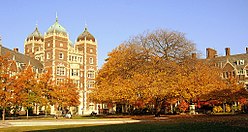
[edit] The Quadrangle dormitories, designed by Cope and Stewardson in a Collegiate Gothic style, are among the best-known buildings on Penn's campus.
The University of Pennsylvania's main campus occupies about 299 acres (121 ha) in the University City neighborhood of West Philadelphia and includes the University of Pennsylvania Campus Historic District. It contains most of the university's schools, research institutes, libraries, residences, and athletic facilities.
Architecture and layout
[edit]Much of the historic core campus was shaped by the Philadelphia firm Cope and Stewardson, whose work helped establish the campus's Collegiate Gothic character.[136][137][138] A central pedestrian spine, Locust Walk, connects major academic and residential areas; its conversion to a largely car-free corridor was developed in the mid-20th century and completed in the 1970s.[139]
Expansion and adjacent sites
[edit]Penn has expanded and redeveloped facilities beyond the historic core, including the Pennovation complex along the Schuylkill River, which includes flexible workspaces, laboratories, and incubator-style facilities.[140] The Wistar Institute is located adjacent to the campus and collaborates with the university in biomedical research.[141]
Parks and arboreta
[edit]Penn maintains the Penn Campus Arboretum, an accredited arboretum encompassing the main campus and associated green spaces.[142] Penn also operates the Morris Arboretum, the official arboretum of the Commonwealth of Pennsylvania.[143]
New Bolton Center
[edit]Penn's veterinary school operates the New Bolton Center near Kennett Square, a large-animal hospital and research center.[144][145]
Libraries
[edit]Penn Libraries is a multi-library system anchored by Van Pelt Library and including specialized libraries and collections across the university, such as the Fisher Fine Arts Library.[146]
Museums, galleries, and public art
[edit]Penn is home to the University of Pennsylvania Museum of Archaeology and Anthropology (Penn Museum).[147] The university also supports galleries and an outdoor public art collection across campus.[148] Notable works installed on or near campus include Simone Leigh's Brick House (2020) and Claes Oldenburg's Split Button (The Button).[149][148]
Residences
[edit]Undergraduates are housed primarily through the College Houses residential system, which combines on-campus housing with faculty-led programming and advising.[150]
-
 The university's first purpose-built dormitory in the foreground (on right), built in 1765[151]
 -
-
 Woodland Walk pathway between Hill College House and Lauder College House
 -
 Hill College House, a dormitory designed in 1958 to house female students, was designed by Eero Saarinen
 -
 "The Quad", formerly known as the Men's Dormitory, in 2014
 -
 The Alpha Tau Omega fraternity house, built by George W. Childs Drexel as one of two mansions for his daughters
_(14578281487).jpg)


_-_University_of_Pennsylvania_-_IMG_6638.jpg)
Organization
[edit]| School | Year founded |
|---|---|
| Medicine | 1765[155] |
| Engineering | 1852[156] |
| Law | 1850[note 11] |
| Design | 1868 |
| Dental | 1878[158] |
| Wharton | 1881[159] |
| Arts and Sciences | 1755[160] |
| Veterinary | 1884[161] |
| Social Policy | 1908 |
| Education | 1915 |
| Nursing | 1935 |
| Communication | 1958 |
The College of Arts and Sciences is the undergraduate division of the School of Arts and Sciences. The School of Arts and Sciences also contains the Graduate Division and the College of Liberal and Professional Studies, which is home to the Fels Institute of Government, the master's programs in Organizational Dynamics, and the Environmental Studies (MES) program. Wharton School is the business school of the University of Pennsylvania. Other schools with undergraduate programs include the School of Nursing and the School of Engineering and Applied Science (SEAS).
The current president is J. Larry Jameson (interim).[162]
Campus police
[edit]The University of Pennsylvania Police Department (UPPD) is the largest private police department in Pennsylvania, with 117 members. All officers are sworn municipal police officers and retain general law enforcement authority while on the campus.[163]
Seal
[edit] The 1757 seal of the academy and College of Philadelphia
The official seal of the Trustees of the University of Pennsylvania serves as the signature and symbol of authenticity on documents issued by the corporation.[164] The most recent design, a modified version of the original seal, was approved in 1932, adopted a year later and is still used for much of the same purposes as the original.[164] The official seal of the Trustees of the University of Pennsylvania serves as the signature and symbol of authenticity on documents issued by the corporation.[164] A request for one was first recorded in a meeting of the trustees in 1753 during which some of the Trustees "desired to get a Common Seal engraved for the Use of [the] Corporation." In 1756, a public seal and motto for the college was engraved in silver.[165]
The outer ring of the current seal is inscribed with "Universitas Pennsylvaniensis", the Latin name of the University of Pennsylvania. The inside contains seven stacked books on a desk with the titles of subjects of the trivium and a modified quadrivium, components of a classical education: Theolog[ia], Astronom[ia], Philosoph[ia], Mathemat[ica], Logica, Rhetorica and Grammatica. Between the books and the outer ring is the Latin motto of the university, "Leges Sine Moribus Vanae".[164]
 The updated seal of the University of Pennsylvania with the school's present name of in Latin
Academics
[edit]The University of Pennsylvania is organized into twelve schools, including four undergraduate schools and eight graduate and professional schools.[166] Since at least the early 1970s, the university has used the term "One University" in institutional planning materials to describe coordination across its schools.[167]
Students may enroll in courses offered by schools other than their home school, subject to prerequisites and school- or program-specific rules.[167] Under a reciprocal cross-registration arrangement known as the Quaker Consortium, Penn students may take approved courses at Bryn Mawr College, Haverford College, and Swarthmore College.[168]
Coordinated dual-degree, accelerated, interdisciplinary programs
[edit] Smith Walk with a view of Towne Building and the Engineering Quad
Penn offers unique and specialized coordinated dual-degree (CDD) programs, which selectively award candidates degrees from multiple schools at the university upon completion of graduation criteria of both schools in addition to program-specific programs and senior capstone projects. Additionally, there are accelerated and interdisciplinary programs offered by the university. These undergraduate programs include:
- Huntsman Program in International Studies and Business[169]
- Jerome Fisher Program in Management and Technology (M&T)[170]
- Roy and Diana Vagelos Program in Life Sciences and Management (LSM)[171]
- Nursing and Health Care Management (NHCM)[172]
- Roy and Diana Vagelos Integrated Program in Energy Research (VIPER)[173]
- Vagelos Scholars Program in Molecular Life Sciences (MLS)[174]
- Singh Program in Networked and Social Systems Engineering (NETS)[175]
- Digital Media Design (DMD)[176]
- Computer and Cognitive Science: Artificial Intelligence[177]
- Accelerated 7-Year Bio-Dental Program[178]
- Accelerated 6-Year Law and Medicine Program[179]
Dual-degree programs that lead to the same multiple degrees without participation in the specific above programs are also available. Unlike CDD programs, "dual degree" students fulfill requirements of both programs independently without the involvement of another program. Specialized dual-degree programs include Liberal Studies and Technology as well as an Artificial Intelligence: Computer and Cognitive Science Program. Both programs award a degree from the College of Arts and Sciences and a degree from the School of Engineering and Applied Sciences. Also, the Vagelos Scholars Program in Molecular Life Sciences allows its students to either double major in the sciences or submatriculate and earn both a BA and an MS in four years. The most recent Vagelos Integrated Program in Energy Research (VIPER) was first offered for the class of 2016. A joint program of Penn's School of Arts and Sciences and the School of Engineering and Applied Science, VIPER leads to dual Bachelor of Arts and Bachelor of Science in Engineering degrees by combining majors from each school.
The School of Social Policy and Practice, commonly known as Penn SP2, is a school of social policy and social work that offers degrees in a variety of subfields, in addition to several dual degree programs and sub-matriculation programs.[180][181][182] Penn SP2's vision is: "The passionate pursuit of social innovation, impact and justice."[183]
Originally named the School of Social Work, SP2 was founded in 1908 and is a graduate school of the University of Pennsylvania. The school specializes in research, education, and policy development in relation to both social and economic issues.[184][185]
The School of Veterinary Medicine offers five dual-degree programs, combining the Doctor of Veterinary Medicine (VMD) with a Master of Social Work (MSW), Master of Environmental Studies (MES), Doctor of Philosophy (PhD), Master of Public Health (MPH) or Masters in Business Administration (MBA) degree. The Penn Vet dual-degree programs are meant to support veterinarians planning to engage in interdisciplinary work in the areas of human health, environmental health, and animal health and welfare.[186]
Academic medical center and biomedical research complex
[edit]In 2018, the university's nursing school was ranked number one by Quacquarelli Symonds.[187] That year, Quacquarelli Symonds also ranked Penn's school of Veterinary Medicine sixth.[188] In 2019, the Perelman School of Medicine was named the third-best medical school for research in U.S. News & World Report's 2020 ranking.[189]
The University of Pennsylvania Health System, also known as UPHS, is a multi-hospital health system headquartered in Philadelphia, Pennsylvania, owned by Trustees of University of Pennsylvania. UPHS and the Perelman School of Medicine at the University of Pennsylvania together constitute Penn Medicine, a clinical and research entity of the University of Pennsylvania. UPHS hospitals include the Hospital of the University of Pennsylvania,[190] Penn Presbyterian Medical Center, Pennsylvania Hospital, Chester County Hospital, Lancaster General Hospital, and Princeton Medical Center.[191] Penn Medicine owns and operates the first hospital in the United States, the Pennsylvania Hospital.[192] It is also home to America's first surgical amphitheatre[193] and its first medical library.[194]
Admissions
[edit]Undergraduate admission is selective. For the Class of 2026 (entering fall 2022), Penn received 54,588 applications and admitted 3,404 applicants (4.24%).[195][196] Reported test score ranges for enrolled first-year students (25th–75th percentile) were 1510–1560 (SAT) and 34–36 (ACT).[195]
Admission is need-blind for U.S., Canadian, and Mexican applicants.[197]
Reputation and rankings
[edit]| Academic rankings | |
|---|---|
| National | |
| Forbes[198] | 10 |
| U.S. News & World Report[199] | 7 (tie) |
| Washington Monthly[200] | 15 |
| WSJ/College Pulse[201] | 13 |
| Global | |
| ARWU[202] | 14 |
| QS[203] | 15 |
| THE[205] | 14[204] |
| U.S. News & World Report[206] | 15 |
U.S. News & World Report's 2024 rankings place Penn 6th of 394 national universities in the United States.[199] In international rankings, Penn is consistently placed among the top universities globally by several publications.[207] The Princeton Review student survey ranked Penn in 2023 as 7th in their Dream Colleges list.[208] Penn was ranked 4th of 444 in the United States by College Factual for 2024.[209] The Wall Street Journal reported in 2024 that Penn's undergraduate alumni earned the 5th highest salaries (taking into account the cost of education and other factors[210]).
Among its professional schools, the school of education was ranked number one in 2021 and Wharton School was ranked number one in 2022[211] and 2024[212] and the communication, dentistry, medicine, nursing, law and veterinary schools rank in the top 5 nationally.[213] Penn's Law School was ranked number 4 in 2023[214] and Penn's School of Design and Architecture, and its School of Social Policy and Practice are ranked in the top 10.[213]
Research
[edit] ENIAC, the first general purpose electronic computer, founded at Penn in 1946
Penn is classified as an "R1" doctoral university: "Highest research activity".[215] A 2016 study estimated Penn's economic impact on the Commonwealth of Pennsylvania in 2015 at $14.3 billion.[216] Penn reported research expenditures totaling over $1.9 billion in 2023; the National Science Foundation ranked Penn third among U.S. universities in reported research and development spending for that year.[217] In fiscal year 2019, Penn received $582.3 million in funding from the National Institutes of Health.[218]
Penn's research centers and institutes often span multiple disciplines. In the 2010–2011 academic year, several interdisciplinary research centers were created or substantially expanded, including the Center for Health-care Financing,[219] the Center for Global Women's Health at the Nursing School,[220] and the Translational Research Center at Penn Medicine.[221] Penn also supports cross-school faculty appointments through the "Penn Integrates Knowledge" program.[222]
Research conducted at Penn has been associated with developments in computing and medicine. During World War II, engineers at the Moore School of Electrical Engineering developed ENIAC, an early electronic general-purpose computer, at the University of Pennsylvania.[223][224] In oncology, Penn Medicine researchers were involved in the development of CAR T cell therapy; the U.S. Food and Drug Administration approved tisagenlecleucel (Kymriah) in 2017 as the first CAR T-cell immunotherapy approved by the agency.[225][226]
Penn faculty have also been recognized through major scientific awards. In 1972, physicist John Robert Schrieffer, then a professor at the University of Pennsylvania, shared the Nobel Prize in Physics for work on the theory of superconductivity (BCS theory).[227] In 2000, chemist Alan G. MacDiarmid, then a professor at the University of Pennsylvania, shared the Nobel Prize in Chemistry for the discovery and development of electrically conductive polymers.[228]
Student life
[edit]Penn offers undergraduate housing through its College Houses system, which includes residence halls and residential programs that combine housing with faculty involvement and student programming.[229]
Penn students participate in a wide range of student organizations, including publications, performing arts groups, and community and cultural organizations. Student media include The Daily Pennsylvanian, an independent student-run newspaper founded in 1885, and 34th Street Magazine.[230] One of the university’s oldest student organizations is the Philomathean Society, founded in 1813.[231]
Penn’s performing arts groups include ensembles such as the University of Pennsylvania Glee Club and the University of Pennsylvania Band.[232][233] Student performing arts groups are coordinated through the university’s Performing Arts Council.[234] The Penn Singers is a light opera company at the University of Pennsylvania. The group was founded in 1957 as the University's first all-female choir and was converted into a co-ed light opera company in 1972. The group performs two major productions each year - a Broadway-style musical or revue in the fall, and a Gilbert and Sullivan operetta or a show in the spring.[235][236][237] Founded in 1936, the Pennsylvania Players was the first student theatre group at the University of Pennsylvania. With the guidance of professional directors, Penn Players produces two major shows each year, a musical in the fall and a straight play in the spring, in the Harold Prince Theater of the Annenberg Center.[238]
The Penn Debate Society (PDS), founded in 1984 as the Penn Parliamentary Debate Society, is Penn's debate team, which competes regularly on the American Parliamentary Debate Association and the international British Parliamentary circuit.[239]
Penn Electric Racing
[edit] Penn Electric Racing unveiled REV8 on March 31, 2023, in front of the Statue of Benjamin Franklin in front of College Hall.
Penn Electric Racing is the university's Formula SAE (FSAE) team, competing in the international electric vehicle (EV) competition. Colloquially known as "PER", the team designs, manufactures, and races custom electric racecars against other collegiate teams. In 2015, PER built and raced their first racecar, REV1, at the Lincoln Nebraska FSAE competition, winning first place.[240] The team repeated their success with their next two racecars: REV2 won second place in 2016,[241] and REV3 won first place in 2017.[242]
Traditions
[edit]Toast throwing
[edit]As a sign of school pride, crowds of Quaker fans perform a unique ritual. After the third quarter of football games, spirited onlookers unite in the singing of "Drink a Highball," which refers to the University's unofficial cocktail, the Pennsylvanian, made with Calvados, a dash of Madeira Wine, an egg white, and a twist of lemon.[243][244][245] In years long past, students would make a toast with the drink to the success of Penn's athletic teams. During Prohibition, stubborn students insisted on keeping their tradition - since they could not use alcohol, they had no choice but to literally "toast" Penn. As the last line, "Here's a toast to dear old Penn," is sung, the fans send toast hurling through the air onto the sidelines. In another version of the origins of toast throwing, in 1977, a student threw the first slice of toast after being inspired while attending a showing of The Rocky Horror Picture Show where members of the audience throw toast at the screen. In more recent years, some students have become more creative in their choice of projectiles, and it is not rare to see a hail of bagels or donuts, or even a loaf of French bread come flying down from the stands.[246]
The sweeper is often called the "toast Zamboni".[247]
Hey Day
[edit] A scene from the finale of Hey Day for Class of 2006
In April, several class traditions are celebrated. Class Day, which began in 1865 to supplement the final graduation exercises, celebrates the progression of all classes and the departure of the seniors. In 1916, this day merged with Straw Hat Day and became the "day of two events." In 1931, Hey Day arose from these two celebrations. On this day, the juniors gather on High Rise Field for a picnic, don straw "skimmers" and canes, and march triumphantly down Locust Walk to College Hall.
The procession tradition began in 1949. More recently, the straw skimmers have changed to Styrofoam hats, and classmates take bites out of one another's hats. When the procession reaches College Hall, the students make an arch with their canes to greet the President of the University. The outgoing and incoming senior class presidents then give speeches, and the juniors are "officially" declared seniors. In May 2015, the university commemorated the celebration of the 100th Hey Day.[248]
Ivy Day
[edit]One plants ivy by a building, and an "Ivy Stone" is placed on the building to commemorate the occasion. In 1981, the day was officially moved to the Saturday before Commencement. Also on this day, the Spoon, Bowl, Cane, and Spade awards, honoring four graduating men, and the Hottel, Harnwell, Goddard, and Brownlee awards, honoring four graduating women, are presented. During the celebration, a noted individual who is chosen by the class gives an address. Recent Ivy Day addresses have been presented by Penn Parent Joan Rivers, former Philadelphia Mayor and Governor of Pennsylvania (and also a Penn alumnus) Ed Rendell, and basketball player Julius Erving.
 Penn's 250th Commencement.
The building receiving the Ivy Stone is very often a building of some significance to the graduating class. For example, in 1983, a stone was placed near the field in Franklin Field celebrating Penn's first Ivy League championship in football since 1959, the previous fall—at the yard line from which the game-winning field goal against Harvard was kicked, clinching at least a share of the championship.[249]
Spring Fling
[edit]Spring Fling is an annual festival for the students at the end of each Spring semester, usually beginning on the Friday of the second-to-last week of the semester and continuing until Saturday night. Fling, which began in 1973, is dubbed the largest college party on the East Coast, and is hosted by the university's Social Planning and Events Committee.[250] The event takes place on College Green, Penn Commons, and The Quadrangle (or Quad) for a student body drenched in alcohol, for the most part. Over the past few years, there has been legitimate discussion towards potentially moving the event out of the Quad, but improved behavior has resulted in the carnival aspect of the festival remaining in the Quad. College Green becomes a staging area for carnival games and carnival food. Two stages in the Quad host Penn's performing arts groups. Saturday night, Penn holds a festival on College Green, and Friday night SPEC (The Social Planning and Events Committee SPEC – Bringing events to Penn since 1989) brings in a headlining musical act for a concert. Past guests for this concert have included Wyclef Jean, Busta Rhymes, Sonic Youth, and Of A Revolution.[76]
Student health and well-being
[edit]Student life at Penn has been the subject of national attention in discussions of student stress and campus mental health. The term "Penn Face" has been used to describe a perceived culture of presenting confidence or happiness despite academic and social pressures.[251] The university has convened task forces and issued reports addressing student psychological health and welfare.[252]
Athletics
[edit] Penn Athletics Logo
 Penn’s early cricket team, one of the university’s first organized sports, in 1843
Penn’s varsity teams are known as the Penn Quakers (also called “the Red and Blue”).[253] Penn competes in NCAA Division I and is a member of the Ivy League. Its football team competes in the Division I Football Championship Subdivision. Penn sponsors 33 varsity sports.[254]
Several of Penn’s athletics traditions and facilities are nationally notable. Franklin Field, home to Penn football and the annual Penn Relays, is among the country’s best-known historic college stadiums. Penn’s athletics history includes early participation in sports such as cricket and rowing, and the university has produced numerous Olympic athletes and medalists.[255] At least 43 different Penn alumni have earned 81 Olympic medals (26 gold).[29][note 12]
Notable programs
[edit]- Football – Ivy League competition at Franklin Field; notable alumni include Chuck Bednarik.[256]
- Men's basketball – A long-running Ivy League program and a member of Philadelphia’s Big 5; Penn's best-known postseason run was its 1979 Final Four appearance.[257]
- Rowing – One of Penn’s oldest competitive sports, with long-standing participation on Philadelphia’s Boathouse Row and alumni who have competed internationally[258]
- Track and field – Central to Penn's athletics identity through the Penn Relays, one of the sport's major annual meets[259]
Facilities
[edit] Penn's Franklin Field, in photograph taken shortly after completion of the upper deck in 1925
Franklin Field, with a present seating capacity of 52,593,[260] is where the Quakers play football, lacrosse, sprint football and track and field (and formerly played baseball, field hockey, soccer, and rugby). It is the oldest stadium still operating for college football games,[261] first stadium to sport two tiers,[262] first stadium in the country to have a scoreboard, second stadium to have a radio broadcast of football, first stadium from which a commercially televised football game was broadcast,[260] and first stadium from which college football game was broadcast in color.[263] Franklin Field also played host to the Philadelphia Eagles from 1958 to 1970.[260] Since 1895, Franklin Field has hosted the annual collegiate track and field event "the Penn Relays", which is the oldest and largest track and field competition in the United States.[264]
 Penn's Palestra is often referred to as the Cathedral of College Basketball.[265]
Penn's Palestra is home gym of the Penn Quakers men's and women's basketball and volleyball teams, wrestling team, Philadelphia Big Five basketball, and other high school and college sporting events, and is located mere yards from Franklin Field.[266] The Palestra has been called "the most important building in the history of college basketball" and "changed the entire history of the sport for which it was built".[267] The Palestra has hosted more NCAA Tournament basketball games than any other facility.
Penn's River Fields hosts a number of athletic fields including the Rhodes Soccer Stadium, the Ellen Vagelos C'90 Field Hockey Field, and Irving "Moon" Mondschein Throwing Complex.[268] Penn baseball plays its home games at Meiklejohn Stadium at Murphy Field.
Penn's Class of 1923 Arena (with seating for up to 3,000 people) was built to host the University of Pennsylvania Varsity Ice Hockey Team, which has been disbanded, and now hosts or in the past hosted: Penn's Men's and Penn Women's club ice hockey teams, practices or exhibition games for the Philadelphia Flyers, Colorado Avalanche and Carolina Hurricanes, roller hockey for the Philadelphia Bulldogs professional team, and rock concerts such as one in 1982 featuring Prince.[269][270][271]
People
[edit]Notable people
[edit] |
Since its founding, Penn alumni, trustees, and faculty have included eight Founding Fathers of the United States who signed the Declaration of Independence,[23] seven who signed the United States Constitution,[23] and 24 members of the Continental Congress.
Penn alumni include two presidents of the United States (William Henry Harrison,[note 5] and Donald Trump),[273][274] 32 U.S. senators, 163 members of the U.S. House of Representatives, 19 U.S. Cabinet Secretaries, 46 governors, and 28 State Supreme Court justices, 36 billionaires,[26][275] and as of 2023[update] there have been 38 Nobel laureates affiliated (see List of Nobel laureates by university affiliation) with the University.[276][135]
Prior to becoming president of the United States, Joe Biden was a Benjamin Franklin Presidential Practice Professor at University of Pennsylvania, where he led the Penn Biden Center for Diplomacy and Global Engagement, a center focused principally on diplomacy, foreign policy, and national security.[277][278]
Nine foreign heads of state attended Penn (including former prime minister of the Philippines, Cesar Virata;[279] first president of Nigeria, Nnamdi Azikiwe;[280] first president of Ghana, Kwame Nkrumah,[281] former Prime Minister of Latvia, Krišjānis Kariņš, former President of Panama, Ernesto Pérez Balladares, former President of Argentina, Mauricio Macri, former President of Estonia, Toomas Hendrik Ilves, and the current president of Ivory Coast, Alassane Ouattara.[282] [citation needed]
Penn alumni or faculty also include three United States Supreme Court justices (William J. Brennan,[283] Owen J. Roberts,[284] and James Wilson) and four Supreme Court justices of foreign nations, (including Ronald Wilson of the High Court of Australia, Ayala Procaccia of the Israel Supreme Court, Yvonne Mokgoro, former justice of the Constitutional Court of South Africa, and Irish Court of Appeal justice Gerard Hogan).[citation needed]
Penn alumni in business, finance and investment banking include Warren Buffett[note 13] (CEO of Berkshire Hathaway), Charles Butt (Chairman and CEO of H-E-B),[285] Richard Bloch (Co-founder of H&R Block), Josh Harris (Co-founder of Apollo Global Management),[286] Leonard Lauder (Chairman & CEO of The Estée Lauder Companies),[287] Elon Musk (CEO of Tesla, cofounder of OpenAI and Neuralink, founder of SpaceX, The Boring Company and xAI),[288] Edmund T. Pratt Jr. (Chairman & CEO of Pfizer),[289] and Sundar Pichai (CEO of Alphabet and Google).[290]
Penn alumni have won 53 Tony Awards,[291][292] 17 Grammy Awards,[293] 25 Emmy Awards,[294][295] 13 Oscars, and 1 EGOT (John Legend[296]).[note 14]
In the military, Penn alumni include Samuel Nicholas, "founder" of United States Marine Corps[297] and William A. Newell, whose congressional action formed a predecessor to the current United States Coast Guard.[298] Two Penn alumni have been NASA astronauts,[299] and five Penn alumni have been awarded the Medal of Honor.[27][28]
 In 1952, in presence of then Penn President Harold Stassen Penn installed (near corner of 33rd Street and Smith Walk) "War Memorial Flagpole" (aka "All Wars Memorial to Penn Alumni"), which honors Penn faculty, students, and alumni who died in military service.[300]
Penn's alumni also include poets Ezra Pound and William Carlos Williams,[301] civil rights leader Martin Luther King, Jr.,[302] linguist and political theorist Noam Chomsky, athletes Jerome Allen, Chuck Bednarik, Mark DeRosa,[303] Doug Glanville,[304] and Justin Watson,[305] businesspeople Steve Cohen,[306] J. D. Power III,[307] Donald Trump Jr.,[308] Ivanka Trump[309] and George Herbert Walker IV, journalist's Max Blumenthal, Nancy Cordes,[310]Jeffrey Goldberg,[311] Andrea Mitchell[312] and Ashley Parker,[313] architect Louis Kahn, cartoonist Charles Addams, actors and actresses Candice Bergen,[314] Elizabeth Banks,[315] Bruce Dern, Melissa Fitzgerald, James McDaniel, Becki Newton and Noah Schnapp.
Alumni organizations
[edit]Penn has over 120 international alumni clubs in 52 countries and 37 states, which offer opportunities for alumni to reconnect, participate in events, and work on collaborative initiatives.[316] In addition, in 1989, Penn bought a 14-story clubhouse building (purpose-built for Yale Club) in New York City from Touro College for $15 million[317] to house Penn's largest alumni chapter. After raising a separate $25 million (including $150,000+ donations each from such alumni as Estee Lauder heirs Leonard Lauder and Ronald Lauder, Saul Steinberg, Michael Milken, Donald Trump, and Ronald Perelman) and two years of renovation,[318] the Penn Club of New York moved to its current location at 30 West 44th Street on NYC's Clubhouse Row.[319]
See also
[edit]

- Education in Philadelphia
- List of universities by number of billionaire alumni
- Think Tanks and Civil Societies Program (TTCSP)
- University of Pennsylvania Press
Notes
[edit]- ^ see "Statutes of the Trustees". University of Pennsylvania. Retrieved September 12, 2022.
- ^ a b The university officially uses 1740 as its founding date and has since 1899. The ideas and intellectual inspiration for the academic institution stem from 1749, with a pamphlet published by Benjamin Franklin (1705/1706–1790). When Franklin's institution was established, it inhabited a schoolhouse built on November 14, 1740, for another school, which never came to practical fruition.[5] Penn archivist Mark Frazier Lloyd noted, "In 1899, UPenn's Trustees adopted a resolution that established 1740 as the founding date, but good cases may be made for 1749, when Franklin first convened the Trustees, or 1751, when the first classes were taught at the affiliated secondary school for boys, Academy of Philadelphia, or 1755, when Penn obtained its collegiate charter to add a post-secondary institution, the College of Philadelphia."[6] Princeton's library presents another diplomatically-phrased view.[7]
- ^ The registered trademark as the primary substitute for using the University's full name; it is part of the university's official brand.[14]
- ^ From The Pennsylvania Gazette: "The University's online style guide says that while Penn is the officially sanctioned term, UPenn is 'permissible ... in situations where it may help to distinguish Penn from other universities within the Commonwealth of Pennsylvania."[15] UPenn is the element used in the university's domain name.
- ^ a b William Henry Harrison studied medicine at Penn from 1790 until his father died in 1791; after his father's death Harrison left the University to join the army.[272]
- ^ In 1753, a Presbyterian minister without a pulpit, Reverend Kinnersley, was elected Chief Master in the College of Philadelphia, and in 1755 was appointed professor of English and oratory. See Wilson, J. G.; Fiske, J., eds. (1892). "Kinnersley, Ebenezer". Appletons' Cyclopædia of American Biography. New York: D. Appleton.
- ^ As Penn moved West, "College Hall" continued to be the name of Penn's headquarters building and now serves as location of "The Office of the President". See "President's Center". University of Pennsylvania. Retrieved June 5, 2022.
- ^ "...(d) On November 27, 1779, the General Assembly of the Commonwealth of Pennsylvania passed an act for the establishment of a University incorporating the rights and powers of the College, Academy, and Charitable School. This was the first designation of an institution in the United States as a University; (e) On September 22, 1785, an act was passed naming the University the University of the State of Pennsylvania..." See "Statues of the Trustees". University of Pennsylvania. Retrieved September 12, 2022.
- ^ The "College Hall" on the 9th Street campus was the second of three Penn buildings named "College Hall", which was initially located on the original campus at 4th and Arch streets and served as the capital of the United States temporarily for ten days
- ^ Now known at Penn as "St. Elmo's Club" with male and female members."St. Elmo Club". St. Elmo Club. Archived from the original on May 26, 2016. Retrieved August 18, 2021.
- ^ In 1790, the first lecture on law was given by James Wilson; however, a full time program was not offered until 1850.[157]
- ^ See list of University of Pennsylvania people athletics section for a list of Penn Olympic medal winners.
- ^ Buffett studied at Penn for two years before he transferred to the University of Nebraska.
- ^ See List of University of Pennsylvania people 'Arts, media, and entertainment' section for list of Penn alumni who earned Emmy, Grammy, Oscar, and Tony award winners, replete with hyperlinks.
References
[edit]- ^ "Frequently Asked Questions | Office of the University Secretary".
- ^ Record of the Jubilee Celebrations of the University of Sydney. Sydney, New South Wales: William Brooks and Co. 2009 [1903]. ISBN 9781112213304.
- ^ Actes du Jubilé de 1909 (in Swiss French). Geneva, Switzerland: Georg Keck & Cie. 2016 [1910]. ISBN 9781360078335.
- ^ "Penn in the 18th Century". upenn.edu. Archived from the original on April 28, 2006. Retrieved July 20, 2021.
- ^ "Penn History Exhibits". University Archives and Records Center. Archived from the original on August 22, 2019. Retrieved January 31, 2019.
- ^ "A Penn Trivial Pursuit – Penn Current". June 3, 2011. Archived from the original on June 3, 2011.
- ^ Weeren, John (March 19, 2003) [20 July 2001]. "Seeley G. Mudd Library: FAQ Princeton vs. University of Pennsylvania: Which is the Older Institution?". Princeton University. Archived from the original on March 19, 2003.
- ^ "About Us Penn Office of Investments". Penn Office of Investments. June 30, 2025. Retrieved October 11, 2025.
- ^ "Operating Budget". Office of Budget and Management Analysis, University of Pennsylvania. Archived from the original on October 9, 2023. Retrieved December 10, 2023.
- ^ "Penn: Penn Facts". University of Pennsylvania. Archived from the original on October 23, 2019. Retrieved January 18, 2020.
- ^ "Facts". University of Pennsylvania. Archived from the original on January 24, 2020. Retrieved February 1, 2020.
- ^ a b c "Common Data Set 2022–2023" (PDF). University of Pennsylvania. Archived (PDF) from the original on August 3, 2023. Retrieved September 12, 2023.
- ^ "Elements of the Penn Logo". Branding.Web-Resources.UPenn.edu. Retrieved November 14, 2022.
- ^
- "Penn Brand Standards". UPenn Web Resources. University of Pennsylvania. Archived from the original on April 18, 2022. Retrieved December 19, 2023.
- UPenn Brand Guidelines, University of Pennsylvania, September 2022
- ^ Yagoda, Ben (August 29, 2017). "Penn v. UPenn". The Pennsylvania Gazette. Archived from the original on November 4, 2021. Retrieved June 30, 2024.
- ^ "Penn's History". University of Pennsylvania. Retrieved January 4, 2026.
- ^ "Schools". University of Pennsylvania. Retrieved January 4, 2026.
- ^ "Higher Education Research and Development: Fiscal Year 2024". National Center for Science and Engineering Statistics (NCSES), National Science Foundation. Retrieved February 14, 2026.
- ^ "Table 20. Higher education R&D expenditures, ranked by all sources of funds: FY 2024" (PDF). National Center for Science and Engineering Statistics (NCSES), National Science Foundation. Retrieved February 14, 2026.
- ^ "FY25 Annual Report (endowment total)" (PDF). University of Pennsylvania. Retrieved February 14, 2026.
- ^ "Houston Hall". SAH Archipedia (Society of Architectural Historians). Retrieved February 14, 2026.
- ^ "Philadelphia's Franklin Field". Ancestry. Retrieved February 14, 2026.
- ^ a b c "Penn Notables: Penn Signers of the Declaration of Independence and the Constitution". Penn University Archives and Records Center. Penn Libraries, University of Pennsylvania. Archived from the original on June 4, 2024. Archived March 7, 2017, at the Wayback Machine
- ^ two as students: William Henry Harrison see note 5, and Donald Trump and one as Professor: Joe Biden https://www.nytimes.com/2021/07/02/us/politics/biden-ambassador-germany-gutmann.html?smid=nytcore-
- ^ see list with citations in Notable People section
- ^ a b "Nearly a fifth of America's billionaires went to just 5 colleges". Quartz. June 9, 2024. Slide 1: University of Pennsylvania. Retrieved June 10, 2024.
- ^ a b Ahern, Joseph-James; Hawley, Scott W. (January 2011). "Congressional Medals of Honor, Recipients from the Civil War". University Archives and Records Center. Penn Libraries, University of Pennsylvania. Archived from the original on January 23, 2019. Retrieved October 9, 2020.
- ^ a b "Frederick C. Murphy, Our Facility's Namesake". archives.gov. National Archives at Boston. August 15, 2016. Retrieved October 14, 2023.
- ^ a b "Penn in the Olympics". University of Pennsylvania. Archived from the original on August 21, 2021. Retrieved August 12, 2021.
- ^ see second footnote 9 in Extracts from the Benjamin Franklin published Pennsylvania Gazette, (January 3 to December 25, 1740) – Founders Online https://founders.archives.gov/documents/Franklin/01-02-02-0065 Archived August 26, 2023, at the Wayback Machine "Note: The annotations to this document, and any other modern editorial content, are copyright the American Philosophical Society and Yale University. All rights reserved."
- ^ Montgomery, Thomas Harrison (1900). A History of the University of Pennsylvania from Its Foundation to A. D. 1770. Philadelphia: George W. Jacobs & Co. LCCN 00003240.
- ^ Friedman, Steven Morgan. "A Brief History of the University, University of Pennsylvania Archives". Archives.upenn.edu. Archived from the original on January 2, 2010. Retrieved December 9, 2010.
- ^ a b Wood, George Bacon (1834). The History of the University of Pennsylvania, from Its Origin to the Year 1827. McCarty and Davis. p. 13. LCCN 07007833. OCLC 760190902. Cite error: The named reference "WoodHistory" was defined multiple times with different content (see the help page).
- ^ a b c "Penn in the 18th Century Student Life: A Campus Shared by the College, the Academy, and the Charity School". University of Pennsylvania. Archived from the original on August 18, 2021. Retrieved August 18, 2021.
- ^ University of Pennsylvania's The Alumni Register, June 1905, article by Isaac Anderson Pennypacker, (Penn College Class of '02) pp. 408–412
- ^ "A Description of Life at the Academy and College of Philadelphia by Student Alexander Graydon, 1811". University of Pennsylvania. Archived from the original on August 18, 2021. Retrieved August 18, 2021.
- ^ "Mohawk Nation Council of Chiefs – Akwesasne, NY". www.mohawknation.org. Archived from the original on August 11, 2014. Retrieved July 24, 2021.
- ^ "History: Native American Studies at Penn | Native American & Indigenous Studies at Penn". Archived from the original on December 14, 2020. Retrieved February 28, 2021.
- ^ "History: Native American Studies at Penn". Native American & Indigenous Studies at Penn. Archived from the original on December 14, 2020. Retrieved February 28, 2021.
- ^ "University of Pennsylvania". World Digital Library. Archived from the original on January 1, 2014. Retrieved February 14, 2013.
- ^ A Committee of the Society of the Alumni (1894). "Biographical catalogue of the matriculates of the college together with lists of the members of the college faculty and the trustees, officers and recipients of honorary degrees, 1749–1893". Philadelphia: Avil Printing Company. p. 18 – via Internet Archive.
- ^ Bell, Whitfield J., and Charles Greifenstein, Jr. Patriot-Improvers: Biographical Sketches of Members of the American Philosophical Society. 3 volumes, 1997: volume I: pages 80, 90, 154, 339—40; volume II: pages 69, 179; volume III: pages 22, 33, 41, 200–207, 298, 307, 533 (needs to be confirmed as this cite was copied from other Wikipedia entry for Kinnersley)
- ^ "Ebenezer Kinnersley 1711 – 1778". University of Pennsylvania. Archived from the original on August 18, 2021. Retrieved August 18, 2021.
- ^ "October 17, 1775". Trustees of the University of Pennsylvania Minute Books 1768–1779; 1789–1791. Vol. II. College, Academy and Charitable School; University of Pennsylvania. p. 93. Archived from the original on August 18, 2021. Retrieved August 18, 2021 – via Schoenberg Center for Electronic Text and Image.
- ^ The Trustees Minutes and a 1779 Plan of the College
- ^ "Meeting Places for the Continental Congresses and the Confederation Congress, 1774–1789". Archived from the original on January 14, 2021. Retrieved January 30, 2022.
- ^ "College Hall, Philadelphia, Pennsylvania: July 2, 1778 to July 20, 1778". unitedstatescapitals.org. Archived from the original on August 18, 2022. Retrieved May 28, 2022.
- ^ "U.S. Senate: The Nine Capitals of the United States". United States Senate. Archived from the original on June 16, 2021. Retrieved May 30, 2022.
- ^ a b "Penn in the 18th Century, University of Pennsylvania Archives". University of Pennsylvania. Archived from the original on April 28, 2006. Retrieved April 29, 2006.
- ^ "The University of Pennsylvania: America's First University". University Archives and Records Center, University of Pennsylvania. Archived from the original on July 11, 2006. Retrieved April 29, 2006.
- ^ See also "Statutes of the Trustees". University of Pennsylvania. Archived from the original on March 26, 2019. Retrieved September 12, 2022.
- ^ Renker, Elizabeth M. (1989). "'Declaration–Men' and the Rhetoric of Self-Presentation". Early American Literature. 24 (2): 123 and n. 10 there. JSTOR 25056766.
- ^ Rush, Benjamin (1970) [1948]. George Washington Corner (ed.). The autobiography of Benjamin Rush; his Travels through life together with his Commonplace book for 1789–1813. Westport, CT: Greenwood Press.
- ^ "Benjamin Rush (1746–1813)". University of Pennsylvania. Archived from the original on June 10, 2011. Retrieved August 20, 2011.
- ^ a b c "Timeline of Diversity at Penn: 1740–1915". University Archives and Records Center. Penn. Archived from the original on January 17, 2021. Retrieved February 28, 2021.
- ^ Maxwell, Will J. (ed.). General Alumni Catalogue of the University of Pennsylvania, 1917. University of Pennsylvania General Alumni Society. p. 597.
- ^ Urquiola's March 1829 dissertation Urquiola, Joseph M. (1829). "Essay on Menstruation". Penn Libraries Franklin. Archived from the original on September 1, 2021. Retrieved September 1, 2021. was cited in August 2021. See Shepard, Louisa (August 10, 2021). "Two centuries old, a handwritten record of medical education". Penn Today. Archived from the original on September 1, 2021. Retrieved September 1, 2021.
- ^ Biographical Memoranda Respecting All who Ever Were Members of the Class of 1832. Yale University. 1880. p. 217. Archived from the original on December 19, 2023. Retrieved March 30, 2021 – via Google Books. (note: Venezuela was officially known as Captaincy General of Venezuela, a department of Spain, when Pena was born)
- ^ "Early Fraternities Delta Phi (St. Elmo)". University of Pennsylvania. Archived from the original on June 3, 2021. Retrieved April 7, 2021.
- ^ "Early Penn Fraternities". University Archives and Records Center. Archived from the original on April 27, 2023. Retrieved December 19, 2023.
- ^ "Histories of Early Penn Fraternities: Earliest Account of Penn Fraternities". University of Pennsylvania. Archived from the original on April 18, 2021. Retrieved April 7, 2021. excerpted from the diary of George D. Budd (1843–1874) who received his A.B. from Penn in 1862, and LL.B. from Penn Law in 1865.
- ^ "Histories of Early Penn Fraternities". University Archives and Records Center. Penn. Archived from the original on May 9, 2021. Retrieved May 12, 2021.
- ^ Thomas, George E.; Brownlee, David Bruce (2000). Building America's First University: An Historical and Architectural Guide to the University of Pennsylvania. Philadelphia: University of Pennsylvania Press. p. 3. ISBN 978-0-8122-3515-9.
- ^ "Penn Vet | Our History". Archived from the original on May 3, 2020. Retrieved May 28, 2023.
- ^ "Brief History: School of Veterinary Medicine". Archived from the original on May 28, 2023. Retrieved May 28, 2023.
- ^ J. William White, Biography by Agnes Repplier, page 220, The Riverside Press, Cambridge, Massachusetts, Houghton Mifflin 1919
- ^ "Tosni Imadate (born 1856), B.S. 1879, portrait photograph". University of Pennsylvania. Archived from the original on December 19, 2023. Retrieved February 28, 2021 – via Artstor.
- ^ Davis, Heather A. (September 21, 2017). "For the Record: William Adger". Penn Today, University of Pennsylvania. Archived from the original on June 23, 2021. Retrieved February 28, 2021.
- ^ "James Brister". University Archives and Records Center. Penn. Archived from the original on February 28, 2021. Retrieved February 28, 2021.
- ^ Cite error: The named reference
The Center for Hellenic Studieswas invoked but never defined (see the help page). - ^ "Lewis Baxter Moore". Penn Libraries, University Archives and Records Center. Retrieved February 5, 2025.
- ^ https://franklypenn.com/category/historical/page/3/ accessed September 27, 2024
- ^ "Dr. (Mary) Alice Bennett". Changing The Face Of Medicine. National Library of Medicine. Archived from the original on May 12, 2016. Retrieved February 8, 2014.
- ^ Ogilvie, Marilyn; Harvey, Joy (2000). The Biographical Dictionary Of Women In Science. New York, New York: Routledge. pp. 115. ISBN 0-415-92038-8.
- ^ Baltzell, Digby (1996). Puritan Boston and Quaker Philadelphia. Piscataway, NJ: Transaction Publishers. p. 253. ISBN 978-1560008309.
- ^ a b c Linck, Elizabeth (1990). "The Quadrangle". University of Pennsylvania Archives & Records Center. Archived from the original on February 19, 2019. Retrieved March 16, 2019. Cite error: The named reference "auto" was defined multiple times with different content (see the help page).
- ^ Pieczynski, Denise (1990). "National Crisis, Institutional Change: Penn and the Civil War" (PDF). University of Pennsylvania Archives & Records Center. Archived (PDF) from the original on March 2, 2019. Retrieved April 26, 2021.
- ^ "Class Collection". University Archives and Records Center. Archived from the original on December 11, 2021. Retrieved December 11, 2021.
- ^ a b George Henderson, Old Penn and Other Universities: A Comparative Study of Twenty Years Progress of The University of Pennsylvania, (U. of Pa. Class of '89) June 1909 Monograph in Penn Archives for Class of 1889: Box 9, Folder 8 (PDF) Archived December 11, 2021, at the Wayback Machine
- ^ "Penn Chemistry History". University of Pennsylvania. Archived from the original on April 2, 2015. Retrieved March 11, 2015.
- ^ . New International Encyclopedia. Vol. XVIII. 1905.
- ^ Klickstein, Herbert S. (1959). "Edgar Fahs Smith-His Contributions to the History of Chemistry" (PDF). Chymia. 5: 11–30. doi:10.2307/27757173. JSTOR 27757173. Archived from the original on December 19, 2023. Retrieved February 28, 2021.
- ^ Bohning, James J. (Spring 2001). "Women in chemistry at Penn 1894-1908, Edgar Fahs Smith as Mentor". Chemical Heritage Magazine. 19 (1): 10–11, 38–43.
- ^ . Collier's New Encyclopedia. Vol. VIII. 1921.
- ^ "Alpheus Waldo Stevenson". University of Pennsylvania. Archived from the original on February 27, 2021. Retrieved March 15, 2021. Stevenson earned his Bachelor of Arts degree from Penn in 1883
- ^ "Taking Action for the Community: The International Students' House at Penn". University of Pennsylvania. Archived from the original on January 19, 2022. Retrieved December 24, 2021. The Christian Association bought 3905 Spruce building from a member of the Potts family (who was a member of the Board of Trustees at the University of Pennsylvania)
- ^ "Global Engagement: The International Students' House at Penn". University Archives and Records Center. Archived from the original on April 2, 2023. Retrieved December 19, 2023.
- ^ a b c Franklin, Michael (ed.). "A Timeline of Diversity at the University of Pennsylvania". Archived from the original on July 23, 2019.
- ^ "The Alexander Technique", The Economist, vol. 437, no. 9225, December 19, 2020, pp. 46-47.
- ^ Banks, Nina; Whatley, Warren C. (2022). "A Nation of Laws, and Race Laws". Journal of Economic Literature. 60 (2): 427–453. doi:10.1257/jel.20211689. ISSN 0022-0515. S2CID 249328541. Archived from the original on June 2, 2022. Retrieved June 2, 2022.
- ^ Malveaux, Julianne (1991). "Missed Opportunity: Sadie Tanner Mossell Alexander and the Economics Profession". The American Economic Review. 81 (2): 307–310. ISSN 0002-8282. JSTOR 2006875. Archived from the original on September 22, 2022. Retrieved September 22, 2022.
- ^ "Negress Gets Ph.D at Pennsylvania". The Evening World. No. 21, 767. June 15, 1921. Retrieved December 13, 2024.
- ^ Cite error: The named reference
Almanacwas invoked but never defined (see the help page). - ^ Snyder, Susan (April 3, 2022). "Black women now lead three of Penn's prestigious law journals. They talk about what other change they'd like to see". www.inquirer.com. Philadelphia Inquirer. Archived from the original on April 7, 2022. Retrieved April 7, 2022.
- ^ Baltzell, E. Digby (1989). Philadelphia Gentlemen: The Making of a National Upper Class. Glencoe, Illinois: Free Press. p. 440. ISBN 9781412830751.
- ^ University Archives and Records Center University of Pennsylvania Thomas Sovereign Gates retrieved on 2 December 2024
- ^ a b McConaghy, Mary D.; Ashish Shrestha. "Student Traditions Rowbottom: Documented Rowbottoms, 1910–1970". University Archives and Records Center. University of Pennsylvania. Archived from the original on February 10, 2015. Retrieved August 25, 2011.
- ^ Bessin, James. "The Modern Urban University". University of Pennsylvania Archives & Records Center. Archived from the original on March 2, 2019. Retrieved March 16, 2019.
- ^ Puckett, John; Lloyd, Mark (1995). Becoming Penn: The Pragmatic American University, 1950–2000. Philadelphia: University of Pennsylvania Press. p. 45. ISBN 978-0812246803.
- ^ McClelland, George W, and Albert C. Baugh. Century Types of English Literature: Chronologically Arranged. New York: The Century Co, 1925. Print. and https://web.archive.org/web/20140303030358/http://www.upenn.edu/president/about-presidency/history-presidency#mcclelland
- ^ "Guide, Harold Edward Stassen Papers, 1940–1957, 1914–1919, University of Pennsylvania University Archives". Archives.upenn.edu. Archived from the original on August 29, 2018. Retrieved December 2, 2024.
- ^ Krebs, Albin (March 5, 2001). "Harold E. Stassen, Who Sought G.O.P. Nomination for President 9 Times, Dies at 93". The New York Times. Retrieved December 2, 2024.
- ^ "Integrated Development Plan" (PDF). 1962. Archived (PDF) from the original on March 2, 2019. Retrieved December 2, 2024.
- ^ a b c Herman, Edward S.; Robert J. Rutman; University of Pennsylvania (August 1967). "University of Pennsylvania's CB Warfare Controversy". BioScience. 17 (8): 526–529. doi:10.2307/1294007. JSTOR 1294007.
- ^ Martin Meyerson, 84, Leader at 3 Universities, Dies https://www.nytimes.com/2007/06/07/obituaries/07meyerson.html?smid=nytcore-android-share accessed January 11, 2025
- ^ Lubin, Joan; Vaccaro, Jeanne (September 14, 2020). "AIDS infrastructures, queer networks: Architecting the critical path". First Monday. doi:10.5210/fm.v25i10.10403. ISSN 1396-0466. S2CID 225026921. Archived from the original on September 26, 2021. Retrieved November 8, 2021.
- ^ a b https://web.archive.org/web/20191206175441/https://www.carnegie.org/about/trustees-and-staff/vartan-gregorian/
- ^ a b https://library.brown.edu/cds/portraits/display.php?idno=234
- ^ "LEADERS of the UNIVERSITY OF PENNSYLVANIA: PROVOSTS". archives.upenn.edu. University of Pennsylvania. Archived from the original on April 23, 2018.
- ^ Puckett, John L.; Lloyd, Mark Frazier (2015). Becoming Penn: The Pragmatic American University, 1950-2000. University of Pennsylvania Press. pp. 178-180. ISBN 9780812291087.
- ^ Cite error: The named reference
NYT88Bergerwas invoked but never defined (see the help page). - ^ McCarthy, Charles R. "OEC – Reflections on the Organizational Locus of the Office for Protection from Research Risks (Research Involving Human Participants V2)". onlineethics.org. National Academy of Sciences. Archived from the original on August 6, 2010. The university was put on probation by OPRR. The Head Injury Clinic was closed. The chief veterinarian was fired, the administration of animal facilities was consolidated, new training programs for investigators and staff were initiated, and quarterly progress reports to OPRR were required.
- ^ Alan Charles Kors; Harvey A. Silverglate. "The Shadow University". The New York Times. Archived from the original on July 9, 2009. Retrieved August 17, 2013.
- ^ "Claire Fagin (M.A. '51)". Teachers College Columbia University.
- ^ "Judith Rodin: Rockefeller Foundation Head Changes the Charity and the World – US News and World Report". usnews.com. Retrieved November 30, 2024.
- ^ "Leaders of the University of Pennsylvania: Presidents". Archived from the original on April 23, 2018. Retrieved July 16, 2010.
- ^ "Dr. Judith Rodin". huffingtonpost.com. Archived from the original on April 14, 2016. Retrieved November 30, 2024.
- ^ "With All Due Respect". Sadie Tanner Mossell Alexander: University of Pennsylvania, PH.D, 1921, LLD 1927. 15 (1).
- ^ "A community reborn", APA Online, accessed November 30, 2024
- ^ "Amy Gutmann, Ph.D. | Annenberg".
- ^ Staff, 6abc Digital (January 14, 2022). "Calls continue for action against Penn professor who made anti-Asian comments". 6abc Philadelphia. Archived from the original on June 26, 2022. Retrieved June 26, 2022.
}: CS1 maint: numeric names: authors list (link) - ^ Mitovich, Jared. "Penn Law's Amy Wax doubles down on racist comments, says she will not resign 'without a fight'". www.thedp.com. Archived from the original on June 30, 2022. Retrieved June 26, 2022.
- ^ "ALOK named first Scholar in Residence at Penn's Lesbian Gay Bisexual Transgender Center". March 6, 2023. Archived from the original on March 7, 2023. Retrieved March 7, 2023.
- ^ Makdisi, Saree (October 3, 2023). "The War Against Palestinians on Campus Keeps Getting More Absurd". ISSN 0027-8378. Retrieved February 14, 2024.
- ^ Maruf, Ramishah (October 25, 2023). "UPenn donors were furious about the Palestine Writes Literature Festival. What about it made them pull their funds? | CNN Business". CNN. Retrieved February 14, 2024.
- ^ Meko, Hurubie (November 17, 2023). "U.S. Investigates Colleges for Antisemitism and Islamophobia Complaints". The New York Times. ISSN 0362-4331. Retrieved February 14, 2024.
- ^ Questioning University Presidents on Antisemitism, Stefanik Goes Viral https://www.nytimes.com/2023/12/07/us/politics/elise-stefanik-antisemitism-congress.html?smid=nytcore-android-share accessed June 24, 2024
- ^ Rep. Elise Stefanik (R-NY) Questions University Presidents on Antisemitism, December 8, 2023, retrieved February 14, 2024
- ^ Snyder, Susan; Tornoe, Rob; Schneider, Aliya; McGoldrick, Gillian; DiStefano, Joseph N.; Hanna, Maddie; Terruso, Julia; Vadala, Nick. "Penn president Liz Magill faces intense pressure to resign; Pa. lawmakers say Penn Vet funding at risk over her comments". www.inquirer.com. Retrieved February 14, 2024.
- ^ Saul, Stephanie; Blinder, Alan; Hartocollis, Anemona; Farrell, Maureen (December 9, 2023). "Penn's Leadership Resigns Amid Controversies over Antisemitism". The New York Times. Archived from the original on December 9, 2023. Retrieved December 10, 2023.
- ^ Gallagher, Bryanna (December 10, 2023). "Penn president Liz Magill, Board Chair Scott Bok resign amid firestorm over House testimony". WHYY PBS.
- ^ Bok, Scott. "Scott Bok | Penn's next search for a president will be different". thedp.com. Retrieved February 14, 2024.
- ^ Staff, Daily Pennsylvanian. "LIVE UPDATES: Penn encampment enters first night as University warns of consequences". www.thedp.com. Archived from the original on April 26, 2024. Retrieved May 19, 2024.
- ^ Schwartz, Mattathias (May 10, 2024). "Police Clear Pro-Palestinian Encampment at Penn". The New York Times. ISSN 0362-4331. Archived from the original on May 19, 2024. Retrieved May 19, 2024.
- ^ a b Sohn, Ella. "Pro-Palestinian encampment on College Green brings nationwide student protests to Penn's campus". www.thedp.com. Archived from the original on April 26, 2024. Retrieved May 19, 2024. Cite error: The named reference ":1" was defined multiple times with different content (see the help page).
- ^ "Walter Cope". Archived from the original on March 23, 2023. Retrieved March 23, 2023.
- ^ "John Stewardson". University Archives and Records Center. Penn Libraries, University of Pennsylvania. Archived from the original on March 23, 2023. Retrieved March 23, 2023.
- ^ Cope & Stewardson (fl. 1885–1912) data from the Philadelphia Architects and Buildings (PAB) project of the Athenaeum of Philadelphia
- ^ Leong, Jeanne (October 22, 2015). "For the Record: Locust Walk". University of Pennsylvania. Retrieved December 5, 2024.
- ^ Helmer, Madeleine (March 16, 2017). "Tracking The Evolution Of Industry At 34th And Grays Ferry". Pennovation Works University of Pennsylvania. Archived from the original on June 23, 2021. Retrieved March 19, 2021.
- ^ Clarke, Dominique (September 26, 2011). "Wistar strategic plan includes new building and research". The Daily Pennsylvanian. Archived from the original on January 21, 2012. Retrieved November 10, 2011.
- ^ "Penn Campus Arboretum at the University of Pennsylvania". arbnet.org. Archived from the original on April 19, 2021. Retrieved March 19, 2021.
- ^ George E. Thomas (August 1978). "National Register of Historic Places Inventory Nomination Form: Compton and Bloomfield" (PDF). Archived (PDF) from the original on August 14, 2022. Retrieved September 1, 2023.
- ^ "National Historic Landmarks & National Register of Historic Places in Pennsylvania". CRGIS: Cultural Resources Geographic Information System. Archived from the original (Searchable database) on July 21, 2007. Retrieved March 25, 2021. Note: This includes George E. Thomas (June 1991). "Pennsylvania Historic Resource Survey Form: South Brook Farm" (PDF). Archived from the original (PDF) on December 16, 2013. Retrieved December 16, 2012.
- ^ "Barbaro". Archived from the original on April 4, 2023. Retrieved December 19, 2023.
- ^ "Reimagining the Penn Libraries | Penn Today". penntoday.upenn.edu. April 8, 2025. Archived from the original on June 6, 2025. Retrieved January 1, 2026.
- ^ "Our Museum – Penn Museum". Penn Museum. University of Pennsylvania Museum of Archaeology and Anthropology. Archived from the original on September 4, 2020. Retrieved September 6, 2020.
- ^ a b "Campus Sculpture Tour". University of Pennsylvania. Archived from the original on November 12, 2020. Retrieved March 16, 2021.
- ^ "Brick House". The High Line. Archived from the original on December 3, 2019. Retrieved February 29, 2020.
- ^ "College Houses at Penn" (PDF). College Houses and Academic Services. University of Pennsylvania. Archived from the original (PDF) on October 1, 2011. Retrieved August 19, 2011.
- ^ "Penn's First Campus, 1749–1801". University Archives and Records Center. Archived from the original on December 12, 2022. Retrieved December 12, 2022.
- ^ Nitzche, George Erazmus (1918). The University of Pennsylvania: Its History, Traditions, Buildings and Memorials (7th ed.). Philadelphia: International Printing Company. pp. 62–74. Retrieved April 5, 2021 – via The Internet Archive.
- ^ "For the Record: Quadrangle dormitories". Penn Today. November 15, 2012. Archived from the original on April 5, 2023. Retrieved December 19, 2023.
- ^ "Graduate and Professional Programs". University of Pennsylvania. Retrieved August 22, 2011.
- ^ Carson, Joseph (1869). . Philadelphia: Lindsay and Blakiston – via Wikisource.
- ^ "History and Heritage". Penn Engineering. University of Pennsylvania School of Engineering and Applied Science. Retrieved August 22, 2011.
- ^ "History of Penn Law school". Penn Law. University of Pennsylvania Law School. Retrieved August 22, 2011.
- ^ "History". Penn Dental Medicine. The Robert Schattner Center University of Pennsylvania School of Dental Medicine. Retrieved August 22, 2011.
- ^ "About Wharton". The Wharton School, University of Pennsylvania. Retrieved August 22, 2011.
- ^ "About the Graduate Division". Penn Arts & Sciences. University of Pennsylvania School of Arts and Sciences. Retrieved August 22, 2011.
- ^ "About Us". Penn Veterinary Medicine. University of Pennsylvania School of Veterinary Medicine. Retrieved August 22, 2011.
- ^ "Perelman School of Medicine Dean J. Larry Jameson named Penn's interim president".
- ^ "Penn Police Department". University of Pennsylvania. Archived from the original on June 3, 2016. Retrieved November 3, 2016.
- ^ a b c d "Frequently Asked Questions: Questions about the University". University of Pennsylvania. Archived from the original on October 31, 2012. Retrieved October 4, 2011.
- ^ Coleman, William (1749–1768). Trustees of the University of Pennsylvania Minute Books, volume 1. University of Pennsylvania Archives: University of Pennsylvania. pp. 36, 68. Archived from the original on June 7, 2012. Retrieved October 5, 2011.
- ^ "Schools". University of Pennsylvania. Retrieved February 14, 2026.
- ^ a b "Pennsylvania: One University (Almanac supplement, January 29, 1973)". University Archives and Records Center, Penn Libraries. University of Pennsylvania. Retrieved February 14, 2026.
- ^ "Quaker Consortium". Haverford College. Retrieved February 14, 2026.
- ^ "The Huntsman Program in International Studies and Business". The Huntsman Program in International Studies and Business. Archived from the original on January 18, 2022. Retrieved January 16, 2022.
- ^ "Home". Jerome Fisher Program in Management & Technology. Archived from the original on January 18, 2022. Retrieved January 16, 2022.
- ^ "Home | Penn Life Sciences & Management Program". lsm.upenn.edu. Archived from the original on January 16, 2022. Retrieved January 16, 2022.
- ^ "Nursing and Healthcare Management Dual Degree Program". nursing.upenn.edu. Archived from the original on January 18, 2022. Retrieved January 16, 2022.
- ^ "VIPER | Vagelos Integrated Program in Energy Research | Vagelos Integrated Program in Energy Research". viper.upenn.edu. Archived from the original on January 16, 2022. Retrieved January 16, 2022.
- ^ "Vagelos MLS Scholars: Frequently Asked Questions". sas.upenn.edu. Archived from the original on January 16, 2022. Retrieved January 16, 2022.
- ^ "Networked & Social Systems Engineering". Archived from the original on January 16, 2022. Retrieved January 16, 2022.
- ^ "CG@Penn | DMD Program". cg.cis.upenn.edu. Archived from the original on November 24, 2021. Retrieved January 16, 2022.
- ^ "Computer and Cognitive Science Dual Degree". Archived from the original on January 18, 2022. Retrieved January 16, 2022.
- ^ "Seven Year Bio-Dental Program | Department of Biology". bio.upenn.edu. Archived from the original on January 18, 2022. Retrieved January 16, 2022.
- ^ "Penn to launch joint degree program in law and medicine". Philly.com. June 22, 2016. Archived from the original on June 23, 2016. Retrieved June 22, 2016.
- ^ "SP2 Programs". Archived from the original on June 22, 2014. Retrieved May 16, 2020.
- ^ "Peterson's National Guide University of Pennsylvania SP2". Petersons. Archived from the original on May 23, 2020. Retrieved May 16, 2020.
- ^ "About the Programs | School of Social Policy & Practice". sp2.upenn.edu. Archived from the original on July 30, 2016. Retrieved June 30, 2016.
- ^ "About SP2". University of Pennsylvania School of Social Policy & Practice. Archived from the original on July 15, 2014. Retrieved May 16, 2020.
- ^ "SP2 Vision". Archived from the original on July 15, 2014. Retrieved May 16, 2020.
- ^ "SP2 School of Social Policy & Practice". Graduate Guide. August 10, 2018. Archived from the original on October 14, 2018. Retrieved May 16, 2020.
- ^ Hackett, Martin (September 11, 2020). "Penn Vet expands timely dual degree during COVID-19 pandemic | Penn Today". Penn Today. Archived from the original on September 29, 2020. Retrieved September 14, 2020.
- ^ Chin, Zachary. "Penn Nursing ranked top in the world, but receives mediocre score for 'employer reputation'". The Daily Pennsylvanian. Archived from the original on February 25, 2020. Retrieved February 25, 2020.
- ^ "QS world university rankings 2018: veterinary science". The Guardian. February 28, 2018. ISSN 0261-3077. Archived from the original on February 25, 2020. Retrieved February 25, 2020.
- ^ Hachenburg, Carmina. "Perelman School of Medicine ranked third place for research in U.S. News report". The Daily Pennsylvanian. Archived from the original on February 25, 2020. Retrieved February 25, 2020.
- ^ Ellison, Alya (September 22, 2021). "Penn Medicine to open $1.6B hospital in October". Becker's Hospital Review. Archived from the original on October 22, 2021. Retrieved December 24, 2021.
- ^ "Hospitals of the University of Pennsylvania-Penn Presbyterian". U.S. News & World Report. Archived from the original on February 13, 2022. Retrieved December 24, 2021.
- ^ Williams, William Henry (1976). America's First Hospital: The Pennsylvania Hospital, 1751–1841. Haverford House. ISBN 9780910702027.
- ^ "Visitor Information for Pennsylvania Hospital". University of Pennsylvania. Penn Medicine. Archived from the original on March 4, 2016. Retrieved September 23, 2021.
- ^ Weise, F (January 2004). "Being there: the library as place". Journal of the Medical Library Association. 92 (1): 6–13. PMC 314099. PMID 14762459.
- ^ a b "Common Data Set 2020–2021" (PDF). University of Pennsylvania. June 25, 2021. pp. 35, 11. Archived from the original (PDF) on August 17, 2022. Retrieved January 19, 2022.
- ^ Tilitei, Leanna. "Penn accepts record-low 5.68% of applicants to the Class of 2025". The Daily Pennsylvanian. Archived from the original on March 17, 2022. Retrieved January 19, 2022.
- ^ "Financial Aid At Penn". Penn admissions. Archived from the original on December 23, 2019. Retrieved December 23, 2019.
- ^ "America's Top Colleges 2025". Forbes. August 26, 2025. Retrieved November 12, 2025.
- ^ a b "2025-2026 Best National Universities Rankings". U.S. News & World Report. September 23, 2025. Retrieved November 12, 2025.
- ^ "2025 Best Colleges for Your Tuition (and Tax) Dollars". Washington Monthly. August 25, 2025. Retrieved November 12, 2025.
- ^ "2026 Best Colleges in the U.S." The Wall Street Journal/College Pulse. September 29, 2025. Retrieved November 12, 2025.
- ^ "2025 Academic Ranking of World Universities". ShanghaiRanking Consultancy. August 15, 2025. Retrieved November 12, 2025.
- ^ "QS World University Rankings 2026". Quacquarelli Symonds. June 19, 2025. Retrieved November 12, 2025.
- ^ https://www.timeshighereducation.com/world-university-rankings/latest/world-ranking retrieved October 10, 2025
- ^ "World University Rankings 2026". Times Higher Education. October 9, 2025. Retrieved November 12, 2025.
- ^ "2025-2026 Best Global Universities Rankings". U.S. News & World Report. June 17, 2025. Retrieved November 12, 2025.
- ^ https://time.com/7358185/top-universities-globally-2026/ retrieved 28 January 2026v
- ^ "2024 College Hopes & Worries Survey Results Are Here!". The Princeton Review. Retrieved January 20, 2024.
- ^ "2024 Best Colleges in the United States". College Factual. Retrieved January 20, 2024.
- ^ Note: see methodology in WSJ / College Pulse Rankings Best Salaries https://www.wsj.com/rankings/college-rankings/salary-impact-2025?mod=article_inline&wsj_native_webview
- ^ "2023 Best Business Schools". U.S. News & World Report. Archived from the original on March 14, 2012. Retrieved March 30, 2022.
- ^ Ethier, Marc (March 29, 2024). "The Top 100 Business Schools, Ranked By Research". Poets & Quants. Retrieved March 30, 2024.
- ^ a b "University of Pennsylvania Grad Schools". U.S. News & World Report. Archived from the original on March 20, 2019. Retrieved March 19, 2019.
- ^ "2023 Best Law Schools". U.S. News & World Report. Archived from the original on January 13, 2024. Retrieved January 13, 2024.
- ^ "University of Pennsylvania". Center for Postsecondary Research. 2018. Archived from the original on August 6, 2018. Retrieved August 5, 2018.
- ^ "Study: Penn has $14.3B economic impact". February 18, 2016. Archived from the original on March 1, 2016. Retrieved February 18, 2016.
- ^ "Higher Education Research and Development: Fiscal Year 2023". National Center for Science and Engineering Statistics. November 25, 2024. Retrieved November 26, 2024.
- ^ "NIH Awards by Location & Organization". National Institutes of Health. Archived from the original on May 10, 2020. Retrieved May 2, 2020.
- ^ "New Penn Medicine/Wharton Center to Study Health-care Financing". Archived from the original on October 31, 2012. Retrieved September 4, 2011.
- ^ "Nursing Goes Global". Penn Current. June 9, 2011. Archived from the original on June 4, 2016. Retrieved May 8, 2016.
- ^ Nadine Zylberberg (September 17, 2010). "Penn Med receives $13 million for new research center". The Daily Pennsylvanian. Archived from the original on August 29, 2011. Retrieved April 7, 2015.
- ^ "Penn's PIK Professors". Archived from the original on October 11, 2019.
- ^ "ENIAC". Encyclopaedia Britannica. Retrieved February 14, 2026.
- ^ "ENIAC". National Museum of American History. Smithsonian Institution. Retrieved February 14, 2026.
- ^ "FDA approves tisagenlecleucel for B-cell ALL and tocilizumab for cytokine release syndrome". U.S. Food and Drug Administration. August 30, 2017. Retrieved February 14, 2026.
- ^ Braendstrup, Peter; Levine, Bruce L.; Ruella, Marco (February 2020). "The Long Road to the First FDA Approved Gene Therapy: Chimeric Antigen Receptor T Cells Targeting CD19". Cytotherapy. 22 (2): 57–69. doi:10.1016/j.jcyt.2019.12.004. ISSN 1465-3249. PMC 7036015. PMID 32014447.
- ^ "The Nobel Prize in Physics 1972 – Press release". The Nobel Prize. Retrieved February 14, 2026.
- ^ "The Nobel Prize in Chemistry 2000 – Press release". The Nobel Prize. Retrieved February 14, 2026.
- ^ "College Houses at Penn" (PDF). College Houses and Academic Services. University of Pennsylvania. Archived from the original (PDF) on October 1, 2011. Retrieved August 19, 2011.
- ^ "About Us". The Daily Pennsylvanian. Archived from the original on August 7, 2011. Retrieved August 19, 2011.
- ^ Philomathean Society (1913). A History of the Philomathean Society of the University of Pennsylvania. Philadelphia: University of Pennsylvania. p. 22. Retrieved November 5, 2015.
- ^ "A Timeline of The History of The University of Pennsylvania". University of Pennsylvania Archives. Archived from the original on August 11, 2007. Retrieved July 5, 2008.
- ^ "Who are we?!". Penn Band. University of Pennsylvania Band. Archived from the original on October 5, 2011. Retrieved August 20, 2011.
- ^ "Performing Arts Council at the University of Pennsylvania". University of Pennsylvania. Archived from the original on November 1, 2015. Retrieved November 3, 2015.
- ^ "History". Penn Singers Light Opera Company. Archived from the original on June 25, 2020. Retrieved May 1, 2025.
- ^ de Leon, Melissa (April 8, 1994) "Penn Singers present light operatic fare." The Daily Pennsylvanian.
- ^ Geschwind, Melissa (December 3, 1993) "Penn Players put on fun show." The Daily Pennsylvanian.
- ^ "The Pennsylvania Players Let Us Entertain You". Archived from the original on June 10, 2011. Retrieved January 3, 2011. The Pennsylvania Players
- ^ "History — Penn Debate Society". Penndebatesociety.com. Retrieved July 4, 2022.
- ^ "Electric 2015 Overall Results" (PDF). SAE. June 24, 2015. p. 1. Retrieved July 28, 2023.
- ^ "Electric 2016 Overall Results" (PDF). SAE. June 30, 2016. p. 1. Retrieved July 28, 2023.
- ^ "Electric 2017 Overall Results" (PDF). SAE. June 28, 2017. p. 1. Retrieved July 28, 2023.
- ^ "The Highball, For Penn Tradition's Sake". Spoon University. December 3, 2014.
- ^ Patterson, Troy (September 16, 2013). "Every Ivy League School Has a Cocktail Named After It". Slate. ISSN 1091-2339. Retrieved March 11, 2018.
- ^ "Pennsylvanian | Kindred Cocktails". kindredcocktails.com. Retrieved March 11, 2018.
- ^ "For The Record: Toast-Throwing Tradition". Archived from the original on July 20, 2006.
- ^ "The Penn Current / November 13, 2003 / At Work With...Juan Torres". Archived from the original on June 4, 2007.
- ^ "Marking 100 Years of Hey Day".
- ^ "ICA Ivy Stone Brochure". The Institute of Contemporary Art. Retrieved June 28, 2006.
- ^ "Fling – SPEC".
- ^ Scelfo, Julie (August 2, 2015). "Suicide on Campus and the Pressure of Perfection". The New York Times. Archived from the original on June 14, 2019. Retrieved June 17, 2019.
- ^ "Report of the Task Force on Student Psychological Health and Welfare" (PDF). Almanac Supplement. University of Pennsylvania. February 27, 2015. Archived (PDF) from the original on March 25, 2018. Retrieved June 17, 2019.
- ^ "William John Goeckel". University of Pennsylvania. Retrieved February 14, 2026.
- ^ "Joshua LaRosa – Staff Directory". Penn Athletics. Retrieved February 14, 2026.
- ^ "Penn put on a show at the 1900 Olympics". Penn Today. Retrieved February 14, 2026.
- ^ "Football". Penn Athletics. Retrieved February 14, 2026.
- ^ "The Ivy's last stand: Penn's 1979 Final Four run marked end of an era". ESPN. April 2, 2019. Retrieved February 14, 2026.
- ^ "1901 Henley Regatta". University of Pennsylvania. Retrieved February 14, 2026.
- ^ "Men's Track & Field". Penn Athletics. Retrieved February 14, 2026.
- ^ a b c "Historic Moments". University of Pennsylvania Athletics. December 21, 2018. Retrieved October 6, 2022.
- ^ Northam, Mitchell (July 26, 2022). "These are the 10 oldest stadiums in Division I college football". NCAA. Archived from the original on October 4, 2023. Retrieved September 13, 2023.
- ^ "Penn Athletics in the 19th Century". archives.upenn.edu. Penn Libraries. Retrieved October 1, 2025.
- ^ "September 29, 1951 ... Two College Football Television Firsts". Eyes Of A Generation – Television's Living History. September 29, 2016. Archived from the original on August 4, 2021. Retrieved August 4, 2021.
- ^ "History of the Penn Relays". Official Site of the Penn Relay Carnival. https://web.archive.org/web/20100427063802/http://www.thepennrelays.com/ViewArticle.dbml?DB_OEM_ID=1720&KEY=&ATCLID=1403812 Retrieved September 13, 2023
- ^ "Visit The Palestra".
- ^ "Take a Tour of College Basketball Mecca The Palestra". July 3, 2008 – via YouTube.
- ^ "HomePage - OnSI - Sports Illustrated". On SI.
- ^ "River Fields". University of Pennsylvania Facilities and Real Estate Services. December 20, 2012. Retrieved July 26, 2021.
- ^ "Colorado Avalanche practice on Penn's campus". thedp.com. Retrieved February 25, 2016.
- ^ "Practice at the Class of 1923 Arena in Philadelphia – 01/22/2010 – Carolina Hurricanes – Photo Galleries". hurricanes.nhl.com. Retrieved February 25, 2016.
- ^ "Penn Ice Rink at the Class of 1923 Arena Philadelphia PA".
- ^ "William H. Harrison". Ohio History Central An Online Encyclopedia of Ohio History. Ohio Historical Society. Archived from the original on June 28, 2011. Retrieved August 19, 2011.
- ^ Jackson, Abby (November 16, 2016). "Trump is the first UPenn graduate to make it to the White House — here are the colleges that have produced the most US presidents". Business Insider. Retrieved December 17, 2025.
- ^ Spinelli, Dan (November 6, 2016). "Why Penn Won't Talk About Donald Trump". Politico. Retrieved January 6, 2026.
- ^ "Top Colleges for Billionaires". Forbes. Retrieved June 10, 2024.
- ^ "Nobel Laureates at Penn". University of Pennsylvania. Archived from the original on November 3, 2013. Retrieved October 20, 2008.
- ^ "Joe Biden | the Andrea Mitchell Center for the Study of Democracy".
- ^ "Joe Biden's longtime ties to Penn". Penn Today. January 19, 2021. Retrieved January 4, 2026.
- ^ "Progressive Leader For The Philippines: Cesar Virata, WG '53". Wharton Magazine. Retrieved February 20, 2026.
- ^ French, Howard (May 14, 1996). "Nnamdi Azikiwe, the First President of Nigeria, Dies at 91". The New York Times. Retrieved February 20, 2026.
- ^ "Kwame Nkrumah quotes, biography and what to know about de Ghanaian late politician and memorial day". BBC News. September 21, 2021. Retrieved February 20, 2026.
- ^ clock on hyperlink to see sources: List of heads of state and government educated in the United States
- ^ "Brennan, William Joseph, Jr". Federal Judicial Center. Retrieved January 6, 2026.
- ^ "Roberts, Owen Josephus". Federal Judicial Center. Retrieved January 6, 2026.
- ^ "Express Checkout For Retailing Innovations: Charles Butt, W'59". Wharton Magazine. Retrieved December 24, 2025.
- ^ "Wharton School Receives $10 Million Gift from Josh and Marjorie Harris to Advance Learning and Engagement in Alternative Investments". Wharton School of the University of Pennsylvania. February 21, 2019. Retrieved January 6, 2026.
- ^ McFadden, Robert (June 15, 2025). "Leonard A. Lauder, Philanthropist and Cosmetics Heir, Dies at 92". The New York Times. Retrieved December 24, 2025.
- ^ Rawiszer, Paige (November 14, 2024). "Inside Elon Musk and Trump's friendship: The two Penn alumni jointly revamping government". The Daily Pennsylvanian. Retrieved December 24, 2025.
- ^ Saxon, Wolfgang (September 7, 2002). "Edmund Taylor Pratt Jr., 75, A Former Chairman of Pfizer". The New York Times. Retrieved December 24, 2025.
- ^ Long, Heather (October 2, 2014). "Want a job on Wall Street? Go to UPenn or Georgetown". CNNMoney. Retrieved August 26, 2020.
- ^ Siegel, Tatiana (October 10, 2012), "NY Comic-Con: Beatles Manager Getting Biopic From Broadway's Vivek J. Tiwary", The Hollywood Reporter
- ^ "Vivek Tiwary: Award winning producer who brought punk to Broadway - '96 Penn". August 9, 2022.
- ^ "Indian American Vivek Tiwary Wins Grammy for Best Musical Theater Album for 'Jagged Little Pill'". American Kahani. March 17, 2021. Retrieved September 9, 2023.
- ^ "Tom Rinaldi Bio & Career Accomplishments".
- ^ "Who is Tom Rinaldi? Breaking Down the Award-Winning Journalist's Career". February 12, 2023.
- ^ "This chart shows how long it took all 15 EGOT winners to get their awards, and John Legend was one of the fastest". Business Insider.
- ^ "Major Samuel Nicholas, Continental Marines (Ca. 1744 –1790)".
- ^ "Death of Governor Newell" (PDF). The Matawan Journal. Vol. 33, no. 7. August 15, 1901. p. 1, col. 5; p. 2 col. 1. Archived from the original (PDF) on July 23, 2015. Retrieved July 23, 2015.
- ^ "Biographical Data" (PDF). Archived (PDF) from the original on February 12, 2021. Retrieved October 14, 2023.
- ^ "War Memorial Flagpole (1951)". Association for Public Art. Retrieved December 3, 2024.
- ^ Timpane, John (June 20, 2017). "Penn conference on Ezra Pound: Homecoming for a bad-boy genius". Philadelphia Inquirer. Retrieved December 26, 2025.
- ^ "Martin Luther King Jr.'s time studying at Penn". Penn Today. April 4, 2018. Retrieved December 26, 2025.
- ^ Katz, Emma (April 10, 2025). "Former dual-sport Penn athlete Mark DeRosa will serve as Team USA manager at 2026 World Baseball Cup". The Daily Pennsylvanian. Retrieved December 24, 2025.
- ^ "Doug Glanville". Baseball Reference. Retrieved January 4, 2026.
- ^ "Justin Watson". Pro Football Reference. Retrieved January 6, 2026.
- ^ "Steve Cohen". Forbes. Retrieved January 5, 2026.
- ^ "How J.D. Power III Transformed the Auto Industry". Knowledge at Wharton. January 14, 2014. Retrieved January 4, 2026.
- ^ McAfee, Tierney (July 19, 2017). "Stay Away from Donnie Trump': Inside Don Jr.'s Drinking, Womanizing and Frat Guy Antics". People. Retrieved December 26, 2025.
- ^ "Ivanka Trump". The White House. Retrieved January 4, 2026.
- ^ "2015 Annenberg Lecture: Nancy Cordes, CBS News". Annenberg School for Communication at the University of Pennsylvania. October 6, 2015. Retrieved February 20, 2026.
- ^ Robertson, Katie (March 25, 2025). "Who Is Jeffrey Goldberg, the Editor Mistakenly Added to the Signal Chat?". The New York Times. Retrieved January 5, 2026.
- ^ "Andrea Mitchell to be Honored with Beacon Award at Penn". University of Pennsylvania. October 28, 2025. Retrieved January 5, 2026.
- ^ "Communication Major Alumna Q&A: Ashley Parker (C'05), White House Reporter for the Washington Post". Annenberg School for Communication at the University of Pennsylvania. September 18, 2017. Retrieved January 5, 2026.
- ^ "Penn Honors Eight Alumni Including Creative Spirit Awardee, Actress and Author Candice Bergen". Penn Today. October 25, 2017. Retrieved January 4, 2026.
- ^ Young, Ethan (March 24, 2025). "Actress, Penn alumna Elizabeth Banks named 2025 Commencement speaker". The Daily Pennsylvanian. Retrieved January 4, 2026.
- ^ "Alumni Regional Clubs".
- ^ "(Former) Yale Club of New York City Building (now Penn Club of New York)" (PDF). Landmarks Preservation Commission of New York City. February 9, 2010. Archived from the original (PDF) on December 19, 2021. Retrieved July 24, 2022.
- ^ Moonan, Wendy (July 14, 1994). "CURRENTS; Clubhouse for Penn (Published 1994)". The New York Times.
- ^ Slatin, Peter (May 9, 1993). "Penn's Racing to Join Clubhouse Row". The New York Times. Retrieved November 2, 2020.
External links
[edit]


| ||||||||||||||||||||||||||||||||||||||||||||||||||||||||

.JPG)

.jpg)
| International | |
|---|---|
| National | |
| Geographic | |
| Academics | |
| Artists | |
| People | |
| Other | |