
| Arctosa | |
|---|---|

| |
| A. cinerea | |

| |
| A. raptor with egg sac | |
Scientific classification 
| |
| Kingdom: | Animalia |
| Phylum: | Arthropoda |
| Subphylum: | Chelicerata |
| Class: | Arachnida |
| Order: | Araneae |
| Infraorder: | Araneomorphae |
| Family: | Lycosidae |
| Genus: | Arctosa C. L. Koch, 1847[1] |
| Type species | |
| Aranea cinerea Fabricius, 1777
| |
| Species | |
|
See text | |
| Diversity | |
| 165 species | |
| Synonyms | |
| |
Arctosa is a genus of wolf spiders first described by Carl Ludwig Koch in 1847, with more than 150 described species.[2]
Life style
[edit]Arctosa species are swift runners with relatively keen eyesight. Most species inhabit sandy places such as seashores or the banks of rivers and lakes, though some occupy heath or lichen habitats in high mountains. The principal body colors are gray, off-white, and tawny brown, matching their habitat.[3]
_2.jpg) A. fulvolineata in France
A. fulvolineata in France
Description
[edit] Arctosa sp.
Arctosa species are medium-sized wolf spiders with a total length ranging from 4.5 to 16.0 mm.[3]
The carapace is broad and rather low, with relatively uniform height between the dorsal groove and posterior row of eyes. The carapace is usually glabrous or nearly so, colored yellow, off-white, or mottled with gray, yellow, or brown.[3]
The anterior row of eyes may be straight, somewhat procurved, or recurved, and varies in length relative to the middle row. The promargin of the fang furrow bears two or three teeth, while the retromargin has three teeth. The abdomen is usually pale and mottled similar to the carapace.[3]
The legs are usually pale and robust with dark bands, lightly scopulate. Tibia III bears two dorsal macrosetae or one plus a basal bristle, along with one to three retrolateral macrosetae. The trochanters are usually deeply notched at the tip on the ventral surface.[3]
The terminal apophysis of the male pedipalp is conspicuous and occurs in two parts or in one part of two different shapes and degrees of sclerotization. The embolus is straight or curved and largely hidden by the median apophysis in ventral view. The epigyne of females usually has a conspicuous atrium divided by a median septum and lacks a hood.[3]
Females usually attend their eggs in silk-lined burrows rather than carrying them about, and most species appear to be nocturnal.[3]
Taxonomy
[edit]The numerous African Arctosa species require revision.[3]
Species
[edit]As of October 2025[update], this genus includes 165 species and two subspecies.[2]
These species have articles on Wikipedia:
- Arctosa albida (Simon, 1898) – South Africa
- Arctosa alpigena (Doleschall, 1852) – North America, Greenland, Europe, Russia (Europe to Far East)
- A. a. lamperti Dahl, 1908 – France, central and northern Europe, Baltic states, Romania, Russia (Europe)
- Arctosa brevispina (Lessert, 1915) – Tanzania, South Africa
- Arctosa capensis Roewer, 1960 – South Africa
- Arctosa chungjooensis Paik, 1994 – Korea
- Arctosa cinerea (Fabricius, 1777) – Europe, North Africa, Congo, Caucasus, Russia (Europe to Far East), Middle East, Kazakhstan, China, Korea, Japan (type species)
- Arctosa coreana Paik, 1994 – Korea
- Arctosa emertoni Gertsch, 1934 – Canada, United States
- Arctosa excellens (Simon, 1876) – Portugal, Spain
- Arctosa figurata (Simon, 1876) – Europe, Caucasus
- Arctosa fulvolineata (Lucas, 1846) – Britain, Portugal, Spain, France, Italy, Slovenia, North Africa, Turkey
- Arctosa lawrencei (Roewer, 1960) – South Africa
- Arctosa leopardus (Sundevall, 1833) – Europe, Turkey, Caucasus, Russia (Europe to South Siberia), Iran, Central Asia
- Arctosa lightfooti (Purcell, 1903) – South Africa
- Arctosa littoralis (Hentz, 1844) – Canada to Panama
- Arctosa nivosa (Purcell, 1903) – South Africa
- Arctosa oneili (Purcell, 1903) – South Africa
- Arctosa perita (Latreille, 1799) – Europe, North Africa, Turkey, Caucasus, Iran. Introduced to Canada
- Arctosa promontorii (Pocock, 1900) – South Africa
- Arctosa raptor (Kulczyński, 1885) – Nepal, Russia (Kamchatka), Alaska, Canada, United States
- Arctosa rubicunda (Keyserling, 1877) – Canada, United States
- Arctosa sanctaerosae Gertsch & Wallace, 1935 – United States
- Arctosa similis Schenkel, 1938 – Canary Is. to Cyprus, Iraq, Iran
- Arctosa stigmosa (Thorell, 1875) – France and Norway to Russia (West Siberia), Turkey, Iran
- Arctosa tbilisiensis Mcheidze, 1946 – Greece, Bulgaria, Turkey, Caucasus (Russia, Georgia, Azerbaijan), Iraq, Iran, Afghanistan
- Arctosa tenuissima (Purcell, 1903) – South Africa
- Arctosa transvaalana Roewer, 1960 – South Africa
- Arctosa virgo (Chamberlin, 1925) – United States
-
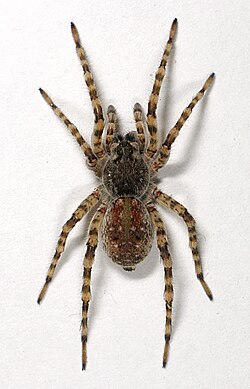 A. cinerea
 -
 female A. japonica
 -
 A. leopardus
 -
 A. perita with spiderlings
 -
 Arctosa sp.


,_Arnhem,_the_Netherlands.jpg)

Complete species list as of October 2025[update]
|
|---|
|
References
[edit]- ^ Koch, C. L. (1847). Die Arachniden.
- ^ a b "Genus Arctosa". World Spider Catalog. doi:10.24436/2. Retrieved 2025-10-02.
- ^ a b c d e f g h Dippenaar-Schoeman, A.S.; Haddad, C.R.; Foord, S.H.; Lotz, L.N. (2021). The Lycosidae of South Africa. Version 1: part 1 (A-H). South African National Survey of Arachnida Photo Identification Guide. p. 23. doi:10.5281/zenodo.6324709.
 This article incorporates text available under the CC BY 4.0 license.
