

The Vietnamese tilde, also known by its Latin name of apex, was a curved diacritic used in the 17th century to mark final nasalization in the early Vietnamese alphabet.[1] It was an adoption of the Portuguese tilde, and should not be confused with the tone mark ngã, which is encoded as a tilde in Unicode (and in Vietnamese derivatives of ISO-8859-1 such as VISCII, VPS or Windows-1258), despite actually being an adoption of the Greek perispomeni.[2][4] Apex is the Latin name used in contemporary texts.
In his 1651 Dictionarium Annamiticum Lusitanum et Latinum, Alexandre de Rhodes describes the diacritic:[5][6][7]
The third sign, finally, is the apex, which in this language is entirely necessary because of a difference in the ending [i.e. of a word], which the apex makes entirely distinct from the ending that m or n makes, with a meaning entirely diverse in words in which it is employed. However, this sign, namely the apex, only affects o᷃ and u᷃, at the end of a word, as ao᷃ "bee", ou᷃ "grandfather" or "lord". It is pronounced, however, such that neither the lips touch together nor the tongue touches the palate.
— Dictionarium Annamiticum Lusitanum et Latinum[8]
The tilde appears atop ⟨o⟩, ⟨u⟩, and less commonly ⟨ơ⟩. As with other accent marks, a tone mark can appear atop the tilde.[9]
According to canon law historian Roland Jacques, the tilde indicated a final labial-velar nasal [ŋ͡m], an allophone of /ŋ/ that is peculiar to the Hanoi dialect to the present day. The tilde apparently fell out of use during the mid-18th century, being unified with ⟨-ng⟩ (representing /ŋ/), in a major simplification of the orthography, though the Vietnamese Jesuit Philipphê Bỉnh (Philiphê do Rosario) continued to use the old orthography into the early 19th century.[10] In Pierre Pigneau de Behaine and Jean-Louis Taberd's 1838 Dictionarium Anamitico-Latinum,[11] the words ao᷃ and ou᷃ became ong and ông, respectively.
The Middle Vietnamese tilde is known as dấu sóng or dấu lưỡi câu in modern Vietnamese. The nasal tilde is sometimes mistaken for the tone mark ngã in modern reproductions of early Vietnamese writing, such as in Phạm Thế Ngũ's Việt Nam văn học sử.[12][13]
Examples
[edit]Obtained from Dictionarium Annamiticum Lusitanum et Latinum, a trilingual Vietnamese, Portuguese and Latin dictionary by Jesuit Alexandre de Rhodes.
-
 The entry for dĕóu᷃ shows distinct breves (ĕ), acutes (ó), and tildes (u᷃).
 -
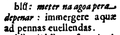 The entry for blu᷃́ shows that a vowel with a tilde can take on an additional tone mark, in this case an acute.
 -
 The entry for bao giơ᷃ đến illustrates the difference between a horn and a tilde.


References
[edit]- ^ Jacques, Roland (2002). Portuguese Pioneers of Vietnamese Linguistics. Bangkok: Orchid Press. p. 91. The accent mark written by the amanuensis on the first word can be read as the apex (or tilde), an abbreviation sign used in 17th and 18th century Quốc Ngữ to represent the rounded nasal finals: '-aõ' (spelt today '-ong'); '-oũ' (= '-ông'), and '-ũ' (= '-ung'). Thus 'chã' would stand for the word presently spelt 'chẳng.' Note that de Rhodes called the tilde a "circumflex".
- ^ Haudricourt, André-Georges (2010). "The origin of the peculiarities of the Vietnamese alphabet" (PDF). Mon-Khmer Studies. 39. Translated by Michaud, Alexis: 89–104. HAL halshs-00918824v2. Originally published as "L'origine des particularités de l'alphabet vietnamien". Dân Việt Nam (in French). 3: 61–68. 1949.
- ^ Wills, Tarrin (2024-04-09). "Clarification of use and forms of certain combining characters" (PDF). UTC L2/24-103.
- ^ Nguyen, Minh; Miller, Kirk (2024-04-05). "Conflict with the Unicode tilde" (PDF). Annotation request for Vietnamese apex. pp. 2–3. UTC L2/24-111. [Note that equating specifically U+1DD1 with the Vietnamese Apex, as proposed in that document, was opposed by the Medieval Unicode Font Initiative.][3]
- ^ Nguyễn Khắc Xuyên (1993). Ngữ Pháp Tiếng Việt của Đắc Lộ 1651 [De Rhodes's Vietnamese grammar of 1651] (in Vietnamese). Garden Grove, California: Thời điểm. OCLC 32129692. Archived from the original on November 12, 2011.
- ^ de Rhodes, Alexandre (1991) [1651]. "Về các dấu và dấu hiệu khác trên nguyên âm". In Hồ Lê; Cao Xuân Hạo; Hồ Tuyết Mai (eds.). Từ điển Annam-Lusitan-Latinh (Thường gọi Từ điển Việt-Bồ-La) (in Vietnamese). Translated by Thanh Lãnh; Hoàng Xuân Việt; Đỗ Quang Chính. Ho Chi Minh City: Social Science Publishing House. p. 11.
- ^ Nguyễn Thị Bạch Nhạn (1994). Sự biến đổi các hình thức chữ quốc ngữ từ 1620 đến 1877 [Changes in the Vietnamese alphabet's form from 1629 to 1877] (PDF) (PTSKH) (in Vietnamese). Hà Nội: Hanoi National University of Education. Archived from the original (PDF) on 2014-03-09. Retrieved 2014-03-08.
- ^ de Rhodes, Alexandre (1651). "De Accentibus & aliis signis in vocalibus.". Dictionarium annamiticum lusitanum, et latinum (in Latin). Rome: Sacred Congregation for the Propagation of the Faith. p. 10.
- ^ de Rhodes, Alexandre (1651). "cou᷒̀ la". Dictionarium annamiticum lusitanum, et latinum (in Latin). Rome: Sacred Congregation for the Propagation of the Faith. p. 135.
- ^ Jacques, Roland (1998). "Le Portugal et la romanisation de la langue vietnamienne. Faut-il réécrire l'histoire ?" [Portugal and the romanization of the Vietnamese language. Should we rewrite history?]. Revue française d'histoire d'outre-mer (in French). 85 (318). Société française d'histoire d'outre-mer: 52. doi:10.3406/outre.1998.3600.
- ^ Pigneaux, Pierre Joseph (1838). "Litterarum anamiticarum ex ordine disposita series". In Taberd, Jean-Louis (ed.). Dictionarium anamitico-latinum (in Latin). Joshua C. Marshman.
- ^ Phạm Thế Ngũ (1961). Việt Nam Văn Học Sử: Giản Ước Tân Biên [History of Vietnamese Literature: New Survey] (in Vietnamese). Saigon: Quốc Học Tùng Thư. p. 61 – via Google Books.
- ^ "Bulletin de l'Institut de recherches archéologiques". Việt-Nam khảo-cổ tập-san: Bulletin de l'Institut de recherches historiques (in Vietnamese). Vietnam Historical Research Institute: 86. 1961 – via Google Books.
| In Latin, Cyrillic and Greek |
|
|---|---|
| In Early Cyrillic |
|
| In Indic | |
| In other scripts | |
| Marks used as diacritics |
|
| Non-diacritic uses | |
| In Unicode |
|

