
Upper and lower probabilities are representations of imprecise probability. Whereas probability theory uses a single number, the probability, to describe how likely an event is to occur, this method uses two numbers: the event's upper probability and the event's lower probability.
Because frequentist statistics disallow metaprobabilities,[citation needed] frequentists have had to propose new solutions. Cedric Smith and Arthur Dempster each developed a theory of upper and lower probabilities. Glenn Shafer developed Dempster's theory further, now known as Dempster–Shafer theory or Choquet (1953). More precisely, in the work of these authors, one considers in a power set, , a mass function satisfying the conditions

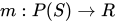

In turn, a mass is associated with two non-additive continuous measures called belief and plausibility, defined as follows:

In the case where is infinite there can be such that there is no associated mass function. See p. 36 of Halpern (2003). Probability measures are a special case of belief functions in which the mass function only assigns positive mass to the event space's singletons.


A different notion of upper and lower probabilities is obtained by the lower and upper envelopes obtained from a class C of probability distributions by setting

The upper and lower probabilities also relate to probabilistic logic: see Gerla (1994).
Observe also that a necessity measure can be seen as a lower probability, and a possibility measure as an upper probability.
See also
[edit]References
[edit]- Choquet, G. (1953). "Theory of Capacities". Annales de l'Institut Fourier. 5: 131–295. doi:10.5802/aif.53.
- Gerla, G. (1994). "Inferences in Probability Logic". Artificial Intelligence. 70 (1–2): 33–52. doi:10.1016/0004-3702(94)90102-3.
- Halpern, J. Y. (2003). Reasoning about Uncertainty. MIT Press. ISBN 978-0-262-08320-1.
- Halpern, J. Y.; Fagin, R. (1992). "Two views of belief: Belief as generalized probability and belief as evidence". Artificial Intelligence. 54 (3): 275–317. CiteSeerX 10.1.1.70.6130. doi:10.1016/0004-3702(92)90048-3. S2CID 11339219.
- Huber, P. J. (1980). Robust Statistics. New York: Wiley. ISBN 978-0-471-41805-4.
- Saffiotti, A. (1992). "A Belief-Function Logic". Procs of the 10h AAAI Conference. San Jose, CA. pp. 642–647. ISBN 978-0-262-51063-9.
}: CS1 maint: location missing publisher (link) - Shafer, G. (1976). A Mathematical Theory of Evidence. Princeton: Princeton University Press. ISBN 978-0-691-08175-5.
- Walley, P.; Fine, T. L. (1982). "Towards a frequentist theory of upper and lower probability". Annals of Statistics. 10 (3): 741–761. doi:10.1214/aos/1176345868. JSTOR 2240901.