
Unicoi County, Tennessee | |
|---|---|
 Unicoi County Courthouse in Erwin | |
 Seal  Logo | |
 Location within the U.S. state of Tennessee | |
| Coordinates: 36°06′N 82°26′W / 36.1°N 82.43°W | |
| Country |  United States United States |
| State |  Tennessee Tennessee |
| Founded | March 23, 1875 |
| Named after | Cherokee word for "fog-draped" or "hazy"[1] |
| Seat | Erwin |
| Largest town | Erwin |
| Area | |
• Total | 186 sq mi (480 km2) |
| • Land | 186 sq mi (480 km2) |
| • Water | 0.3 sq mi (0.78 km2) 0.2% |
| Population (2020) | |
• Total | 17,928  |
| • Density | 98/sq mi (38/km2) |
| Time zone | UTC−5 (Eastern) |
| • Summer (DST) | UTC−4 (EDT) |
| Congressional district | 1st |
| Website | www.unicoicountytn.gov |
Unicoi County (/ˈjuːnɪˌkɔɪ/) is a county located in the U.S. state of Tennessee. As of the 2020 census, the population was 17,928.[2] Its county seat is Erwin.[3] Unicoi is a Cherokee word meaning "white," "hazy," "fog-like," or "fog draped," and refers to the mist often seen in the foothills and mountains of this far northeast county.[1] Unicoi County is part of the Johnson City metropolitan area, which is a component of the "Tri-Cities" region.
History
[edit]This area was long inhabited by Indigenous peoples, including the historic Cherokee who encountered European and English traders and settlers. The mountainous terrain made it less attractive to subsistence farmers.
Unicoi County was created in 1875 from portions of Washington and Carter counties. Its first European-American settlers had arrived more than a century earlier but the population had been small.[1] The county remained predominantly agrarian until the railroads were constructed in the area in the 1880s.[1]
During the 1910s, the Clinchfield Railroad established a pottery in Erwin, which eventually incorporated under the name, "Southern Potteries." This company produced a popular brand of dishware, commonly called Blue Ridge China, which featured hand-painted underglaze designs. While the company folded in the 1950s, Blue Ridge dishes remain popular with antique collectors.[1]
On September 13, 1916, a circus elephant, Mary, was hanged in Erwin for killing her trainer in nearby Kingsport. The hanging was the subject of a book, The Day They Hung the Elephant (1992), by Charles Edwin Price.
Geography
[edit] The Appalachian Trail approaching the summit of Big Bald
According to the U.S. Census Bureau, the county has a total area of 186 square miles (480 km2), of which 186 square miles (480 km2) is land and 0.3 square miles (0.78 km2) (0.2%) is water.[4] It is the fifth-smallest county in Tennessee by total area. The Nolichucky River, which enters Unicoi County from North Carolina, is the county's primary drainage.
Unicoi County is situated entirely within the Blue Ridge Mountains,[5] specifically the Bald Mountains (south of the Nolichucky) and the Unaka Range (north of the Nolichucky). Big Bald, which at 5,516 feet (1,681 m) is the highest mountain in the Balds, is also Unicoi County's high point.[6] Traversed by the Appalachian Trail, the mountain is topped by a grassy bald, allowing a 360-degree view of the surrounding mountains.
Adjacent counties
[edit]- Washington County (north)
- Carter County (northeast)
- Mitchell County, North Carolina (east)
- Yancey County, North Carolina (south)
- Madison County, North Carolina (southwest)
- Greene County (west)
National protected areas
[edit]- Appalachian Trail (part)
- Cherokee National Forest (part)
State protected areas
[edit]Major highways
[edit]


Demographics
[edit]| Census | Pop. | Note | %± |
|---|---|---|---|
| 1880 | 3,645 | — | |
| 1890 | 4,619 | 26.7% | |
| 1900 | 5,851 | 26.7% | |
| 1910 | 7,201 | 23.1% | |
| 1920 | 10,120 | 40.5% | |
| 1930 | 12,678 | 25.3% | |
| 1940 | 14,128 | 11.4% | |
| 1950 | 15,886 | 12.4% | |
| 1960 | 15,082 | −5.1% | |
| 1970 | 15,254 | 1.1% | |
| 1980 | 16,362 | 7.3% | |
| 1990 | 16,549 | 1.1% | |
| 2000 | 17,667 | 6.8% | |
| 2010 | 18,313 | 3.7% | |
| 2020 | 17,928 | −2.1% | |
| U.S. Decennial Census[7] 1790-1960[8] 1900-1990[9] 1990-2000[10] 2010-2014[11] | |||
2020 census
[edit]| Race | Number | Percentage |
|---|---|---|
| White (non-Hispanic) | 16,175 | 90.22% |
| Black or African American (non-Hispanic) | 44 | 0.25% |
| Native American | 38 | 0.21% |
| Asian | 37 | 0.21% |
| Other/Mixed | 527 | 2.94% |
| Hispanic or Latino | 1,107 | 6.17% |
As of the 2020 census, the county had a population of 17,928, 7,638 households, and 4,953 families, and the median age was 47.7 years.[13]
17.9% of residents were under the age of 18 and 24.2% were 65 years of age or older; for every 100 females there were 98.6 males, and for every 100 females age 18 and over there were 95.8 males age 18 and over.[13]
The racial makeup of the county was 91.4% White, 0.2% Black or African American, 0.4% American Indian and Alaska Native, 0.2% Asian, <0.1% Native Hawaiian and Pacific Islander, 2.7% from some other race, and 5.1% from two or more races; Hispanic or Latino residents of any race comprised 6.2% of the population.[14]
48.6% of residents lived in urban areas, while 51.4% lived in rural areas.[15]
There were 7,638 households, of which 24.3% had children under the age of 18 living in them; 47.8% were married-couple households, 19.6% were households with a male householder and no spouse or partner present, and 26.0% were households with a female householder and no spouse or partner present. About 30.4% of all households were made up of individuals and 15.4% had someone living alone who was 65 years of age or older.[13]
There were 8,702 housing units, of which 12.2% were vacant; among occupied housing units, 72.0% were owner-occupied and 28.0% were renter-occupied, with homeowner and rental vacancy rates of 1.9% and 7.4%, respectively.[13]
2000 census
[edit]As of the census[16] of 2000, there were 17,667 people, 7,516 households, and 5,223 families residing in the county. The population density was 95 people per square mile (37 people/km2). There were 8,214 housing units at an average density of 44 units per square mile (17/km2). The racial makeup of the county was 97.96% White, 0.07% Black or African American, 0.25% Native American, 0.08% Asian, 0.03% Pacific Islander, 0.95% from other races, and 0.66% from two or more races. 1.94% of the population were Hispanic or Latino of any race.
There were 7,516 households, out of which 26.60% had children under the age of 18 living with them, 56.40% were married couples living together, 9.50% had a female householder with no husband present, and 30.50% were non-families. 27.50% of all households were made up of individuals, and 13.40% had someone living alone who was 65 years of age or older. The average household size was 2.31 and the average family size was 2.80.
In the county, the population was spread out, with 20.50% under the age of 18, 7.50% from 18 to 24, 27.50% from 25 to 44, 26.50% from 45 to 64, and 18.10% who were 65 years of age or older. The median age was 42 years. For every 100 females, there were 95.10 males. For every 100 females age 18 and over, there were 91.60 males.
The median income for a household in the county was $29,863, and the median income for a family was $36,871. Males had a median income of $30,206 versus $20,379 for females. The per capita income for the county was $15,612. About 8.70% of families and 13.10% of the population were below the poverty line, including 17.70% of those under age 18 and 13.50% of those age 65 or over.
Communities
[edit]Towns
[edit]Census-designated place
[edit]Unincorporated communities
[edit]- Bumpus Cove (partial)
- Clearbranch
- Flag Pond
- Limestone Cove
- Shallowford
Politics
[edit]Voters of Unicoi County, like most of eastern Tennessee, have been strongly affiliated with the Republican Party since before the Civil War, when it was a Unionist enclave. Since its founding, it has supported the Republican presidential candidate in all but one election (1912, when it backed Theodore Roosevelt's Progressive Party campaign).
At the state level, Unicoi County has historically been slightly more receptive to Democratic candidates, generally when they win by landslides. It often supported Democratic candidates for governor in the Solid South era, when white conservatives largely were affiliated as Democrats. More recently, it backed Democrat Ned McWherter in the 1986 and 1990 gubernatorial elections and Phil Bredesen in 2006, when he won every county in the state.
| Year | Republican | Democratic | Third party(ies) | |||
|---|---|---|---|---|---|---|
| No. | % | No. | % | No. | % | |
| 1912 | 280 | 22.84% | 170 | 13.87% | 776 | 63.30% |
| 1916 | 961 | 80.96% | 226 | 19.04% | 0 | 0.00% |
| 1920 | 2,584 | 82.42% | 547 | 17.45% | 4 | 0.13% |
| 1924 | 1,381 | 72.68% | 381 | 20.05% | 138 | 7.26% |
| 1928 | 2,043 | 84.25% | 375 | 15.46% | 7 | 0.29% |
| 1932 | 1,716 | 66.87% | 850 | 33.13% | 0 | 0.00% |
| 1936 | 1,850 | 67.13% | 879 | 31.89% | 27 | 0.98% |
| 1940 | 1,863 | 64.67% | 985 | 34.19% | 33 | 1.15% |
| 1944 | 1,992 | 71.89% | 779 | 28.11% | 0 | 0.00% |
| 1948 | 1,927 | 67.35% | 844 | 29.50% | 90 | 3.15% |
| 1952 | 3,453 | 74.81% | 1,163 | 25.19% | 0 | 0.00% |
| 1956 | 3,978 | 77.71% | 1,111 | 21.70% | 30 | 0.59% |
| 1960 | 4,004 | 75.04% | 1,322 | 24.78% | 10 | 0.19% |
| 1964 | 2,731 | 57.73% | 2,000 | 42.27% | 0 | 0.00% |
| 1968 | 3,327 | 65.49% | 910 | 17.91% | 843 | 16.59% |
| 1972 | 3,877 | 81.35% | 822 | 17.25% | 67 | 1.41% |
| 1976 | 3,211 | 55.53% | 2,526 | 43.69% | 45 | 0.78% |
| 1980 | 3,828 | 65.50% | 1,880 | 32.17% | 136 | 2.33% |
| 1984 | 4,249 | 71.07% | 1,696 | 28.37% | 34 | 0.57% |
| 1988 | 3,664 | 66.79% | 1,794 | 32.70% | 28 | 0.51% |
| 1992 | 3,344 | 51.87% | 2,375 | 36.84% | 728 | 11.29% |
| 1996 | 3,122 | 54.25% | 2,131 | 37.03% | 502 | 8.72% |
| 2000 | 3,780 | 58.80% | 2,566 | 39.91% | 83 | 1.29% |
| 2004 | 5,030 | 67.40% | 2,374 | 31.81% | 59 | 0.79% |
| 2008 | 5,011 | 69.38% | 2,107 | 29.17% | 105 | 1.45% |
| 2012 | 5,032 | 71.01% | 1,913 | 27.00% | 141 | 1.99% |
| 2016 | 5,671 | 78.82% | 1,262 | 17.54% | 262 | 3.64% |
| 2020 | 6,599 | 79.44% | 1,615 | 19.44% | 93 | 1.12% |
| 2024 | 6,876 | 80.51% | 1,578 | 18.48% | 87 | 1.02% |
Education
[edit]All Unicoi County residents are in the Unicoi County School District.[19]
See also
[edit]References
[edit]- ^ a b c d e Hilda Britt Padgett, "Unicoi County," Tennessee Encyclopedia of History and Culture. Retrieved: April 19, 2013.
- ^ "Census - Geography Profile: Unicoi County, Tennessee". United States Census Bureau. Retrieved January 7, 2023.
- ^ "Find a County". National Association of Counties. Retrieved June 7, 2011.
- ^ "2010 Census Gazetteer Files". United States Census Bureau. August 22, 2012. Retrieved April 14, 2015.
- ^ Tennessee Department of Environment and Conservation, et al., "Ambient Air Monitoring Plan," Environmental Protection Agency website, July 1, 2010. Accessed: March 18, 2015.
- ^ Tom Dunigan, Tennessee County High Points, Tennessee Landforms. Retrieved: November 7, 2013.
- ^ "U.S. Decennial Census". United States Census Bureau. Retrieved April 14, 2015.
- ^ "Historical Census Browser". University of Virginia Library. Retrieved April 14, 2015.
- ^ Forstall, Richard L., ed. (March 27, 1995). "Population of Counties by Decennial Census: 1900 to 1990". United States Census Bureau. Retrieved April 14, 2015.
- ^ "Census 2000 PHC-T-4. Ranking Tables for Counties: 1990 and 2000" (PDF). United States Census Bureau. April 2, 2001. Archived (PDF) from the original on October 9, 2022. Retrieved April 14, 2015.
- ^ "State & County QuickFacts". United States Census Bureau. Archived from the original on June 7, 2011. Retrieved December 7, 2013.
- ^ "Explore Census Data". data.census.gov. Retrieved December 26, 2021.
- ^ a b c d "2020 Decennial Census Demographic Profile (DP1)". United States Census Bureau. 2021. Retrieved January 1, 2026.
- ^ "2020 Decennial Census Redistricting Data (Public Law 94-171)". United States Census Bureau. 2021. Retrieved January 1, 2026.
- ^ "2020 Decennial Census Demographic and Housing Characteristics (DHC)". United States Census Bureau. 2023. Retrieved January 1, 2026.
- ^ "U.S. Census website". United States Census Bureau. Retrieved May 14, 2011.
- ^ Leip, David. "Dave Leip's Atlas of U.S. Presidential Elections". uselectionatlas.org. Retrieved March 12, 2018.
- ^ State of Tennessee General Election Results, November 5, 2024, Results By County (PDF) (Report). Secretary of State of Tennessee. December 2, 2024. Retrieved December 2, 2024.
- ^ "2020 CENSUS - SCHOOL DISTRICT REFERENCE MAP: Unicoi County, TN" (PDF). U.S. Census Bureau. Retrieved June 24, 2024.
External links
[edit]
Places adjacent to Unicoi County, Tennessee | |
|---|---|


Municipalities and communities of Unicoi County, Tennessee, United States | ||
|---|---|---|
| Towns | 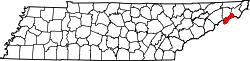 | |
| CDP | ||
| Unincorporated communities | ||
| Footnotes | ‡This populated place also has portions in an adjacent county or counties | |
36°06′N 82°26′W / 36.10°N 82.43°W
| International | |
|---|---|
| National | |
| Other | |
