
| This is the talk page for discussing improvements to the Net present value article. This is not a forum for general discussion of the subject of the article. |
Article policies
|
| Find sources: Google (books · news · scholar · free images · WP refs) · FENS · JSTOR · TWL |
Archives: 1Auto-archiving period: 3 months  |
 | This article is rated C-class on Wikipedia's content assessment scale. It is of interest to the following WikiProjects: | |||||||||||||||||||||||
| ||||||||||||||||||||||||


Simple Formula
[edit]The formula below is most easier that table
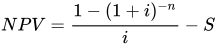
and also used by many ERP systems now a days as a base formula to determine NPV why people make any article their personal matter i added this formula for public's best interest but it is removed many time if anyone think that this formula is improper then discuss here
Needs Example
[edit]The article needs an example of NPV of a bond paying 5% yearly coupon for 10 years and a face value of 10,000.00. as well as a zero coupon bond maturing in 10 years and a face value of 10,000.00.
The article needs a discussion of how to compare the two bonds above to
- a risk free rate NPV such as 10 year US treasuray
- inflation assumptions for 10 years (using for example, the 10 year US TIPS inflation adjusted security).
you can view detailed cases on bonds and how to compare them at the following link
http://www.oopine.com/view_topic.php?ti=121
however by the time i will update this article also
Without Title
[edit]added "and no cash inflow for the 12 months of Year 0." It makes the example more complete, and highlights that cashflow in applies to Year 0 just as it does for years 1 to 6. The first monkey 12 months of a projects life is Year 0 and many projects do generate cash within the first 12 months of life.
Removed "and no cash inflow for the 12 months of t=0" as previous poster has misunderstood the time periods. This project does generate cashflow in during the first 12 months, and that is what is shown at the end of that first year as the entry for t=1.
Is there something wrong with this calculation?
[edit]A while ago I had posted a link to the finance wonk's version of net present value calculation at http://finance wonk.blogspot.com/2006/05/present-value-analysis-fundamentals.html
(Remove the space in the first word in the address to use the link, the blacklist kills it here too!)
Recently it was removed and I was notified the site had been blacklisted?
Did I do something wrong? Or is something wrong with the analysis on the destination site?
Looking at the finance wonk page (I haven't reread it in detail) it still looks like a neat runthrough and I like the plots, they do a lot more for me than the equations on the current wikipedia page. Especially the third and fourth ones.
I also like the discussion of how to do NPV in excel, although I see someone has found a possibly better site for that and added it to external links (cool!).
It still looks like the plots contribute a lot, I would add them into the Wikipedia write up except that it would violate copyright since that site obviously owns them (or so I assume).
I read Wikipedia's policy on external links and the link would seem to qualify on the basis of the cool plots alone, and financewonk doesn't ACTUALLY show up on the blacklist (http://meta.wikimedia.org/wiki/Spam_blacklist) so I can't even tell if there's an overall site problem or what.
Mostly I'm intrigued by the process and hoping the person who did the blacklisting/removal could comment. Is it because the blogspot page has google ads on it? There is hardly any of it and it's kind of out of the way, but I could see if that were a policy.
Full disclosure -- I do know the guy who writes that page. I consider a (small) handful of his work link-worthy, most of it being rather more specific and of limited application.
References
[edit]Added a reference to Expected commercial value as Cooper suggests it as a possible replacement for NPV in his "Winning at New Products" book
Merge proposal
[edit]I propose merging Risk-adjusted net present value into Net present value. I think the content in Risk-adjusted net present value can easily be explained in the context of this article, and merging them would not cause any article-size or weighting problems. Duncnbiscuit (talk) 10:50, 4 February 2026 (UTC)