
| Shitalanatha | |
|---|---|
10th Jain Tirthankara | |
 Shri Shitalanatha bhagwan at Badridas Jain temple, Kolkata | |
| Venerated in | Jainism |
| Predecessor | Pushpadanta |
| Successor | Shreyansanatha |
| Symbol | Kalpavriksha (Wishing Tree) As per Digambar. Srivatsa as per Shwetambar |
| Height | 90 bows (270 meters) |
| Age | 100,000 purva (7.056 Quintillion years) |
| Color | Golden |
| Genealogy | |
| Born | |
| Died | |
| Parents |
|
| Dynasty | Ikṣvākuvaṁśa |
| Part of a series on |
| Jainism |
|---|
 |

Shitalanatha was the tenth tirthankara of the present age according to Jainism. According to Jain beliefs, he became a siddha, a liberated soul which has destroyed all of its karma. Jains believe Shitalanatha was born to King Dradhrath and Queen Nanda at Bhaddilpur into the Ikshvaku dynasty. His birth date was the twelfth day of the Magha Krishna month of the Indian national calendar. Shitalanatha is associated with Svastika (Dig.)/ Srivatasa (Svet.) emblem, Pilurikha tree, Brahma Yaksha and Manavi (Dig.) & Ashoka (Svet.) Yakshi.
Biography
[edit]Shitalanatha was the tenth tirthankara of the present age according to Jainism.[1] According to Jain beliefs, he became a siddha, a liberated soul which has destroyed all of its karma. Jains believe Shitalanatha was born to King Dradhrath and Queen Nanda at Bhaddilpur into the Ikshvaku dynasty.[1] His birth date was the twelfth day of the Magha Krishna month of the Indian national calendar. Shitalanatha is associated with Svastika (Dig.)/ Srivatasa (Svet.) emblem, Pilurikha tree, Brahma Yaksha and Manavi (Dig.) & Ashoka (Svet.) Yakshi.[2] His height is mentioned as 90 dhanusha.[3] He is said to have lived for 100,000 purva.[3]
Shitalanatha is said to have been born 9 crore sagara after his predecessor, Pushpadanta.[3] His successor, Shreyansanatha, is said to have been born 9,999,900 sagara after him.[3]
Main Temple
[edit]- Shitalanatha Temple, Kolkata
-
 Kallu Basadi, Moodbidri
 -

-
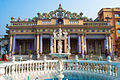 Shitalanatha Temple, Kolkata


See also
[edit]
References
[edit]Citations
[edit]- ^ a b Tukol 1980, p. 31.
- ^ Tandon 2002, p. 44.
- ^ a b c d Finegan 1952, p. 190.
Sources
[edit]- Finegan, Jack (1952), The archeology of world religions, Princeton University Press
- Johnson, Helen M. (1931), Shitalanathacaritra (Book 3.8 of the Trishashti Shalaka Purusha Caritra), Baroda Oriental Institute
- Tandon, Om Prakash (2002) [1968], Jaina Shrines in India (1 ed.), New Delhi: Publications Division, Ministry of Information and Broadcasting, Government of India, ISBN 81-230-1013-3
- Tukol, T. K. (1980), Compendium of Jainism, Dharwad: University of Karnataka
| Gods | |||||
|---|---|---|---|---|---|
| Philosophy | |||||
| Branches |
| ||||
| Practices | |||||
| Literature | |||||
| Symbols | |||||
| Ascetics | |||||
| Scholars | |||||
| Community |
| ||||
| Jainism in |
| ||||
| Jainism and | |||||
| Dynasties and empires | |||||
| Related | |||||
| Lists | |||||
| Navboxes | |||||

 | This biography of an Indian religious figure is a stub. You can help Wikipedia by adding missing information. |
 | This Jainism-related article is a stub. You can help Wikipedia by adding missing information. |