
| Sambhavanatha | |
|---|---|
3rd Jain Tirthankara | |
 The largest known single-stone idol of the 3rd Sambhavnatha Bhagwan at Sambhavnath ni Khadki, Ahmedabad, Gujarat, India | |
| Venerated in | Jainism |
| Predecessor | Ajitanatha |
| Successor | Abhinandananatha |
| Symbol | Horse |
| Height | 400 dhanusa (1,200 meters) |
| Age | 6,000,000 purva |
| Color | Golden |
| Genealogy | |
| Born | |
| Died | |
| Parents |
|
| Dynasty | Ikṣvākuvaṁśa |
| Part of a series on |
| Jainism |
|---|
 |

Sambhavanatha was the third Jain tirthankara (omniscient teaching god) of the present age (Avasarpini). Sambhavanatha was born to King Jitari and Queen Susena at Shravasti. His birth date was the fourteenth day of the Margshrsha shukla month of the Indian calendar. Like all arihant (omniscient beings), Sambhavanatha at the end of his life destroyed all associated karmas and attained moksha (liberation).
Life
[edit]Sambhavanatha was the third tirthankara (omniscient Jain teacher) of the present age (Avasarpini).[1] He was born to King Jitārī and Queen Susena at Sravasti.[2][3] in the Ikshvaku dynasty.[1] His height was 400 bows (1,200 meters).[4][2][5] He is said to have lived for 6,000,000 purva.[4] Sambavanatha is associated with Horse emblem, Sala tree,[6] Trimukha (three-faced) Yaksha and Prajnapthi & Duritari Yakshi.[7]
According to Jain text Uttarapurāṇa, Sambhavanatha possessed three types of knowledge from birth.[8]
Sambhavanatha is said to have been born 30 lakh crore sagara after his predecessor, Ajitanatha.[4] His successor, Abhinandananatha, is said to have been born 10 lakh crore sagara after him.[4]
Prayer
[edit]Svayambhustotra by Acarya Samantabhadra is the adoration of twenty-four tirthankaras. Its five slokas (aphorisms) adore the qualities of Sambhavanātha.[9]
O Lord Sambhavanātha! The worldly life appears to be transient, without a protector, sullied with the blemishes of pride and delusion, and tormented by birth, old-age and death. You had helped worldly souls attain ambrosial happiness by ridding these of the karmic dirt.
— Svayambhustotra (3-2-12)[10]
Main Temples
[edit]- Shobhnath temple: birthplace of Sambhavanatha
- Chaturmukha Basadi, Gerusoppa
- Sambhavanath Temple in Idar, Gujarat
-
 Image of Tirthankara Sambhavnatha at Gujari Mahal Archaeological Museum
 -
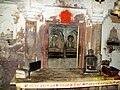 Lord Sumatinatha and Lord Sambhavnatha at Ranthambore Fort
 -
 Sambhabnath Temple, Madhuban
 -
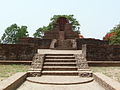 Ruins Shobhnath temple, Shravasti, believed to be birthplace of Sambhavanatha


.jpg)
See also
[edit]
References
[edit]Citations
[edit]- ^ a b Tukol 1980, p. 31.
- ^ a b Vijay K. Jain 2015, p. 183.
- ^ "Sravasti", asiexbrpatna.bih.nic.in
- ^ a b c d Finegan 1952, p. 190.
- ^ Finegan 1952, p. 191.
- ^ Krishna & Amirthalingam 2014, p. 46.
- ^ Tandon 2002, p. 44.
- ^ Jain 2015, p. 15.
- ^ Vijay K. Jain 2015, p. 16–19.
- ^ Vijay K. Jain 2015, p. 17.
Sources
[edit]- Finegan, Jack (1952), The archeology of world religions, Princeton University Press
- Johnson, Helen M. (1931), Sambhavajinacaritra (Book 3.1 of the Trishashti Shalaka Purusha Caritra), Baroda Oriental Institute
- Jain, Dr. Pannalal (2015), Uttarapurāṇa of Āchārya Guṇabhadra, Bhartiya Jnanpith, ISBN 978-81-263-1738-7
- Jain, Vijay K. (2015), Acarya Samantabhadra's Svayambhustotra: Adoration of The Twenty-four Tirthankara, Vikalp Printers, ISBN 978-81-903639-7-6, archived from the original on 16 September 2015,
 This article incorporates text from this source, which is in the public domain.
 - Krishna, Nanditha; Amirthalingam, M. (2014) [2013], Sacred Plants of India, Penguin Books, ISBN 978-9-351-18691-5
- Tandon, Om Prakash (2002) [1968], Jaina Shrines in India (1 ed.), New Delhi: Publications Division, Ministry of Information and Broadcasting, Government of India, ISBN 81-230-1013-3
- Tukol, T. K. (1980), Compendium of Jainism, Dharwad: University of Karnataka

| Gods | |||||
|---|---|---|---|---|---|
| Philosophy | |||||
| Branches |
| ||||
| Practices | |||||
| Literature | |||||
| Symbols | |||||
| Ascetics | |||||
| Scholars | |||||
| Community |
| ||||
| Jainism in |
| ||||
| Jainism and | |||||
| Dynasties and empires | |||||
| Related | |||||
| Lists | |||||
| Navboxes | |||||

 | This biography of an Indian religious figure is a stub. You can help Wikipedia by adding missing information. |
 | This Jainism-related article is a stub. You can help Wikipedia by adding missing information. |