
 SS Eastland in Cleveland, Ohio (1911) | |
| History | |
|---|---|
 United States United States | |
| Name | Eastland |
| Owner | Michigan Steamship Company |
| Route | South Haven, Michigan – Chicago, Illinois |
| Ordered | October 1902 |
| Builder | Jenks Ship Building Company |
| Launched | May 6, 1903 |
| Christened | May 1903 by Francis Elizabeth Stufflebeam |
| Maiden voyage | July 16, 1903 |
| Nickname(s) | "Greyhound of the Lakes" |
| Fate | Company restructured in 1905 to the Michigan Transportation Company |
| United States | |
| Name | Eastland |
| Owner | Michigan Transportation Company |
| Operator | Chicago-South Haven Line |
| Route | South Haven – Chicago route |
| Fate | Sold August 5, 1906, to the Lake Shore Navigation Company of Cleveland, Ohio |
 United States United States | |
| Name | Eastland |
| Owner | Lake Shore Navigation Company of Cleveland, Ohio |
| Route | Cleveland-Cedar Point route |
| Fate | Company restructured in 1909 to the Eastland Navigation Company of Cleveland, Ohio |
 United States United States | |
| Name | Eastland |
| Owner | Eastland Navigation Company of Cleveland, Ohio |
| Route | Cleveland-Cedar Point route |
| Fate | Sold on June 1, 1914 to the St. Joseph-Chicago Steamship Company of St. Joseph, Michigan. |
| United States | |
| Name | Eastland |
| Owner | St. Joseph-Chicago Steamship Company of St. Joseph, Michigan |
| Route | St. Joseph, Michigan, to Chicago route |
| Fate | Raised after accident in October 1915 and sold at auction on 20 December 1915 to Captain Edward A. Evers, sold on 21 November 1917 to the Illinois Naval Reserve. |
 United States Navy United States Navy | |
| Name | USS Wilmette |
| Acquired | November 21, 1917 |
| Commissioned | September 20, 1918 |
| Recommissioned |
|
| Decommissioned |
|
| Renamed | Wilmette on February 20, 1918 |
| Reclassified |
|
| Stricken | December 19, 1945 |
| Honors and awards |
|
| Fate | Sold for scrap on October 31, 1946 to Hyman Michaels Company of Chicago and scrapped, scrapping completed in 1947 |
| General characteristics | |
| Type | Passenger Ship |
| Tonnage | 1,961 gross |
| Displacement | 2,600 (estimated) |
| Length | 265 ft (81 m) |
| Beam | 38 ft 2 in (11.63 m) |
| Draft | 19 ft 6 in (5.94 m) |
| Installed power |
|
| Propulsion | Two shafts |
| Speed | 16.5 knots (30.6 km/h; 19.0 mph) |
| Capacity | As Eastland: 2,500 passengers, 70 crew (1915) |
| Complement | As USS Wilmette: 209 |
| Armament |
|
| Notes |
|


SS Eastland was a passenger ship based in Chicago. On July 24, 1915, the ship capsized while tied to a dock in the Chicago River.[1] In total, 844 passengers and crew were killed in what is the largest loss of life from a single shipwreck on the Great Lakes.[1][2]
After the disaster, Eastland was salvaged and sold to the United States Navy. After restorations and modifications, Eastland was designated a gunboat and renamed USS Wilmette. She was used primarily as a training vessel on the Great Lakes, and was scrapped after World War II.
Construction
[edit]The ship was ordered during 1902 by the Michigan Steamship Company and built by the Jenks Ship Building Company of Port Huron, Michigan.[3] The ship was originally meant to be named The City of South Haven, but a rival company built a ship with the same name. The ship was named in May 1903, immediately before her inaugural voyage by a Mrs. David Reid of South Haven.
History
[edit]Early problems
[edit]On 27 July of her 1903 inaugural season, the ship struck the laid-up tugboat George W. Gardner, which sank at its dock at the Lake Street Bridge in Chicago. Eastland received only minor damage.[4][5]
Mutiny on the Eastland
[edit]On 14 August 1903, while on a cruise from Chicago to South Haven, Michigan, six of the ship's firemen refused to stoke the fire for the ship's boiler, claiming that they had not received their potatoes for a meal.[4] When they refused to return to the fire hole, Captain John Pereue arrested the six men at gunpoint. Firemen George Lippen and Benjamin Myers, who were not a part of the group of six, stoked the fires until the ship reached harbor. Upon the ship's arrival in South Haven, the six men were taken to the town jail and charged with mutiny. Shortly thereafter, Captain Pereue was replaced.[4]
Speed modifications
[edit]Because the ship did not meet a targeted speed of 22 miles per hour (35 km/h; 19 kn) during her inaugural season and had a draft too deep for the Black River in South Haven, Michigan, where she was being loaded, the ship returned in September 1903 to Port Huron for modifications, including the addition of an air-conditioning system, an induced-draft system for the boilers to increase power, and repositioning of the ship's machinery to reduce the draft of the hull.[4][6][7] Even though the modifications increased the ship's speed, the reduced hull draft and extra weight mounted up high reduced the metacentric height and inherent stability as originally designed.[6][7]
 The SS Eastland under the State Street Bridge in Chicago
Listing incidents
[edit]Upon her return to South Haven in May 1904, the ship handily won a race to Chicago against the City of South Haven.[6] In the meantime, the Eastland was experiencing periodic problems with her stability while loading and unloading cargo and passengers, and nearly capsized on 17 July 1904 after leaving South Haven with about 3,000 passengers.[4][6] Subsequently, her capacity was lowered to 2,800 passengers, cabins were removed, lifeboats were added and the hull was repaired. On 5 August 1906, another listing incident occurred, which resulted in complaints filed against the Chicago-South Haven Line that had purchased the ship earlier that year.[6]
Before the 1907 season, the ship was sold to the Lake Shore Navigation Company and moved to Lake Erie.[4] In 1909, the ship was sold again to the Eastland Navigation Company and continued running excursions between Cleveland and Cedar Point.[6] After the 1909 season, the remaining 39 cabins were removed, and prior to the 1912 season, the top smokestack sections were removed to shorten her stack height.[6] On 1 July 1912, another incident occurred when the Eastland experienced a severe listing of about 25° while loading passengers in Cleveland.[4][6]
In June 1914, the Eastland was sold to the St. Joseph–Chicago Steamship Company and returned to Lake Michigan for St. Joseph, Michigan-to-Chicago service.[4]
The Eastland disaster
[edit]On July 24, 1915, Eastland and four other Great Lakes passenger steamers—Theodore Roosevelt, Petoskey, Racine, and Rochester—were chartered to take employees from Western Electric Company's Hawthorne Works in Cicero, Illinois to a picnic in Michigan City, Indiana.[8][9]
The federal Seamen's Act had been passed in 1915 following the RMS Titanic disaster three years earlier. The law required retrofitting of a complete set of lifeboats on Eastland, as on many other passenger vessels.[10] This additional weight may have made Eastland more dangerous by making her even more top-heavy. Some argued that other Great Lakes ships would suffer from the same problem,[10] but the bill was signed into law by President Woodrow Wilson. Eastland's owners could choose to either maintain a reduced capacity or add lifeboats to increase capacity, and they elected to add lifeboats to qualify for a license to increase the ship's capacity to 2,570 passengers.[11] Eastland was already so top-heavy that she had special restrictions concerning the number of passengers that could be carried. In June 1914, Eastland had again changed ownership, this time bought by the St. Joseph and Chicago Steamship Company, with captain Harry Pederson appointed the ship's master. In 1914, the company removed the old hardwood flooring of the forward dining room on the cabin level and replaced it with 2 inches (51 mm) of concrete. It also added a layer of concrete near the aft gangway. This added 15–20 tons of weight.[12]
 Postcard of the Eastland and Pederson; postmarked 24 July 1915
On the morning of 24 July, passengers began boarding Eastland on the south bank of the Chicago River between Clark and LaSalle Streets at about 6:30 a.m., and by 7:10 a.m., the ship had reached her capacity of 2,572 passengers. Many passengers were standing on the open upper decks when the ship began to list slightly to the port side (away from the wharf). The crew attempted to stabilize the ship by admitting water into her ballast tanks, but to little avail. At 7:28 a.m., Eastland lurched sharply to port and then rolled completely onto her port side, coming to rest on the river bottom, only 20 feet (6.1 m) below the surface; barely half of the vessel was submerged. Many passengers had already moved below decks on the cool and damp morning to warm themselves before the departure. Consequently, hundreds were trapped inside by the water and the sudden rollover, and some were crushed by heavy furniture, including pianos, bookcases, and tables. The ship was only 20 feet (6.1 meters) from the wharf. Captain John O'Meara and the crew of the nearby vessel Kenosha responded quickly by pulling alongside the hull to allow stranded passengers to leap to safety. Other notable heroes of the day included Peter Boyle, a deckhand from the SS Petoskey who drowned while saving passengers, and Helen Repa, a Western Electric nurse who commanded much of the rescue operation. However, 841 passengers and 2 crew members died. Many of the passengers on Eastland were immigrants, with large numbers from present-day Czech Republic, Poland, Norway, Germany, Ireland, Sweden, Denmark, Italy, Hungary, and Austria.[13] Many of the Czech immigrants had settled in Cicero; of the Czech passengers aboard, 220 perished in the disaster.[13]
The bodies were taken to temporary morgues established in the area for identification, with the nearby Reid, Murdoch & Co. Building (the headquarters of the Britannica company as of 2026) acting as one such place; by afternoon, the remaining unidentified bodies were consolidated in the armory of the 2nd Regiment.[8][14]
In the aftermath, the Western Electric Company provided $100,000 (equivalent to $3.11 million in 2024)[15] to relief and recovery efforts of the family members of the victims.[16]
Among those scheduled to be on Eastland was 20-year-old football player George Halas, later the coach and owner of the Chicago Bears and a founding member of the National Football League, who was delayed leaving for the dock and arrived after the ship had overturned. Halas's name was listed on the list of deceased in newspapers, but he was later revealed to be unharmed. His friend and future Bears executive Ralph Brizzolara and his brother were on the Eastland when she capsized but escaped through portholes.[17] Despite rumors to the contrary, entertainer Jack Benny was neither aboard Eastland nor scheduled for the excursion.[citation needed]
The first known film footage of the recovery efforts was discovered and released in 2015.[18]
Marion Eichholz (born July 12, 1912), the last known survivor, died on November 24, 2014 at the age of 102. She was three years old at the time of the disaster.[19][20]
Media reports
[edit]Writer Jack Woodford witnessed the disaster and offered a first-hand account to the Herald and Examiner. In his autobiography, Woodford wrote:
And then movement caught my eye. I looked across the river. As I watched in disoriented stupefaction a steamer large as an ocean liner slowly turned over on its side as though it were a whale going to take a nap. I didn't believe a huge steamer had done this before my eyes, lashed to a dock, in perfectly calm water, in excellent weather, with no explosion, no fire, nothing. I thought I had gone crazy.[citation needed]
Carl Sandburg, then known better as a journalist than as a poet, wrote an angry account for The International Socialist Review, accusing regulators of ignoring safety issues and claiming that many of the workers were aboard following company orders for a mandatory staged picnic.[21] Sandburg also wrote a poem, "The Eastland", which contrasted the disaster with the mistreatment and poor health of the lower classes. Sandburg concluded the poem with a comparison: "I see a dozen Eastlands/Every morning on my way to work/And a dozen more going home at night."[22] The poem was considered too harsh for publication when written, but was eventually published in a collection of poems in 1993.[23]
Inquiry and indictments
[edit]A grand jury indicted the president and three other officers of the steamship company for manslaughter, and the ship's captain and engineer for criminal carelessness, and found that the disaster was caused by "conditions of instability" caused by overloading of passengers, mishandling of water ballast and the ship's faulty construction.[24]
During hearings regarding the extradition of the men to Illinois for trial, principal witness Sidney Jenks, president of the company that built Eastland, testified that her first owners wanted a fast ship to transport fruit, and he designed one capable of reaching 20 mph (32 km/h) and carrying 500 passengers. Defense counsel Clarence Darrow asked whether Jenks had ever concerned himself with the potential conversion of the ship into a passenger steamer with a capacity of 2,500 or more passengers. Jenks replied, "I had no way of knowing the quantity of its business after it left our yards ... No, I did not worry about the Eastland." Jenks testified that a stability test of the ship was never performed, and stated that after tilting to an angle of 45° at launching, "it righted itself as straight as a church, satisfactorily demonstrating its stability."[25]
The court refused extradition, holding that the evidence was too weak, with "barely a scintilla of proof" to establish probable cause to find the six guilty. The court reasoned that the four company officers were not aboard the ship, and that every act charged against the captain and engineer was performed in the ordinary course of business, "more consistent with innocence than with guilt." The court also reasoned that Eastland "was operated for years and carried thousands safely", and therefore the accused were justified in believing the ship to be seaworthy.[26]
Photo gallery
[edit]-
 Cartoonist Bob Satterfield witnessed the capsizing from the Clark Street Bridge, and sketched it for his syndicate
 -
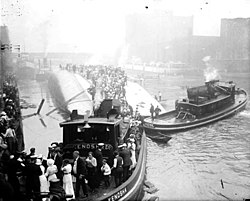 Passengers being rescued from the hull of the Eastland by a tugboat.
 -
 Victim recovered from the Eastland
 -
 View of Eastland from fire tug.
 -
 Eastland being righted after the disaster.
 -
 View of the Eastland rescue underway. From a post card
 -
 Postcard of Eastland. "The Ill Fated Eastland, which turned turtle in the Chicago River, July 24, 1915, at 7:30 A.M., causing the death of over 1000 persons, mostly women and children."


Second life as USS Wilmette
[edit] USS Wilmette, c. 1918
After Eastland was raised on August 14, 1915, she was sold to the Illinois Naval Reserve and recommissioned as USS Wilmette, stationed at the Naval Station Great Lakes. She was converted to a gunboat, renamed Wilmette on February 20, 1918, and commissioned on 20 September 1918 under captain William B. Wells.[27] Commissioned late in World War I, Wilmette did not experience combat. It trained sailors and experienced normal upkeep and repairs until placed in ordinary at Chicago on 9 July 1919, retaining a 10-man caretaker crew aboard. On 29 June 1920, the gunboat was returned to full commission.[27]
On June 7, 1921, Wilmette was tasked with sinking UC-97, a German U-boat surrendered to the United States after World War I.[28] The guns of Wilmette were manned by gunner's mate J. O. Sabin, who had fired the first American cannon of World War I, and gunner's mate A. F. Anderson, the man who fired the first American torpedo of the war.[29]
For the remainder of her 25-year career, the gunboat served as a training ship for naval reservists of the 9th, 10th and 11th Naval Districts. It made voyages along the shores of the Great Lakes carrying trainees assigned to her from the Naval Station Great Lakes. Wilmette was placed "out of commission, in service" on 15 February 1940.[27]
Given hull designation IX-29 on February 17, 1941, she resumed training duty at Chicago on 30 March 1942, preparing armed guard crews for duty manning the guns on armed merchantmen. That assignment continued until the end of World War II in Europe obviated measures to protect transatlantic merchant shipping from German U-boats.[27]
During August 1943, Wilmette transported President Franklin D. Roosevelt, Admiral William D. Leahy, James F. Byrnes and Harry Hopkins[4] on a 10-day fishing vacation in McGregor and Whitefish Bay.[30]
On April 9, 1945, she was returned to full commission for a brief interval. Wilmette was decommissioned on November 28, 1945, and her name was deleted from the Navy list on 19 December 1945. During 1946, Wilmette was offered for sale. On October 31, 1946, she was sold to the Hyman Michaels Company for scrapping, which was completed in 1947.[27]
For her service in the US Navy, Wilmette was eligible for the following awards:
- World War I Victory Medal
- American Defense Service Medal
- American Campaign Medal
- World War II Victory Medal
Memorials
[edit] Historical marker along the Chicago River
A marker commemorating the accident was dedicated on 4 June 1989. This marker was reported stolen on April 26, 2000, and a replacement marker was installed and dedicated on 24 July 2003.
On July 12, 2015, 100 years after the disaster, a memorial to the dead was dedicated at Bohemian National Cemetery in Chicago.
In popular culture
[edit]The disaster was incorporated into the 1999 series premiere of the Disney Channel original series So Weird, in which teenage paranormal enthusiast Fiona Phillips encounters the ghost of a boy who drowned.[31]
In 2012, Chicago's Lookingglass Theatre produced a musical entitled Eastland: A New Musical, written by Andy White and scored by Ben Collins-Sussman and Andre Pluess.[32][33]
The Eastland disaster is also pivotal to the story of one family told in the play/musical Failure: A Love Story, written by Philip Dawkins, which premiered in Chicago in 2012 at Victory Gardens Theater.[34] The play premiered in Los Angeles on 24 July 2015, the 100th anniversary of the tragedy.[35] The play was again staged in Chicago at the Oil Lamp Theater and was nominated for multiple awards.[36]
In 2024, Chicago's Neo-Futurists produced a puppetry show based on the disaster entitled Switchboard.[37]
See also
[edit]Notes
[edit]- ^ a b "The Eastland". Eastland Memorial Society. Archived from the original on March 24, 2016. Retrieved April 25, 2009.
- ^ Baillod, Brendon. "Introduction". The Wreck of the Steamer Lady Elgin. Archived from the original on July 27, 2015. Retrieved April 26, 2009.
- ^ "Jenks Shipbuilding, Port Huron MI". Shipbuilding History. Archived from the original on October 8, 2014. Retrieved June 26, 2014.
- ^ a b c d e f g h i "Eastland (1903)". Builder's Data and History. Maritime Quest. Archived from the original on February 16, 2020. Retrieved May 10, 2020.
- ^ "Annual report of the Supervising Inspector-general Steamboat-inspection Service, Year ending June 30, 1903". Washington: Government Printing Office. 1903. p. 75. Archived from the original on April 7, 2022. Retrieved May 18, 2020 – via Haithi Trust.
- ^ a b c d e f g h "The Eastland – Early Life". Eastland Memorial Society. Archived from the original on January 19, 2009. Retrieved May 10, 2020.
- ^ a b Hilton, George (1995). Eastland: Legacy of the Titanic. Stanford University Press. pp. 41–43. ISBN 0-8047-2801-1. Whatever may have been the additional weight from the induced-draft and air-conditioning systems, it was enough to cause the ship to squat when under way, promising to aggravate her chronic problem of striking bottom. To deal with the problem Wood undertook to relocate some of the ship's machinery. The exact nature of the repositioning was never stated, either at the time or after the disaster. Because the ship's machinery was quite limited, this probably meant some forward or aft movement of the engines and incidentally moving the condensers. ... The new induced-draft and air-conditioning systems, combined with Wood's repositioning of machinery to reduce her draft, however, produced a ship that was to prove chronically top-heavy.
- ^ a b "Eastland Memorial Edition". Western Electric News. August 1915. Archived from the original on September 14, 2011. Retrieved August 14, 2012.
- ^ Hilton, George (1995). Eastland: Legacy of the Titanic. Stanford University Press. p. 93. ISBN 0-8047-2801-1.
- ^ a b "The Prophecy". The Eastland – Lake Erie. Eastland Memorial Society. Archived from the original on January 22, 2009. Retrieved April 25, 2009.
- ^ Bonansinga, Jay (2004). The Sinking of the Eastland: America's Forgotten Tragedy. Citadel Press. p. 52. ISBN 0-8065-2628-9.
- ^ Bonansinga (2004)[page needed]
- ^ a b "The Passengers". Eastland Disaster Historical Society. 2022. Archived from the original on September 25, 2022. Retrieved September 24, 2022.
- ^ "ITB: Eastland ghost stories". Chicago Bears. October 29, 2013. Archived from the original on October 6, 2014. Retrieved November 5, 2013. He decided they needed to set up a consolidated, temporary morgue. They did at the 2nd Regiment Armory building, which later became the studios for Oprah Winfrey.
- ^ 1634–1699: McCusker, J. J. (1997). How Much Is That in Real Money? A Historical Price Index for Use as a Deflator of Money Values in the Economy of the United States: Addenda et Corrigenda (PDF). American Antiquarian Society. 1700–1799: McCusker, J. J. (1992). How Much Is That in Real Money? A Historical Price Index for Use as a Deflator of Money Values in the Economy of the United States (PDF). American Antiquarian Society. 1800–present: Federal Reserve Bank of Minneapolis. "Consumer Price Index (estimate) 1800–". Retrieved February 29, 2024.
- ^ "Financial Relief". Eastland Disaster Historical Society. Retrieved August 2, 2024.
- ^ "ITB: Halas escapes Eastland Disaster". Chicago Bears. October 29, 2013. Archived from the original on December 13, 2013. Retrieved November 5, 2013.
- ^ Rodriguez, Meredith (February 8, 2015). "First known film clips emerge of 1915 Eastland disaster". Chicago Tribune. Archived from the original on February 12, 2015. Retrieved February 12, 2015.
- ^ "Eichholz, Marion - Eastland Disaster". Retrieved October 30, 2025.
- ^ Manchir, Michelle (December 14, 2014). "Last Survivor of 1915 Eastland Disaster Dies". Chicago Tribune. Archived from the original on December 14, 2014. Retrieved December 14, 2014.
- ^ Sandburg, Carl (September 1915). "Looking 'em over". The International Socialist Review. XVI (3): 132–137.
- ^ Sandburg, Carl. "Eastland". Archived from the original on June 23, 2015. Retrieved July 9, 2015.
- ^ Sandburg, Carl (1993). Hendrik, George; Hendrik, Willene (eds.). Billy Sunday and Other Poems. Harcourt Brace & Company. p. xiii.
- ^ "Six Are Indicted for Eastland Loss – President of the Company, Captain, and Engineer Among Those Held for Disaster". The New York Times. August 11, 1915. Archived from the original on March 5, 2016. Retrieved February 12, 2017.
- ^ "Eastland Never Tested – Builder of Ill-Fated Ship Says She Was Designed to Carry 500". The New York Times. January 23, 1916. Archived from the original on March 5, 2016. Retrieved February 12, 2017.
- ^ "Nation Loses Point in Eastland Case; Court Refuses Application for Removal of Indicted Persons to Jurisdiction of Illinois". The New York Times. February 18, 1916. Archived from the original on January 5, 2024. Retrieved February 12, 2017.
- ^ a b c d e "Wilmette". Dictionary of American Naval Fighting Ships. United States Navy. Archived from the original on August 7, 2020. Retrieved April 26, 2009.
- ^ "The UC-97". Eastland Disaster Historical Society. Archived from the original on August 10, 2007. Retrieved April 26, 2009.
- ^ "USS Wilmette". Eastland Memorial Society. Archived from the original on January 19, 2009. Retrieved April 26, 2009.
- ^ Mount, Graeme S. (July 2001). "Myths and Realities: FDR's Vacation on Lake Huron, 1-7 August 1943" (PDF). The Northern Mariner. XI (3): 23–32. doi:10.25071/2561-5467.600. S2CID 247554079. Archived from the original (PDF) on October 18, 2023.
- ^ AwesomeTVShows. "So Weird 1x01 – Family Reunion". Dailymotion. Archived from the original on January 8, 2015. Retrieved March 7, 2015.
- ^ Ingram, Bruce (June 28, 2012). "Musical Memorial for a Chicago Tragedy". Deerfield Review. Glenview, IL: Pioneer Press. pp. 98=B.
- ^ Zoglin, Richard (June 27, 2012). "Scandal in the Second City: Two Remarkable Shows From Chicago". Time. Archived from the original on March 6, 2021. Retrieved September 7, 2020.
- ^ "Failure: A Love Story*". Victory Gardens. July 23, 2019. Archived from the original on August 28, 2022. Retrieved August 28, 2022.
- ^ Rohrer, Jason (July 24, 2015). "Theater Review: FAILURE: A LOVE STORY (Coeurage Theatre Company at GTC in Burbank – Los Angeles)". stageandcinema.com. Archived from the original on July 28, 2015. Retrieved March 22, 2018.
- ^ "Failure: A Love Story". Oil Lamp Theater. Archived from the original on August 9, 2022. Retrieved August 28, 2022.
- ^ "SWITCHBOARD". The Neo-Futurist Theater. November 21, 2023. Retrieved January 10, 2024.
References
[edit] This article incorporates text from the public domain Dictionary of American Naval Fighting Ships. The entry can be found here.

Further reading
[edit]- Dial, Caitlyn Perry (2016). Only the River Remains: History and Memory of the Eastland Disaster in the Great Lakes Region, 1915 – 2015 (PhD thesis). Western Michigan University.
- Green, Jocelyn (2022). Drawn By The Current. Bethany House Publishers. ISBN 9780764233326.
- Kemp, Bill (July 20, 2014). "Bloomington witness to Eastland disaster". The Pantagraph. Bloomington, IL.
- McCarthy, Michael (2014). Ashes Under Water: The SS Eastland and the Shipwreck that Shook America. Lyons Press. ISBN 978-0762793280.
- Myers, Quinn (July 25, 2019). "New Documentary Revisits Chicago's 'Deadliest Day'". WTTW.
- Wachholz, Ted (2005). The Eastland Disaster. Arcadia Publishing. ISBN 0-7385-3441-2.
- Zett, Natalie (2021). Flower in the River. Zidova Publishing. ISBN 978-1737579618.
External links
[edit]
- Eastland Disaster Historical Society
- MaritimeQuest Eastland Photo Gallery
- Chicago Tribune Photographs
| Telephones |  | |
|---|---|---|
| Switching systems | ||
| Other technology | ||
| Related companies | ||
| Competitors | ||
| See also | ||
Shipwrecks and maritime incidents in July 1915 | |
|---|---|
| Shipwrecks |
|
| Other incidents |
|

