
| Part of a series of articles about |
| Quantum mechanics |
|---|
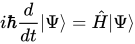
i
ℏ
d
d
t
|
Ψ
⟩
=
H
^
|
Ψ
⟩
{\displaystyle i\hbar {\frac {d}{dt}}|\Psi \rangle ={\hat {H}}|\Psi \rangle }
 |
|
Equations |
|
Scientists
|
This article concerns the rotation operator, as it appears in quantum mechanics.
Quantum mechanical rotations
[edit]With every physical rotation
R
{\displaystyle R}


The translation operator
[edit]The rotation operator
R
(
z
,
θ
)
{\displaystyle \operatorname {R} (z,\theta )}


Translation of the particle at position
x
{\displaystyle x}



Because a translation of 0 does not change the position of the particle, we have (with 1 meaning the identity operator, which does nothing):
T
(
0
)
=
1
{\displaystyle \operatorname {T} (0)=1}


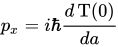
Taylor development gives:
T
(
d
a
)
=
T
(
0
)
+
d
T
(
0
)
d
a
d
a
+
⋯
=
1
−
i
ℏ
p
x
d
a
{\displaystyle \operatorname {T} (da)=\operatorname {T} (0)+{\frac {d\operatorname {T} (0)}{da}}da+\cdots =1-{\frac {i}{\hbar }}p_{x}da}

From that follows:
T
(
a
+
d
a
)
=
T
(
a
)
T
(
d
a
)
=
T
(
a
)
(
1
−
i
ℏ
p
x
d
a
)
⇒
T
(
a
+
d
a
)
−
T
(
a
)
d
a
=
d
T
d
a
=
−
i
ℏ
p
x
T
(
a
)
{\displaystyle \operatorname {T} (a+da)=\operatorname {T} (a)\operatorname {T} (da)=\operatorname {T} (a)\left(1-{\frac {i}{\hbar }}p_{x}da\right)\Rightarrow {\frac {\operatorname {T} (a+da)-\operatorname {T} (a)}{da}}={\frac {d\operatorname {T} }{da}}=-{\frac {i}{\hbar }}p_{x}\operatorname {T} (a)}

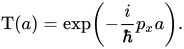
This is a differential equation with the solution
T
(
a
)
=
exp
(
−
i
ℏ
p
x
a
)
.
{\displaystyle \operatorname {T} (a)=\exp \left(-{\frac {i}{\hbar }}p_{x}a\right).}
Additionally, suppose a Hamiltonian
H
{\displaystyle H}

![{\displaystyle [p_{x},H]=0}](https://wikimedia.org/api/rest_v1/media/math/render/svg/1ac4683d7b95f08cb67a9705027f1f3eb74b67e2)
![{\displaystyle [H,\operatorname {T} (a)]=0.}](https://wikimedia.org/api/rest_v1/media/math/render/svg/c27d81bcad703e4df6dbf760d00b58c91237268f)
In relation to the orbital angular momentum
[edit] Classically we have for the angular momentum
L
=
r
×
p
.
{\displaystyle \mathbf {L} =\mathbf {r} \times \mathbf {p} .}


x
′
=
r
cos
(
t
+
d
t
)
=
x
−
y
d
t
+
⋯
y
′
=
r
sin
(
t
+
d
t
)
=
y
+
x
d
t
+
⋯
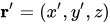
{\displaystyle {\begin{aligned}x'&=r\cos(t+dt)=x-y\,dt+\cdots \\y'&=r\sin(t+dt)=y+x\,dt+\cdots \end{aligned}}}

From that follows for states:
R
(
z
,
d
t
)
|
r
⟩
=
R
(
z
,
d
t
)
|
x
,
y
,
z
⟩
=
|
x
−
y
d
t
,
y
+
x
d
t
,
z
⟩
=
T
x
(
−
y
d
t
)
T
y
(
x
d
t
)
|
x
,
y
,
z
⟩
=
T
x
(
−
y
d
t
)
T
y
(
x
d
t
)
|
r
⟩
{\displaystyle \operatorname {R} (z,dt)|r\rangle =\operatorname {R} (z,dt)|x,y,z\rangle =|x-y\,dt,y+x\,dt,z\rangle =\operatorname {T} _{x}(-y\,dt)\operatorname {T} _{y}(x\,dt)|x,y,z\rangle =\operatorname {T} _{x}(-y\,dt)\operatorname {T} _{y}(x\,dt)|r\rangle }

And consequently:
R
(
z
,
d
t
)
=
T
x
(
−
y
d
t
)
T
y
(
x
d
t
)
{\displaystyle \operatorname {R} (z,dt)=\operatorname {T} _{x}(-y\,dt)\operatorname {T} _{y}(x\,dt)}

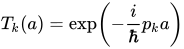
Using
T
k
(
a
)
=
exp
(
−
i
ℏ
p
k
a
)
{\displaystyle T_{k}(a)=\exp \left(-{\frac {i}{\hbar }}p_{k}a\right)}

![{\displaystyle \operatorname {R} (z,dt)=\exp \left[-{\frac {i}{\hbar }}\left(xp_{y}-yp_{x}\right)dt\right]=\exp \left(-{\frac {i}{\hbar }}L_{z}dt\right)=1-{\frac {i}{\hbar }}L_{z}dt+\cdots }](https://wikimedia.org/api/rest_v1/media/math/render/svg/e706213a1d81d36483b133417102966271d9d16d)

To get a rotation for the angle
t
{\displaystyle t}


R
(
z
,
t
+
d
t
)
=
R
(
z
,
t
)
R
(
z
,
d
t
)
⇒
d
R
d
t
=
R
(
z
,
t
+
d
t
)
−
R
(
z
,
t
)
d
t
=
R
(
z
,
t
)
R
(
z
,
d
t
)
−
1
d
t
=
−
i
ℏ
L
z
R
(
z
,
t
)
⇒
R
(
z
,
t
)
=
exp
(
−
i
ℏ
t
L
z
)
{\displaystyle {\begin{aligned}&\operatorname {R} (z,t+dt)=\operatorname {R} (z,t)\operatorname {R} (z,dt)\\[1.1ex]\Rightarrow {}&{\frac {d\operatorname {R} }{dt}}={\frac {\operatorname {R} (z,t+dt)-\operatorname {R} (z,t)}{dt}}=\operatorname {R} (z,t){\frac {\operatorname {R} (z,dt)-1}{dt}}=-{\frac {i}{\hbar }}L_{z}\operatorname {R} (z,t)\\[1.1ex]\Rightarrow {}&\operatorname {R} (z,t)=\exp \left(-{\frac {i}{\hbar }}\,t\,L_{z}\right)\end{aligned}}}
![{\displaystyle {\begin{aligned}&\operatorname {R} (z,t+dt)=\operatorname {R} (z,t)\operatorname {R} (z,dt)\\[1.1ex]\Rightarrow {}&{\frac {d\operatorname {R} }{dt}}={\frac {\operatorname {R} (z,t+dt)-\operatorname {R} (z,t)}{dt}}=\operatorname {R} (z,t){\frac {\operatorname {R} (z,dt)-1}{dt}}=-{\frac {i}{\hbar }}L_{z}\operatorname {R} (z,t)\\[1.1ex]\Rightarrow {}&\operatorname {R} (z,t)=\exp \left(-{\frac {i}{\hbar }}\,t\,L_{z}\right)\end{aligned}}}](https://wikimedia.org/api/rest_v1/media/math/render/svg/ef6f72cb544ee1c3f63e21ec324269ce87655498)
Similar to the translation operator, if we are given a Hamiltonian
H
{\displaystyle H}
![{\displaystyle [L_{z},H]=0}](https://wikimedia.org/api/rest_v1/media/math/render/svg/a428a66380deb52c3d77434ad3e02b8c1b8bda30)
![{\displaystyle [\operatorname {R} (z,t),H]=0}](https://wikimedia.org/api/rest_v1/media/math/render/svg/f98875d763eb69b9312d65f6807fff522837a6fd)
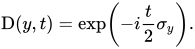
For the spin angular momentum about for example the
y
{\displaystyle y}


Effect on the spin operator and quantum states
[edit]Operators can be represented by matrices. From linear algebra one knows that a certain matrix
A
{\displaystyle A}





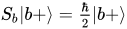
From standard quantum mechanics we have the known results
S
b
|
b
+
⟩
=
ℏ
2
|
b
+
⟩
{\textstyle S_{b}|b+\rangle ={\frac {\hbar }{2}}|b+\rangle }




Comparison with
S
b
|
b
+
⟩
=
ℏ
2
|
b
+
⟩
{\textstyle S_{b}|b+\rangle ={\frac {\hbar }{2}}|b+\rangle }

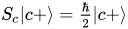
This means that if the state
|
c
+
⟩
{\displaystyle |c+\rangle }
See also
[edit]References
[edit]- L.D. Landau and E.M. Lifshitz: Quantum Mechanics: Non-Relativistic Theory, Pergamon Press, 1985
- P.A.M. Dirac: The Principles of Quantum Mechanics, Oxford University Press, 1958
- R.P. Feynman, R.B. Leighton and M. Sands: The Feynman Lectures on Physics, Addison-Wesley, 1965
| General |
| ||||||||||||
|---|---|---|---|---|---|---|---|---|---|---|---|---|---|
| Quantum |
| ||||||||||||