Riemann invariants are mathematical transformations made on a system of conservation equations to make them more easily solvable. Riemann invariants are constant along the characteristic curves of the partial differential equations where they obtain the name invariant. They were first obtained by Bernhard Riemann in his work on plane waves in gas dynamics.[1]
Mathematical theory
[edit]Consider the set of conservation equations:
l
i
(
A
i
j
∂
u
j
∂
t
+
a
i
j
∂
u
j
∂
x
)
+
l
j
b
j
=
0
{\displaystyle l_{i}\left(A_{ij}{\frac {\partial u_{j}}{\partial t}}+a_{ij}{\frac {\partial u_{j}}{\partial x}}\right)+l_{j}b_{j}=0}

where
A
i
j
{\displaystyle A_{ij}}
 and
a
i
j
{\displaystyle a_{ij}}
and
a
i
j
{\displaystyle a_{ij}}
 are the elements of the matrices
A
{\displaystyle \mathbf {A} }
are the elements of the matrices
A
{\displaystyle \mathbf {A} }
 and
a
{\displaystyle \mathbf {a} }
and
a
{\displaystyle \mathbf {a} }
 where
l
i
{\displaystyle l_{i}}
where
l
i
{\displaystyle l_{i}}
 and
b
i
{\displaystyle b_{i}}
and
b
i
{\displaystyle b_{i}}
 are elements of vectors. It will be asked if it is possible to rewrite this equation to
m
j
(
β
∂
u
j
∂
t
+
α
∂
u
j
∂
x
)
+
l
j
b
j
=
0
{\displaystyle m_{j}\left(\beta {\frac {\partial u_{j}}{\partial t}}+\alpha {\frac {\partial u_{j}}{\partial x}}\right)+l_{j}b_{j}=0}
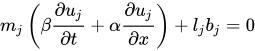
To do this curves will be introduced in the
(
x
,
t
)
{\displaystyle (x,t)}
 plane defined by the vector field
(
α
,
β
)
{\displaystyle (\alpha ,\beta )}
plane defined by the vector field
(
α
,
β
)
{\displaystyle (\alpha ,\beta )}
 . The term in the brackets will be rewritten in terms of a total derivative where
x
,
t
{\displaystyle x,t}
. The term in the brackets will be rewritten in terms of a total derivative where
x
,
t
{\displaystyle x,t}
 are parametrized as
x
=
X
(
η
)
,
t
=
T
(
η
)
{\displaystyle x=X(\eta ),t=T(\eta )}
are parametrized as
x
=
X
(
η
)
,
t
=
T
(
η
)
{\displaystyle x=X(\eta ),t=T(\eta )}

d
u
j
d
η
=
T
′
∂
u
j
∂
t
+
X
′
∂
u
j
∂
x
{\displaystyle {\frac {du_{j}}{d\eta }}=T'{\frac {\partial u_{j}}{\partial t}}+X'{\frac {\partial u_{j}}{\partial x}}}
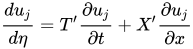
comparing the last two equations we find
α
=
X
′
(
η
)
,
β
=
T
′
(
η
)
{\displaystyle \alpha =X'(\eta ),\beta =T'(\eta )}

which can be now written in characteristic form
m
j
d
u
j
d
η
+
l
j
b
j
=
0
{\displaystyle m_{j}{\frac {du_{j}}{d\eta }}+l_{j}b_{j}=0}
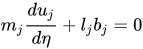
where we must have the conditions
l
i
A
i
j
=
m
j
T
′
{\displaystyle l_{i}A_{ij}=m_{j}T'}
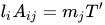 l
i
a
i
j
=
m
j
X
′
{\displaystyle l_{i}a_{ij}=m_{j}X'}
l
i
a
i
j
=
m
j
X
′
{\displaystyle l_{i}a_{ij}=m_{j}X'}
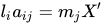
where
m
j
{\displaystyle m_{j}}
 can be eliminated to give the necessary condition
l
i
(
A
i
j
X
′
−
a
i
j
T
′
)
=
0
{\displaystyle l_{i}(A_{ij}X'-a_{ij}T')=0}

so for a nontrivial solution is the determinant
|
A
i
j
X
′
−
a
i
j
T
′
|
=
0
{\displaystyle |A_{ij}X'-a_{ij}T'|=0}

For Riemann invariants we are concerned with the case when the matrix
A
{\displaystyle \mathbf {A} }
is an identity matrix to form
∂
u
i
∂
t
+
a
i
j
∂
u
j
∂
x
=
0
{\displaystyle {\frac {\partial u_{i}}{\partial t}}+a_{ij}{\frac {\partial u_{j}}{\partial x}}=0}
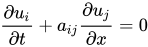
notice this is homogeneous due to the vector
n
{\displaystyle \mathbf {n} }
 being zero. In characteristic form the system is
l
i
d
u
i
d
t
=
0
{\displaystyle l_{i}{\frac {du_{i}}{dt}}=0}

with
d
x
d
t
=
λ
{\displaystyle {\frac {dx}{dt}}=\lambda }

Where
l
{\displaystyle l}
 is the left eigenvector of the matrix
A
{\displaystyle \mathbf {A} }
and
λ
′
s
{\displaystyle \lambda 's}
is the left eigenvector of the matrix
A
{\displaystyle \mathbf {A} }
and
λ
′
s
{\displaystyle \lambda 's}
 is the characteristic speeds of the eigenvalues of the matrix
A
{\displaystyle \mathbf {A} }
which satisfy
is the characteristic speeds of the eigenvalues of the matrix
A
{\displaystyle \mathbf {A} }
which satisfy
|
A
−
λ
δ
i
j
|
=
0
{\displaystyle |A-\lambda \delta _{ij}|=0}
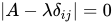
To simplify these characteristic equations we can make the transformations such that
d
r
d
t
=
l
i
d
u
i
d
t
{\displaystyle {\frac {dr}{dt}}=l_{i}{\frac {du_{i}}{dt}}}

which form
μ
l
i
d
u
i
=
d
r
{\displaystyle \mu l_{i}du_{i}=dr}

An integrating factor
μ
{\displaystyle \mu }
 can be multiplied in to help integrate this. So the system now has the characteristic form
d
r
d
t
=
0
{\displaystyle {\frac {dr}{dt}}=0}

on
d
x
d
t
=
λ
i
{\displaystyle {\frac {dx}{dt}}=\lambda _{i}}

which is equivalent to the diagonal system[2]
r
t
k
+
λ
k
r
x
k
=
0
,
{\displaystyle r_{t}^{k}+\lambda _{k}r_{x}^{k}=0,}
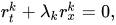 k
=
1
,
.
.
.
,
N
.
{\displaystyle k=1,...,N.}
k
=
1
,
.
.
.
,
N
.
{\displaystyle k=1,...,N.}

The solution of this system can be given by the generalized hodograph method.[3][4]
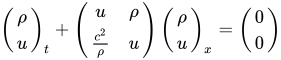
Consider the one-dimensional Euler equations written in terms of density
ρ
{\displaystyle \rho }
 and velocity
u
{\displaystyle u}
and velocity
u
{\displaystyle u}
 are
are
ρ
t
+
ρ
u
x
+
u
ρ
x
=
0
{\displaystyle \rho _{t}+\rho u_{x}+u\rho _{x}=0}
 u
t
+
u
u
x
+
(
c
2
/
ρ
)
ρ
x
=
0
{\displaystyle u_{t}+uu_{x}+(c^{2}/\rho )\rho _{x}=0}
u
t
+
u
u
x
+
(
c
2
/
ρ
)
ρ
x
=
0
{\displaystyle u_{t}+uu_{x}+(c^{2}/\rho )\rho _{x}=0}

with
c
{\displaystyle c}
 being the speed of sound is introduced on account of isentropic assumption. Write this system in matrix form
(
ρ
u
)
t
+
(
u
ρ
c
2
ρ
u
)
(
ρ
u
)
x
=
(
0
0
)
{\displaystyle \left({\begin{matrix}\rho \\u\end{matrix}}\right)_{t}+\left({\begin{matrix}u&\rho \\{\frac {c^{2}}{\rho }}&u\end{matrix}}\right)\left({\begin{matrix}\rho \\u\end{matrix}}\right)_{x}=\left({\begin{matrix}0\\0\end{matrix}}\right)}
where the matrix
a
{\displaystyle \mathbf {a} }
from the analysis above the eigenvalues and eigenvectors need to be found. The eigenvalues are found to satisfy
λ
2
−
2
u
λ
+
u
2
−
c
2
=
0
{\displaystyle \lambda ^{2}-2u\lambda +u^{2}-c^{2}=0}

to give
λ
=
u
±
c
{\displaystyle \lambda =u\pm c}

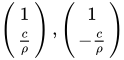
and the eigenvectors are found to be
(
1
c
ρ
)
,
(
1
−
c
ρ
)
{\displaystyle \left({\begin{matrix}1\\{\frac {c}{\rho }}\end{matrix}}\right),\left({\begin{matrix}1\\-{\frac {c}{\rho }}\end{matrix}}\right)}
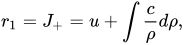
where the Riemann invariants are
r
1
=
J
+
=
u
+
∫
c
ρ
d
ρ
,
{\displaystyle r_{1}=J_{+}=u+\int {\frac {c}{\rho }}d\rho ,}
 r
2
=
J
−
=
u
−
∫
c
ρ
d
ρ
,
{\displaystyle r_{2}=J_{-}=u-\int {\frac {c}{\rho }}d\rho ,}
r
2
=
J
−
=
u
−
∫
c
ρ
d
ρ
,
{\displaystyle r_{2}=J_{-}=u-\int {\frac {c}{\rho }}d\rho ,}
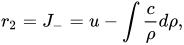
(
J
+
{\displaystyle J_{+}}
 and
J
−
{\displaystyle J_{-}}
and
J
−
{\displaystyle J_{-}}
 are the widely used notations in gas dynamics). For perfect gas with constant specific heats, there is the relation
c
2
=
const
γ
ρ
γ
−
1
{\displaystyle c^{2}={\text{const}}\,\gamma \rho ^{\gamma -1}}
are the widely used notations in gas dynamics). For perfect gas with constant specific heats, there is the relation
c
2
=
const
γ
ρ
γ
−
1
{\displaystyle c^{2}={\text{const}}\,\gamma \rho ^{\gamma -1}}
 , where
γ
{\displaystyle \gamma }
, where
γ
{\displaystyle \gamma }
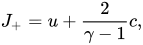
 is the specific heat ratio, to give the Riemann invariants[5][6]
J
+
=
u
+
2
γ
−
1
c
,
{\displaystyle J_{+}=u+{\frac {2}{\gamma -1}}c,}
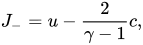
 J
−
=
u
−
2
γ
−
1
c
,
{\displaystyle J_{-}=u-{\frac {2}{\gamma -1}}c,}
J
−
=
u
−
2
γ
−
1
c
,
{\displaystyle J_{-}=u-{\frac {2}{\gamma -1}}c,}
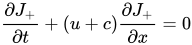
to give the equations
∂
J
+
∂
t
+
(
u
+
c
)
∂
J
+
∂
x
=
0
{\displaystyle {\frac {\partial J_{+}}{\partial t}}+(u+c){\frac {\partial J_{+}}{\partial x}}=0}
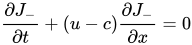
 ∂
J
−
∂
t
+
(
u
−
c
)
∂
J
−
∂
x
=
0
{\displaystyle {\frac {\partial J_{-}}{\partial t}}+(u-c){\frac {\partial J_{-}}{\partial x}}=0}
∂
J
−
∂
t
+
(
u
−
c
)
∂
J
−
∂
x
=
0
{\displaystyle {\frac {\partial J_{-}}{\partial t}}+(u-c){\frac {\partial J_{-}}{\partial x}}=0}
In other words,
d
J
+
=
0
,
J
+
=
const
along
C
+
:
d
x
d
t
=
u
+
c
,
d
J
−
=
0
,
J
−
=
const
along
C
−
:
d
x
d
t
=
u
−
c
,
{\displaystyle {\begin{aligned}&dJ_{+}=0,\,J_{+}={\text{const}}\quad {\text{along}}\,\,C_{+}\,:\,{\frac {dx}{dt}}=u+c,\\&dJ_{-}=0,\,J_{-}={\text{const}}\quad {\text{along}}\,\,C_{-}\,:\,{\frac {dx}{dt}}=u-c,\end{aligned}}}
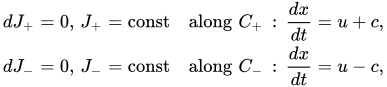
where
C
+
{\displaystyle C_{+}}
 and
C
−
{\displaystyle C_{-}}
and
C
−
{\displaystyle C_{-}}
 are the characteristic curves. This can be solved by the hodograph transformation. In the hodographic plane, if all the characteristics collapses into a single curve, then we obtain simple waves. If the matrix form of the system of pde's is in the form
A
∂
v
∂
t
+
B
∂
v
∂
x
=
0
{\displaystyle A{\frac {\partial v}{\partial t}}+B{\frac {\partial v}{\partial x}}=0}
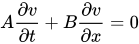
Then it may be possible to multiply across by the inverse matrix
A
−
1
{\displaystyle A^{-1}}
 so long as the matrix determinant of
A
{\displaystyle \mathbf {A} }
is not zero.
so long as the matrix determinant of
A
{\displaystyle \mathbf {A} }
is not zero.
- ^
Riemann, Bernhard (1860). "Ueber die Fortpflanzung ebener Luftwellen von endlicher Schwingungsweite" (PDF). Abhandlungen der Königlichen Gesellschaft der Wissenschaften zu Göttingen. 8. Retrieved 2012-08-08.
- ^
Whitham, G. B. (1974). Linear and Nonlinear Waves. Wiley. ISBN 978-0-471-94090-6.
- ^
Kamchatnov, A. M. (2000). Nonlinear Periodic Waves and their Modulations. World Scientific. ISBN 978-981-02-4407-1.
- ^ Tsarev, S. P. (1985). "On Poisson brackets and one-dimensional hamiltonian systems of hydrodynamic type" (PDF). Soviet Mathematics - Doklady. 31 (3): 488–491. MR 2379468. Zbl 0605.35075. Archived from the original (PDF) on 2012-03-30. Retrieved 2011-08-20.
- ^ Zelʹdovich, I. B., & Raĭzer, I. P. (1966). Physics of shock waves and high-temperature hydrodynamic phenomena (Vol. 1). Academic Press.
- ^ Courant, R., & Friedrichs, K. O. 1948 Supersonic flow and shock waves. New York: Interscience.

