

The Yorkshire Portal

Yorkshire (/ˈjɔːrkʃər, -ʃɪər/ YORK-shər, -sheer) is an area of Northern England which was historically a county. Despite no longer being used for administration, Yorkshire retains a strong regional identity. The county was named after the city of York.
The south-west of Yorkshire includes the cities of Leeds, Sheffield, Bradford, Doncaster and Wakefield. The north and east of the county includes the southern part of the Teesside conurbation; the port city of Hull is located in the south-east. York is positioned near the centre of the county. Yorkshire has a coastline on the North Sea. The North York Moors occupy the north-east of the county, and the centre contains the Vale of Mowbray and the Vale of York. The west contains part of the Pennines, which includes the Yorkshire Dales. (Full article...)
Selected article
 LCW waymarker
The Leeds Country Way is a circular long-distance footpath of 62 miles (99 km) around Leeds, West Yorkshire. It is nowhere further than 7 miles (11 km) from Leeds City Square, but is mainly rural with extensive views in the outlying areas of the Leeds metropolitan district. It follows public footpaths and minor lanes, with a few short sections along roads.
A route was first devised by Fred Andrews of the Ramblers Association, and then developed by West Yorkshire County Council in the early 1980s. This council was abolished in 1986, and the path is now under the care of the Countryside section of Leeds City Council. The Leeds Country Way was realigned in 2006, using a route devised by Bob Brewster, to bring it entirely within the boundary of the Leeds metropolitan district (previously it crossed the boundary into Wakefield), and the path was officially relaunched on 26 September 2006 with a revised set of map leaflets and improved waymarking. The path is waymarked in both directions and can be started at any point, but is described here clockwise from the A660 road at Golden Acre Park, divided into parts and sections which correspond with the official map leaflets. (read more . . . )
Selected image

Selected biography
Saint William of York, (d. 1154) also known as William FitzHerbert, William I FitzHerbert and William of Thwayt, was an English priest and Archbishop of York. FitzHerbert is unusual in having been Archbishop of York twice, both before and after his rival Henry Murdac. He was a relative of King Stephen of England, and the king helped secure FitzHerbert's election to York after a number of candidates had failed to secure papal confirmation. FitzHerbert faced opposition from the Cistercians who, after the election of the Cistercian Pope Eugenius III, managed to have the archbishop deposed in favor of the Cistercian Murdac. From 1147 until 1153, FitzHerbert worked to secure his restoration to York, which he finally achieved after the deaths of both Murdac and Eugenius. He did not retain the see long, as he died shortly after returning to York, allegedly having been poisoned. After his death miracles were reported at his tomb, and in 1227 he was declared a saint. (read more . . . )
Selected list -
 Hull City players and staff celebrate promotion to the Premier League for the first time in their history, which was achieved after victory in the 2008 Football League Championship play-off final.
Hull City Association Football Club, an English association football club based in Kingston upon Hull, East Riding of Yorkshire, was founded in 1904. The team's first competitive matches came in the FA Cup, being beaten 4–1 by Stockton in a replay following a 3–3 draw, before they were elected to the Football League Second Division ahead of the 1905–06 season. Hull missed out on promotion in the 1909–10 season, having an inferior goal average to Oldham Athletic and finishing in third. The 1929–30 season saw Hull relegated to the Third Division North after 21 seasons in the Second Division while reaching the semi-final of the FA Cup, where they were beaten by Arsenal after a replay. Promotion back to the Second Division was achieved three years later, with the Third Division North championship becoming the club's first major honour. However, they were relegated in the 1935–36 season and it was 13 years before another return to the Second Division was made, when, under the player-management of former England international Raich Carter, the Third Division North title was won. Relegation back to this division came in the 1955–56 season and following League reorganisation implemented for the 1958–59 season Hull won promotion in the Third Division's inaugural season, although they were relegated after one year. The Third Division championship was won in the 1965–66 season and Hull remained in the Second Division for 12 years before relegation in 1978. Hull reached the semi-final of the Watney Cup in the tournament's inaugural staging in 1970, where they were beaten by Manchester United in a penalty shoot-out; this was the first game in English football to be decided by this method. The Final of this competition was reached in 1974, where Hull were beaten by Stoke City. Relegation to the Fourth Division for the first time in the club's history came in 1981 and a return to the Third Division was secured two years later in the 1982–83 season. The season after, Hull reached the final of the Associate Members' Cup in its inaugural season and were beaten by AFC Bournemouth. Promotion to the Second Division came the following season, although relegations in the 1990–91 and 1995–96 seasons saw the club return to the fourth tier.Hull's first play-off campaign ended unsuccessfully, being beaten by Leyton Orient in the semi-final in the 2000–01 season. However, successive promotions in the 2003–04 and 2004–05 seasons saw Hull rise from the fourth tier to the second tier in a space of two years. After 104 years of existence, Hull were promoted to the Premier League for the first time in their history, beating Watford in the play-off semi-finals and Bristol City in the 2008 Football League Championship play-off final. Hull's first Premier League season saw safety from relegation ensured on the last day of the season, although the club was relegated the following season after finishing 19th in the league. Three years later, Hull returned to the Premier League after finishing the 2012–13 season as Championship runners-up. In the 2013–14 season they achieved their highest ever league finish of 16th and were runners-up to Arsenal in their first ever FA Cup Final appearance. Since then, they have been relegated to the Championship and promoted again. (Full article...)
Selected Did You Know . . .
 Hull Maritime Museum
- ...that the Maritime Museum (pictured), in Kingston upon Hull, England, houses the largest collection of scrimshaw artwork in Europe?
- ...that the rivalry between Leeds United and Manchester United football clubs has its roots in the 15th century English civil war, the Wars of the Roses?
- ...that Denton Hall once the home of General Fairfax, the English Civil War commander-in-chief, was later sold for less than the value of the timber on the estate?
General images -
-
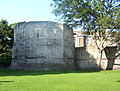 Roman wall and the west corner tower of the fort at York, with medieval additions (from History of Yorkshire)
 -
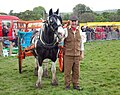 Mr Pack dressed in traditional Yorkshire attire takes his horse, Danny, for a turn of the field in front of the crowd at Otley Show. (from Culture of Yorkshire)
 -
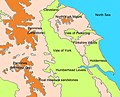 The natural sub-regions of Yorkshire (from History of Yorkshire)
 -
 Harold Wagstaff – Prince of the Centres. (from Culture of Yorkshire)
 -
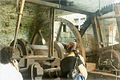 Water-powered, belt-driven machinery, Abbeydale Industrial Hamlet, Sheffield. (from History of Yorkshire)
 -
 The main rivers of Yorkshire. (from History of Yorkshire)
 -
 A flat cap associated with the stereotypical Yorkshireman (from Culture of Yorkshire)
 -

-

-
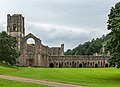 Fountains abbey from the west (from History of Yorkshire)
 -
 Thornborough Henge (from History of Yorkshire)
 -
 The Brontë sisters (from Culture of Yorkshire)
 -

-
 Sean Bean's Yorkshire accent is highly recognised and is utilised on many of his castings including Game of Thrones Stark accent. (from Culture of Yorkshire)
 -
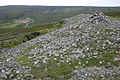 A prehistoric settlement on Harkerside Moor in Swaledale. (from History of Yorkshire)
 -

-
 Roman Britain (from History of Yorkshire)
 -
 Yorkshire is often described as "God's own county/country" due to its beautiful landscape and unspoiled countryside (from Culture of Yorkshire)
 -
 The Rudston Monolith, almost 26ft high, close to Rudston Parish Church of all Saints (from History of Yorkshire)
 -
 Depiction of Edwin of Northumbria from Sledmere (from History of Yorkshire)
 -
 A medieval representation of Saint Olaf (from History of Yorkshire)
 -
 Herbert Sutcliffe, batsman. (from Culture of Yorkshire)
 -
 Richmond castle walls and towers seen from the Keep (from History of Yorkshire)
 -
 Long Sword dancers (from Culture of Yorkshire)
 -
 Brazilian legend Pelé (left) in Sheffield in November 2017, marking the 150th anniversary of the world's oldest football club, Sheffield F.C. (from Culture of Yorkshire)
 -
 The Humble Petition of The Gentry and Commons of the County of York, presented to His Majestie at York, 22 April 1642 : and His Majesties message sent to the Parliament, 24 April 1642 : concerning Sir John Hothams Refusall to give His Majestie entrance into Hull. Printed at London, 1642 (from History of Yorkshire)


Apr2006.jpg)


.jpg)


Subcategories
 Category puzzle
This article is sourced from Wikipedia. Content is available under the Creative Commons Attribution-ShareAlike License.