


Introduction
 Image created by Walter Crane to celebrate International Workers' Day (May Day, 1 May), 1889. The image depicts workers from the five populated continents (Africa, Asia, Americas, Australia and Europe) in unity underneath an angel representing freedom, fraternity and equality.The labour movement is the collective organisation of working people to further their shared political and economic interests. It consists of the trade union or labour union movement, as well as political parties of labour. It can be considered an instance of class conflict.
- In trade unions, workers campaign for higher wages, better working conditions and fair treatment from their employers, and through the implementation of labour laws, from their governments. They do this through collective bargaining, sectoral bargaining, and when needed, strike action. In some countries, co-determination gives representatives of workers seats on the board of directors of their employers.
- Political parties representing the interests of workers campaign for labour rights, social security and the welfare state. They are usually called a labour party (in English-speaking countries), a social democratic party (in Germanic and Slavic countries), a socialist party (in Romance countries), or sometimes a workers' party.
- Though historically less prominent, the cooperative movement campaigns to replace capitalist ownership of the economy with worker cooperatives, consumer cooperatives, and other types of cooperative ownership. This is related to the concept of economic democracy.
The labour movement developed as a response to capitalism and the Industrial Revolution of the late 18th and early 19th centuries, at about the same time as socialism. The early goals of the movement were the right to unionise, the right to vote, democracy, safe working conditions and the 40-hour week. As these were achieved in many of the advanced economies of Western Europe and North America in the early decades of the 20th century, the labour movement expanded to issues of welfare and social insurance, wealth distribution and income distribution, public services like health care and education, social housing and in some cases common ownership. (Full article...)
Selected article
The eight-hour day movement (also known as the 40-hour week movement or the short-time movement) was a social movement that appeared in various countries to regulate the length of a working day. The goal was preventing excesses and abuses of working time.
The modern movement originated in the Industrial Revolution in Britain, where industrial production in large factories transformed working life. At that time, the working day could range from 10 to 16 hours, the work week was typically six days, and child labour was common. Since the 19th century, the eight-hour workday has been gradually adopted in various countries and industries, with widespread adoption occurring in the first half of the 20th century. (Full article...)
February in Labor History
Significant dates in labour history.
- February 01 – The Paterson silk strike of 1913 began in the U.S.; the San Diego free speech fight began in the U.S. in 1912
- February 02 – Shannon J. Wall died
- February 03 – George Becker died; José Vitoriano died
- February 04 – Bill Haywood was born; John Mitchell was born; Benyoucef Benkhedda died
- February 05 – Neil Aggett died; Ludvik Buland died
- February 06 – The Seattle General Strike of 1919 began in the U.S.; Elba Esther Gordillo was born; William Hutcheson was born
- February 07 – The Cripple Creek miners' strike of 1894 began in the U.S.; the 2006 labour protests in France began; Paul Mattick died
- February 08 – Ong Teng Cheong died; Jakob Kaiser was born
- February 09 – George Lippard died; the Supreme Court of Canada issued its reasoning in Ontario Human Rights Commission v. Etobicoke
- February 10 – 11 strikers were killed during the Reesor Siding Strike of 1963 in Canada; Peter Smith died; the Building and Construction Trades Department, AFL-CIO was founded; the film Blue Collar was released
- February 11 – The Oxnard strike of 1903 began in the U.S.; the UAW won a first contract at GM, ending the Flint sit-down strike; Nellie Quander was born; Mark Hewitson died; Clyde Cameron was born; the Memphis sanitation strike began
- February 12 – John L. Lewis was born
- February 13 – The Sons of Vulcan win the first contract in the U.S. iron and steel industry and the first union contract of any kind in American history; Margaretta Scott was born; Dennis McDermott died; John Healey was born
- February 14 – The Asbestos Strike began in 1949 in Australia; the Winter of Discontent ended in the U.K. in 1979; Jimmy Hoffa was born; Michael Sacco was born; the Confederation of State and Municipal Employees of Iceland was founded; Mary Lee was born
- February 15 – The 1951 New Zealand waterfront dispute began; Baldemar Velasquez was born; Alice Henry died
- February 16 – The Griviţa Strike of 1933 began in Romania in 1933; William Quesse died; the National Hockey League cancelled its season in the middle of the 2004-05 NHL lockout; James Orange died;
- February 17 – Harry Van Arsdale, Jr. died
- February 18 – Peter J. McGuire died; George Campbell was born
- February 19 – The U.S. Supreme Court decided Garcia v. San Antonio Metropolitan Transit Authority and NLRB v. J. Weingarten, Inc.; I. C. Frimu died
- February 20 – Chittabrata Majumdar died
- February 21 – Patrick J. Campbell died; Phil Hare was born; Felix Aylmer was born
- February 22 – Albert Shanker died; David Dubinsky was born; the Democratic Organization of African Workers' Trade Union was founded; Poncke Princen died
- February 23 – Douglas Fraser died; Graduate Employees Together – University of Pennsylvania was formed; John Holman died; Kate Barnard died; Benyoucef Benkhedda was born; the Marine Engineers' Beneficial Association was founded
- February 24 – The General Union of Algerian Workers was founded; the U.S. Supreme Court decided Muller v. Oregon; John P. Frey was born; Marshall W. Mason was born
- February 25 – Edgar Nixon died; Las Aguas Bajan Turbias, an Argentine film about workers forming a trade union, debuted in the U.S.
- February 26 – John Holman was born; the Southern California supermarket strike of 2003–04 ended in the U.S.; Frederick Hayday died
- February 27 – The Labour Party was founded in the U.K. in 1909; Mark Hewitson died; the first Spanish Trade Union Organisation congress was held; the European Court of Human Rights decided ASLEF v. United Kingdom; Tom Williamson, Baron Williamson died
- February 28 – The University of Miami 2006 custodial workers' strike began in the U.S.; John White was born; Hal C. Banks was born; Lim Chin Siong was born; John La Rose died; Tommy Lewis died; Ted Theodore died; Arthur Hayday died
- February 29 – A. L. Lloyd was born
More Did you know (auto-generated)
- ... that a number of bus drivers who participated in a strike were unaware that it was illegally held?
- ... that while the United States publicly denied any wrongdoing in a 2013 drone strike on a wedding convoy, it likely gave over $1 million in compensation to the victims' families?
- ... that Sting wrote "We Work the Black Seam" because he felt that "the case for coal was never put to the nation" during the 1984–85 British miners' strike, which began 40 years ago today?
- ... that Thames lightermen would pull their barges up to the Leaning Tower of Rotherhithe to collect their wages?
- ... that the execution of Burkinabé trade union leader Soumane Touré was prevented by the intervention of his childhood friend, then-president Thomas Sankara?
- ... that during World War I the organ of evacuated Polish railway workers in Moscow denounced the trade unions of the Warsaw–Vienna railway as "separatists"?
Related Portals


Selected image
-
 Strike sign used by the German Train Drivers' Union in the German national rail strike of 2007.
 -
 Lewis Hine's 1920 image "Power house mechanic working on steam pump," which shows a working class young American man with wrench in hand, hunched over, surrounded by the machinery that defines his work.
 -
 John L. Lewis (right, President of the United Mine Workers, confers with Thomas Kennedy (left), UMW Secretary-Treasurer of the UMW, and a UMW official at the War Labor Board in 1943 about a coal miners' strike.
 -
 Empty Gare du Nord train station during the November 2007 strikes in France.
 -
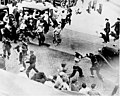 Striking teamsters armed with pipes battle police in the streets during the Minneapolis Teamsters Strike of 1934.
 -
 Striking workers march moments before the Swedish military opened fire, killing five workers during the Ådalen shootings.
 -
 Shields used by striking workers at the Carnegie Steel Works during the Homestead Strike in 1892.
 -
 United Mine Workers of America poster circa 1902.
 -
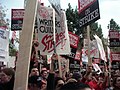 Picket signs at the 2007 Writers Guild of America strike.
 -

-
 Memorial marker for the Bay View Tragedy.
 -
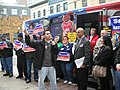 An AFL–CIO protest of Rite Aid, with Rev. Mark Reisinger (Pastor of Grace United Methodist Church in Mechanicsburg, Pennsylvania), Bill George, and Richard Bloomingdale.
 -
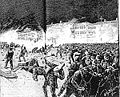 Exaggerated 19th century engraving showing flames and smoke following the Haymarket riot.
 -
 Members of the United Steelworkers in Ohio phone bank other union members to educate them about critical issues in the 2008 election in the U.S.
 -
 Strike leaders at the Paterson silk strike of 1913. From left, Patrick Quinlan, Carlo Tresca, Elizabeth Gurley Flynn, Adolph Lessig, and Bill Haywood.
 -

-
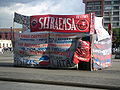
 Rally in Dhaka, organized by Jatiyo Nari Shramik Trade Union Kendra (National Women Workers Trade Union Centre), an organization affiliated with the Bangladesh Trade Union Kendra.
 -
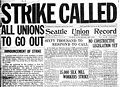 The front page of the Union Record on the Seattle General Strike of 1919.
 -
 Protesters barricade the street on June 22 during the 2006 Oaxaca protests.
 -

-
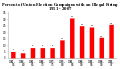 Union elections with an illegal firing, 1951 to 2007.
 -
 The Western Federation of Miners' famous flyer entitled "Is Colorado in America?".
 -
 Union members picketing recent NLRB rulings outside the agency's Washington, D.C., headquarters in November 2007.
 -

-
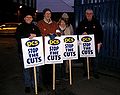 Public and Commercial Services Union members on strike in Manchester 2006.
 -
 Crowd gathered outside old City Hall during the Winnipeg general strike, June 21, 1919.
 -

-
 Mounted police chase demonstrators through Vancouver's East End during the Battle of Ballantyne Pier in 1935.
 -
 Union members march in Argentina on Human Rights Day in December 2005. The signs read "Worker rights are human rights..
 -
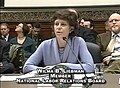 Wilma B. Liebman, chair, NLRB.
 -

-
 Armed vigilantes deport striking copper miners during the Bisbee Deportation in Bisbee, Arizona, July 12, 1917.
 -
 Big Bill Haywood, a founding member and leader of the Industrial Workers of the World.
 -
 Metropolitan Transportation Authority (New York) notice of subway closure during the 2005 New York City transit strike.
 -

-

-
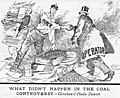 Political cartoon about the Coal Strike of 1902 from the Cleveland Plain Dealer.
 -
 Cripple Creek, Colo., under martial law, during the 1894 strike.
 -
-
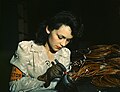 During World War II, a female aircraft worker checks electrical assemblies at the Vega Aircraft Corporation in Burbank, California.
 -
 Striking American Railway Union members confront Illinois National Guard troops in Chicago, Illinois, during the Pullman Strike in 1894.
 -

-
 Illustration from the Brisbane Worker newspaper condemning the brutality of the Queensland Police on Black Friday during the 1912 Brisbane General Strike.
 -

-
 National Federation of Federal Employees officials sign a collective bargaining agreement with the U.S. 8th Army in October 2002.
 -
 American Federation of Teachers (AFT) president Albert Shanker.
 -
 Barges set ablaze by steelworkers during the Homestead strike in 1892.
 -
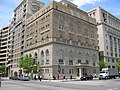 Former headquarters of the United Mine Workers of America and the Congress of Industrial Organizations, 900 15th Street NW, Washington, D.C., in 200.
 -
 Knights of Labor Grand Master Workman Terence V. Powderly.
 -
 Breaker boys, child laborers, working in a U.S. coal mine in 1911.
 -
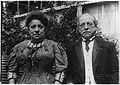 Samuel Gompers, President of the American Federation of Labor, and his wife, circa 1908.
 -

-

-
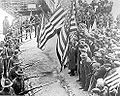 Striking I.W.W. members confront Massachusetts National Guard troops in Boston, during the Lawrence textile strike in 1912.
 -
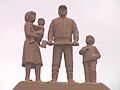 Detail of monument to the Reesor Siding Strike of 1963.
 -
 William Green, president of the AFL–CIO from 1924 to 1952.
 -

-
 George Meany, former leader of the AFL–CIO.


.JPG)


.jpg)


Selected Quote

|
By virtually all measures (National Labor Relations Act) is derelict if not dead.
|

|
— Wilma B. Liebman, National Labor Relations Board member, May 2007. |
Did you know
- ...that at the 1974 Coalition of Labor Union Women convention, Myra Wolfgang declared "...there are 3,000 women in Chicago and they didn't come here to swap recipes!"?
- ...that Alliance for Labor Action launched a $4 million organizing drive targeting African American workers in Atlanta, Georgia, in the fall of 1969?
- ...that even though the 1952 steel strike lasted 53 days and cost the U.S. $4 billion in lost economic output, it was settled on nearly the same terms offered by the union at the strike's beginning?
Topics
Trade unions by region | |
|---|---|


Get involved

Also see our sister WikiProject, Housing and Tenant Rights!

Associated Wikimedia
The following Wikimedia Foundation sister projects provide more on this subject:
-
 Commons
Free media repository -
 Wikibooks
Free textbooks and manuals -
 Wikidata
Free knowledge base -
 Wikinews
Free-content news -
 Wikiquote
Collection of quotations -
 Wikisource
Free-content library -
 Wikiversity
Free learning tools -
 Wiktionary
Dictionary and thesaurus


