

The Martial Arts Portal
 United States Marine practicing martial arts, 2008
Martial arts are codified systems and traditions of combat. They are practiced for a number of reasons ranging from; violent street fighting, self-defense, military and law enforcement; to non-violent exercising, ceremonial, competition; physical, mental, and spiritual development; entertainment; and to preserve the intangible cultural heritage of a nation. The term "martial arts" was originally used to refer to the traditions of East Asia, but has subsequently been applied to other practices which originated outside that region. (Full article...)
Although the earliest evidence of martial arts goes back millennia, the true roots are difficult to reconstruct. Inherent patterns of human aggression which inspire practice of mock combat (in particular wrestling) and optimization of serious close combat as cultural universals are doubtlessly inherited from the pre-human stage and were made into an "art" from the earliest emergence of that concept. Indeed, many universals of martial art are fixed by the specifics of human physiology and not dependent on a specific tradition or era.
Specific martial traditions become identifiable in Classical Antiquity, with disciplines such as shuai jiao, Greek wrestling or those described in the Indian epics or the Spring and Autumn Annals of China. (Full article...)
Selected articles
-

 Japanese swords. Two tachi with full mountings (middle and bottom right), a sword with a Shirasaya-style tsuka (top right), a wakizashi (top left), and various tsuba (bottom left).
A Japanese sword (Japanese: 日本刀, Hepburn: nihontō) is one of several types of traditionally made swords from Japan. Bronze swords were made as early as the Yayoi period (1,000 BC – 300 AD), though most people generally refer to the curved blades made from the Heian period (794–1185) to the present day when speaking of "Japanese swords". There are many types of Japanese swords that differ by size, shape, field of application, and method of manufacture. Some of the more commonly known types of Japanese swords are the katana, tachi, ōdachi, wakizashi, and tantō. (Full article...) -
Fencing is a combat sport that features sword fighting. It consists of three primary disciplines: foil, épée, and sabre (also spelled saber), each with its own blade and set of rules. Most competitive fencers specialise in one of these disciplines. The modern sport gained prominence near the end of the 19th century, evolving from historical European swordsmanship. The Italian school altered the historical European martial art of classical fencing, and the French school later refined that system. Scoring points in a fencing competition is done by making contact with the opponent with one's sword.
The 1904 Olympic Games featured a fourth discipline of fencing known as singlestick, but it was dropped after that year and is not a part of modern fencing. Competitive fencing was one of the first sports to be featured in the Olympics and, along with athletics, cycling, swimming, and gymnastics, has been featured in every modern Olympics. (Full article...) -
Karate (空手) (/kəˈrɑːti/; Japanese pronunciation: [kaɾate] ⓘ; Okinawan pronunciation: [kaɾati]), also karate-do (空手道, Karate-dō), is a martial art developed in the Ryukyu Kingdom. It developed from the indigenous Ryukyuan martial arts (called te (手), "hand"; tī in Okinawan) under the influence of Chinese martial arts. While modern karate is primarily a striking art that uses punches and kicks, traditional karate training also employs throwing and joint locking techniques. A karate practitioner is called a karate-ka (空手家).
Beginning in the 1300s, early Chinese martial artists brought their techniques to Okinawa. Despite the Ryukyu Kingdom being turned into a puppet state by Japanese samurai in 1609, after the Invasion of Ryukyu, its cultural ties to China remained strong. Since Ryukyuans were banned from carrying swords under samurai rule, groups of young aristocrats created unarmed combat methods as a form of resistance, combining Chinese and local styles of martial arts. Training emphasized self-discipline. This blend of martial arts became known as kara-te 唐手, which translates to "Chinese hand." Initially, there were no uniforms, colored belts, ranking systems, or standardized styles. Many elements essential to modern karate were actually incorporated a century ago. (Full article...) -

Savate (French pronunciation: [savat]), also known as French Boxing (French: Boxe Française) or French Foot Fighting, is a French hybrid martial art and full-contact combat sport that combines principles of western boxing with a wide variety of kicking techniques. Unlike kickboxing which allow knee and/or shin strikes in competitive bouts, savate involves kicking exclusively with one's feet, but participants can nonetheless target any part of the body. The sport is also notable for requiring footwear to be worn by the competitors, as would not be expected from individuals fighting in the streets. A male practitioner of savate is called a "tireur" while a female one is a "tireuse".
Savate de rue (lit. 'street savate'), the term used to differentiate the original martial art meant for self-defense from the subsequent combat sport, is an overarching hand-to-hand combat discipline that incorporates knee and elbow strikes as well as joint locks, sweeps, throws, headbutts and takedowns, in addition to punches and kicks. (Full article...) -
Muay Thai or Muaythai (Thai: มวยไทย, RTGS: muai thai, pronounced [mūaj tʰāj] ⓘ), sometimes referred to as Thai boxing, the Art of Eight Limbs or the Science of Eight Limbs, is a Thai martial art and full-contact combat sport that uses stand-up striking, sweeps, and various clinching techniques. The name “Art of Eight Limbs” refers to the combined use of fists, elbows, knees and shins. Muay Thai became widespread internationally in the late 20th to 21st century, when Westernised practitioners from Thailand began competing in kickboxing and mixed-rules matches as well as matches under Muay Thai rules around the world. The professional league is governed by the Professional Boxing Association of Thailand, sanctioned by the Sports Authority of Thailand.
Muay Thai is related to other martial art styles of the Indian cultural sphere such as Musti-yuddha, Muay Chaiya, Muay Boran, Muay Lao, Lethwei, Kun Khmer, Benjang and Tomoi. A practitioner of Muay Thai is known as a Nak Muay. Western practitioners in Thailand are sometimes called Nak Muay Farang, meaning "foreign boxer". (Full article...) -
Greek wrestling (Ancient Greek: πάλη, romanized: pálē), also known as Ancient Greek wrestling and Pále (πάλη), was the most popular organized sport in Ancient Greece. A point was scored when one player touched the ground with his back, hip or shoulder, or conceding defeat due to a submission-hold or was forced out of the wrestling-area. Three points had to be scored to win the match.
One particularly important position in this form of wrestling was one where one of the contestants was lying on his abdomen with the other on his back trying to strangle him (back mount). The athlete on the bottom would try to grasp an arm of the one on top and turn him over onto his back while the athlete on top would try to complete the choke without being rolled. (Full article...) -
 Five types of shuriken
A shuriken (Japanese: 手裏剣; lit. 'hand-hidden blade') is a Japanese concealed weapon used by samurai or ninja or in martial arts as a hidden dagger or metsubushi to distract or misdirect. (Full article...) -
 Shintō Musō-ryū, or Shindō Musō-ryū (神道夢想流), most commonly known by its practice of jōdō, is a traditional school (koryū) of the Japanese martial art of jōjutsu, or the art of wielding the short staff (jō). The technical purpose of the art is to learn how to defeat a swordsman in combat using the jō, with an emphasis on proper combative distance, timing and concentration. The system includes teachings of other weapon systems which are contained in Shintō Musō-ryū as auxiliary arts (Fuzoku ryuha). The school is sometimes abbreviated as SMR.
The art was founded by the samurai Musō Gonnosuke Katsuyoshi (夢想 權之助 勝吉, fl. c.1605, dates of birth and death unknown) in the early Edo period (1603–1868) and, according to legend, first put to use in a duel with Miyamoto Musashi (宮本 武蔵, 1584–1645). The original art created by Musō Gonnosuke has evolved and been added upon ever since its inception and up to modern times. The art was successfully brought outside of its original domain in Fukuoka and outside Japan itself in the 19th and 20th century. The spreading of Shintō Musō-ryū beyond Japan was largely the effort of Takaji Shimizu, (1896–1978), considered the 25th headmaster, who, unlike many other traditional martial arts teachers, wanted Jodo to be known and taught internationally. With the assistance of his own students and the cooperation of the kendō community, Shimizu spread Shintō Musō-ryū worldwide. (Full article...) -
Taekwondo (/ˌtaɪkwɒnˈdoʊ, ˌtaɪˈkwɒndoʊ, ˌtɛkwənˈdoʊ/; Korean: 태권도; [t̪ʰɛ.k͈wʌ̹n.d̪o] ⓘ) is a Korean martial art and combat sport involving primarily kicking techniques and punching. "Taekwondo" can be translated as tae ("strike with foot"), kwon ("strike with hand"), and do ("the art or way").
Depending on the style, Hyeong, Poomsae or Teul are patterns that demonstrate a range of kicking, punching and blocking techniques, gyeokpa is the art of breaking wooden boards and in the combat sport kyorugi involves the kind of sparring seen in the Olympics. Taekwondo also sometimes involves the use of weapons such as swords and nunchucks (nunchaku). Taekwondo practitioners wear a uniform known as a dobok. (Full article...) -
The traditional martial arts of the Mainland Southeast Asia are related to one another, and as a group to Indian martial arts. The most salient common feature is Mainland Southeast Asia kickboxing. The region of Mainland Southeast Asia is believed to be the land of Suvarnabhumi that ancient Indians mentioned in Buddhist text and Hindu text. In 790 A.D., a Khmer prince who grew up abroad by the name of Jayavarman II returned to unify the Khmer civilization. In 802 A.D., Jayavarman II established the Khmer Empire, the precursor to modern Cambodia, and declared himself the Chakravatin (universal ruler). Around 850 A.D., Pagan, the ancestor of modern-day Burma, was established by Tibeto-Burman speakers. For 200 years, Pagan remained a small principality until the reign of King Anawrahta. In 1238 A.D., Thailand's first state, Sukhothai, was started when the residents declared independence from the Khmer Empire. In 1353 A.D., Laos's first state, Lan Xang, was started by Fa Ngum with the assistance of the Khmer from Angkor. (Full article...)


.jpeg)


.jpg)
Selected biography

Maeda was the head of the second generation of Kodokan judōka, and was integral to the martial art's expansion into the United States during the 1900's. Along with Soshihiro Satake, he pioneered judo in Brazil, the United Kingdom, and other countries during the following decades, eventually becoming a naturalized Brazilian citizen and a promoter of Japanese immigration to Brazil. (Full article...)
Selected entertainment
"The Fight" is the sixth episode of the second season of the television series The Office and the show's twelfth episode overall. It was written by Gene Stupnitsky and Lee Eisenberg and directed by Ken Kwapis. It originally aired on November 1, 2005, on NBC. "The Fight" guest starred Lance Krall, who played the part of Dwight's sensei, Ira.
The series depicts the everyday lives of office employees in the Scranton, Pennsylvania branch of the fictional Dunder Mifflin Paper Company. In this episode, Michael Scott (Steve Carell), after being embarrassed by Dwight Schrute's (Rainn Wilson) superior fighting skills, engages in a karate match with Dwight during lunch. Meanwhile, Jim Halpert's (John Krasinski) flirting with Pam Beesly (Jenna Fischer) goes too far.
"The Fight" was known as "Karate" and "The Dojo" by members of the cast and crew due to many of the scenes featuring the titular fight. Several of the cast members of the show—recurring and starring—had martial arts experience. The episode contained several cultural references, with many referring to popular fighting-related movies and television shows. "The Fight" received largely positive reviews from critics. The episode earned a Nielsen rating of 3.9 in the 18–49 demographic and was viewed by 7.9 million viewers.
Sports portals


Selected image
 Kendoka at the 2006 World Fencing Championships in Torino, Italy. Kendoka at the 2006 World Fencing Championships in Torino, Italy.
|
Kendo (Japanese: 剣道, Hepburn: Kendō; lit. 'sword way' or 'sword path' or 'way of the sword') is a modern Japanese martial art, descended from kenjutsu (one of the old Japanese martial arts, swordsmanship), that uses bamboo swords (shinai) as well as protective armor (bōgu). It began as samurai warriors' customary swordsmanship exercises, and today, it is widely practiced within Japan and has spread to many other nations across the world. (Full article...)
General images -
-
 Chōki Motobu in Naihanchi-dachi, one of the basic karate stances (from Karate)
 -
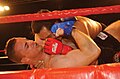 Groundfighting in MMA. Differently from other grappling-based martial arts, you are allowed to strike your opponent when fighting on the ground. (from Mixed martial arts)
 -

-
 Karate movements in Lappeenranta (from Karate)
 -
 Kung fu sword (from Chinese martial arts)
 -
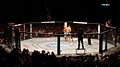 An octagon cage used by the UFC (from Mixed martial arts)
 -
 A ring used by PRIDE (from Mixed martial arts)
 -
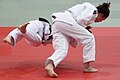 Throw during competition, leads to an ippon (from Judo)
 -
 A Chinese martial artist preparing to throw his opponent during a lei tai contest in ancient China (from Mixed martial arts)
 -
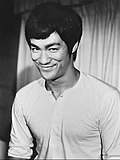 Bruce Lee is known for practicing many martial arts styles, including Karate, having trained with Chuck Norris for many years. (from Karate)
 -

-

-
 MMA gloves. They are fingerless gloves which allow both striking and grappling to occur. (from Mixed martial arts)
 -

-
 Cosplayers of Karateka characters from Street Fighter (from Karate)
 -
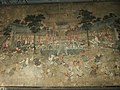 Mural at Shaolin temple from 1830's depicting forearm strikes and reverse kicks (from Chinese martial arts)
 -
 Yoshihiko Yoshimatsu attempting to throw Toshiro Daigo with an uchi mata in the final of the 1951 All-Japan Judo Championships (from Judo)
 -
 The Pancrastinae: a statue portraying the pancratium, an event which took place in the Roman Colosseum. Even as late as the Early Middle Ages, statues were put up in Rome and other cities to honor remarkable pankratiasts. This statue, now part of the Uffizi collection, is a Roman copy of a lost Greek original, circa 3rd century BC. (from Mixed martial arts)
 -
 Pankratiast in fighting stance, Ancient Greek red-figure amphora, 440 BC. (from History of martial arts)
 -

-
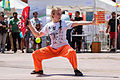 Martial arts fan (from Chinese martial arts)
 -

-
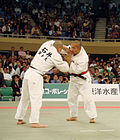 All-Japan Judo Championships, 2007 men's final (from Judo)
 -
 Jigoro Kano, founder of judo (from Judo)
 -

-

-
 Fighter performs a takedown on his opponent. (from Mixed martial arts)
 -
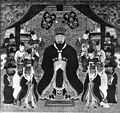 King Shō Shin (from Karate)
 -
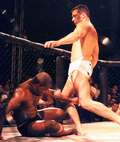 A "soccer kick", movement where the fighter kicks the head of a downed opponent. While common in vale tudo, early MMA and Japanese promotions, the soccer kick has been banned from the Unified Rules of Mixed Martial Arts. (from Mixed martial arts)
 -
 Bronze medal match at the 2018 Summer Youth Olympics in Buenos Aires, Argentina. (from Karate)
 -
Bruce Lee popularized the concept of mixed martial arts via his hybrid philosophy of Jeet Kune Do during the late 1960s to early 1970s. (from Mixed martial arts)
-

-
 Gichin Funakoshi (from Karate)
 -
 Karatekas wearing different colored belts (from Karate)
 -
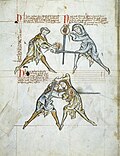 Fol. 4v of the I.33 (from History of martial arts)
 -
 Modern forms are used in the sport of wushu, as seen in this staff routine (from Chinese martial arts)
 -
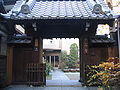 Eisho-ji temple, Tokyo (from Judo)
 -
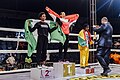 GAMMA medallists on the podium at the 2023 African Games (from Mixed martial arts)
 -
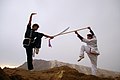 Kung fu in Iran (from Chinese martial arts)
 -
 Two judoka wearing judogi (from Judo)
 -
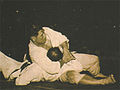 Masahiko Kimura vs. Hélio Gracie, a 1951 bout between Japanese judo fighter Masahiko Kimura and Brazilian jiu jitsu founder Hélio Gracie in Brazil, was an early high-profile mixed martial arts bout. (from Mixed martial arts)
 -
 Ancient Chinese weapons (from Chinese martial arts)
 -
 The judogi is made from a heavy weave to withstand the stress of throwing and grappling. (from Judo)
 -
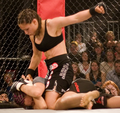 Gina Carano applying a ground-and-pound on her opponent (from Mixed martial arts)
 -
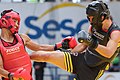 Two Brazilian fighters in a Sanda/Sanshou match. Sanda is a modernized form of Kung Fu and one of the two disciplines of Sport Wushu (from Chinese martial arts)
 -
 Two children training in judo techniques (from Judo)
 -
 Judo (1935) (from Judo)
 -
-
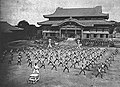
 Depiction of fighting monks demonstrating their skills to visiting dignitaries (early 19th-century mural in the Shaolin Monastery). (from Chinese martial arts)
 -
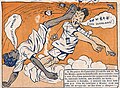 Panel by Alfredo Storni featuring capoeirista Ciríaco defeating jujitsu fighter Sada Miyako with a rabo de arraia kick, O Malho, 1909. (from Mixed martial arts)
 -

-
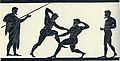 Ancient Greek pankratiasts fighting. This drawing is an early 20th century copy of a scene from a Panathenaic amphora. (from Mixed martial arts)
 -
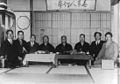 Masters of karate in Tokyo (c. 1930s), from left to right, Kanken Toyama, Hironori Otsuka, Takeshi Shimoda, Gichin Funakoshi, Chōki Motobu, Kenwa Mabuni, Genwa Nakasone, and Shinken Taira (from Karate)
 -

-
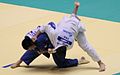 Japanese judoka Takamasa Anai Vs French judoka Thierry Fabre during the 2010 World Judo Championships held in Tokyo (from Judo)
 -

-

-
 Olympic Judo pictogram (from Judo)
 -
 A ring-side doctor attends to a fighter following a loss. (from Mixed martial arts)


_Mohammad_Akbari_12.jpg)


.jpg)


.jpg)


_18.jpg)


_Mohammad_Akbari_27.jpg)


.jpg)
.JPG)


.jpg)


.jpg)


Selected quote
Topics
- Regional origin - China - Europe - India - Indonesia - Japan - Korea - Philippines
- Unarmed techniques - Chokehold - Clinch - Footwork - Elbow strike - Headbutt - Hold - Kick - Knee strike - Joint lock - Punch - Sweep - Takedown - Throw
- Weapons - Archery - Duel - Knife fighting - Melee weapons - Shooting - Stick-fighting - Swordsmanship - Nunchaku
- Training - Kata - Practice weapon - Punching bag - Pushing hands - Randori - Sparring
- Striking - Boxing - Capoeira - Karate - Kickboxing - Muay Thai - Lethwei - Sanshou - Savate - Taekwondo - Vovinam
- Internal - Aikido - Aikijutsu - Baguazhang - Tai chi - Xing Yi Quan
- Full contact / Combat sports - Professional boxing - Professional kickboxing - Knockdown karate - Mixed martial arts - Pankration - Submission wrestling
- Self-defense / Combatives - Arnis - Bartitsu - Hapkido - Kajukenbo - Krav Maga - MCMAP - Pencak Silat - Systema - Wing Chun - Legal aspects
- Eclectic / Hybrids - American Kenpo - Chun Kuk Do - Jeet Kune Do - Shooto - Shorinji Kempo - Unifight
- Entertainment - Fighting game - Martial arts film (Chanbara) - Professional wrestling - Stage combat - Wuxia
| |||||||||||||||||||||||||||||
| |||||||||||||||||||||||||||||


Categories
 Category puzzle
This article is sourced from Wikipedia. Content is available under the Creative Commons Attribution-ShareAlike License.