

The History of Science Portal
The history of science covers the development of science from ancient times to the present. It encompasses all three major branches of science: natural, social, and formal. Protoscience, early sciences, and natural philosophies such as alchemy and astrology that existed during the Bronze Age, Iron Age, classical antiquity and the Middle Ages, declined during the early modern period after the establishment of formal disciplines of science in the Age of Enlightenment.
The earliest roots of scientific thinking and practice can be traced to Ancient Egypt and Mesopotamia during the 3rd and 2nd millennia BCE. These civilizations' contributions to mathematics, astronomy, and medicine influenced later Greek natural philosophy of classical antiquity, wherein formal attempts were made to provide explanations of events in the physical world based on natural causes. After the fall of the Western Roman Empire, knowledge of Greek conceptions of the world deteriorated in Latin-speaking Western Europe during the early centuries (400 to 1000 CE) of the Middle Ages, but continued to thrive in the Greek-speaking Byzantine Empire. Aided by translations of Greek texts, the Hellenistic worldview was preserved and absorbed into the Arabic-speaking Muslim world during the Islamic Golden Age. The recovery and assimilation of Greek works and Islamic inquiries into Western Europe from the 10th to 13th century revived the learning of natural philosophy in the West. Traditions of early science were also developed in ancient India and separately in ancient China, the Chinese model having influenced Vietnam, Korea and Japan before Western exploration. Among the Pre-Columbian peoples of Mesoamerica, the Zapotec civilization established their first known traditions of astronomy and mathematics for producing calendars, followed by other civilizations such as the Maya.
Natural philosophy was transformed by the Scientific Revolution that transpired during the 16th and 17th centuries in Europe, as new ideas and discoveries departed from previous Greek conceptions and traditions. The New Science that emerged was more mechanistic in its worldview, more integrated with mathematics, and more reliable and open as its knowledge was based on a newly defined scientific method. More "revolutions" in subsequent centuries soon followed. The chemical revolution of the 18th century, for instance, introduced new quantitative methods and measurements for chemistry. In the 19th century, new perspectives regarding the conservation of energy, age of Earth, and evolution came into focus. And in the 20th century, new discoveries in genetics and physics laid the foundations for new sub disciplines such as molecular biology and particle physics. Moreover, industrial and military concerns as well as the increasing complexity of new research endeavors ushered in the era of "big science," particularly after World War II. (Full article...)
Selected article -
 Fourteenth-century drawing of angels turning the celestial spheres
Ancient, medieval and Renaissance astronomers and philosophers developed many different theories about the dynamics of the celestial spheres. They explained the motions of the various nested spheres in terms of the materials of which they were made, external movers such as celestial intelligences, and internal movers such as motive souls or impressed forces. Most of these models were qualitative, although a few of them incorporated quantitative analyses that related speed, motive force and resistance. (Full article...)
Selected image

Did you know
... that the Merton Thesis—an argument connecting Protestant pietism with the rise of experimental science—dates back to Robert K. Merton's 1938 doctoral dissertation, which launched the historical sociology of science?
...that a number of scientific disciplines, such as computer science and seismology, emerged because of military funding?
...that the principle of conservation of energy was formulated independently by at least 12 individuals between 1830 and 1850?
Selected Biography -

James Bryant Conant (March 26, 1893 – February 11, 1978) was an American chemist, a President of Harvard University, and the first U.S. Ambassador to West Germany.
During World War I, he served in the U.S. Army, where he worked on the development of poison gases, especially lewisite. He became an assistant professor of chemistry at Harvard University in 1919 and the Sheldon Emery Professor of Organic Chemistry in 1929. He researched the physical structures of natural products, particularly chlorophyll, and he was one of the first to explore the sometimes complex relationship between chemical equilibrium and the reaction rate of chemical processes. He studied the biochemistry of oxyhemoglobin providing insight into the disease methemoglobinemia, helped to explain the structure of chlorophyll, and contributed important insights that underlie modern theories of acid-base chemistry. (Full article...)
Selected anniversaries
- 1729 - Death of Francesco Bianchini, Italian philosopher and scientist (b. 1662)
- 1779 - Birth of Joel Roberts Poinsett, American statesman and botanist (d. 1851)
- 1808 - The inaugural meeting of the Wernerian Natural History Society, a former Scottish learned society, was held in Edinburgh
- 1840 - Death of Heinrich Wilhelm Matthäus Olbers, German astronomer (b. 1758)
- 1862 - Birth of Boris Borisovich Galitzine, Russian physicist (d. 1916)
- 1962 - Death of Charles Jean de la Vallée-Poussin, Belgian mathematician (b. 1866)
- 1998 - Data sent from the Galileo spacecraft indicates that Jupiter's moon Europa has a liquid ocean under a thick crust of ice
Related portals


Topics
| Background |  | |
|---|---|---|
| By era | ||
| By culture | ||
| Natural sciences | ||
| Mathematics | ||
| Social sciences | ||
| Technology | ||
| Medicine | ||


General images
-

-
 Islamic expansion:under Muhammad, 622–632under Rashidun caliphs, 632–661under Umayyad caliphs, 661–750(from Science in the medieval Islamic world)
 -
 The first treatise about optics by Johannes Kepler, Ad Vitellionem paralipomena quibus astronomiae pars optica traditur (1604) (from Scientific Revolution)
 -
 Page from the Kitāb al-Hayawān (Book of Animals) by Al-Jahiz. Ninth century (from Science in the medieval Islamic world)
 -

-
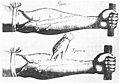 Image of veins from William Harvey's Exercitatio Anatomica de Motu Cordis et Sanguinis in Animalibus. Harvey demonstrated that blood circulated around the body, rather than being created in the liver. (from Scientific Revolution)
 -
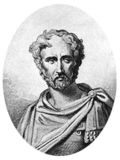 A 19th-century portrait of Pliny the Elder (from Science in classical antiquity)
 -
 Air pump built by Robert Boyle. Many new instruments were devised in this period, which greatly aided in the expansion of scientific knowledge. (from Scientific Revolution)
 -
 An Egyptian practice of treating migraine in ancient Egypt (from Science in the ancient world)
 -
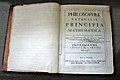 Isaac Newton's Principia developed the first set of unified scientific laws. (from Scientific Revolution)
 -
 A page from al-Khwarizmi's Algebra (from Science in the medieval Islamic world)
 -

-
 Ancient India was an early leader in metallurgy, as evidenced by the wrought iron Pillar of Delhi. (from Science in the ancient world)
 -
-
 Title page from The Sceptical Chymist, a foundational text of chemistry, written by Robert Boyle in 1661 (from Scientific Revolution)
 -
 A mosaic depicting Plato's Academy, from the Villa of T. Siminius Stephanus in Pompeii (1st century AD) (from Science in classical antiquity)
 -
 Quince, cypress, and sumac trees, in Zakariya al-Qazwini's 13th century Wonders of Creation (from Science in the medieval Islamic world)
 -
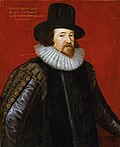 Francis Bacon was a pivotal figure in establishing the scientific method of investigation. Portrait by Frans Pourbus the Younger (1617). (from Scientific Revolution)
 -

-
 The four classical elements (fire, air, water, earth) of Empedocles illustrated with a burning log. The log releases all four elements as it is destroyed. (from Science in classical antiquity)
 -
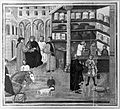 Ibn Sina teaching the use of drugs. 15th-century Great Canon of Avicenna (from Science in the medieval Islamic world)
 -

-
 Self trimming lamp in Ahmad ibn Mūsā ibn Shākir's treatise on mechanical devices, c. 850 (from Science in the medieval Islamic world)
 -
 An early Western Han (202 BC – AD 9) silk map found in tomb 3 of Mawangdui, depicting the Kingdom of Changsha and Kingdom of Nanyue in southern China (note: the south direction is oriented at the top) (from Science in the ancient world)
 -
 Apollonius wrote a comprehensive study of conic sections in the Conics. (from Science in classical antiquity)
 -
 Matteo Ricci (left) and Xu Guangqi (right) in Athanasius Kircher, La Chine ... Illustrée, Amsterdam, 1670 (from Scientific Revolution)
 -
 Surviving fragment of the first World Map of Piri Reis (1513) (from Science in the medieval Islamic world)
 -
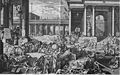 The French Academy of Sciences was established in 1666. (from Scientific Revolution)
 -
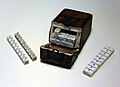 An ivory set of Napier's Bones, an early calculating device invented by John Napier (from Scientific Revolution)
 -
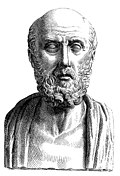 The physician Hippocrates, known as the "Father of Modern Medicine" (from Science in classical antiquity)
 -

-
 Schematics of the Antikythera mechanism (from Science in the ancient world)
 -
 Detail showing columns of glyphs from a portion of the 2nd century AD La Mojarra Stela 1 (found near La Mojarra, Veracruz, Mexico); the left column gives a Long Count calendar date of 8.5.16.9.7, or 156 AD. The other columns visible are glyphs from the Epi-Olmec script. (from Science in the ancient world)
 -
 Portrait of Johannes Kepler, one of the founders and fathers of modern astronomy, the scientific method, natural and modern science (from Scientific Revolution)
 -
 A medieval university class, 1350s (from Scientific Revolution)
 -

-
 Ptolemaic model of the spheres for Venus, Mars, Jupiter, and Saturn. Georg von Peuerbach, Theoricae novae planetarum, 1474. (from Scientific Revolution)
 -
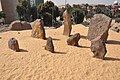 Megaliths from Nabta Playa, constructed by Neolithic populations, located in Aswan, Upper Egypt. Excavations of the megalith structures were completed in 2008. (from Science in the ancient world)
 -
 George Trebizond's Latin translation of Ptolemy's Almagest (c. 1451) (from Science in classical antiquity)
 -
 Diagram from William Gilbert's De Magnete, a pioneering 1600 work of experimental science (from Scientific Revolution)
 -
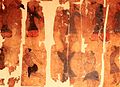 The physical exercise chart; a painting on silk depicting calisthenics; unearthed in 1973 in Hunan, China, from the 2nd-century BC Western Han burial site of Mawangdui, Tomb Number 3 (from Science in the ancient world)
 -
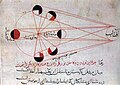
-
 Modern copy of al-Idrisi's 1154 Tabula Rogeriana, upside-down, north at top (from Science in the medieval Islamic world)
 -
 Omar Khayyam's "Cubic equation and intersection of conic sections" (from Science in the medieval Islamic world)
 -
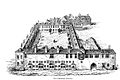 The Royal Society had its origins in Gresham College in the City of London, and was the first scientific society in the world. (from Scientific Revolution)
 -
 Scholar Nersi with Anahita in Persia (from Science in the ancient world)
 -
 The Tusi couple, a mathematical device invented by the Persian polymath Nasir al-Din Tusi to model the not perfectly circular motions of the planets (from Science in the medieval Islamic world)
 -
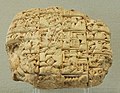 Mesopotamian clay tablet-letter from 2400 BC, Louvre (from King of Lagash, found at Girsu) (from Science in the ancient world)
 -
Pliny the Elder: an imaginative 19th-century portrait (from Science in the ancient world)
-
Diagram of the Antikythera mechanism, an analog astronomical calculator (from Science in classical antiquity)


.jpg)
_Venenbild.jpg)


.jpg)


.jpg)


Subcategories
 Category puzzle
This article is sourced from Wikipedia. Content is available under the Creative Commons Attribution-ShareAlike License.