


The Greater Manchester Portal

Greater Manchester is a metropolitan and ceremonial county in North West England. It borders Lancashire to the north, West Yorkshire and Derbyshire to the east, Cheshire to the south, and Merseyside to the west. Its largest settlement is the city of Manchester.
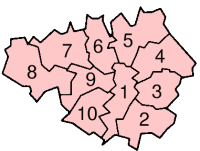
The county has an area of 1,276 km2 (493 sq mi) and is highly urbanised, with an estimated population of 3,009,664 in 2024. Manchester is located in the centre of the county, with the city of Salford immediately adjacent to the west. Other large settlements include Rochdale in the north-east, Stockport in the south-east, Sale in the south-west, Wigan in the far north-west, and Bolton in the north-west. The majority of the county's settlements are part of the Greater Manchester Built-up Area, which extends into Cheshire and Merseyside and is the second most populous urban area in the United Kingdom. For local government purposes the county comprises ten metropolitan boroughs: Manchester, Salford, Bolton, Bury, Oldham, Rochdale, Stockport, Tameside, Trafford and Wigan. The borough councils collaborate through the Greater Manchester Combined Authority. Greater Manchester was created on 1 April 1974 from parts of north-east Cheshire, south-east Lancashire, and a small part of the West Riding of Yorkshire.
The centre and south-west of Greater Manchester are lowlands, similar to the West Lancashire Coastal Plain to the north-west and the Cheshire Plain to the south-west. The north and east are part of the Pennines: the West Pennine Moors in the northwest, the South Pennines in the northeast and the Peak District in the east. Most of the county's rivers rise in the Pennines and are tributaries of the Mersey and Irwell, the latter of which is itself a tributary of the Mersey. The county is connected to the Mersey Estuary by the Manchester Ship Canal, which for its entire length within Greater Manchester consists of canalised sections of the Mersey and Irwell. (Full article...)
Selected article -

The M62 motorway is a west–east trans-Pennine motorway in northern England, connecting the cities of Liverpool and Hull via Manchester and Leeds. The road is 107 miles (172 km) long. The motorway, first proposed in the 1930s, was built between 1971 and 1976, with construction beginning at Pole Moor and finishing in Tarbock. The motorway also absorbed the northern end of the Stretford-Eccles bypass, which was built between 1957 and 1960. Adjusted for inflation to 2007, the motorway cost approximately £765 million to build.
Since the Stretford-Eccles bypass was opened, the motorway's history beyond construction has included a coach bombing and a rail crash. The motorway is additionally memorable for Stott Hall Farm, a farm in the Pennines situated between the carriageways which has become one of the most known sights in West Yorkshire.
The road passes the cities of Salford, Manchester, Bradford and Leeds. Between Liverpool and Manchester, the terrain of the road is relatively flat, while between Manchester and Leeds, the road crosses the hilly Pennines to its highest point on Windy Hill near Saddleworth Moor, which is also the highest point of any motorway in the United Kingdom, at 1,221 feet (372 m) above sea level.
General images
-
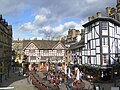 Old Wellington Inn Shambles Square was built in 1552. (from History of Manchester)
 -
 The Lowry is a combined theatre and exhibition centre at Salford Quays, and is Greater Manchester's most visited tourist attraction. (from Greater Manchester)
 -
 Much of Greater Manchester's housing stock consists of terraced houses constructed as low-cost dwellings for the populations of local factory towns. (from Greater Manchester)
 -
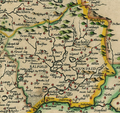 Map of the Salford Hundred, with Manchester in the south-east (from History of Manchester)
 -
 Oldham, painted during the Industrial Revolution by J. H. Carse. Many towns in Greater Manchester were built around the mills. (from Greater Manchester)
 -
 Runway 2 of Manchester Airport lies on top of Oversley Farm, a Neolithic farming community. (from History of Manchester)
 -
 Beetham Tower, Manchester's second tallest building, was completed in 2006. (from History of Manchester)
 -

-
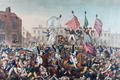 The Peterloo Massacre was a major event in the history of the city. (from History of Manchester)
 -
 The multiple urban areas of Greater Manchester's boroughs (from Greater Manchester)
 -
 Skyline of Salford. (from Greater Manchester Built-up Area)
 -
 The population of Greater Manchester increased from around 328 thousand in 1801, to 2.8M in 2021. (from Greater Manchester)
 -
 Chetham's School of Music (from History of Manchester)
 -
 Stockport bus station in 1988. Greater Manchester Transport (later GM Buses) operated bus services throughout the county, from 1974 to 1993. (from Greater Manchester)
 -
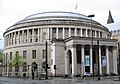 Manchester Central Library, St Peter's Square (from History of Manchester)
 -

-
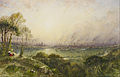 Manchester from Kersal Moor, by William Wyld in 1852. Manchester acquired the nickname "Cottonopolis" during the early 19th century owing to its many textile factories. (from History of Manchester)
 -
 Go North West operate bus services in northern-Greater Manchester. (from Greater Manchester)
 -
 Former weavers' cottages in Wardle. An increase in domestic cloth production, and textile manufacture during the Industrial Revolution is attributed to a population boom in the area. (from Greater Manchester)
 -
 Bolton Wanderers F.C. are based at the Toughsheet Community Stadium, in Horwich. (from Greater Manchester)
 -
 Andy Burnham has served as the inaugural Mayor of Greater Manchester since May 2017. (from Greater Manchester)
 -
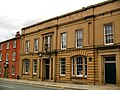 Liverpool Road railway station, the terminus of the Liverpool and Manchester Railway (from History of Manchester)
 -
 A reconstructed gateway of Mamucium fort (from History of Manchester)
 -
 The M60 motorway, seen here at Failsworth, is an orbital motorway in Greater Manchester. (from Greater Manchester)
 -
 Manchester's Exchange Square undergoing extensive regeneration (from History of Manchester)
 -
 The Greater Manchester Urban Area in 2001 (from Greater Manchester Built-up Area)
 -
 Population density map (from Greater Manchester)
 -
 Rochdale, one of the large towns of Greater Manchester (from Greater Manchester)
 -
 A bus stop in Denton bearing the logo of Transport for Greater Manchester (TfGM). TfGM is a functional executive body of the Greater Manchester Combined Authority and has responsibilities for public transport in Greater Manchester. (from Greater Manchester)
 -
 Significant regeneration works are ongoing across Greater Manchester. Walkden Town Centre regeneration is pictured (December 2025). (from Greater Manchester)
 -
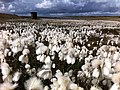 Common cottongrass (Eriophorum angustifolium), seen here at Light Hazzles Reservoir near Littleborough, was voted the county flower of Greater Manchester in 2002. (from Greater Manchester)
 -
 GMC County Hall (now known as Westminster House) in Manchester housed the Greater Manchester County Council until its abolition in 1986. (from Greater Manchester)
 -
 A Metrolink tram in Radcliffe, part of Greater Manchester's light rail network (from Greater Manchester)
 -
 Map of the ancient parish of Manchester (from History of Manchester)
 -
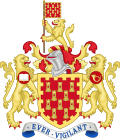 The arms of the Greater Manchester County Council, depicted here, became redundant with the abolition of the council in 1986 (though similar arms are used by the Greater Manchester Fire and Rescue Service). (from Greater Manchester)
 -
 The City of Manchester Stadium, the main venue of the 2002 Commonwealth Games and home to Manchester City F.C. (from Greater Manchester)
 -
 Stockport, one of the large towns of Greater Manchester and historically part of Cheshire (from Greater Manchester)
 -
 Haigh Hall (from Greater Manchester)
 -
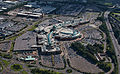 The Trafford Centre in Trafford is one of the largest shopping centres in the United Kingdom. (from Greater Manchester)
 -

-
 The main entrance of Old Trafford Cricket Ground (from Greater Manchester)
 -
 Greater Manchester lies at the conjunction of the ancient county boundaries of Cheshire, Lancashire and the West Riding of Yorkshire. (from Greater Manchester)
 -

-
 Skyline of Manchester. (from Greater Manchester Built-up Area)
 -
 Salford, the second city of the county (from Greater Manchester)
 -
 Albert Square (from History of Manchester)
 -
 The Greater Manchester Exhibition Centre (better known as the G-Mex centre and now rebranded as Manchester Central) is the converted former Manchester Central railway station, in Manchester city centre, used for hosting the county's cultural events. (from Greater Manchester)
 -
 The Imperial War Museum North, in Trafford Park, was designed by Daniel Libeskind, and is one of the Imperial War Museum's five branches. (from Greater Manchester)
 -
 Bury, one of the large towns of Greater Manchester and historically part of Lancashire (from Greater Manchester)
 -
 Looking west along Nico Ditch, near Levenshulme (from History of Manchester)
 -

-
 Eccles cake is a small round flaky pastry cake filled with currants, sugar and spice. It is native to Eccles. (from Greater Manchester)
 -
 Map of Manchester from Roman Manchester (1900) (from History of Manchester)
 -

-
 A 19th-century slum dwelling. The overhang contained privies, whose waste fell straight into the River Medlock below. (from History of Manchester)
 -
 Royal Exchange, Cross Street (from History of Manchester)


.jpg)


.jpg)


.jpg)


.png)


Boroughs
Selected biography -
Hannah Beswick (1688 – February 1758), of Birchin Bower, Hollinwood, England, was a woman with a pathological fear of premature burial. Following her death in 1758 her body was embalmed and kept above ground, to be periodically checked for signs of life. Beswick's mummified body was eventually bequeathed to the Museum of the Manchester Natural History Society, where she was put on display and acquired the soubriquet of the Manchester Mummy, or the Mummy of Birchin Bower.
The museum was subsequently transferred to Manchester University, when it was decided, with the permission of the Bishop of Manchester, that Beswick should finally be buried. Her burial took place at Harpurhey cemetery on 22 July 1868; her grave is unmarked.
Did you know?
- ...that the Albert Medal was one of the awards given to Mark Addy for rescuing more than 50 people from the highly polluted River Irwell, Manchester, in the 19th Century?
- ...that the Port of Runcorn in Cheshire, England, was an independent customs port for two separate periods before becoming part of the Port of Manchester in 1894?
- ...that a word square found in Mamucium (pictured), a Roman fort in Manchester, may be one of the earliest examples of Christianity in Britain?
- ...that the women's scratch race at the 2008 UCI Track Cycling World Championships was held in Manchester and was won by Ellen van Dijk?
Subcategories
 Category puzzle
This article is sourced from Wikipedia. Content is available under the Creative Commons Attribution-ShareAlike License.