

Welcome to the Germany Portal!
Willkommen im Deutschland-Portal!
.svg)
|

|

| |
Germany (German: Deutschland), officially the Federal Republic of Germany (German: Bundesrepublik Deutschland), is a country in Central and Western Europe, lying between the Baltic Sea and the North Sea to the north with the Alps to the south. It borders Denmark to the north, Poland and the Czech Republic to the east, Austria and Switzerland to the south, France to the southwest, and Luxembourg, Belgium and the Netherlands to the west.
Germany includes 16 constituent states, covers an area of 357,596 square kilometres (138,069 sq mi) and has a largely temperate seasonal climate. With over 83 million inhabitants, it is the second most populous state of Europe after Russia, the most populous state lying entirely in Europe, as well as the most populous member state of the European Union. Germany is a very decentralized country. Its capital and most populous city is Berlin, while Frankfurt serves as its financial capital and has the country's busiest airport.
In 1871, Germany became a nation-state when most of the German states unified into the Prussian-dominated German Empire. After World War I and the Revolution of 1918–19, the Empire was replaced by the parliamentary Weimar Republic. The Nazi seizure of power in 1933 led to World War II and the Holocaust. After the end of World War II in Europe and a period of Allied occupation, two new German states were founded: West Germany, formed from the American, British, and French occupation zones, and East Germany, formed from the western part of the Soviet occupation zone, reduced by the newly established Oder-Neisse line. Following the Revolutions of 1989 that ended communist rule in Central and Eastern Europe, the country was reunified on 3 October 1990.
Germany is a federal parliamentary republic led by a chancellor. It is a great power with a strong economy. As a global leader in several industrial, scientific and technological sectors, it is a major trading nation. The Federal Republic of Germany was a founding member of the European Economic Community in 1957 and the European Union in 1993. Read more...
Selected article
 Richard Wagner in 1871
Richard Wagner (22 May 1813 – 13 February 1883) was a German composer, theatre director, polemicist, and conductor who is primarily known for his operas (or, as some of his later works were later known, "music dramas"). Unlike most opera composers, Wagner wrote both the libretto and the music for each of his stage works. Initially establishing his reputation as a composer of works in the romantic vein of Weber and Meyerbeer, Wagner revolutionised opera through his concept of the Gesamtkunstwerk ("total work of art"), by which he sought to synthesise the poetic, visual, musical and dramatic arts, with music subsidiary to drama. He described this vision in a series of essays published between 1849 and 1852. Wagner realised these ideas most fully in the first half of the four-opera cycle Der Ring des Nibelungen (The Ring of the Nibelung).
His compositions, particularly those of his later period, are notable for their complex textures, rich harmonies and orchestration, and the elaborate use of leitmotifs—musical phrases associated with individual characters, places, ideas or plot elements. His advances in musical language, such as extreme chromaticism and quickly shifting tonal centres, greatly influenced the development of classical music. His Tristan und Isolde is sometimes described as marking the start of modern music. More...
Selected picture
-
 Photochrom: Detroit Publishing Co.
Restoration: Lise BroerAn 1890s photochrom print of Dresden, the capital city of Saxony in Germany, with Dresden Frauenkirche (left), Augustus Bridge (centre), and Katholische Hofkirche (right) visible. Dresden in the early 20th century was a leading European centre of culture and science, but suffered heavy damage due to an Allied bombing on February 13, 1945. -
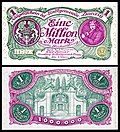 Banknote design credit: Danzig Central Finance Department; photographed by Andrew ShivaThe Papiermark is the name given to the German currency from 4 August 1914, when the link between the Goldmark and gold was abandoned. In particular, the name is used for the banknotes issued during the period of hyperinflation in Germany in 1922 and especially 1923. During this period, the Papiermark was also issued by the Free City of Danzig. The last of five series of the Danzig mark was the 1923 inflation issue, which consisted of denominations of 1 million to 10 billion issued from August to October 1923. The Danzig mark was replaced on 22 October 1923 by the Danzig gulden.
This one-hundred-million-mark banknote, issued on 22 September 1923, is in the National Numismatic Collection of the Smithsonian Institution's National Museum of American History.
Other denominations:
'"`UNIQ--templatestyles-00000017-QINU`"' -
 Design credit: German New Guinea Company; photographed by the National Numismatic CollectionGerman New Guinea was a German colonial protectorate established in 1884 in the northeastern part of the island of New Guinea and several nearby island groups. The German New Guinea Company was founded in Berlin by Adolph von Hansemann and a syndicate of German bankers for the purpose of colonizing and exploiting the protectorate's resources. This gold coin, worth 20 New Guinean marks, was issued by the German New Guinea Company in 1895, and is now part of the National Numismatic Collection at the Smithsonian Institution.
 -

-
 Linderhof PalaceCredit: SofteisLinderhof, a palace built by Ludwig II of Bavaria
 -
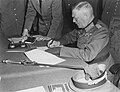 Photograph credit: Lt. Moore; restored by Adam CuerdenThe German Instrument of Surrender was the legal document that effected the termination of the Nazi regime and ended World War II in Europe. A July 1944 draft version had also included the surrender of the German government, but this was changed due to concern that there might be no functional German government that could surrender; instead, the document stated that it could be "superseded by any general instrument of surrender imposed by, or on behalf of the United Nations", which was done the next month.
This photograph shows Field Marshal Wilhelm Keitel signing the German Instrument of Surrender in Berlin. The first surrender document was signed on 7 May 1945 in Reims by General Alfred Jodl, but this version was not recognized by the Soviet High Command and a revised version was required. Prepared in three languages on 8 May, it was not ready for signing in Berlin until after midnight; consequently, the physical signing was delayed until nearly 1:00 a.m. on 9 May, and backdated to 8 May to be consistent with the Reims agreement and public announcements of the surrender already made by Western leaders. -
 Painting: Hans BaluschekCity of Workers is an oil painting on canvas completed by the Berlin Secessionist painter Hans Baluschek in 1920. It depicts a dark and dirty working class sector of the German capital, Berlin, in which industrial smoke dominates the skyline and the few lights of windows are drowned in the gloom. The 48.44 × 36.25 in (123 × 92.1 cm) work is held at the Milwaukee Art Museum.
 -
 ReichstagCredit: Ansgar Koreng
 -
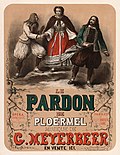 Poster credit: Henri Télory; restored by Adam CuerdenGiacomo Meyerbeer (1791–1864) was a German opera composer. Born to a wealthy Berlin family, he began his musical career as a pianist but soon decided to devote himself to opera. Meyerbeer spent several years in Italy studying and composing, before moving to Paris, where he became a dominant figure in the world of opera. This poster advertised the premiere of Meyerbeer's opera Le pardon de Ploërmel, which opened at the Opéra-Comique in Paris on 4 April 1859.
 -
 Speicherstadt in HamburgCredit: Dietmar RabichSpeicherstadt in Hamburg, June 2016
 -
 Photograph: Henry W. LaurischKadavar are a rock band from Berlin, Germany, founded in 2010. Their retro sound, incorporating psychedelic rock and stoner rock, has been compared to bands of the 1970s hard rock/heavy metal era. Kadavar currently consists of three members: guitarist and lead vocalist Christoph "Lupus" Lindemann, drummer Christoph "Tiger" Bartelt, and bassist Simon "Dragon" Bouteloup.
 -
 Painting: Caspar David FriedrichCairn in Snow is a landscape painting by Caspar David Friedrich that was completed in 1807. The painting is a Romantic allegorical landscape, showing a pagan burial site between three oaks, near the town Gützkow in Germany. It is held by the Galerie Neue Meister in Dresden, Germany.
 -
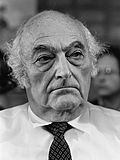 Photograph: Marcel Antonisse / AnefoHelmut Flieg (1913–2001) was a German writer best-known by the pseudonym Stefan Heym. He lived in the United States (or served in its army abroad) between 1935 and 1952, before moving back to his native Germany. He published works in English and German at home and abroad, including Nazis in the U.S.A. (1938), Goldsborough (1953), and Five Days in June (1977).
 -
 German war bond posterPoster: Lucian Bernhard; restoration: BellhallaA 1917 poster by Lucian Bernhard intended to sell war bonds in Germany. The caption, roughly translated, is "This is how your money helps you fight! Turned into submarines, it keeps enemy shells away! That's why you should subscribe to war bonds!" Mostly excluded from international financial markets during World War I, Germany was largely limited to domestic borrowing. The bond drives proved extremely successful, raising approximately 100 billion marks in funds.
 -
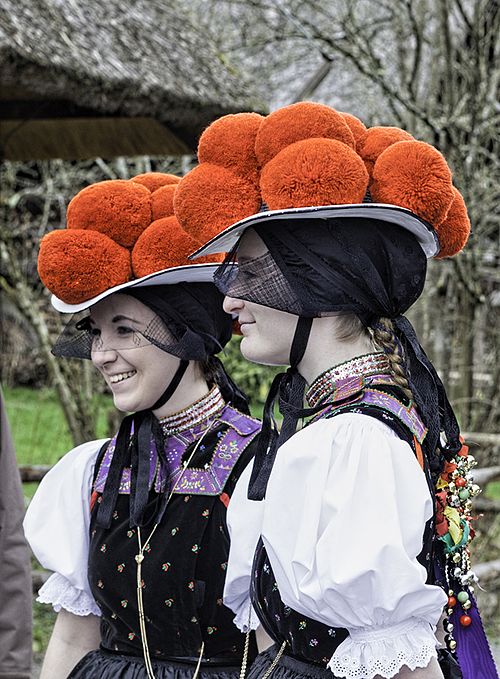 Women in the wearing BollenhutCredit: Michel Lefranc aka Tournachon
 -
 Photo credit: Karsten DörreA twilight panorama of Regensburg, Bavaria, Germany with the 12th century bridge Steinerne Brücke and Regensburg Cathedral on the left and the river Danube in the foreground. Located at the confluence of the Danube and Regen rivers, the first settlements in the area date to the Stone Age. A Roman fort was constructed in 179. In contrast to almost all other major German cities, Regensburg had little damage from Allied air raids in World War II and thus has an almost intact medieval city center, which is listed as a UNESCO World Heritage Site.
 -
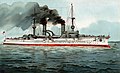 Illustration: Hugo Graf; restoration: Adam CuerdenSMS Fürst Bismarck was Germany's first armored cruiser, built for the Kaiserliche Marine before the turn of the 20th century and launched in 1900. Named for the German statesman Otto von Bismarck, the ship was primarily intended for colonial duties. She served in this capacity as part of the East Asia Squadron until she was relieved in 1909, at which point she returned to Germany. The ship was rebuilt between 1910 and 1914, and after the start of World War I, she was briefly used as a coastal defense ship. She proved inadequate to this task, and so she was withdrawn from active duty and served as a training ship for engineers until the end of the war. Fürst Bismarck was decommissioned in 1919 and sold for scrap.
 -
 Map credit: Lencer and NordNordWestA general map, showing the geography of Germany, the seventh largest country in Europe and the second most populous. Located in Central Europe, Germany is second only to Russia in the number of borders it shares with other European countries (9).
 -
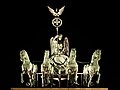 Close-up of the quadriga (four-horse chariot) on top of the Brandenburg Gate in Berlin (Germany) at night. The sculpture was produced by Johann Gottfried Schadow in 1793. The word quadriga may refer to the chariot alone, the four horses without it, or the combination. All modern quadrigas are based on the Horses of Saint Mark, a Roman or Greek sculpture which is the only surviving ancient quadriga.
 -
 Moritzburg CastleCredit: Olaf Leillinger
 -
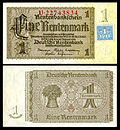 The Rentenmark was a currency introduced on 15 November 1923 in Weimar Germany after the value of the previous currency had been destroyed by hyperinflation.
The banknote shown at left was printed in 1937 or later. It bears an adhesive coupon attached by the East German government in 1948, extending its validity while new East German mark banknotes were being printed. -
 Church of Peace in Sanssouci ParkCredit: Wolfgang StaudtThe Church of Peace in the Marly Gardens, Sanssouci Park

.jpg)


.jpg)


.jpg)


.jpg)


.jpg)

Related portals
.svg)


 Holy Roman Empire (900–1806)
 East Germany (1949–1990)


Anniversaries for February 28
 Alfred Graf von Schlieffen
- 1746 - Death of historian Hermann von der Hardt
- 1833 - Birth of field marshal Alfred Graf von Schlieffen (pictured), strategist of the Schlieffen Plan
- 1900 - Birth of sailplane designer Wolf Hirth
- 1944 - Birth of Sepp Maier, goalkeeper of the German national football team in the Football World Cup 1974
- 2002 - Last day on which the German Mark is accepted as a form of payment
Did you know...

- ... that Gabriele Lösekrug-Möller worked as a bookseller before entering politics?
- ... that there were more than a thousand Nazi concentration camps?
- ... that Thomas Johannes Mayer went from performing jazz, rock, and punk, to portraying operatic characters such as Wotan and Wozzeck?
- ... that Ingrid Fischbach did not expect to win her first election, instead considering it a "test run"?
- ... that three members of the Hamburg Parliament—Mehria Ashuftah, Hila Latifi, and Zohra Mojadeddi—are Afghan refugees?
- ... that Ernst Hinsken smuggled a red lantern into the Bundestag to draw attention to Germany's economic struggles?
- ... that Hermann E. Sieger, a Nazi Party official, was considered to be a trusted contact of the Liechtenstein government?
- ... that in his 1720 Christmas cantata, Georg Philipp Telemann used folk music, a rarity in his church music?
Selected cuisines, dishes and foods
 Pomeranian cuisine is famous for its great variety of fish dishes, such as herring in cream ("Sahnehering", pictured) and Bismarck herring.
Pomeranian cuisine generally refers to dishes typical of the area that once formed the historic Province of Pomerania in northeast Germany and which included Stettin (now Szczecin) and Further Pomerania. It is characterised by ingredients produced by Pomeranian farms, such as swede (Wruken) and sugar beet, by poultry rearing, which has produced the famous Pomeranian goose, by the wealth of fish in the Baltic Sea, rivers and inland lakes of the Pomeranian Lake District, and the abundance of quarry in Pomeranian forests. Pomeranian cuisine is hearty. Several foodstuffs have a particularly important role to play here in the region: potatoes, known as Tüften, prepared in various ways and whose significance is evinced by the existence of a West Pomeranian Potato Museum (Vorpommersches Kartoffelmuseum), Grünkohl and sweet and sour dishes produced, for example, by baking fruit.
Pomeranian farmers were self-sufficient: crops were stored until the following harvest, meat products were preserved in the smoke store of the home, or in the smokeries of larger villages such as Schlawin. Fruit, vegetables, lard and Gänseflomen were preserved by bottling in jars. Syrup was made from the sugar beet itself. (Full article...)Topics
Categories
 Category puzzle
This article is sourced from Wikipedia. Content is available under the Creative Commons Attribution-ShareAlike License.