

The Feminism Portal
.svg)
.JPG) International Women's Day, Bangladesh (2005)
International Women's Day, Bangladesh (2005)Feminism is a range of socio-political movements and ideologies that aim to define and establish the political, economic, personal, and social equality of the sexes. Feminism holds the position that modern societies are patriarchal—they prioritize the male point of view—and that women are treated unjustly in these societies. Efforts to change this include fighting against gender stereotypes and improving educational, professional, and interpersonal opportunities and outcomes for women.
Originating in late 18th-century Europe, feminist movements have campaigned and continue to campaign for women's rights, including the right to vote, run for public office, work, earn equal pay, own property, receive education, enter into contracts, have equal rights within marriage, and maternity leave. Feminists have also worked to ensure access to contraception, legal abortions, and social integration; and to protect women and girls from sexual assault, sexual harassment, and domestic violence. Changes in female dress standards and acceptable physical activities for women have also been part of feminist movements.
Many scholars consider feminist campaigns to be a main force behind major historical societal changes for women's rights, particularly in the West, where they are near-universally credited with achieving women's suffrage, gender-neutral language, reproductive rights for women (including access to contraceptives and abortion), and the right to enter into contracts and own property. Although feminist advocacy is, and has been, mainly focused on women's rights, some argue for the inclusion of men's liberation within its aims, because they believe that men are also harmed by traditional gender roles. Feminist theory, which emerged from feminist movements, aims to understand the nature of gender inequality by examining women's social roles and lived experiences. Feminist theorists have developed theories in a variety of disciplines in order to respond to issues concerning gender.
Numerous feminist movements and ideologies have developed over the years, representing different viewpoints and political aims. Traditionally, since the 19th century, first-wave liberal feminism, which sought political and legal equality through reforms within a liberal democratic framework, was contrasted with labour-based proletarian women's movements that over time developed into socialist and Marxist feminism based on class struggle theory. Since the 1960s, both of these traditions are also contrasted with the radical feminism that arose from the radical wing of second-wave feminism and that calls for a radical reordering of society to eliminate patriarchy. Liberal, socialist, and radical feminism are sometimes referred to as the "Big Three" schools of feminist thought.
Since the late 20th century, many newer forms of feminism have emerged. Some forms, such as white feminism and gender-critical feminism, have been criticized as taking into account only white, middle class, college-educated, heterosexual, or cisgender perspectives. These criticisms have led to the creation of ethnically specific or multicultural forms of feminism, such as black feminism and intersectional feminism. (Full article...)
Featured article

Featured picture
 Joan of Arc
The "Maid of Orleans", Joan of Arc is a national heroine of France and a saint of the Roman Catholic Church. She helped inspire Charles VII's troops to retake most of his dynasty's former territories, which had been under English and Burgundian dominance during the Hundred Years' War. She later was convicted of heresy (overturned posthumously) and burnt at the stake at the age of nineteen. Pope Benedict XV canonized her on 16 May 1920 and she is now one of the most popular saints of the Catholic Church.
Shown here is a statue of Joan of Arc inside Notre-Dame de Paris, a Gothic cathedral in Paris, where she was beatified in 1909.
In this month
- February 1975 – First publication of The Female Man, a feminist science fiction novel by Joanna Russ, which follows the lives of four women living in parallel worlds who visit each other and encounter new notions of what it means to be a woman
- February 1976 – Andrea Dworkin organizes public pickets of the movie Snuff out of which the activist group Women Against Pornography eventually grew
- 14 February 1998 – First V-Day benefit to raise money to end violence against women, inspired by Eve Ensler's play The Vagina Monologues
- 18 February 1934 – Birth of Audre Lorde, African-American feminist and poet who criticized earlier feminists, such as Betty Friedan, for not considering the effects of race and sexual orientation on feminism
- 19 February 1963 – First publication of The Feminine Mystique by Betty Friedan, which inspired second-wave feminism
Selected quote

Related portals


.svg)

Featured biography

Did you know (auto-generated) -

- ... that the subculture of Aristasia combined Guénonian Traditionalism with lesbian separatism?
- ... that Mary Kahil, an Egyptian Christian mystic, cofounded one of the earliest women's movements in the Arab world?
- ... that Margareth Rago seeks to establish a methodology for what she calls "feminist science"?
- ... that the retelling of stories can focus on female characters to reflect the feminist perspective?
- ... that after dying in her daughter's arms in an asylum in 1897, Maria Trubnikova was remembered as the "heart and soul" of feminist activism in Russia?
More "Did you know"

- ..that Emmy Noether (pictured) was called "the most significant creative mathematical genius thus far produced since the higher education of women began" by Albert Einstein?
- ...that Mary K. Shell, the first woman mayor of Bakersfield, California, chided NBC's Johnny Carson for his jokes about "beautiful downtown Bakersfield" and invited Carson to visit the city to see its improvements?
- ...that the 2008 film Forever the Moment is based on the real life story of South Korea's women's handball team which won silver at the 2004 Summer Olympics, and is also the first film to revolve around the sport of handball?
General images -
-
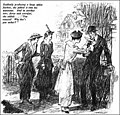 The White Feather: A Sketch of English Recruiting" (Arnold Bennett, 1914) (from History of feminism)
 -
 Giorgia Meloni, first female prime minister of Italy at a 2024 Women's Day event in Rome (from International Women's Day)
 -
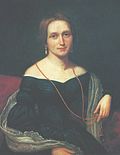 Camilla Collett (from History of feminism)
 -
 Huda Shaarawi, founder of the Egyptian Feminist Union (from History of feminism)
 -
-
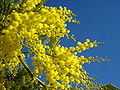 Yellow mimosa is the symbol of International Women's Day in Italy as well as in Russia, Ukraine and many other ex-Soviet Union republics (from International Women's Day)
 -

-
 Author and scholar Helen Kendrick Johnson opposed women's suffrage. (from History of feminism)
 -
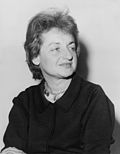 Betty Friedan 1960 (from History of feminism)
 -

-
 María Elena Oddone holding a banner, on International Women's Day in 1984 in Argentina. The banner says "No to motherhood, yes to pleasure" (from International Women's Day)
 -
 Frances Cobbe (from History of feminism)
 -
 bell hooks (from History of feminism)
 -
 Germaine Greer in June 1972 (from History of feminism)
 -
 Emily Davison (from History of feminism)
 -

-
 Margaret Sanger (from History of feminism)
 -
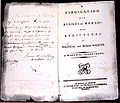 First edition print of A Vindication of the Rights of Woman (from History of feminism)
 -
 8M 2020 in Spain (from International Women's Day)
 -
 The Nineteenth Amendment (from History of feminism)
 -
 Female members of the Australian Builders Labourers Federation march on International Women's Day 1975 in Sydney (from International Women's Day)
 -

-
 Lucy Stone (from History of feminism)
 -

-
 Wealthy Chinese women with bound feet (Beijing, 1900). Foot binding was a symbol of women's oppression during the reform movements in the 19th and 20th centuries. (from History of feminism)
 -
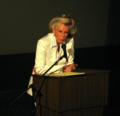 Catharine MacKinnon (from History of feminism)
 -
 An Antimonumenta, installed in Mexico City on International Women's Day 2019, as photographed the day after. The circle part says "In Mexico 9 women are murdered daily" and the cross part says "Not one more!" On the opposite side, the Antimonumenta reads "We demand a national gender alert", and in the central part "No + Femicides" (from International Women's Day)
 -
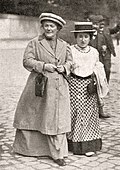
-
-
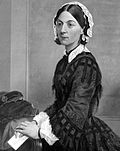
 Simone de Beauvoir (from History of feminism)
 -
 8M 2018 in Pamplona (from International Women's Day)
 -
 Suffrage parade in New York, May 6, 1912 (from History of feminism)
 -
 Gloria Steinem at news conference, Women's Action Alliance, January 12, 1972 (from History of feminism)
 -
 Women on the street celebrating International Women's Day in Cameroon (from International Women's Day)
 -
 A veil-burning ceremony in Andijan on International Women's Day in 1927 (from International Women's Day)
 -
 Ida B. Wells (from History of feminism)
 -
 Cover of WSPU's The Suffragette, April 25, 1913 (after Delacroix's Liberty Leading the People, 1830) (from History of feminism)
 -

-

-
 Board of directors of "Jam'iat e nesvan e vatan-khah", a women's rights association in Tehran (1923–1933) (from History of feminism)
 -
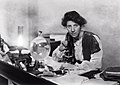 Marie Stopes (from History of feminism)
 -
 John Neal (from History of feminism)
 -
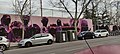 The vandalized Concepción Feminist Mural in Spain, which was vandalized on International Women's Day 2021. (from International Women's Day)
 -
 Women's Liberation march in Washington, D.C., 1970 (from History of feminism)

.jpg)


.jpg)


.jpg)


WikiProjects

Topics


Categories
 Category puzzle
This article is sourced from Wikipedia. Content is available under the Creative Commons Attribution-ShareAlike License.