

| Main page | Assessment | Articles | Templates | Translation | Noticeboard | To Do List | Portal |
The Chile Portal
 The flag of Chile
Chile, officially the Republic of Chile, is a country in western South America. It is the southernmost country in the world and the closest to Antarctica, extending along a narrow strip of land between the Andes Mountains and the Pacific Ocean. According to the 2024 census, Chile had an enumerated population of 18.5 million. The country covers a territorial area of 756,102 square kilometers (291,933 sq mi), sharing borders with Peru to the north, Bolivia to the northeast, Argentina to the east, and the Drake Passage to the south. It also administers several Pacific islands, including Juan Fernández, Isla Salas y Gómez, Desventuradas, and Easter Island, and claims about 1,250,000 square kilometers (480,000 sq mi) of Antarctica as the Chilean Antarctic Territory. The capital and largest city is Santiago, and the national language is Spanish.
Spain conquered and colonized the region in the mid-16th century, replacing Inca rule; however, they failed to conquer the autonomous tribal Mapuche people who inhabited what is now south-central Chile. Chile emerged as a relatively stable authoritarian republic in the 1830s after its 1818 declaration of independence from Spain. During the 19th century, Chile experienced significant economic and territorial growth, putting an end to Mapuche resistance in the 1880s and gaining its current northern territory in the War of the Pacific (1879–83) by defeating Peru and Bolivia.
In the 20th century, until the 1970s, Chile underwent a process of democratization and experienced rapid population growth and urbanization, while relying increasingly on exports from copper mining to support its economy. During the 1960s and 1970s, the country was marked by severe left-right political polarization and turmoil, which culminated in the 11 September 1973 coup d'état that overthrew Salvador Allende's democratically elected left-wing government, with support from the United States. This was followed by a 16-and-a-half-year right-wing military dictatorship led by Augusto Pinochet, during which the 1980 Constitution was enacted, along with numerous political and economic reforms, and which was marked by widespread human rights violations, including more than 3,000 deaths and disappearances. The regime ended in 1990, following a referendum in 1988, and was succeeded by a center-left coalition, which ruled until 2010. (Full article...)
 Good article -


Sollipulli (Spanish pronunciation: [soʝiˈpuʝi]; lit. 'reddish mountain' in the Mapuche language) is an ice-filled volcanic caldera and volcanic complex, which lies southeast of the small town of Melipeuco in the La Araucanía Region, Chile. It is part of the Southern Volcanic Zone of the Andes, one of the four volcanic belts in the Andes chain.
The volcano has evolved in close contact with glacial ice. It differs from many calderas in that Sollipulli appears to have collapsed in a non-explosive manner. The age of collapse is not yet known, but it is presently filled with ice to thicknesses of 650 m (2,130 ft). The ice drains through two glaciers in the west and the north of the caldera. Sollipulli has developed on a basement formed by Mesozoic and Cenozoic geological formations. (Full article...)
Selected biography -

Cecilia Vicuña (born 1948) is a Chilean poet and artist based in New York and Santiago, Chile.
Her work is noted for themes of language, memory, dissolution, extinction and exile. Critics also note the relevance of her work to the politics of ecological destruction, cultural homogenization, and economic disparity, particularly the way in which such phenomena disenfranchise the already powerless. Her commitment to feminist forms and methodologies is considered to be a unifying theme across her diverse body of work, among which her fibre art quipus, knotted or unknotted strings, palabrarmas and precarios, made from natural, delicate materials, stand out. Her practice has been specifically linked to the term eco-feminism. (Full article...)
Selected article -

Chiloé Island (Spanish: Isla de Chiloé, pronounced [tʃiloˈe], locally [ʃiloˈe]), also known as Greater Island of Chiloé (Isla Grande de Chiloé), is the largest island of the Chiloé Archipelago off the west coast of Chile, in the Pacific Ocean. The island is located in southern Chile, in the Los Lagos Region.
The island is roughly rectangular. Its southwestern half is a wilderness of contiguous forests and swamps. Mountains form a belt running from the northwestern to the southeastern corners of the island. Cordillera del Piuchén make up the northern mountains and the more subdued Cordillera de Pirulil gathers the southern mountains. The landscape of the northeastern sectors of Chiloé Island is dominated by rolling hills with a mosaic of pastures, forests and cultivated fields. While the western shores are rocky and relatively straight, the eastern and northern shores contain many inlets, bays and peninsulas, and it is here where all towns and cities lie. (Full article...)
General images
-
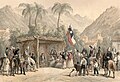 Fiestas Patrias of Chile, 1854 (from History of Chile)
 -
 Paila marina (from Culture of Chile)
 -

-
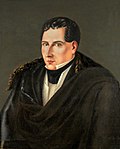 Diego Portales (from History of Chile)
 -
 The Mapuche were the original inhabitants of central and southern Chile (from History of Chile)
 -
 Map showing changes of territory due to the War of the Pacific (from History of Chile)
 -
 "No" supporters celebrate their victory in the 1988 referendum (from History of Chile)
 -
 Nobel laureate Gabriela Mistral (from Culture of Chile)
 -
 Picture of the 1915 presidential election in Chile (from History of Chile)
 -
 Five presidents of Chile since Transition to democracy (1990–2022), celebrating the Bicentennial of Chile (from History of Chile)
 -

-
 Territorial losses of the Republic of Chile de jure (by law) according to Chilean historiography. (from History of Chile)
 -
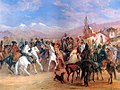 Chilean patriots, by Johann Moritz Rugendas (from History of Chile)
 -

-
 Los Jaivas, performing "Alturas de Machu Picchu", a version of a part of Pablo Neruda´s Canto General live at Machu Picchu (from Culture of Chile)
 -
 Marchers for Salvador Allende (from History of Chile)
 -

-
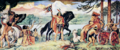 Picture "The young Lautaro" of Pedro Subercaseaux that show to genius military and hero of the Arauco war after the arrival of the Spanish to Chilean territory (from History of Chile)
 -
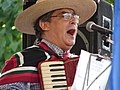 Chilean huaso singing (from Culture of Chile)


.jpg)


.jpg)


Did you know (auto generated)

- ... that the Swedish broadcaster organising the Eurovision Song Contest 1975 refused to allow the contest to be shown in Chile, as a protest against the country's military dictatorship?
- ... that, while in exile in Paris, the Greek composer Mikis Theodorakis worked with the Chilean ambassador and poet Pablo Neruda on Canto General?
- ... that Angelito de Canal 13, the mascot of the Chilean television network Canal 13, was inspired by its creator's son?
- ... that Rincón Chileno was nicknamed the "second Chilean consulate" by the Chilean immigrant community in Los Angeles?
- ... that anti-Pinochet dissident Luis Corvalán had his appearance surgically altered by Soviet doctors before returning to Chile?
- ... that Salar de Pedernales in Chile features dark slope streaks resembling dark slope streaks on Mars?
Topics
Categories
 Category puzzle
This article is sourced from Wikipedia. Content is available under the Creative Commons Attribution-ShareAlike License.