

The Modern History Portal
The modern era or the modern period is considered the current historical period of human history. It was originally applied to the history of Europe and Western history for events that came after the Classical antiquity and the Middle Ages, often from around the year 1500, like the Reformation in Germany giving rise to Protestantism. Since the 1990s, it has been more common among historians to refer to the period after the Middle Ages and up to the 19th century as the early modern period. The modern period is today more often used for events from the 19th century until today. The time from the end of World War II (1945) can also be described as being part of contemporary history. The common definition of the modern period today is often associated with events like the French Revolution, the Industrial Revolution, and the transition from nationalism toward the liberal international order.
The modern period has been a period of significant development in the fields of science, politics, warfare, and technology. It has also been an Age of Discovery and globalization. During this time, the European powers and later their colonies, strengthened their political, economic, and cultural colonization of the rest of the world. It also created a new modern lifestyle and has permanently changed the way people around the world live.
In the 19th and early 20th century, modernist art, politics, science, and culture have come to dominate not only Western Europe and North America, but almost every area on the globe, including movements thought of as opposed to the western world and globalization. The modern era is closely associated with the development of individualism, capitalism, socialism, urbanization and a belief in the positive possibilities of technological and political progress. (Full article...)
Selected articles -
-

 A scene on the ice, Dutch Republic, first half of the 17th centuryThe 17th century lasted from January 1, 1601 (represented by the Roman numerals MDCI), to December 31, 1700 (MDCC).
It falls into the early modern period of Europe and in that continent (whose impact on the world was increasing) was characterized by the Baroque cultural movement, the latter part of the Spanish Golden Age, the Dutch Golden Age, the French Grand Siècle dominated by Louis XIV, the Scientific Revolution, the world's first public company and megacorporation known as the Dutch East India Company, and according to some historians, the General Crisis.
From the mid-17th century, European politics were increasingly dominated by the Kingdom of France of Louis XIV, where royal power was solidified domestically in the civil war of the Fronde. The semi-feudal territorial French nobility was weakened and subjugated to the power of an absolute monarchy through the reinvention of the Palace of Versailles from a hunting lodge to a gilded prison, in which a greatly expanded royal court could be more easily kept under surveillance. With domestic peace assured, Louis XIV caused the borders of France to be expanded. It was during this century that the English monarch became increasingly involved in conflicts with the Parliament - this would culminate in the English civil war and an end to the dominance of the English monarchy. (Full article...) -
 1700 map of the world by Paolo PetriniThe early modern period is a historical period, with divisions based primarily on the history of Europe and the broader concept of modernity. There is no exact date that marks the beginning or end of the period and its extent may vary depending on the area of history being studied. In general, the early modern period is considered to have started at the beginning of the 16th century (around 1500), and is variably considered to have ended at the 18th or 19th century (1700–1800). In a European context, it is defined as the period following the Middle Ages and preceding the advent of modernity, but there is no universal agreement on the dates of these boundaries. In the context of global history, the early modern period is often used even in contexts where there is no equivalent "medieval" period.
Various events and historical transitions have been proposed as the start of the early modern period, including the fall of Constantinople in 1453, the start of the Renaissance, the end of the Crusades, the Reformation in Germany giving rise to Protestantism, and the beginning of the Age of Discovery and with it the onset of the first wave of European colonization. Its end is often marked by the French Revolution, and sometimes also the American Revolution or Napoleon's rise to power, with the advent of the second wave of modern colonization known as New Imperialism.
Historians in recent decades have argued that, from a worldwide standpoint, the most important feature of the early modern period was the spread of globalization. From this viewpoint, the Columbian contact and its newfound notion of a New World being added to the Old World is another marker of the start of the period. New economies and institutions emerged, becoming more sophisticated and globally articulated over the course of the period. The early modern period also included the rise of the dominance of mercantilism as an economic theory. Other notable trends of the period include the development of experimental science, increasingly rapid technological progress, secularized civic politics, accelerated travel due to improvements in mapping and ship design, and the emergence of nation states. (Full article...) -
 Reenactors in period uniforms firing muskets in the Battle of Waterloo reenactment, in front of the wood of Hougoumont, 2011Historical reenactment (or reenactment) is an educational or recreational activity in which history enthusiasts and amateur hobbyists dress in period-accurate clothing and recreate aspects of past events or eras. This may be as narrow as a specific moment from a battle, such as a reenactment of Pickett's Charge presented during the 1913 Gettysburg reunion, or as broad as an entire period, such as Regency reenactment.
While historical reenactors are generally amateurs, some participants are military personnel or historians. The participants, called reenactors, often research the equipment, uniform, and other gear they will carry or use. Reenactors buy the apparel or items they need from specialty stores or make items themselves. Historical reenactments cover a wide span of history, from as far back as ancient warfare, the medieval warfare era, and the early modern warfare, to as recent as the World Wars, the Cold War era, and even the early 21st-century modern warfare in modern reenactment. (Full article...) -
The modern political history of the United Kingdom (1979–present) began when Margaret Thatcher gained power in 1979, giving rise to 18 years of Conservative government. Victory in the Falklands War (1982) and the government's strong opposition to trade unions helped lead the Conservative Party to another three terms in government. Thatcher initially pursued monetarist policies and went on to privatise many of Britain's nationalised companies such as British Telecom, British Gas Corporation, British Airways and British Steel Corporation. She kept the National Health Service. The controversial "poll tax" to fund local government was unpopular, and the Conservatives removed Thatcher as prime minister in 1990, although Michael Heseltine, the minister who did much to undermine her, did not personally benefit from her being ousted.
Thatcher's successor, John Major, replaced the "poll tax" with Council Tax and oversaw successful British involvement in the Gulf War. Despite a recession, Major led the Conservatives to a surprise victory in 1992. The events of Black Wednesday in 1992, party disunity over the European Union and several scandals involving Conservative politicians all led to the Labour Party winning a landslide election victory under Tony Blair in 1997. Labour had shifted its policies from the political left closer to the centre, under the slogan of 'New Labour'. The Bank of England was given independence over monetary policy and Scotland and Wales were given a devolved Scottish Parliament and Welsh Assembly respectively, whilst London wide local government was also re-established in the form of an Assembly and Mayor. The Good Friday Agreement was negotiated in 1997 in an effort to end The Troubles in Northern Ireland, with a devolved, power-sharing Northern Ireland Assembly being established in 1998.
Blair led Britain into the Afghanistan and Iraq Wars before leaving office in 2007, when he was succeeded by his chancellor, Gordon Brown. The 2008 financial crisis led to Labour's defeat in the 2010 election. It was replaced by a Conservative-Liberal Democrat coalition government, headed by David Cameron, that pursued a series of public spending cuts with the intention of reducing the budget deficit. In 2016, the UK voted in an advisory referendum to leave the European Union, which led to Cameron's resignation. Cameron was succeeded by his home secretary, Theresa May. (Full article...) -

The Italian colonization of Libya began in 1911 and it lasted until 1943. The country, which was previously an Ottoman possession, was occupied by Italy in 1911 after the Italo-Turkish War, which resulted in the establishment of two colonies: Italian Tripolitania and Italian Cyrenaica. In 1934, the two colonies were merged into one colony which was named the colony of Italian Libya. In 1937, this colony was divided into four provinces, and in 1939, the coastal provinces became a part of metropolitan Italy as the Fourth Shore. The colonization lasted until Libya's occupation by Allied forces in 1943, but it was not until the 1947 Paris Peace Treaty that Italy officially renounced all of its claims to Libya's territory. (Full article...) -
The Years of Lead (Italian: Anni di piombo) were a period of social and political turmoil in Italy that lasted from the late 1960s to the late 1980s, marked by a wave of both far-left and far-right political terrorism.
The Years of Lead are sometimes considered to have begun with the 1968 movement in Italy and the Hot Autumn strikes starting in 1969;
the death of the policeman Antonio Donnarumma in November 1969;
the Piazza Fontana bombing in December of that year, which killed 17 and was perpetrated by right-wing terrorists in Milan; and the death shortly after of anarchist worker Giuseppe Pinelli while in police custody under suspicion of being responsible for the attack, which he was ultimately deemed as not having committed.
The conflict involved violent struggles between militant neo-fascist and far-left organizations, as well as the Italian state. Neo-fascist groups pursued a campaign of indiscriminate bombings and massacres known as the "strategy of tension", which sought to sow panic, blame the left, and provoke an authoritarian coup. Far-left groups, most prominently the Red Brigades, carried out targeted assassinations, kidnappings, and bombings intended to destabilize the state and inspire a proletarian revolution. This political violence emerged from a backdrop of widespread social unrest following the post-war economic boom, and disillusionment with the mainstream political parties, primarily the ruling Christian Democracy and the Italian Communist Party. (Full article...) -
In its modern history, Tunisia is a sovereign republic, officially called the Republic of Tunisia. Tunisia has over ten million citizens, almost all of Arab-Berber descent. The Mediterranean Sea is to the north and east, Libya to the southeast, and Algeria to the west. Tunis is the capital and the largest city (over 800,000); it is located near the ancient site of the city of Carthage.
Its first modern leader, President Habib Bourguiba brought to the office hard-won political experience, after many decades of service in the leadership of the independence movement. As the major figure of the Neo-Destour Party, he was instrumental in obtaining full independence for Tunisia in 1956. He dominated the government until his removal in 1987. During his years in office, his accomplishments included: a law reform, economic policies which detoured briefly in a socialist direction, a moderate but steady improvement in standard of living, and a foreign policy which retained an independent approach while maintaining trade and economic connections to the west.
Ben Ali became President of the Republic in 1987, and kept power until he was forced to leave in 2011. His economic policies emphasized a market orientation. His attempt at reapproachment with Islamist groups did not meet expectations. The ruling party was reorganized. Under his leadership Tunisia's economy continued to perform at a pace which yielded a moderate but overall steady rate of growth. (Full article...) -
The modern history of Saudi Arabia begins with the declaration of the unification of Saudi Arabia in a single kingdom in 1932. This period of time in Saudi Arabia's history includes the discovery of oil in Saudi Arabia and many events. It goes on to encompass Saudi Arabia's brief involvement in World War II in 1945. Afterwards, it includes Saudi Arabia's involvement in the Western Bloc and the Cold War. It also includes Saudi Arabia's proxy conflict with Iran, the Arab Spring, and the ongoing Arab Winter. (Full article...)
-
 An 1835 illustration of power loom weaving, as part of the Industrial Revolution
The 19th century began on 1 January 1801 (represented by the Roman numerals MDCCCI), and ended on 31 December 1900 (MCM). It was the 9th century of the 2nd millennium. It was characterized by vast social upheaval. Slavery was abolished in much of Europe and the Americas, most importantly, the Haitian Revolution (1791–1804) which directly linked to Napoleon Bonaparte’s decision to sell the Louisiana Territory to the United States, because of failed attempt to regain control of Saint-Domingue that shattered Napoleon’s dreams of a "New World Empire" that led a total defeat of French forces at the Battle of Vertières in 1803, Dessalines, the successor of the Haitian general and leader of African slaves in the colony, Toussaint Louverture, declared independence from France in 1804, which rename the colony as Haiti, a Taíno name meaning "Land of High Mountains", the first and oldest free black country in the New World and the second oldest independent nation in the Americas after the United States, also declared independence from Britain in 1783. The First Industrial Revolution, though it began in the late 18th century, expanded beyond its British homeland for the first time during the 19th century, particularly remaking the economies and societies of the Low Countries, France, the Rhineland, Northern Italy, and the Northeastern United States. A few decades later, the Second Industrial Revolution led to ever more massive urbanization and much higher levels of productivity, profit, and prosperity, a pattern that continued into the 20th century. The Catholic Church, in response to the growing influence and power of modernism, secularism and materialism, formed the First Vatican Council in the late 19th century to deal with such problems and confirm certain Catholic doctrines as dogma. Religious missionaries were sent from the Americas and Europe to Asia, Africa and the Middle East. The Communist Manifesto is a foundational 19th-century pamphlet commissioned by the Communist League to outline a platform for the working class (proletariat) as it became a call to action that framed all of human history as a series of class struggles to reshape the modern world which regard its ideals of struggle, common ownership of the means of production, and the necessity of worker-led revolution heavily influenced the structural transformation of countries in the 20th century, most notably China and Vietnam, both adapted by futuristic leaders such as Mao Zedong and Ho Chi Minh to reshape their respective nations for the 20th century revolutions that utilized the Manifesto's principles to justify the violent overthrow of existing social structures and the implementation of state-controlled economies.
In the Middle East, it was an era of change and reform. The Islamic gunpowder empires fell into decline and European imperialism brought much of South Asia, Southeast Asia, and almost all of Africa under colonial rule. Reformers were opposed at every turn by conservatives who strove to maintain the centuries-old Islamic laws and social order. The 19th century also saw the collapse of the large Spanish, Portuguese, French and Mughal empires, which paved the way for the growing influence of the British, French, German, Russian, Austro-Hungarian, Italian, and Japanese empires along with the Americans.
The defeat of France in the Napoleonic Wars marked the end of France’s status as the world superpower. Britain took France’s status as the world superpower, the British and Russian empires expanded considerably, becoming two of the world's leading powers. Russia expanded its territory to the Caucasus and Central Asia. The Ottoman Empire underwent a period of Westernization and reform known as the Tanzimat, vastly increasing its control over core territories in the Middle East. However, it remained in decline and became known as the sick man of Europe, losing territory in the Balkans and North Africa. (Full article...) -
The Industrial Revolution, sometimes divided into the First Industrial Revolution and Second Industrial Revolution, was a transitional period of the global economy toward more widespread, efficient and stable manufacturing processes, succeeding the Second Agricultural Revolution. Beginning in Great Britain around 1760, the Industrial Revolution had spread to continental Europe and the United States by about 1840. This transition included going from hand production methods to machines; new chemical manufacturing and iron production processes; the increasing use of water power and steam power; the development of machine tools; and rise of the mechanised factory system. Output greatly increased, and the result was an unprecedented rise in population and population growth. The textile industry was the first to use modern production methods, and textiles became the dominant industry in terms of employment, value of output, and capital invested .
Many technological and architectural innovations were British. By the mid-18th century, Britain was the leading commercial nation, controlled a global trading empire with colonies in North America and the Caribbean, and had military and political hegemony on the Indian subcontinent. The development of trade and rise of business were among the major causes of the Industrial Revolution. Developments in law facilitated the revolution, such as courts ruling in favour of property rights. An entrepreneurial spirit and consumer revolution helped drive industrialisation.
The Industrial Revolution influenced almost every aspect of life. In particular, average income and population began to exhibit unprecedented sustained growth. Economists note the most important effect was that the standard of living for most in the Western world began to increase consistently for the first time, though others have said it did not begin to improve meaningfully until the 20th century. GDP per capita was broadly stable before the Industrial Revolution and the emergence of the modern capitalist economy, afterwards saw an era of per-capita economic growth in capitalist economies. Economic historians agree that the onset of the Industrial Revolution is the most important event in human history, comparable only to the adoption of agriculture with respect to material advancement. (Full article...) -
 An early nuclear power plant that used atomic energy to generate electricity
The Atomic Age, also known as the Atomic Era, is the period of history following the detonation of the first nuclear weapon, The Gadget at the Trinity test in New Mexico on 16 July 1945 during World War II. Although nuclear chain reactions had been hypothesized in 1933 and the first artificial self-sustaining nuclear chain reaction (Chicago Pile-1) had taken place in December 1942, the Trinity test and the ensuing bombings of Hiroshima and Nagasaki that ended World War II represented the first large-scale use of nuclear technology and ushered in profound changes in sociopolitical thinking and the course of technological development.
While atomic power was promoted for a time as the epitome of progress and modernity, entering into the nuclear power era also entailed frightful implications of nuclear warfare, the Cold War, mutual assured destruction, nuclear proliferation, the risk of nuclear disaster (potentially as extreme as anthropogenic global nuclear winter), as well as beneficial civilian applications in nuclear medicine. It is no easy matter to fully segregate peaceful uses of nuclear technology from military or terrorist uses (such as the fabrication of dirty bombs from radioactive waste), which complicated the development of a global nuclear-power export industry right from the outset.
In 1973, concerning a flourishing nuclear power industry, the United States Atomic Energy Commission predicted that by the turn of the 21st century, 1,000 reactors would be producing electricity for homes and businesses across the U.S. However, the "nuclear dream" fell far short of what was promised because nuclear technology produced a range of social problems, from the nuclear arms race to nuclear meltdowns, and the unresolved difficulties of bomb plant cleanup and civilian plant waste disposal and decommissioning. Since 1973, reactor orders declined sharply as electricity demand fell and construction costs rose. Many orders and partially completed plants were cancelled. (Full article...) -
The war on terror, officially the Global War on Terrorism (GWOT), is a global military campaign initiated by the United States in response to the September 11 attacks in 2001. A global conflict spanning multiple wars, some researchers and political scientists have argued that it replaced the Cold War.
The main targets of the campaign were militant Islamist movements such as al-Qaeda, the Taliban and their allies. Other major targets included the Ba'athist regime in Iraq, which was deposed in an invasion in 2003, and various militant factions that fought during the ensuing insurgency. Following its territorial expansion in 2014, the Islamic State also emerged as a key adversary of the United States. Starting in 2025, Operation Southern Spear emerged as an extension of the war on terror adapted to combat narcoterrorism, with the US government utilizing the same legal frameworks established since 2001 to justify the use of lethal force. Some analysts have identified this new approach as a hybridization of the war on terror and the war on drugs.
The term "war on terror" uses war as a metaphor to describe a variety of actions which fall outside the traditional definition of war. US president George W. Bush first used the term "war on terrorism" on 16 September 2001, and then "war on terror" a few days later in a formal speech to Congress. Bush indicated the enemy of the war on terror as "a radical network of terrorists and every government that supports them". The initial conflict was aimed at al-Qaeda, with the main theater in Afghanistan and Pakistan, a region that would later be referred to as "AfPak". The term "war on terror" was immediately criticized by individuals including Richard Myers, then chairman of the Joint Chiefs of Staff, and eventually more nuanced terms came to be used by the Bush administration to define the campaign. While "war on terror" was never used as a formal designation of US operations, a Global War on Terrorism Service Medal was and is issued by the US Armed Forces. (Full article...) -
The history of the Italian Republic concerns the events relating to the history of Italy that have occurred since 1946, when Italy became a republic after the 1946 Italian institutional referendum. The Italian republican history is generally divided into two phases, the First and Second Republic.
After the fall of the Fascist regime in Italy and the end of World War II, Italian politics and society were dominated by Christian Democracy (DC), a broad-based Christian political party, from 1946 to 1994. From the late 1940s until 1991, the opposition was led by the Italian Communist Party (PCI). Christian Democracy governed uninterrupted during this period, dominating every cabinet and providing nearly every prime minister. It governed primarily with the support of an array of minor parties from the centre-left to the centre-right, including the Italian Socialist Party (PSI), Italian Democratic Socialist Party (PSDI), Italian Republican Party (PRI), and Italian Liberal Party (PLI), and even far-right parties like the Italian Social Movement (MSI). The Communist Party was excluded entirely from government, with the partial exception of the short-lived Historic Compromise, in which the PCI provided external support to a DC minority government from 1976 to 1979.
The political situation was radically transformed in the early 1990s due to two major shocks: the dissolution of the Soviet Union in 1991 and the wide-reaching Tangentopoli corruption scandal from 1992 to 1994. The former caused the dissolution and split of the PCI and splintering of the opposition, while the latter led to the collapse of nearly every established political party in Italy, including Christian Democracy, the PSI, PSDI, PRI, PLI, and others. Anti-establishment sentiment resulted in a 1993 referendum enabling the reform of the electoral system from pure proportional representation to a majoritarian-leaning mixed system. (Full article...) -
 Old artistic rendering of the Monastery of El Escorial, historic 16th-century Renaissance complex near Madrid
The history of Spain dates to contact between the pre-Roman peoples of the Mediterranean coast of the Iberian Peninsula with the Greeks and Phoenicians. During Classical Antiquity, the peninsula was the site of multiple successive colonizations of Greeks, Carthaginians, and Romans. Native peoples of the peninsula, such as the Tartessos, intermingled with the colonizers to create a uniquely Iberian culture. The Romans referred to the entire peninsula as Hispania, from which the name "Spain" originates. As was the rest of the Western Roman Empire, Spain was subject to numerous invasions of Germanic tribes during the 4th and 5th centuries AD, resulting in the end of Roman rule and the establishment of Germanic kingdoms, marking the beginning of the Middle Ages in Spain.
Germanic control lasted until the Umayyad conquest of Hispania began in 711. The region became known as Al-Andalus, and except for the small Kingdom of Asturias, the region remained under the control of Muslim-led states for much of the Early Middle Ages, a period known as the Islamic Golden Age. By the time of the High Middle Ages, Christians from the north gradually expanded their control over Iberia, a period known as the Reconquista. As they expanded southward, a number of Christian kingdoms were formed, including the Kingdom of Navarre, the Kingdom of León, the Kingdom of Castile, and the Kingdom of Aragon. They eventually consolidated into two roughly equivalent polities, the Crown of Castile and the Crown of Aragon. The early modern period is generally dated from the union of the Crowns of Castile and Aragon by royal marriage in 1469.
The joint rule of Isabella I and Ferdinand II is historiographically considered the foundation of a unified Spain. The conquest of Granada, and the first voyage of Columbus, both in 1492, made that year a critical inflection point in Spanish history. The same year saw the expulsion of Spain's Jews and the conversion of many others to Christianity. In the subsequent decades, the voyages of the explorers and conquistadors of Spain helped establish a Spanish colonial empire which was among the largest ever. King Charles I established the Spanish Habsburg dynasty. Under his son Philip II the Spanish Golden Age flourished, the Spanish Empire reached its territorial and economic peak, and his palace at El Escorial became the center of artistic flourishing. However, Philip's rule also saw the destruction of the Spanish Armada, a number of state bankruptcies and the independence of the Northern Netherlands, which marked the beginning of the slow decline of Spanish influence in Europe. Spain's power was further tested by its participation in the Eighty Years' War, whereby it tried and failed to recapture the newly independent Dutch Republic, and the Thirty Years' War, which resulted in continued decline of Habsburg power in favor of the French Bourbon dynasty. Matters came to a head with the death of the last Habsburg ruler Charles II of Spain; the War of the Spanish Succession broke out between two European alliances led by the French Bourbons and the Austrian Habsburgs, for the control of the Spanish throne. The Bourbons prevailed, resulting in the ascension of Philip V of Spain, who took Spain into various wars and eventually recaptured the territories in southern Italy that had been lost in the War of the Spanish Succession. Spain's late entry into the Seven Years' War was the result of fear of the growing successes of the British at the expense of the French, but Spanish forces suffered major defeats. Motivated by this and earlier setbacks during Bourbon rule, Spanish institutions underwent a period of reform, especially under Charles III, that culminated in Spain's largely successful involvement in the American War of Independence. (Full article...) -
 Flag of the Arab Kingdom of Syria (1920)
The modern history of Syria begins with the termination of Ottoman control of Syria by French forces and the establishment of the Occupied Enemy Territory Administration during World War I. The short-lived Arab Kingdom of Syria emerged in 1920, which was however soon committed under the French Mandate, which produced the short-lived autonomous State of Aleppo, State of Damascus (later State of Syria), Alawite State and Jabal al-Druze (state); the autonomies were transformed into the Mandatory Syrian Republic in 1930. Syrian Republic gained independence in April 1946. The Republic took part in the Arab–Israeli War and remained in a state of political instability during the 1950s and 1960s.
The 8 March 1963 coup resulted in the installation of the National Council for the Revolutionary Command (NCRC), a group of military and civilian officials who assumed control of all executive and legislative authority. The takeover was engineered by members of the Ba'ath Party led by Michel Aflaq and Salah al-Din al-Bitar. He was overthrown in early 1966 by Marxist–Leninist military dissidents of the party led by General Salah Jadid. After the Arab Spring of 2011, Bashar al-Assad's government was embroiled in the ongoing Syrian civil war.
On 8 December 2024, Bashar al-Assad fled to Russia after rebels seized the capital city of Damascus, resulting in the fall of the Assad regime and establishment of a caretaker government. Following the fall of the Assad regime, Syria entered a political transition under a transitional government on 29 March 2025, headed by president Ahmed al-Sharaa. (Full article...)


.svg)
Need help?
Do you have a question about Modern history that you can't find the answer to?
Consider asking it at the Wikipedia reference desk.
General images -
-
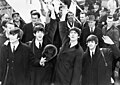 The Beatles in 1964, widely regarded as the most influential band in Western popular music. (from 20th century)
 -

-
 Map of territorial changes in Europe after World War I (as of 1923). (from 20th century)
 -
 Dutch colonial officer with Papuans in the Baliem Valley, Dutch New Guinea, 1958 (from 20th century)
 -
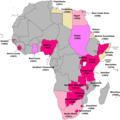 Decolonization of the British Empire in Africa. (from Contemporary history)
 -
-
 Hong Kong, under British administration from 1842 to 1997, is one of the original Four Asian Tigers. (from 20th century)
 -
 The international community grew in the second half of the century significantly due to a new wave of decolonization, particularly in Africa. Most of the newly independent states, were grouped together with many other so called developing countries. Developing countries gained attention, particularly due to rapid population growth, leading to a record world population of nearly 7 billion people by the end of the century. (from 20th century)
 -
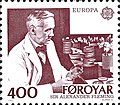 A stamp commemorating Alexander Fleming. His discovery of penicillin changed the world of medicine by introducing the age of antibiotics. (from 20th century)
 -

-
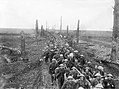
 The Siege of Leningrad during World War II is widely considered one of the most lethal sieges in history (from 20th century)
 -

-
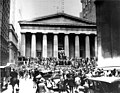 The Wall Street Crash of 1929 was a major factor contributing to the Great Depression (from 20th century)
 -
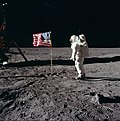 Photograph of the American astronaut Buzz Aldrin during the first moonwalk in 1969, taken by Neil Armstrong. The relatively young aerospace engineering industries rapidly grew in the 66 years after the Wright brothers' first flight. (from 20th century)
 -
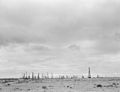 Oil field in California, US, in 1938. The first modern oil well is drilled in 1848 by the Russian engineer F.N. Semyonov, on the Apsheron Peninsula north-east of Baku. (from 20th century)
 -
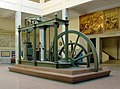 A Watt steam engine in Madrid. The development of the steam engine started the industrial revolution in England. The steam engine was created to pump water from coal mines, enabling them to be deepened beyond groundwater levels. (from Modern era)
 -
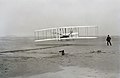 First flight of the Wright brothers' Wright Flyer on q7 December 1903 in Kitty Hawk, North Carolina, US; Orville piloting with Wilbur running at wingtip. (from 20th century)
 -
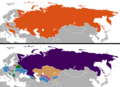 Changes in national boundaries after the end of the Cold War and the dissolution of the Soviet Union in 1991 (from 20th century)
 -
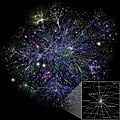 A visualization of the various routes through a portion of the Internet. Partial map of the Internet based in 2005 (from Contemporary history)
 -

-
 World powers and empires in 1914, just before the First World War.(from 20th century)
 -

-
 Ayatollah Ruhollah Khomeini was the Shia cleric who led the 1979 Iranian Revolution, overthrowing the Shah and establishing Iran as an Islamic Republic. (from 20th century)
 -
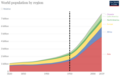 The 20th century saw an explosive increase in human population, rising from about 1.6 billion in 1900 to over 6 billion by 2000, with the Green Revolution (mid-20th century) being a key factor (from 20th century)
 -
 Martin Luther King Jr., an African American civil rights movement leader (Washington, August 1963) (from 20th century)
 -
 Countries by real GDP growth rate in 2014. (Countries in brown were in recession.) (from Contemporary history)
 -
 In 1924, Edwin Hubble announced that the Andromeda Nebula is actually a galaxy and that the Milky Way is just one of many galaxies in the universe. (from 20th century)
 -

-
 The mushroom cloud of the detonation of Little Boy, the first nuclear attack in history, on 6 August 1945 over Hiroshima, igniting the nuclear age with the international security dominating thread of mutual assured destruction in the latter half of the 20th century. (from 20th century)
 -
 The division of Europe during the Cold War (from Contemporary history)
 -
 The Empire State Building is an iconic building of the 1930s. (from 20th century)
 -

-
 The Blue Marble, Earth as seen from Apollo 17 in December 1972. The photograph is taken by LMP Harrison Schmitt. The second half of the 20th century saw humanity's first space exploration. (from 20th century)
 -
 Earthrise, taken on 24 December 1968 by the American astronaut William Anders during the Apollo 8 space mission. It is the first photograph taken of Earth from lunar orbit. (from 20th century)
 -


.jpg)


.jpg)


.jpg)
.svg)


.jpg)


Related portals


.svg)
Related WikiProjects

Topics
- 16th century
- 17th century
- 18th century
- 19th century
- 20th century
- 21st century
- A History of the Modern World
- Christianity in the modern era
- Contemporary archaeology
- Contemporary history
- Early modern period
- Modern Europe
- Fin de siècle
- Industrial Revolution
- Interwar period
- Late modern period
- Modern literature
- Modern languages
- Modern reenactment
- Modern philosophy
- Modern warfare
- The Journal of Modern History
- Modern history of East Asian martial arts
- Modern history of Los Angeles
- War on terror
Countries
- Modern Cambodia
- History of Cyprus since 1878
- History of modern Egypt
- Modern history of Fiji
- History of India (1947–present)
- Modern history of Iraq
- Modern history of Saudi Arabia
- History of modern Serbia
- Modern history of Syria
- History of modern Tunisia
- Modern history of Ukraine
- Modern history of Wales
- Modern history of Yemen
France
- Early modern France
- Ancien Régime
- Valois-Orléans kings – 1498–1515
- Valois-Angoulême kings – 1515–1589
- Bourbon kings – 1589–1792
- France in the long nineteenth century
- History of France (1900 to present)
- Third Republic – 1870–1940
- Free France & Vichy France – 1940–1944
- Provisional Republic – 1944–1946
- Fourth Republic – 1946–1958
- Fifth Republic – 1958–present
Germany
Greece
Ireland
Italy
- Italian unification (1815-1861)
- History of the Kingdom of Italy (1861–1946)
- History of the Italian Republic (1945 to present)
- Years of Lead (Italy) (1969-1988)
- Berlusconi era (2001 to 2011)
Libya
- Tripolitania Vilayet (1864-1911)
- History of Libya as Italian colony (1911-1943)
- World War II and Allied occupation, see Libya during World War II
- Kingdom of Libya (1951-1969)
- Libya under Gaddafi (1969-2011)
Spain
- Early Modern history of Spain
- Habsburg Spain (16th to 17th centuries)
- Bourbon Spain (18th century)
- 19th-century Spain
- Restoration (Spain) (1874–1931)
- 20th-century Spain
- Second Spanish Republic (1931–1939)
- Francoist Spain (1936–1975)
- History of Spain (1975–present)
United Kingdom
Subcategories
 Category puzzle
This article is sourced from Wikipedia. Content is available under the Creative Commons Attribution-ShareAlike License.