

The History Portal
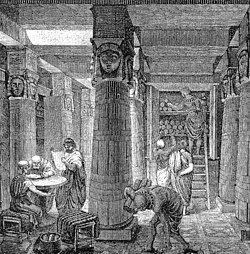
History is the systematic study of the past, focusing primarily on the human past. As an academic discipline, it analyses and interprets evidence to construct narratives about what happened and explain why it happened. Some theorists categorize history as a social science, while others see it as part of the humanities or consider it a hybrid discipline. Similar debates surround the purpose of history—for example, whether its main aim is theoretical, to uncover the truth, or practical, to learn lessons from the past. In a more general sense, the term history refers not to an academic field but to the past itself, times in the past, or to individual texts about the past.
Historical research relies on primary and secondary sources to reconstruct past events and validate interpretations. Source criticism is used to evaluate these sources, assessing their authenticity, content, and reliability. Historians strive to integrate the perspectives of several sources to develop a coherent narrative. Different schools of thought, such as positivism, the Annales school, Marxism, and postmodernism, have distinct methodological approaches.
History is a broad discipline encompassing many branches. Some focus on specific time periods, such as ancient history, while others concentrate on particular geographic regions, such as the history of Africa. Thematic categorizations include political history, military history, social history, and economic history. Branches associated with specific research methods and sources include quantitative history, comparative history, and oral history.
History emerged as a field of inquiry in antiquity to replace myth-infused narratives, with influential early traditions originating in Greece, China, and later in the Islamic world. Historical writing evolved throughout the ages and became increasingly professional, particularly during the 19th century, when a rigorous methodology and various academic institutions were established. History is related to many fields, including historiography, philosophy, education, and politics. (Full article...)
 Featured articles –

-

Hector Macdonald Laws Waller, DSO & Bar (4 April 1900 – 1 March 1942) was a senior officer in the Royal Australian Navy (RAN). His career spanned almost thirty years, including service in both world wars. At the helm of the flotilla leader HMAS Stuart in the Mediterranean from 1939 to 1941, he won recognition as a skilful ship's captain and flotilla commander. He then transferred to the South West Pacific as captain of the light cruiser HMAS Perth, and went down with his ship during the Battle of Sunda Strait in early 1942.
Born in Benalla, Victoria, Waller entered the Royal Australian Naval College aged thirteen. After graduating, he served with the Royal Navy in the closing stages of World War I. Between the wars, he specialised in communications and was posted as signals officer to several British and Australian warships. He gained his first seagoing command in 1937, as captain of the destroyer HMS Brazen. In September 1939, he took command of HMAS Stuart and four other obsolete destroyers that together became known as the "Scrap Iron Flotilla". In 1940, these were augmented by other ships to form the 10th Destroyer Flotilla, supporting Allied troops in North Africa. (Full article...) -
The 1994 Black Hawk shootdown incident, sometimes referred to as the Black Hawk Incident, was a friendly fire incident over northern Iraq that occurred on 14 April 1994 during Operation Provide Comfort (OPC). The pilots of two United States Air Force (USAF) F-15 fighter aircraft, operating under the control of a USAF airborne warning and control system (AWACS) aircraft, misidentified two U.S. Army UH-60 Black Hawk helicopters as Iraqi Mil Mi-24 "Hind" helicopters. The F-15 pilots fired on and destroyed both helicopters, killing all 26 military and civilians aboard, including personnel from the U.S., United Kingdom, France, Turkey, and the Kurdish community.
A subsequent USAF investigation blamed the accident on several factors. The F-15 pilots were faulted for misidentifying the helicopters as hostile. Also, the crew members of the AWACS aircraft were blamed for their inaction in failing to exercise appropriate control and for not intervening in the situation. In addition, the identification friend or foe (IFF) systems had not functioned to identify the helicopters to the F-15 pilots. Furthermore, USAF leaders had failed to adequately integrate U.S. Army helicopter operations into overall OPC air operations. As a result of the investigation, several USAF officers received administrative discipline, but only one, Jim Wang, an AWACS crew member, was tried by court-martial, in which he was acquitted. (Full article...) -
Nezamozhnik (Russian and Ukrainian: Незаможник, Ukrainian romanization: Nezamozhnyk, lit. 'poor peasant') was one of eight Fidonisy-class destroyers built for the Imperial Russian Navy during World War I. Originally named Zante (Занте), the ship was left unfinished during the Russian Revolution in 1917 and later captured by Ukrainian and White forces. The mostly complete destroyer was towed from her shipyard by retreating White forces and wrecked during a storm in 1920. She was refloated by the Soviets following their victory in the Russian Civil War and completed in 1923 as Nezamozhny (Незаможный).
Serving with the Black Sea Fleet, she was renamed Nezamozhnik and made several international port visits. Refitted twice during the interwar period, the destroyer served in the Black Sea during World War II, helping to evacuate Odessa, supply besieged Soviet forces in Sevastopol, and support several amphibious operations during the Kerch–Feodosia Offensive and the Battle of the Caucasus. The ship saw no combat after October 1943 after three destroyers were sunk by German aircraft in a single action. She received the Order of the Red Banner for her actions during the war. Nezamozhnik was converted into a target ship at the end of the 1940s and sunk during the early 1950s. (Full article...) -
The 59th (Staffordshire) Infantry Division was an infantry division of the British Army that was formed during the Second World War and fought in the Battle of Normandy. In March 1939, after Germany re-emerged as a significant military power and invaded Czechoslovakia, the British Army increased the number of divisions in the Territorial Army (TA) by duplicating existing units. The 59th (Staffordshire) Motor Division was formed in September 1939, as a second-line duplicate of the 55th (West Lancashire) Motor Division. The division's battalions were all, initially, raised in Staffordshire.
Established using the motor division concept, the division was formed with only two infantry brigades, rather than the usual three for an infantry division, and was fully mobile. The intention was to increase battlefield mobility, enabling the motor divisions to follow armoured forces through breaches in the enemy frontline to rapidly consolidate captured territory. Following the Battle of France, the concept was abandoned. The division was allocated a third infantry brigade, and became the 59th (Staffordshire) Infantry Division. It remained within the United Kingdom until 1944, assigned to anti-invasion and guard duties, while training for combat overseas. (Full article...) -

Peter Heywood (6 June 1772 – February 1831) was a Royal Navy officer who was on board HMS Bounty during the mutiny of 28 April 1789. He was later captured in Tahiti, tried and condemned to death as a mutineer, but subsequently pardoned. He resumed his naval career and eventually retired with the rank of post-captain, after 29 years of honourable service.
The son of a prominent Isle of Man family with strong naval connections, Heywood joined Bounty under Lieutenant William Bligh at the age of 15. Bounty left England in 1787 on a mission to collect and transport breadfruit from the Pacific, and arrived in Tahiti late in 1788. Relations between Bligh and certain of his officers, notably Fletcher Christian, became strained, and worsened during the five months that Bounty remained in Tahiti. Shortly after the ship began its homeward voyage, Christian and his discontented followers seized Bligh and took control of the vessel. Bligh and 18 loyalists were set adrift in an open boat; Heywood was among those who remained with Bounty. Later, he and 15 others left the ship and settled in Tahiti. Bligh, after an epic open-boat journey, eventually reached England, where he implicated Heywood as one of the mutiny's prime instigators. In 1791, Heywood and his companions were met in Tahiti by the search vessel HMS Pandora. Heywood and one other sailor welcomed the Pandora in canoes, relieved to be rescued. However, they were arrested; the captain, Edward Edwards, had them and 12 others fettered and handcuffed in an 11-foot (3.4 m) box built for the purpose on deck. During their subsequent journey, Pandora was wrecked on the Great Barrier Reef, and four of Heywood's fellow prisoners drowned. (Full article...) -
The Second Battle of Newtonia was fought on October 28, 1864, near Newtonia, Missouri, between cavalry commanded by Major General James G. Blunt of the Union Army and Brigadier General Joseph O. Shelby's rear guard of the Confederate Army of Missouri. In September 1864, Confederate Major General Sterling Price had entered the state of Missouri with hopes of creating a popular uprising against Union control of the state. A defeat at the Battle of Pilot Knob in late September and the strength of Union positions at Jefferson City led Price to abandon the main objectives of the campaign; instead he moved his force west towards Kansas City, where it was badly defeated at the Battle of Westport by Major General Samuel R. Curtis on October 23. Following a set of three defeats on October 25, Price's army halted to rest near Newtonia on October 28.
On the afternoon of the 28th, Union pursuers commanded by Blunt caught up with Price and drove back his skirmishers. Price ordered the withdrawal of his main army, and tasked Shelby with holding a rear guard. Shelby initially had a numerical advantage, and used it to outflank Blunt's shorter line. With his men low on ammunition, Blunt was considering a retreat shortly before sundown when reinforcements arrived in the form of Brigadier General John B. Sanborn and his brigade. Sanborn formed on Blunt's left, and the Union troops counterattacked. Shelby ordered a retreat, and the Union troops did not begin to pursue until October 30. Once the pursuit began, it continued until they reached the Arkansas River. The Confederates did not stop retreating until they reached Texas; Price had lost over two-thirds of his army during the campaign. Though both sides initially claimed victory, modern historians credit the Union with a victory at Newtonia. Estimates of casualties suffered during the battle range greatly. (Full article...) -
Jauréguiberry was a pre-dreadnought battleship constructed for the French Navy (French: Marine Nationale) in the 1890s. Built in response to a naval expansion program of the British Royal Navy, she was one of a group of five roughly similar battleships, including Masséna, Bouvet, Carnot, and Charles Martel. Jauréguiberry was armed with a mixed battery of 305 mm (12 in), 274 mm (10.8 in) and 138 mm (5.4 in) guns. Constraints on displacement imposed by the French naval command produced a series of ships that were significantly inferior to their British counterparts, suffering from poor stability and a mixed armament that was difficult to control in combat conditions.
In peacetime the ship participated in routine training exercises and cruises in the Mediterranean Sea, primarily as part of the Mediterranean Squadron. The ship was involved in several accidents, including a boiler explosion and an accidental torpedo detonation that delayed her entry into service in 1897. Two more torpedo explosions occurred in 1902 and 1905, and she ran aground during a visit to Portsmouth in August 1905. By 1907, she had been transferred to the Reserve Division, although she continued to participate in maneuvers and other peacetime activities. (Full article...) -
Yamato (Japanese: 大和; named after the ancient Yamato Province) was the lead ship of her class of battleships built for the Imperial Japanese Navy (IJN) shortly before World War II. She and her sister ship, Musashi, were the heaviest and most powerfully armed battleships ever constructed, displacing nearly 72,000 tonnes (71,000 long tons) at full load and armed with nine 46 cm (18.1 in) Type 94 main guns, which were the largest guns ever mounted on a warship.
Yamato was designed to counter the numerically superior battleship fleet of the United States, Japan's main rival in the Pacific. She was laid down in 1937 and formally commissioned a week after the attack on Pearl Harbor in December 1941. Throughout 1942, she served as the flagship of the Combined Fleet, and in June 1942 Admiral Isoroku Yamamoto directed the fleet from her bridge during the Battle of Midway, a disastrous defeat for Japan. Musashi took over as the Combined Fleet flagship in early 1943, and Yamato spent the rest of the year moving between the major Japanese naval bases of Truk and Kure in response to American threats. In December 1943, Yamato was torpedoed by an American submarine which necessitated repairs at Kure, where she was refitted with additional anti-aircraft guns and radar in early 1944. Although present at the Battle of the Philippine Sea in June 1944, she played no part in the battle. (Full article...) -
HMS Vanguard was a British fast battleship built during the Second World War and commissioned after the war ended. She was the largest and fastest of the Royal Navy's battleships, and the only ship of her class. Vanguard was the last battleship to be built in history.
The Royal Navy anticipated being outnumbered by the combined German and Japanese battleships in the early 1940s, and had therefore started building the Lion-class battleships. However, the time-consuming construction of the triple-16-inch (406 mm) turrets for the Lion class would delay their completion until 1943 at the earliest. The British had enough 15-inch (381 mm) guns and turrets in storage to allow one ship of a modified Lion-class design with four twin-15-inch turrets to be completed faster than the Lion-class vessels that had already been laid down. Work on Vanguard was started and stopped several times during the war, and her design was revised several times during her construction to reflect war experience. These stoppages and changes prevented her from being completed before the end of the war. (Full article...) -
The Battle of Rennell Island (Japanese: レンネル島沖海戦, Hepburn: Renneru-shima oki kaisen) took place on 29–30 January 1943. It was the last major naval engagement between the United States Navy and the Imperial Japanese Navy during the Guadalcanal campaign of World War II. It occurred in the South Pacific between Rennell Island and Guadalcanal in the southern Solomon Islands.
In the battle, Japanese land-based torpedo bombers, seeking to provide protection for the impending evacuation of Japanese forces from Guadalcanal, made several attacks over two days on U.S. warships operating as a task force south of Rennell Island. In addition to approaching Guadalcanal with the objective of engaging any Japanese ships that might come into range, the U.S. task force was protecting an Allied transport ship convoy carrying replacement troops there. (Full article...) -
The Gunpowder Plot of 1605, in earlier centuries often called the Gunpowder Treason Plot or the Jesuit Treason, was an unsuccessful attempted regicide against King James VI of Scotland and I of England by a group of English Catholics, led by Robert Catesby.
The plan was to blow up the House of Lords during the State Opening of Parliament on Tuesday 5 November 1605, as the prelude to a popular revolt in the Midlands during which King James's nine-year-old daughter, Elizabeth, was to be installed as the new head of state. Catesby is suspected by historians to have embarked on the scheme after hopes of greater religious tolerance under James had faded, leaving many English Catholics disappointed. His fellow conspirators were John and Christopher Wright, Robert and Thomas Wintour, Thomas Percy, Guy Fawkes, Robert Keyes, Thomas Bates, John Grant, Ambrose Rookwood, Sir Everard Digby and Francis Tresham. Fawkes, who had 10 years of military experience fighting in the Spanish Netherlands in the failed suppression of the Dutch Revolt, was given charge of the explosives. (Full article...) -
The 6th Regiment Massachusetts Volunteer Militia was a peacetime infantry regiment that was activated for federal service in the Union army for three separate terms during the American Civil War (1861-1865). The regiment gained notoriety as the first unit in the Union Army to suffer fatal casualties in action during the Civil War in the Baltimore Riot and the first militia unit to arrive in Washington D.C., in response to President Abraham Lincoln's initial call for 75,000 troops. Private Luther C. Ladd of the 6th Massachusetts is often referred to as the first Union soldier killed in action during the war.
In the years immediately preceding the war and during its first enlistment, the regiment consisted primarily of companies from Middlesex County. During its first term of service, four out of ten companies of the regiment were from Lowell, Massachusetts. Colonel Edward F. Jones commanded the regiment during its first term. He later commanded the 26th Massachusetts and was awarded the honorary grade of brevet brigadier general. During its second and third terms of service, the unit was commanded by Colonel Albert S. Follansbee. (Full article...) -
Andrew Johnson (December 29, 1808 – July 31, 1875) was the 17th president of the United States, serving from 1865 to 1869. The 16th vice president, he assumed the presidency following the assassination of Abraham Lincoln. Johnson was a War Democrat who ran with Lincoln on the National Union Party ticket in the 1864 presidential election, coming to office as the American Civil War concluded. Johnson favored quick restoration of the seceded states to the Union without protection for the newly freed people who were formerly enslaved, as well as pardoning ex-Confederates. This led to conflict with the Republican Party-dominated U.S. Congress, culminating in his impeachment by the House of Representatives in 1868. He was acquitted in the Senate by one vote.
Johnson was born into poverty and never attended school. He was apprenticed as a tailor and worked in several frontier towns before settling in Greeneville, Tennessee, serving as an alderman and mayor before being elected to the Tennessee House of Representatives in 1835. After briefly serving in the Tennessee Senate, Johnson was elected to the U.S. House of Representatives in 1843, where he served five two-year terms. He was the governor of Tennessee for four years, and was elected by the legislature to the U.S. Senate in 1857. During his congressional service, he sought passage of the Homestead Bill, which was enacted soon after he left his Senate seat in 1862. Slave states in the Southern U.S., including Tennessee, seceded to form the Confederate States of America, but Johnson remained firmly with the Union. He was the only sitting senator from a Confederate state who did not promptly resign his seat upon learning of his state's secession. In 1862, Lincoln appointed him as Military Governor of Tennessee after most of it had been retaken. Johnson was a logical choice as Lincoln's running mate in 1864 because Lincoln wanted to send a message of national unity in his re-election campaign. Following their victory, Johnson became vice president. (Full article...) -
USS Romeo was a sternwheel steamer that saw service as a tinclad warship during the American Civil War. Completed in August 1862 as a civilian vessel to be used for trade on the Wabash River, she was instead purchased by the Union Navy for military service in the war's western theater in October. Commissioned in December, she cleared naval mines from the Yazoo River later that month before participating in operations against Confederate-held Fort Hindman in January 1863. After the fall of Fort Hindman, Romeo joined an expedition up the White River. In February and March 1863, she was part of the Yazoo Pass expedition, and later that year she fought Confederates at river landings to help isolate Vicksburg, Mississippi, during the Vicksburg campaign.
Later in 1863, Romeo served on the White River for part of the Little Rock campaign, but was in poor condition and required repairs. After these repairs, the vessel was transferred to the Tennessee River. During February 1864, she was part of an expedition up the Yazoo River to Yazoo City, Mississippi. She spent most of the rest of the war patrolling the Mississippi River, encountering Confederate land forces on several occasions. With the war drawing to a close in April and May 1865, Romeo was declared surplus on May 29. Decommissioned on June 30, she was sold on August 17 and was then used in the merchant trade. At some point in her civilian career, she was converted into a sidewheel steamer. Romeo ceased to appear in the shipping registers in 1870. (Full article...) -
HMS Bulwark was one of five London-class pre-dreadnought battleships built for the Royal Navy at the end of the 19th century. The Londons were a sub-class of the Formidable-class pre-dreadnoughts. Completed in 1902 she was initially assigned to the Mediterranean Fleet as its flagship. The ship then served with the Channel and Home Fleets from 1907 to 1910, usually as a flagship. From 1910 to 1914, she was in reserve in the Home Fleet.
Following the start of the First World War in August 1914, Bulwark, along with the rest of the squadron, was attached to the reformed Channel Fleet to protect the British Expeditionary Force as it moved across the English Channel to France. On 26 November 1914 she was destroyed by a large internal explosion with the loss of 741 men near Sheerness; only a dozen men survived the detonation. It was probably caused by the overheating of cordite charges that had been placed adjacent to a boiler-room bulkhead. Little of the ship survived to be salvaged and her remains were designated a controlled site under the Protection of Military Remains Act 1986. Diving on the wreck is generally forbidden. (Full article...)

.jpg)


_underway_c1947.jpg)
_low_in_the_water_on_30_January_1943.jpg)


.jpg)
Featured picture
-
 Illustration: Anton Sorg; Restoration: Lise BroerA knight, a member of the warrior class of the Middle Ages in Europe, in Gothic plate armour, from a German book illustration published 1483. The modern concept of the knight is as an elite warrior sworn to uphold the values of chivalry, faith, loyalty, courage and honour. Knighthood as known in Medieval Europe was characterized by the combination of two elements: feudalism and service as a mounted combatant. Both arose under the reign of the Holy Roman Emperor Charlemagne, from which the knighthood of the Middle Ages can be seen to have had its genesis.
 -
 Photo credit: Gustaf NordenskiöldAn 1891 photograph of Cliff Palace, the largest cliff dwelling—a structure built within caves and under outcroppings in cliffs—in North America, located in what is now Mesa Verde National Park, Colorado, USA. There are about 150 rooms in the 288 ft (88 m) long structure, although only 25 to 30 of those were used as living space by Ancient Pueblo peoples. it is estimated that the population of Cliff Palace was roughly 100–150 people.
 -
 The "Theatre" at PetraPhoto: Douglas PerkinsPetra is an archaeological site in Jordan, lying in a basin among the mountains which form the eastern flank of Wadi Araba, the great valley running from the Dead Sea to the Gulf of Aqaba. It is famous for having many stone structures carved into the rock.
 -
 Photo credit: USHMMJews captured by SS and SD troops during the suppression of the Warsaw Ghetto Uprising are forced to leave their shelter and march to the Umschlagplatz for deportation. The SD trooper pictured second from the right, is Josef Blösche, who was identified by Polish authorities using this photograph. Blösche was tried for war crimes in Erfurt, East Germany in 1969, sentenced to death and executed in July of that year.
 -
 Engraver: George J. Verbeck, after Thérèse van Duyl Schwarze
Restoration: Lise BroerA 1901 etching of Queen Wilhelmina of the Netherlands, based on an 1898 painting of her in her coronation robe. Having assumed the throne at the age of ten after the death of her father, King William III, Wilhemina ruled for fifty-eight years (1890–1948), longer than any other Dutch monarch. In 1948 she abdicated in favor of her daughter Juliana, thereafter making few public appearances until the country was devastated by the North Sea flood of 1953. -
 1895 train wreck, Gare MontparnassePhoto credit: Studio Lévy and SonsOn October 22, 1895, the Granville–Paris Express train overran the buffer stop at Gare Montparnasse station. The engine careened across almost 30 metres (100 feet) of the station concourse, crashed through a 60 centimetre thick wall, shot across a terrace and sailed out of the station, plummeting onto the Place de Rennes 10 metres (30 feet) below where it stood on its nose. While all of the passengers on board the train survived, one woman on the street below was killed by falling masonry.
 -
 Photograph: Felice BeatoA samurai with his sword and armor, photographed by Felice Beato c. 1860. The samurai, records of which date back to the early 10th-century Kokin Wakashū, were the military nobility of medieval and early-modern Japan. As Japan modernized during the Meiji period beginning in the late 1860s, the samurai lost much of their power, and the status was ultimately dissolved. However, samurai values remain common in Japanese society.
 -
![Image 8 Apollo 11 Photograph credit: Neil Armstrong Apollo 11 was the fifth crewed mission of NASA's Apollo program. After launching from the Kennedy Space Center in Florida on July 16, 1969, commander Neil Armstrong and Apollo Lunar Module pilot Buzz Aldrin landed Eagle in Mare Tranquillitatis on July 20, at 20:17:40 UTC, while command module pilot Michael Collins remained on Columbia in lunar orbit. Armstrong was the first to exit the spacecraft, stepping onto the surface 6 hours and 39 minutes later, on July 21, at 02:56:15 UTC; nineteen minutes later, Aldrin joined him on extravehicular activity, which lasted 2 hours, 31 minutes and 40 seconds. Armstrong and Aldrin lifted off from Tranquility Base after almost 22 hours on the lunar surface and rejoined Collins in the command module, before splashing down in the Pacific Ocean on July 24. The mission was planned to the minute, with the majority of the photographic tasks performed by Armstrong with a single Hasselblad camera. Most of the photographs taken on the Moon that include an astronaut are of Aldrin; there are only five images of Armstrong partly shown or reflected, as in this photograph, with Armstrong and the lunar module reflected in Aldrin's helmet visor. "As the sequence of lunar operations evolved," Aldrin explained, "Neil had the camera most of the time [...] It wasn't until we were back on Earth and in the Lunar Receiving Laboratory looking over the pictures that we realized there were few pictures of Neil." More featured pictures](//upload.wikimedia.org/wikipedia/commons/thumb/9/98/Aldrin_Apollo_11_original.jpg/120px-Aldrin_Apollo_11_original.jpg) Photograph credit: Neil ArmstrongApollo 11 was the fifth crewed mission of NASA's Apollo program. After launching from the Kennedy Space Center in Florida on July 16, 1969, commander Neil Armstrong and Apollo Lunar Module pilot Buzz Aldrin landed Eagle in Mare Tranquillitatis on July 20, at 20:17:40 UTC, while command module pilot Michael Collins remained on Columbia in lunar orbit. Armstrong was the first to exit the spacecraft, stepping onto the surface 6 hours and 39 minutes later, on July 21, at 02:56:15 UTC; nineteen minutes later, Aldrin joined him on extravehicular activity, which lasted 2 hours, 31 minutes and 40 seconds. Armstrong and Aldrin lifted off from Tranquility Base after almost 22 hours on the lunar surface and rejoined Collins in the command module, before splashing down in the Pacific Ocean on July 24.
Photograph credit: Neil ArmstrongApollo 11 was the fifth crewed mission of NASA's Apollo program. After launching from the Kennedy Space Center in Florida on July 16, 1969, commander Neil Armstrong and Apollo Lunar Module pilot Buzz Aldrin landed Eagle in Mare Tranquillitatis on July 20, at 20:17:40 UTC, while command module pilot Michael Collins remained on Columbia in lunar orbit. Armstrong was the first to exit the spacecraft, stepping onto the surface 6 hours and 39 minutes later, on July 21, at 02:56:15 UTC; nineteen minutes later, Aldrin joined him on extravehicular activity, which lasted 2 hours, 31 minutes and 40 seconds. Armstrong and Aldrin lifted off from Tranquility Base after almost 22 hours on the lunar surface and rejoined Collins in the command module, before splashing down in the Pacific Ocean on July 24.
The mission was planned to the minute, with the majority of the photographic tasks performed by Armstrong with a single Hasselblad camera. Most of the photographs taken on the Moon that include an astronaut are of Aldrin; there are only five images of Armstrong partly shown or reflected, as in this photograph, with Armstrong and the lunar module reflected in Aldrin's helmet visor. "As the sequence of lunar operations evolved," Aldrin explained, "Neil had the camera most of the time [...] It wasn't until we were back on Earth and in the Lunar Receiving Laboratory looking over the pictures that we realized there were few pictures of Neil." -
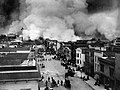 Photo credit: H. D. ChadwickThe Mission District of San Francisco, California, burning in the aftermath of the 1906 San Francisco earthquake. As damaging as the earthquake and its aftershocks were, the fires that burned out of control afterward were much more destructive.
 -
 Graphic: Arne NordmannA color visual interpretation of the digital signal in the Arecibo message, sent in 1974 from the Arecibo Observatory. Broadcast into space via frequency modulated radio waves at a ceremony to mark the remodeling of the Arecibo radio telescope in Puerto Rico, the message consisted of 1,679 binary digits, approximately 210 bytes, transmitted at a frequency of 2,380 MHz. It was aimed at the Great Globular Cluster in Hercules, some 25,000 light-years away, and contains information related to mathematics, chemistry, and astronomy.
 -
 Photo: American Colony; Restoration: Sebastian KolendoThe Mayor of Jerusalem Hussein al-Husayni (centre) meets with soldiers of the British Egyptian Expeditionary Force on December 9, 1917, under the white flag of surrender. The Battle of Jerusalem had begun the day before, but the Turkish forces in the city were no match against the British forces. A Turkish counterattack on December 25 was also repulsed, confirming the capture of Jerusalem by the Allies.
 -
 A Chola dynasty sculpture depicting Shiva. In Hinduism, Shiva is the deity of destruction and one of the most important gods; in this sculpture he is dancing as Nataraja, the divine dancer who unravels the world in preparation for it being remade by Brahma.
 -
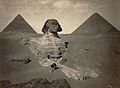 Photo: Maison Bonfils; Restoration: Lise BroerA late nineteenth century photo of the partially excavated Great Sphinx of Giza, with the Pyramid of Khafre (left) and the Great Pyramid of Giza (right) behind it. The Sphinx is the oldest known monumental sculpture, and is commonly believed to have been built by ancient Egyptians of the Old Kingdom in the reign of the pharaoh Khafra.
 -
 "The Trumpet Calls", a recruitment poster for the Australian Army in World War I. When the United Kingdom declared war on Germany, Australia followed without hesitation. This was considered to be expected by the Australian public, because of the very large number of British-born citizens and first generation Anglo-Australians at the time. A total of 331,814 Australians were sent overseas to serve as part of the Australian Imperial Force with a casualty rate (killed or wounded) of 64%.
 -
 Lithography: Day & Son; Restoration: Jake WartenbergAn 1856 lithograph of the Selimiye Barracks, located in Istanbul, Turkey, being used as a hospital during the Crimean War. Florence Nightingale's experiences here during this time helped her develop the foundations of modern nursing. As such, the barracks now contain a museum dedicated to her and her staff.
 -
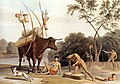 Artist: Samuel Daniell
 -
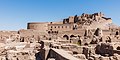 Photograph credit: Diego DelsoThe Arg-e Bam, in Kerman Province in southeastern Iran, is the largest adobe building in the world and a UNESCO World Heritage Site. The ancient citadel has a history dating back around two thousand years, to the Parthian Empire (248 BC – 224 AD), but most of its buildings were constructed during the Safavid dynasty. A strong earthquake on 26 December 2003 largely devastated the fortress and the nearby modern city of Bam. The Arg-e Bam, including the governor's residence, the main tower, the Four Seasons Palace and the hammam, were nearly totally destroyed; this photograph from 2016 shows the citadel partially reconstructed.
 -
 Credit: anonymousA 1793 etching with watercolor of Jean-Paul Marat, a radical journalist and politician from the French Revolution, carried on shoulders with a crown of laurel leaves, celebrating his acquittal by the Revolutionary Tribunal. From January to May 1793, Marat fought bitterly with the Girondins, whom he believed to be covert enemies of republicanism. The National Convention ordered the trial, but his acquittal only served to increase his public profile and popular support.


![Image 8 Apollo 11 Photograph credit: Neil Armstrong Apollo 11 was the fifth crewed mission of NASA's Apollo program. After launching from the Kennedy Space Center in Florida on July 16, 1969, commander Neil Armstrong and Apollo Lunar Module pilot Buzz Aldrin landed Eagle in Mare Tranquillitatis on July 20, at 20:17:40 UTC, while command module pilot Michael Collins remained on Columbia in lunar orbit. Armstrong was the first to exit the spacecraft, stepping onto the surface 6 hours and 39 minutes later, on July 21, at 02:56:15 UTC; nineteen minutes later, Aldrin joined him on extravehicular activity, which lasted 2 hours, 31 minutes and 40 seconds. Armstrong and Aldrin lifted off from Tranquility Base after almost 22 hours on the lunar surface and rejoined Collins in the command module, before splashing down in the Pacific Ocean on July 24. The mission was planned to the minute, with the majority of the photographic tasks performed by Armstrong with a single Hasselblad camera. Most of the photographs taken on the Moon that include an astronaut are of Aldrin; there are only five images of Armstrong partly shown or reflected, as in this photograph, with Armstrong and the lunar module reflected in Aldrin's helmet visor. "As the sequence of lunar operations evolved," Aldrin explained, "Neil had the camera most of the time [...] It wasn't until we were back on Earth and in the Lunar Receiving Laboratory looking over the pictures that we realized there were few pictures of Neil." More featured pictures](/wiki/File:Aldrin_Apollo_11_original.jpg)


Did you know (auto generated)

- ... that the unique, if "Freudian", partnership between Richard A. Hunter and his mother was the most prolific in publishing in the history of psychiatry?
- ... that Ted Aber created a series of alphabetized files on 1,600 family names while researching the history of Hamilton County, New York?
- ... that The Fader praised "Montgomery Brawl" as "a hilarious recap" of the brawl and a "song a piece of history deserves"?
- ... that historically, lichens like Umbilicaria torrefacta have been used to naturally dye traditional Scottish tartans and textiles?
- ... that Samba Yonga and Mulenga Kapwepwe founded the Women's History Museum of Zambia to counter a colonialist perspective on women's history?
- ... that the documentary ...So Goes the Nation is named after Ohio's history of voting for the winning presidential candidate?
Featured biography –
 Wodehouse in 1930
Sir Pelham Grenville Wodehouse (/ˈwʊdhaʊs/ WUUD-howss; 15 October 1881 – 14 February 1975) was an English writer and one of the most widely read humorists of the 20th century. His creations include the feather-brained Bertie Wooster and his sagacious valet, Jeeves; the immaculate and loquacious Psmith; Lord Emsworth and the Blandings Castle set; the Oldest Member, with stories about golf; and Mr. Mulliner, with tall tales on subjects ranging from bibulous bishops to megalomaniac movie moguls.
Born in Guildford, the third son of a British magistrate based in Hong Kong, Wodehouse spent happy teenage years at Dulwich College, to which he remained devoted all his life. After leaving school he was employed by a bank but disliked the work and turned to writing in his spare time. His early novels were mostly school stories, but he later switched to comic fiction. Most of Wodehouse's fiction is set in his native United Kingdom, although he spent much of his life in the US and used New York and Hollywood as settings for some of his novels and short stories. He wrote a series of Broadway musical comedies during and after the First World War, together with Guy Bolton and Jerome Kern, that played an important part in the development of the American musical. He began the 1930s writing for MGM in Hollywood. In a 1931 interview, his naive revelations of incompetence and extravagance in the studios caused a furore. In the same decade, his literary career reached a new peak. (Full article...)
On this day
February 17: Mardi Gras / Shrove Tuesday (2026); Chinese New Year (2026); Korean New Year (2026); Tết (Vietnam, 2026)

- 1621 – Myles Standish was elected the first commander of the militia of Plymouth Colony.
- 1838 – Great Trek: Zulu impis massacred about 532 Voortrekkers, Khoekhoe, and Basuto near present-day Weenen, South Africa.
- 1913 – The Armory Show (commemorative button pictured), the first large modern-art exhibition in the United States, opened at the 69th Regiment Armory in New York City.
- 1978 – The Troubles: The Provisional Irish Republican Army carried out a bombing of a restaurant near Belfast, Northern Ireland, killing twelve people and injuring thirty others.
- 1996 – An earthquake with a moment magnitude of 8.2 and a maximum Mercalli intensity of IX (Violent) occurred in the New Guinea Trench, which generated a tsunami that killed 108 people.
- Ivan Alexander of Bulgaria (d. 1371)
- Mary Carson Breckinridge (b. 1881)
- Friedrich Cerha (b. 1926)
- Jeremy Allen White (b. 1991)
Selected quote
Who controls the past controls the future: who controls the present controls the past.
— George Orwell, author, in Nineteen-Eighty Four
Related portals


More Did you know...

- ... that in 1898, the United States government annexed the Kingdom of Hawaii despite protestation from Queen Liliuokalani (pictured)?
- ... that Jean Thurel was a soldier in the French Régiment de Touraine for more than 75 years?
- ... that the severed head of Julia Martha Thomas — murdered, boiled and dismembered by her maid in 1879 — was found next door to Sir David Attenborough's house in 2010?
- ... that the 18th-century Indian automaton Tipu's Tiger shows a near life-size European being mauled by a tiger, and emits wails and grunts as well as containing a pipe organ?
- ... that Svið, a traditional Icelandic dish, consists of a sheep's head that has been cut in half, singed, and boiled with the brain removed?
- ... that, despite overseeing the construction of the crematoria and gas chambers at Auschwitz, what specifically shocked SS-Obersturmführer Robert Mulka at the camp was his colleagues' dress sense?
- ... that Tsar Alexander II of Russia had a special crystal bottle of Roederer champagne made for the Three Emperors Dinner in 1867 so that he could admire the bubbles?
- ... that the Gudea cylinders are the longest literary composition ever found in the Sumerian language?
Topics
| Primary | |
|---|---|
| Interdisciplinary |
|
| List | |
| Other categorizations | |

| Key concepts | |||||||||
|---|---|---|---|---|---|---|---|---|---|
| Measurement and standards |
| ||||||||
| Philosophy of time | |||||||||
| Human experience and use of time | |||||||||
| Time in science |
| ||||||||
| Related | |||||||||

Categories

This article is sourced from Wikipedia. Content is available under the Creative Commons Attribution-ShareAlike License.