
 | This article needs additional citations for verification. Please help improve this article by adding citations to reliable sources. Unsourced material may be challenged and removed. Find sources: "List of limits" – news · newspapers · books · scholar · JSTOR (August 2019) (Learn how and when to remove this message) |
 |
This is a list of limits for common functions such as elementary functions. In this article, the terms a, b and c are constants with respect to x.
Limits for general functions
[edit]Definitions of limits and related concepts
[edit]
lim
x
→
c
f
(
x
)
=
L
{\displaystyle \lim _{x\to c}f(x)=L}


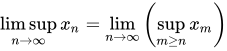
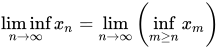
The limit superior and limit inferior of a sequence are defined as
lim sup
n
→
∞
x
n
=
lim
n
→
∞
(
sup
m
≥
n
x
m
)
{\displaystyle \limsup _{n\to \infty }x_{n}=\lim _{n\to \infty }\left(\sup _{m\geq n}x_{m}\right)}
A function,
f
(
x
)
{\displaystyle f(x)}

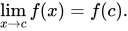
Operations on a single known limit
[edit]If
lim
x
→
c
f
(
x
)
=
L
{\displaystyle \lim _{x\to c}f(x)=L}
-
lim
x
→
c
[
f
(
x
)
±
a
]
=
L
±
a
{\displaystyle \lim _{x\to c}\,[f(x)\pm a]=L\pm a}
-
lim
x
→
c
a
f
(
x
)
=
a
L
{\displaystyle \lim _{x\to c}\,af(x)=aL}
[1][2][3]
-
lim
x
→
c
1
f
(
x
)
=
1
L
{\displaystyle \lim _{x\to c}{\frac {1}{f(x)}}={\frac {1}{L}}}
[4] if L is not equal to 0.
-
lim
x
→
c
f
(
x
)
n
=
L
n
{\displaystyle \lim _{x\to c}\,f(x)^{n}=L^{n}}
if n is a positive integer[1][2][3]
-
lim
x
→
c
f
(
x
)
1
n
=
L
1
n
{\displaystyle \lim _{x\to c}\,f(x)^{1 \over n}=L^{1 \over n}}
if n is a positive integer, and if n is even, then L > 0.[1][3]
![{\displaystyle \lim _{x\to c}\,[f(x)\pm a]=L\pm a}](https://wikimedia.org/api/rest_v1/media/math/render/svg/7e1d3ef86a2d1c54fd7e6cfe84ecc0c4a8809cd8)
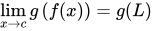
In general, if g(x) is continuous at L and
lim
x
→
c
f
(
x
)
=
L
{\displaystyle \lim _{x\to c}f(x)=L}
Operations on two known limits
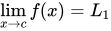
[edit]If
lim
x
→
c
f
(
x
)
=
L
1
{\displaystyle \lim _{x\to c}f(x)=L_{1}}
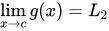
-
lim
x
→
c
[
f
(
x
)
±
g
(
x
)
]
=
L
1
±
L
2
{\displaystyle \lim _{x\to c}\,[f(x)\pm g(x)]=L_{1}\pm L_{2}}
[1][2][3]
-
lim
x
→
c
[
f
(
x
)
g
(
x
)
]
=
L
1
⋅
L
2
{\displaystyle \lim _{x\to c}\,[f(x)g(x)]=L_{1}\cdot L_{2}}
[1][2][3]
-
lim
x
→
c
f
(
x
)
g
(
x
)
=
L
1
L
2
if
L
2
≠
0
{\displaystyle \lim _{x\to c}{\frac {f(x)}{g(x)}}={\frac {L_{1}}{L_{2}}}\qquad {\text{ if }}L_{2}\neq 0}
[1][2][3]
Limits involving derivatives or infinitesimal changes
[edit]In these limits, the infinitesimal change
h
{\displaystyle h}


-
lim
h
→
0
f
(
x
+
h
)
−
f
(
x
)
h
=
f
′
(
x
)
{\displaystyle \lim _{h\to 0}{f(x+h)-f(x) \over h}=f'(x)}
. This is the definition of the derivative. All differentiation rules can also be reframed as rules involving limits. For example, if g(x) is differentiable at x,
-
lim
h
→
0
f
∘
g
(
x
+
h
)
−
f
∘
g
(
x
)
h
=
f
′
[
g
(
x
)
]
g
′
(
x
)
{\displaystyle \lim _{h\to 0}{f\circ g(x+h)-f\circ g(x) \over h}=f'[g(x)]g'(x)}
. This is the chain rule.
-
lim
h
→
0
f
(
x
+
h
)
g
(
x
+
h
)
−
f
(
x
)
g
(
x
)
h
=
f
′
(
x
)
g
(
x
)
+
f
(
x
)
g
′
(
x
)
{\displaystyle \lim _{h\to 0}{f(x+h)g(x+h)-f(x)g(x) \over h}=f'(x)g(x)+f(x)g'(x)}
. This is the product rule.
-
lim
h
→
0
f
∘
g
(
x
+
h
)
−
f
∘
g
(
x
)
h
=
f
′
[
g
(
x
)
]
g
′
(
x
)
{\displaystyle \lim _{h\to 0}{f\circ g(x+h)-f\circ g(x) \over h}=f'[g(x)]g'(x)}
-
lim
h
→
0
(
f
(
x
+
h
)
f
(
x
)
)
1
/
h
=
exp
(
f
′
(
x
)
f
(
x
)
)
{\displaystyle \lim _{h\to 0}\left({\frac {f(x+h)}{f(x)}}\right)^{1/h}=\exp \left({\frac {f'(x)}{f(x)}}\right)}
-
lim
h
→
0
(
f
(
e
h
x
)
f
(
x
)
)
1
/
h
=
exp
(
x
f
′
(
x
)
f
(
x
)
)
{\displaystyle \lim _{h\to 0}{\left({f(e^{h}x) \over {f(x)}}\right)^{1/h}}=\exp \left({\frac {xf'(x)}{f(x)}}\right)}


If
f
(
x
)
{\displaystyle f(x)}


-
lim
x
→
c
f
(
x
)
g
(
x
)
=
lim
x
→
c
f
′
(
x
)
g
′
(
x
)
{\displaystyle \lim _{x\to c}{\frac {f(x)}{g(x)}}=\lim _{x\to c}{\frac {f'(x)}{g'(x)}}}
[2]
Inequalities
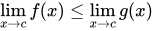
[edit]If
f
(
x
)
≤
g
(
x
)
{\displaystyle f(x)\leq g(x)}

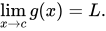
If
lim
x
→
c
f
(
x
)
=
lim
x
→
c
h
(
x
)
=
L
{\displaystyle \lim _{x\to c}f(x)=\lim _{x\to c}h(x)=L}


Polynomials and functions of the form xa
[edit]
Polynomials in x
[edit]-
lim
x
→
c
x
=
c
{\displaystyle \lim _{x\to c}x=c}
[1][2][3]
-
lim
x
→
c
(
a
x
+
b
)
=
a
c
+
b
{\displaystyle \lim _{x\to c}(ax+b)=ac+b}
-
lim
x
→
c
x
n
=
c
n
{\displaystyle \lim _{x\to c}x^{n}=c^{n}}
if n is a positive integer[5]
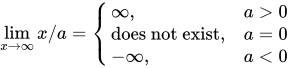
-
lim
x
→
∞
x
/
a
=
{
∞
,
a
>
0
does not exist
,
a
=
0
−
∞
,
a
<
0
{\displaystyle \lim _{x\to \infty }x/a={\begin{cases}\infty ,&a>0\\{\text{does not exist}},&a=0\\-\infty ,&a<0\end{cases}}}

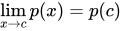
In general, if
p
(
x
)
{\displaystyle p(x)}

Functions of the form xa
[edit]-
lim
x
→
c
x
a
=
c
a
.
{\displaystyle \lim _{x\to c}x^{a}=c^{a}.}
[5] In particular,
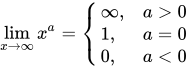
-
lim
x
→
∞
x
a
=
{
∞
,
a
>
0
1
,
a
=
0
0
,
a
<
0
{\displaystyle \lim _{x\to \infty }x^{a}={\begin{cases}\infty ,&a>0\\1,&a=0\\0,&a<0\end{cases}}}
-
lim
x
→
∞
x
a
=
{
∞
,
a
>
0
1
,
a
=
0
0
,
a
<
0
{\displaystyle \lim _{x\to \infty }x^{a}={\begin{cases}\infty ,&a>0\\1,&a=0\\0,&a<0\end{cases}}}
-
lim
x
→
c
x
1
/
a
=
c
1
/
a
{\displaystyle \lim _{x\to c}x^{1/a}=c^{1/a}}
.[5] In particular,
-
lim
x
→
∞
x
1
/
a
=
lim
x
→
∞
x
a
=
∞
for any
a
>
0
{\displaystyle \lim _{x\to \infty }x^{1/a}=\lim _{x\to \infty }{\sqrt[{a}]{x}}=\infty {\text{ for any }}a>0}
[6]
-
lim
x
→
∞
x
1
/
a
=
lim
x
→
∞
x
a
=
∞
for any
a
>
0
{\displaystyle \lim _{x\to \infty }x^{1/a}=\lim _{x\to \infty }{\sqrt[{a}]{x}}=\infty {\text{ for any }}a>0}
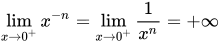
-
lim
x
→
0
+
x
−
n
=
lim
x
→
0
+
1
x
n
=
+
∞
{\displaystyle \lim _{x\to 0^{+}}x^{-n}=\lim _{x\to 0^{+}}{\frac {1}{x^{n}}}=+\infty }
-
lim
x
→
0
−
x
−
n
=
lim
x
→
0
−
1
x
n
=
{
−
∞
,
if
n
is odd
+
∞
,
if
n
is even
{\displaystyle \lim _{x\to 0^{-}}x^{-n}=\lim _{x\to 0^{-}}{\frac {1}{x^{n}}}={\begin{cases}-\infty ,&{\text{if }}n{\text{ is odd}}\\+\infty ,&{\text{if }}n{\text{ is even}}\end{cases}}}
-
lim
x
→
∞
a
x
−
1
=
lim
x
→
∞
a
/
x
=
0
for any real
a
{\displaystyle \lim _{x\to \infty }ax^{-1}=\lim _{x\to \infty }a/x=0{\text{ for any real }}a}


Exponential functions
[edit]Functions of the form ag(x)
[edit]-
lim
x
→
c
e
x
=
e
c
{\displaystyle \lim _{x\to c}e^{x}=e^{c}}
, due to the continuity of e x {\displaystyle e^{x}}
-
lim
x
→
∞
a
x
=
{
∞
,
a
>
1
1
,
a
=
1
0
,
0
<
a
<
1
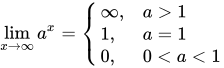
{\displaystyle \lim _{x\to \infty }a^{x}={\begin{cases}\infty ,&a>1\\1,&a=1\\0,&0<a<1\end{cases}}}
-
lim
x
→
∞
a
−
x
=
{
0
,
a
>
1
1
,
a
=
1
∞
,
0
<
a
<
1
{\displaystyle \lim _{x\to \infty }a^{-x}={\begin{cases}0,&a>1\\1,&a=1\\\infty ,&0<a<1\end{cases}}}
[6]
-
lim
x
→
∞
a
x
=
lim
x
→
∞
a
1
/
x
=
{
1
,
a
>
0
0
,
a
=
0
does not exist
,
a
<
0
{\displaystyle \lim _{x\to \infty }{\sqrt[{x}]{a}}=\lim _{x\to \infty }{a}^{1/x}={\begin{cases}1,&a>0\\0,&a=0\\{\text{does not exist}},&a<0\end{cases}}}

![{\displaystyle \lim _{x\to \infty }{\sqrt[{x}]{a}}=\lim _{x\to \infty }{a}^{1/x}={\begin{cases}1,&a>0\\0,&a=0\\{\text{does not exist}},&a<0\end{cases}}}](https://wikimedia.org/api/rest_v1/media/math/render/svg/257587de98c10b53ea0f58512ac1955779cf57d1)
Functions of the form xg(x)
[edit]-
lim
x
→
∞
x
x
=
lim
x
→
∞
x
1
/
x
=
1
{\displaystyle \lim _{x\to \infty }{\sqrt[{x}]{x}}=\lim _{x\to \infty }{x}^{1/x}=1}
![{\displaystyle \lim _{x\to \infty }{\sqrt[{x}]{x}}=\lim _{x\to \infty }{x}^{1/x}=1}](https://wikimedia.org/api/rest_v1/media/math/render/svg/aa1a821ef69483eecca48841d2b536f92682b8d6)
Functions of the form f(x)g(x)
[edit]-
lim
x
→
+
∞
(
x
x
+
k
)
x
=
e
−
k
{\displaystyle \lim _{x\to +\infty }\left({\frac {x}{x+k}}\right)^{x}=e^{-k}}
[2]
-
lim
x
→
0
(
1
+
x
)
1
x
=
e
{\displaystyle \lim _{x\to 0}\left(1+x\right)^{\frac {1}{x}}=e}
[2]
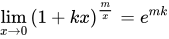
-
lim
x
→
0
(
1
+
k
x
)
m
x
=
e
m
k
{\displaystyle \lim _{x\to 0}\left(1+kx\right)^{\frac {m}{x}}=e^{mk}}
-
lim
x
→
+
∞
(
1
+
1
x
)
x
=
e
{\displaystyle \lim _{x\to +\infty }\left(1+{\frac {1}{x}}\right)^{x}=e}
[7]
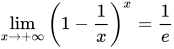
-
lim
x
→
+
∞
(
1
−
1
x
)
x
=
1
e
{\displaystyle \lim _{x\to +\infty }\left(1-{\frac {1}{x}}\right)^{x}={\frac {1}{e}}}
-
lim
x
→
+
∞
(
1
+
k
x
)
m
x
=
e
m
k
{\displaystyle \lim _{x\to +\infty }\left(1+{\frac {k}{x}}\right)^{mx}=e^{mk}}
[6]
-
lim
x
→
0
(
1
+
a
(
e
−
x
−
1
)
)
−
1
x
=
e
a
{\displaystyle \lim _{x\to 0}\left(1+a\left({e^{-x}-1}\right)\right)^{-{\frac {1}{x}}}=e^{a}}
. This limit can be derived from this limit.
Sums, products and composites
[edit]-
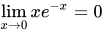
lim
x
→
0
x
e
−
x
=
0
{\displaystyle \lim _{x\to 0}xe^{-x}=0}
-
lim
x
→
∞
x
e
−
x
=
0
{\displaystyle \lim _{x\to \infty }xe^{-x}=0}
-
lim
x
→
0
(
a
x
−
1
x
)
=
ln
a
,
{\displaystyle \lim _{x\to 0}\left({\frac {a^{x}-1}{x}}\right)=\ln {a},}
for all positive a.[4][7]
-
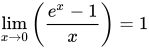
lim
x
→
0
(
e
x
−
1
x
)
=
1
{\displaystyle \lim _{x\to 0}\left({\frac {e^{x}-1}{x}}\right)=1}
-
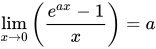
lim
x
→
0
(
e
a
x
−
1
x
)
=
a
{\displaystyle \lim _{x\to 0}\left({\frac {e^{ax}-1}{x}}\right)=a}

Logarithmic functions
[edit]Natural logarithms
[edit]-
lim
x
→
c
ln
x
=
ln
c
{\displaystyle \lim _{x\to c}\ln {x}=\ln c}
, due to the continuity of ln x {\displaystyle \ln {x}}
. In particular,
-
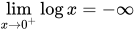
lim
x
→
0
+
log
x
=
−
∞
{\displaystyle \lim _{x\to 0^{+}}\log x=-\infty }
-
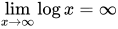
lim
x
→
∞
log
x
=
∞
{\displaystyle \lim _{x\to \infty }\log x=\infty }
-
lim
x
→
0
+
log
x
=
−
∞
{\displaystyle \lim _{x\to 0^{+}}\log x=-\infty }
-
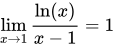
lim
x
→
1
ln
(
x
)
x
−
1
=
1
{\displaystyle \lim _{x\to 1}{\frac {\ln(x)}{x-1}}=1}
-
lim
x
→
0
ln
(
x
+
1
)
x
=
1
{\displaystyle \lim _{x\to 0}{\frac {\ln(x+1)}{x}}=1}
[7]
-
lim
x
→
0
−
ln
(
1
+
a
(
e
−
x
−
1
)
)
x
=
a
{\displaystyle \lim _{x\to 0}{\frac {-\ln \left(1+a\left({e^{-x}-1}\right)\right)}{x}}=a}
. This limit follows from L'Hôpital's rule.
-
lim
x
→
0
x
ln
x
=
0
{\displaystyle \lim _{x\to 0}x\ln x=0}
, hence lim x → 0 x x = 1 {\displaystyle \lim _{x\to 0}x^{x}=1}
-
lim
x
→
∞
ln
x
x
=
0
{\displaystyle \lim _{x\to \infty }{\frac {\ln x}{x}}=0}
[6]

Logarithms to arbitrary bases
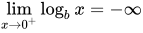
[edit]For b > 1,
-
lim
x
→
0
+
log
b
x
=
−
∞
{\displaystyle \lim _{x\to 0^{+}}\log _{b}x=-\infty }
-
lim
x
→
∞
log
b
x
=
∞
{\displaystyle \lim _{x\to \infty }\log _{b}x=\infty }

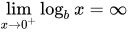
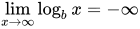
For b < 1,
-
lim
x
→
0
+
log
b
x
=
∞
{\displaystyle \lim _{x\to 0^{+}}\log _{b}x=\infty }
-
lim
x
→
∞
log
b
x
=
−
∞
{\displaystyle \lim _{x\to \infty }\log _{b}x=-\infty }
Both cases can be generalized to:
-
lim
x
→
0
+
log
b
x
=
−
F
(
b
)
∞
{\displaystyle \lim _{x\to 0^{+}}\log _{b}x=-F(b)\infty }
-
lim
x
→
∞
log
b
x
=
F
(
b
)
∞
{\displaystyle \lim _{x\to \infty }\log _{b}x=F(b)\infty }


where
F
(
x
)
=
2
H
(
x
−
1
)
−
1
{\displaystyle F(x)=2H(x-1)-1}


Trigonometric functions
[edit]If
x
{\displaystyle x}
-
lim
x
→
a
sin
x
=
sin
a
{\displaystyle \lim _{x\to a}\sin x=\sin a}
-
lim
x
→
a
cos
x
=
cos
a
{\displaystyle \lim _{x\to a}\cos x=\cos a}
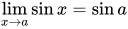

These limits both follow from the continuity of sin and cos.
-
lim
x
→
0
sin
x
x
=
1
{\displaystyle \lim _{x\to 0}{\frac {\sin x}{x}}=1}
.[7][8] Or, in general,
-
lim
x
→
0
sin
a
x
a
x
=
1
{\displaystyle \lim _{x\to 0}{\frac {\sin ax}{ax}}=1}
, for a not equal to 0.
-
lim
x
→
0
sin
a
x
x
=
a
{\displaystyle \lim _{x\to 0}{\frac {\sin ax}{x}}=a}
-
lim
x
→
0
sin
a
x
b
x
=
a
b
{\displaystyle \lim _{x\to 0}{\frac {\sin ax}{bx}}={\frac {a}{b}}}
, for b not equal to 0.
-
lim
x
→
0
sin
a
x
a
x
=
1
{\displaystyle \lim _{x\to 0}{\frac {\sin ax}{ax}}=1}
-
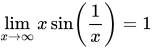
lim
x
→
∞
x
sin
(
1
x
)
=
1
{\displaystyle \lim _{x\to \infty }x\sin \left({\frac {1}{x}}\right)=1}
-
lim
x
→
0
1
−
cos
x
x
=
lim
x
→
0
cos
x
−
1
x
=
0
{\displaystyle \lim _{x\to 0}{\frac {1-\cos x}{x}}=\lim _{x\to 0}{\frac {\cos x-1}{x}}=0}
[4][8][9]
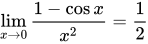
-
lim
x
→
0
1
−
cos
x
x
2
=
1
2
{\displaystyle \lim _{x\to 0}{\frac {1-\cos x}{x^{2}}}={\frac {1}{2}}}
-
lim
x
→
n
±
tan
(
π
x
+
π
2
)
=
∓
∞
{\displaystyle \lim _{x\to n^{\pm }}\tan \left(\pi x+{\frac {\pi }{2}}\right)=\mp \infty }
, for integer n.
-
lim
x
→
0
tan
x
x
=
1
{\displaystyle \lim _{x\to 0}{\frac {\tan x}{x}}=1}
. Or, in general,
-
lim
x
→
0
tan
a
x
a
x
=
1
{\displaystyle \lim _{x\to 0}{\frac {\tan ax}{ax}}=1}
, for a not equal to 0.
-
lim
x
→
0
tan
a
x
b
x
=
a
b
{\displaystyle \lim _{x\to 0}{\frac {\tan ax}{bx}}={\frac {a}{b}}}
, for b not equal to 0.
-
lim
x
→
0
tan
a
x
a
x
=
1
{\displaystyle \lim _{x\to 0}{\frac {\tan ax}{ax}}=1}
-
lim
n
→
∞
sin
sin
⋯
sin
(
x
0
)
⏟
n
=
0
{\displaystyle \lim _{n\to \infty }\ \underbrace {\sin \sin \cdots \sin(x_{0})} _{n}=0}
, where x0 is an arbitrary real number.
-
lim
n
→
∞
cos
cos
⋯
cos
(
x
0
)
⏟
n
=
d
{\displaystyle \lim _{n\to \infty }\ \underbrace {\cos \cos \cdots \cos(x_{0})} _{n}=d}
, where d is the Dottie number. x0 can be any arbitrary real number.

Sums
[edit]In general, any infinite series is the limit of its partial sums. For example, an analytic function is the limit of its Taylor series, within its radius of convergence.
-
lim
n
→
∞
∑
k
=
1
n
1
k
=
∞
{\displaystyle \lim _{n\to \infty }\sum _{k=1}^{n}{\frac {1}{k}}=\infty }
. This is known as the harmonic series.[6]
-
lim
n
→
∞
(
∑
k
=
1
n
1
k
−
log
n
)
=
γ
{\displaystyle \lim _{n\to \infty }\left(\sum _{k=1}^{n}{\frac {1}{k}}-\log n\right)=\gamma }
. This is the Euler Mascheroni constant.
Notable special limits
[edit]-
lim
n
→
∞
n
n
!
n
=
e
{\displaystyle \lim _{n\to \infty }{\frac {n}{\sqrt[{n}]{n!}}}=e}
-
lim
n
→
∞
(
n
!
)
1
/
n
=
∞
{\displaystyle \lim _{n\to \infty }\left(n!\right)^{1/n}=\infty }
. This can be proven by considering the inequality e x ≥ x n n ! {\displaystyle e^{x}\geq {\frac {x^{n}}{n!}}}
at x = n {\displaystyle x=n}
.
-
lim
n
→
∞
2
n
2
−
2
+
2
+
⋯
+
2
⏟
n
=
π
{\displaystyle \lim _{n\to \infty }\,2^{n}\underbrace {\sqrt {2-{\sqrt {2+{\sqrt {2+\dots +{\sqrt {2}}}}}}}} _{n}=\pi }
. This can be derived from Viète's formula for π.
![{\displaystyle \lim _{n\to \infty }{\frac {n}{\sqrt[{n}]{n!}}}=e}](https://wikimedia.org/api/rest_v1/media/math/render/svg/9e67d9f7e2588c9b3d418f1107e9ea27b8f330ed)
Limiting behavior
[edit]Asymptotic equivalences
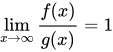
[edit]Asymptotic equivalences,
f
(
x
)
∼
g
(
x
)
{\displaystyle f(x)\sim g(x)}

-
lim
x
→
∞
x
/
ln
x
π
(
x
)
=
1
{\displaystyle \lim _{x\to \infty }{\frac {x/\ln x}{\pi (x)}}=1}
, due to the prime number theorem, π ( x ) ∼ x ln x {\displaystyle \pi (x)\sim {\frac {x}{\ln x}}}
, where π(x) is the prime counting function.
-
lim
n
→
∞
2
π
n
(
n
e
)
n
n
!
=
1
{\displaystyle \lim _{n\to \infty }{\frac {{\sqrt {2\pi n}}\left({\frac {n}{e}}\right)^{n}}{n!}}=1}
, due to Stirling's approximation, n ! ∼ 2 π n ( n e ) n {\displaystyle n!\sim {\sqrt {2\pi n}}\left({\frac {n}{e}}\right)^{n}}
.
Big O notation
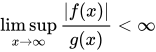
[edit]The behaviour of functions described by Big O notation can also be described by limits. For example
-
f
(
x
)
∈
O
(
g
(
x
)
)
{\displaystyle f(x)\in {\mathcal {O}}(g(x))}
if lim sup x → ∞ | f ( x ) | g ( x ) < ∞ {\displaystyle \limsup _{x\to \infty }{\frac {|f(x)|}{g(x)}}<\infty }
References
[edit]- ^ a b c d e f g h i j "Basic Limit Laws". math.oregonstate.edu. Retrieved 2019-07-31.
- ^ a b c d e f g h i j k l "Limits Cheat Sheet - Symbolab". www.symbolab.com. Retrieved 2019-07-31.
- ^ a b c d e f g h "Section 2.3: Calculating Limits using the Limit Laws" (PDF).
- ^ a b c "Limits and Derivatives Formulas" (PDF).
- ^ a b c d e f "Limits Theorems". archives.math.utk.edu. Retrieved 2019-07-31.
- ^ a b c d e "Some Special Limits". www.sosmath.com. Retrieved 2019-07-31.
- ^ a b c d "SOME IMPORTANT LIMITS - Math Formulas - Mathematics Formulas - Basic Math Formulas". www.pioneermathematics.com. Retrieved 2019-07-31.
- ^ a b "World Web Math: Useful Trig Limits". Massachusetts Institute of Technology. Retrieved 2023-03-20.
- ^ "Calculus I - Proof of Trig Limits". Retrieved 2023-03-20.
| Precalculus | |||||
|---|---|---|---|---|---|
| Limits | |||||
| Differential calculus |
| ||||
| Integral calculus | |||||
| Vector calculus |
| ||||
| Multivariable calculus | |||||
| Sequences and series |
| ||||
| Special functions and numbers | |||||
| History of calculus | |||||
| Lists |
| ||||
| Miscellaneous topics |
| ||||