
| Kumsusan Palace of the Sun | |
|---|---|
Sacred Temple of Juche | |
.jpg) Kumsusan Palace of the Sun (2015) | |
 Interactive map of the Kumsusan Palace of the Sun area | |
| General information | |
| Architectural style | Modern, neoclassical |
| Location |  North Korea North Korea |
| Coordinates | 39°3′51″N 125°47′15″E / 39.06417°N 125.78750°E |
| Completed | 1976 |
| Opened | 8 July 1995 (for Kim Il Sung) 17 December 2012 (current form) |
| Owner | North Korean Government |
| Website | |
| http://www.naenara.com.kp/main/index/en/exhibition | |
| Korean name | |
| Hangul | 금수산태양궁전 |
| Hanja | 錦繡山太陽宮殿 |
| RR | Geumsusan taeyang gungjeon |
| MR | Kŭmsusan t'aeyang kungjŏn |
The Kumsusan Palace of the Sun (Korean: 금수산태양궁전), formerly the Kumsusan Memorial Palace (금수산기념궁전), is the mausoleum where the preserved bodies of Kim Il Sung and Kim Jong Il, the eternal leaders of Juche Korea, are displayed. Located near the northeast corner of the city of Pyongyang, the memorial has been renovated from the Kumsusan Assembly Hall (금수산의사당), Kim Il Sung's official residence and office.
The palace has been described as the "sacred temple of Juche" (주체의 최고성지) and is noted in the Socialist Constitution as the "eternal sanctuary of the entire Korean nation," being preserved as a national landmark.[1]
Overview
[edit]Inside the palace, the embalmed bodies of Kim Il Sung and Kim Jong Il are preserved and displayed within clear glass sarcophagi, housed within separate "Hall of Eternal Life" (영생홀).[2] Their heads rest on a traditional Korean buckwheat pillow and their bodies are covered by the flag of the Workers' Party of Korea. [3]
At 115,000 square feet (10,700 m2),[4] Kumsusan is the largest mausoleum dedicated to a Communist leader[5] and the only one to house the remains of multiple people. Some halls inside the building are up to 1 kilometre (3,300 ft) long.[4] It is fronted by the Kumsusan Palace of the Sun Square Parklands (금수산태양궁전광장공원), which is approximately 500 metres (1,600 ft) in length, and is bordered on its northern and eastern sides by a moat.[6]
The palace is accessed via an underpass across the road at security screening facilities, which is serviced by a tram stop.[7]
Gallery
[edit]-
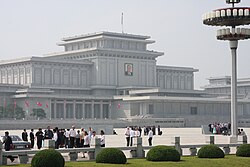 Kumsusan Memorial Palace, with Kim Il Sung (2008).
 -
 Kumsusan Palace of the Sun, with both Kim Il Sung and Kim Jong Il (2013).
 -
 Portion of the Kumsusan Palace of the Sun Square Parklands (2015).

.jpg)
.jpg)
History
[edit]The palace was built in 1976 as the Kumsusan Assembly Hall (금수산의사당) and served Kim Il Sung's official residence. It was used as Kim's primary workplace and was noted for being the venue for hosting various dignitaries and foreign delegations.
Following Kim Il Sung's death in 1994, the building was renovated and transformed into his mausoleum.[8] Original ideas for a memorial included a hall on Kim Il Sung Square similar to the Lenin Mausoleum, a complex at the Mansudae Grand Monument or a shrine at his birthplace in Mangyongdae.[9] However, Kim Jong Il decided that Kim should be preserved at place he was "known by and worked for the people." [9] The interior of the building was significantly renovated from an office and residence to memorial hall, believed to have cost at least $100 million,[10] with some sources put the figure as high as $900 million.[11][12] The monument was renamed as the Kumsusan Memorial Palace (금수산기념궁전) and opened on 8 July 1995.[9]
After Kim Jong Il's death in 2011, his body lay in state at the palace for 10 days.[13] Following this period, on 28 December 2011, the palace served as the start and end point for a 40-kilometre (25 mi) funeral procession lasting three hours.[14][15] On 12 January 2012, the North Korean government confirmed that Kim Jong Il's preserved remains would be put on permanent display in the palace[16], with the building formally renamed the Kumsusan Palace of the Sun by a combined act of the North Korean cabinet and parliament, and the Workers' Party of Korea leadership.[17] Kim Jong Un supposedly gave field guidance at the palace over 150 times in 2012 and gave personal notes over the interior and exterior renovation.[18] These inspection efforts and renovation were categorized in a documentary "May the Sacred Temple of the Eternal Sun Shine for All Eternity"[18]
The palace was opened in its current form 17 December 2012 as the Kumsusan Palace of the Sun (금수산태양궁전).[19]
On 2 April 2013, the Supreme People's Assembly made a full amendment to the Constitution clarifying the status of the palace, and passed the Law on the Kumsusan Palace of the Sun and its corresponding SPA Ordinance. This formally declared the palace as a national landmark, defined its mission and vision, and prepared measures to maintain it for the benefit of Koreans and foreign tourists. It also outlines the duties of citizens towards this memorial edifice.[20]
Role in the Kim family cult of personality
[edit]The palace, which symbolizes the eternal presence of the two leaders, is described by North Korean sources and observers as a place of deep reverence, where they are honored in their “lifetime appearance.” [21] Along with Mansudae Grand Monument, the Kumsusan Palace of the Sun is considered a sacred site and not as a tourist attraction to North Koreans, with peoples' under 17 years of age not permitted to visit.[22] The palace functions as a pilgrimage destination for North Koreans. Citizens, soldiers, and foreign visitors are brought through highly choreographed rituals of mourning and respect. [21]
This ritualisation of political figures is a core mechanism of the cult of personality, where leaders are not just historical figures but treated as quasi‑divine presences. The palace, containing strict protocols such as bowing rituals at the bodies of the leaders, carries a religious presence to visitors, which is exemplified by its characterization as the "sacred temple of Juche" (주체의 최고성지). Violation of these norms can carry severe penalties, which strengthens the climate of reverence or fear around the Kim family.[21]
Current leader Kim Jong Un often visits the palace to pay ritual respects on important national occasions such as the Day of the Sun and Day of the Shining Star as well as the anniversaries of the leaders deaths, sometimes with his wife Ri Sol Ju and his daughter Kim Ju Ae. He is often accompanied by members of the party, government and military. [23]
Interior and layout
[edit]The palace is opened to foreign visitors on Thursday and Sunday mornings and on national holidays, with visits taking between 2 to 3 hours.[22] Photography, videotaping, and smoking are not permitted anywhere inside the palace. The palace gardens, though, is open all week, and is a venue for national rallies.[citation needed]
There are few windows on the building with the exception of one located on the top balcony on the north side. This was the window of Kim Il Sung’s office and was left as is during the 1995 renovation as to gave a clear view of the Revolutionary Martyrs’ Cemetery where his first wife and mother of Kim Jong Il, Kim Jong Suk, was laid to rest. Later, Kim Jong Il's third wife and mother of Kim Jong Un, Ko Yong Hui, would also be buried in her own memorial at the cemetery. Limiting the windows on the palace was done to make the structure more secure in case of any attacks and limit light exposure of the displays within.[22]
Visitors enter from the travelator underpass and enter the building to the Statue Hall, making their way through the Wailing Hall, before entering the Hall of Eternal Life containing the remains of Kim Il Sung and the adjoining rooms with medals and awards. Similarly, visitors then enter the lower level, where the Hall of Eternal Life containing the remains of Kim Jong Il are hosted along with the Medal Hall of accolades given to him during his life. [3]
.jpg) Visitors queuing in the security screening building (2010).
Visitors queuing in the security screening building (2010).
Security and access
[edit]The building is accessed via an underpass from security screening facilities across the road. Upon entering the checkpoint, visitors (both foreigners and North Korean tourists) have to walk over a shoe cleaning device,[7] are asked to check all personal belongings except their wallets in a cloak room, and are given a numbered ticket to claim their belongings when leaving.[24] Visitors proceed along a series of long travelators (moving walkways), which travel underneath the road, towards the palace.[25]
 White marble statue of Kim Il Sung in the Statue Hall (2000).
Statue hall
[edit]Upon exiting the travelators, visitors appear on the eastern side of the building, and upon walking up a stairway, arrive at the doors to the Statue Hall (립상홀).
In the original 1995 refit, the hall was constructed with grey marble arched columns guiding the eye through the space towards a white marble statue of Kim Il Sung, supported by a background of soft red light.[9] Upon its renovation in 2012, a statue of Kim Jong Il was added, along with military flags of the Korean Peoples' Army. In 2015, these were changed to a life-like wax-style statues of Kim Il Sung and Kim Jong Il, standing upon a sunrise background flanked by state and party flags. The interior of the hall has also since been changed to a warm marble color. [26]
Visitors are instructed to stop at a yellow line on the floor and, after a few moments of contemplation, bow towards the statues of the leaders. When Kim Jong Un, party or government officials or foreign dignitaries visit the hall, its sides are flanked by the Korean Peoples' Army Honour Guard. A solemn version of the "Song of General Kim Il Sung" is played in the hall.[23]
Wailing hall
[edit]In the Wailing Hall, visitors are provided with small speaker devices that play a narration detailing the Korean people’s grief following the death of Kim Il Sung and Kim Jong Il. The room features bronze-style busts of grieving figures.
Halls of eternal life
[edit]Accessible by a lift, Kim Il Sung's Hall of Eternal Life (영생홀) was positioned on the topmost floor in the 1995 reconfiguration.
After passing through a dust-blowing machine, visitors enter the first hall dedicated to Kim Il Sung and then second to Kim Jong Il. There are separate halls for each leader which are similar in composition.[3] In these rooms are where the preserved remains of the leaders are lying in state. A red rope barrier surrounds each transparent crystal sarcophagus, with visitors proceeding in groups of four. Visitors bow at they body's feet, then at his left and right sides.
Reportedly, Russian experts were brought to the mausoleum to embalm Kim Jong Il's body for permanent display in the same manner of his father and other former Communist leaders such as Vladimir Lenin, Mao Zedong and Ho Chi Minh.[27]
Medal halls
[edit]After the Halls of Eternal Life, visitors enter the Medal Halls (메달홀) where various awards and honors bestowed upon Kim Il Sung and Kim Jong Il are housed. There are separate halls for each leader which are similar in composition to each other, with Kim Jong Il's hosted on the lower level.[3][28] In Kim Il Sung's hall awards include degree certificates, only one of which is from a Western university: Kensington University in California, US,[29] an unaccredited university.[30][31][32][33]
The palace also contains exhibits of the leaders' personal vehicles, outfits, and medals and decorations, which have now been added to the expanded collection as part of a reorganization.[26]
Kumsusan Palace of the Sun Square Parklands
[edit]After the 1995 renovation, the plaza was left as an empty stone square, with Kim Jong Il remarking that "...while grand events had previously been held in Kim Il Sung Square...from now on, they could be held in this square just as they were held in honor of the Great Leader."[2] On various occasions, military parades by the Korean People's Army were held in the plaza as well as rallies and commemorative photo sessions.
The plaza was made into a public parkland and was renamed the Kumsusan Palace of the Sun Square Parklands (금수산태양궁전광장공원) following the 2012 renovation.[2] The construction and design of the park was reportedly directed by Kim Jong Un.[34] The park is open to visitors all week long, and features a greenhouse which covers an area of 100 hectares with over 400,000 trees of 260 difference species. Over 200 of them are rare trees sent from around the world.[22][35] Parades and rallies are still held in the park on various occasions, such as the death anniversary of the leaders.[36]
As a meeting hall
[edit]The palace has served as the venue for the 3rd Conference of the Workers' Party of Korea in September 2010 and the 4th Conference of the WPK in April 2012. Both events were held in the Plenary Meeting Hall (전원회 실) wing on the west of the building.
Around the palace
[edit]Not far from the palace are the Kumsusan Guest Palace (39°03′40″N 125°48′06″E / 39.06123742°N 125.801766607°E) which was built in 2019 and used by Chinese leader Xi Jinping and the older, Paekhwawon Guesthouse (39°02′48″N 125°48′38″E / 39.046631806°N 125.81060982°E), which was used by South Korean president Moon Jae-in, U.S. secretary of state Mike Pompeo and Russian foreign minister Sergey Lavrov.[37]
See also
[edit]- Mangyongdae
- Mansu Hill Grand Monument
- Grand People's Study House
- International Friendship Exhibition
- Kimilsungia and Kimjongilia Exhibition Hall
- Revolutionary Martyrs' Cemetery
- Patriotic Martyrs' Cemetery
- Seoul National Cemetery
- Day of the Shining Star
- Day of the Sun
- Chairman Mao Memorial Hall
- Sun Yat-sen Mausoleum
- Cihu Mausoleum
- Touliao Mausoleum
- Sükhbaatar's Mausoleum
- Ho Chi Minh Mausoleum
- Ferdinand E. Marcos Presidential Center
- Lenin's Mausoleum
- Valley of the Fallen
- Georgi Dimitrov Mausoleum
- House of Flowers (mausoleum)
- Anıtkabir
- Mausoleum of Ruhollah Khomeini
- Türkmenbaşy Ruhy Mosque
- Mazar-e-Quaid
- Bourguiba mausoleum
- Kwame Nkrumah Mausoleum
- Agostinho Neto's Mausoleum
References
[edit]Citations
[edit]- ^ "Socialist Constitution of the Democratic Peoples Republic of Korea" (PDF).
- ^ a b c "경애하는 김정은동지께서는 금수산태양궁전을 주체의 최고성지로 숭엄하게 더 잘 꾸리도록 정력적으로 이끌어주시였다". 12 February 2022. Archived from the original on 2023-02-12.
- ^ a b c d "First Western Tourists Inside Kim Mausoleum Describe "Surreal" Experience". NK News. Retrieved 27 September 2013.
- ^ a b Cha, Victor (2013). The Impossible State: North Korea, Past and Future. London: Vintage. p. 4. ISBN 978-0-099-57865-9.
- ^ Mark Johanson (January 23, 2013). "Kim Jong-il's Mausoleum, As Described By Its First Western Visitors". International Business Times. Archived from the original on September 28, 2013. Retrieved February 14, 2013.
- ^ Willoughby 2008, p. 126
- ^ a b "Inside The Kumsusan Palace of the Sun: Surreal even by North Korean Standards". visitthedprk.org. Archived from the original on 2021-01-22. Retrieved 2018-01-26.
- ^ Burdick 2010, p. 100
- ^ a b c d "영원한 태양의 집, 주체의 최고성지로". 2017. Archived from the original on 12 February 2023.
- ^ Hassig 2009, p. 53
- ^ Kim 2001, p. 20
- ^ Kongdan 2000, p. 97
- ^ "North Korea leader lies in state". BBC News. 20 December 2011. Retrieved 20 December 2011.
- ^ "Kim Jong-il state funeral held in North Korea". BBC News. 28 December 2011. Retrieved 28 December 2011.
- ^ McCurry, Justin (28 December 2011). "Kim Jong-il funeral: thousands mourn North Korean leader". The Guardian. Retrieved 28 December 2011.
- ^ "Kim Jong-il to be put on display". ABC Sydney. January 13, 2012. Retrieved January 12, 2012.
- ^ "North Korea marks late leader Kim Jong-il's birthday". BBC News. Retrieved 18 February 2012.
- ^ a b "영원한 태양의 성지로 만대에 빛내이시려". 2013.
- ^ "North Korea marks the anniversary of Kim Jong Il's death". NBC News. 2012-12-17. Retrieved 2026-02-08.
- ^ www.kcna.co.jp http://www.kcna.co.jp/item/2013/201304/news01/20130401-29ee.html. Retrieved 2026-02-08.
}: Missing or empty|title=(help) - ^ a b c "Cultural Exploration around Kumsusan Palace of the Sun – Pyongyang – Korea Trip Guide". 2024-02-01. Retrieved 2026-02-08.
- ^ a b c d webmasterypt (2020-08-31). "Kumsusan Palace of the Sun - DPRK Guide 2026". Young Pioneer Tours. Retrieved 2026-02-09.
- ^ a b 조선중앙통신사. "조선중앙통신 | 기사 | 경애하는 김정은동지께서 새해 2026년에 즈음하여 금수산태양궁전을 찾으시였다". kcna.kp. Archived from the original on 2026-01-02. Retrieved 2026-02-08.
- ^ Burdick 2010, p. 110
- ^ Burdick 2010, p. 109
- ^ a b "Kumsusan Memorial Palace of the Sun in Pyongyang, North Korea". Lonely Planet. Retrieved 2016-11-02.
- ^ Salmon, Andrew (December 28, 2011). "Kim Jong-il: a lavish North Korean funeral beneath a leaden sky". Daily Telegraph. Retrieved December 29, 2011.
- ^ Becker 2005, p. 77
- ^ Burdick 2010, p. 116
- ^ Chandler, John (23 April 1996). "Kensington University Faces Closure Hearing". Los Angeles Times. Archived from the original on 16 May 2012. Retrieved 20 December 2011.
- ^ Chandler, John (4 January 1996). "State Orders Closure of Area School: Regulators say the private, Glendale-based Kensington University lacks 'credible academic standards'". Los Angeles Times. Archived from the original on 16 May 2012.
- ^ Chandler, John (27 June 1996). "University Sidesteps Close Order: Kensington correspondence school transfers Glendale student enrollment to 'paper campus' in Hawaii". Los Angeles Times. Archived from the original on 16 May 2012. Retrieved 20 December 2011.
- ^ "Kensington University". Department of Commerce and Consumer Affairs, Hawaii. Archived from the original on 15 June 2011. Retrieved 20 December 2011.
- ^ Kim, Myong Hun. "Plaza Park of Kumsusan Palace of Sun Laid Out Well". Rodong Sinmun. Retrieved May 24, 2013.
- ^ Melvin, Curtis (December 17, 2012). "Kumsusan Palace renovations". North Korean Economy Watch. Retrieved May 24, 2013.
- ^ supersuhui (2021-12-17). 위대한 령도자 김정일동지 서거 10돐 중앙추모대회 엄숙히 거행 경애하는 김정은동지께서 추모대회에 참석하시였다. Retrieved 2026-02-08 – via YouTube.
- ^ Colin Zwirko (2023-02-21). "Large construction camp pops up near Pyongyang's foreign leader guesthouses". NK News. Retrieved 2023-02-21.
Sources
[edit]- Becker, Jasper (2005), Rogue regime: Kim Jong Il and the looming threat of North Korea, Oxford University Press, ISBN 978-0-19-517044-3
- Burdick, Eddie (2010), Three Days in the Hermit Kingdom: An American Visits North Korea, McFarland, ISBN 978-0-7864-4898-2
- Hassig, Ralph (2009), The Hidden People of North Korea: Everyday Life in the Hermit Kingdom, Rowman & Littlefield, ISBN 978-0-7425-6718-4
- Kim, Samuel S (2001), The North Korean System in the Post-Cold War Era, Palgrave Macmillan, ISBN 978-0-312-23974-9
- Oh, Kongdan (2000), North Korea Through the Looking Glass, Brookings Institution Press, ISBN 978-0-8157-6435-9
- Willoughby, Robert (2008), The Bradt Travel Guide: North Korea, Bradt Travel Guides, ISBN 978-1-84162-219-4
Further reading
[edit]- Kumsusan Palace of the Sun (PDF). Pyongyang: Foreign Languages Publishing House. 2016. No. 683203.
External links
[edit]

- Kim Il Sung-Kim Jong Il Foundation Archived 2016-05-07 at the Wayback Machine at Naenara
- 360-degree panorama image at DPRK 360
- In-depth tourist visit at Earth Nutshell
