
Christian-Albrechts-Universität zu Kiel | |
 Seal of Kiel University | |
| Latin: Academia Holsatorum Chiloniensis sive Christiana Albertina[1] | |
| Motto | Pax optima rerum |
|---|---|
Motto in English | Peace is the greatest good |
| Type | Public |
| Established | 1665 |
| Budget | € 223.7 million (2024)[2] Third-party funding: € 77.5 mio |
| President | Vacancy |
Academic staff | 431 professors (2024)[2] |
Total staff | 3,870 (2024, not including UKSH)[2] |
| Students | 24.925 (2024)[2] |
| Location | , , Germany 54°20′20″N 10°7′21″E / 54.33889°N 10.12250°E |
| Campus | Urban |
| Colors | Purple and white |
| Website | www.uni-kiel.de |
 | |
 | |
Kiel University, officially the Christian Albrecht University of Kiel, (German: Christian-Albrechts-Universität zu Kiel, abbreviated CAU, known informally as Christiana Albertina) is a public research university in the city of Kiel, Germany. It was founded in 1665 as the Academia Holsatorum Chiloniensis by Christian Albert, Duke of Holstein-Gottorp and has approximately 27,000 students today. It is the largest, oldest, and most prestigious university in the state of Schleswig-Holstein.
Until 1866, it was not only the northernmost university in Germany but at the same time the 2nd largest university of Denmark. After the Danish-German war Kiel came under Prussian administration which later led to being part of the German Empire and today the Federal Republic of Germany. Kiel is the capital of Schleswig-Holstein, and Kiel University is the largest and only comprehensive university in the federal state.
Faculty, alumni, and researchers of Kiel University have won 12 Nobel Prizes. Kiel University has been a member of the German Universities Excellence Initiative since 2006. The Cluster of Excellence The Future Ocean, which was established in cooperation with the GEOMAR Helmholtz Centre for Ocean Research Kiel in 2006 and existed until 2019, has been internationally recognized.
Since 2018, Kiel University holds two Clusters of Excellence. “Precision Medicine in Chronic Inflammation (PMI)“ deals with chronic inflammatory diseases and is closely tied to the University Medical Center Schleswig-Holstein, the University of Lübeck, the Research Center Borstel – Leibniz Lung Center, the Max Planck Institute for Evolutionary Biology, the Muthesius Academy of Art, the Kiel Institute for the World Economy and the Leibniz Institute for Science and Mathematics Education at Kiel University. „ROOTS - Social, Environmental, and Cultural Connectivity in Past Societies“ explores the roots of social, environmental, and cultural phenomena and processes that substantially marked past human development. It is an interdisciplinary research network involving scientists from 15 institutes at six faculties of Kiel University. There are also project partners in Germany and abroad. The university has a great reputation for its focus on public international law. The oldest public international law institution in Germany and Europe – the Walther Schuecking Institute for International Law – is based in Kiel.[3]
The university works closely with the internationally renowned GEOMAR Helmholtz Centre for Ocean Research Kiel and the Kiel Institute for the World Economy (IfW), which is associated with the university. Through a number of joint appointments, the CAU also has close personnel ties with both institutions.[4][5]
History
[edit]Founding of the University in Kiel
[edit] The inauguration of Kiel University.
The origins of the university in Kiel trace back to the increasing need for well-educated priests during the Reformation. Additionally, the growing involvement of citizens in significant administrative roles contributed to the idea of establishing a university in the duchies. However, wars in the early 17th century and political conflicts between dukes and the king initially delayed these plans. Eventually, Duke Friedrich III commissioned his son, Christian Albrecht, to advance the founding of the university. In 1660, Christian Albrecht succeeded in realizing these plans and selected Kiel as the university's location. On October 5, 1665, the university was inaugurated under the name Christiana Albertina in a former Franciscan monastery with four lecture halls and a library. At that time, 17 professors taught theology, medicine, law, and the liberal arts.[6][7]
Periods of Growth and Stagnation
[edit]A significant growth period for the university occurred a century later under Russian Empress Catherine the Great, from whom it received its colors, purple and white. Following the unification of the duchies in 1773, the university continued to flourish as the northernmost German and southernmost Scandinavian university. Nearly 100 years later, the university's development stagnated, particularly after Schleswig-Holstein became part of Prussia. From 1870, student numbers began to rise again, and 38 years later, women were also admitted.[6]
During and after WWII
[edit]During the Nazi regime starting in 1933, the university experienced Gleichschaltung, the expulsion of Jewish professors, and the persecution of dissenters. In World War II, many buildings were destroyed by Allied air raids, including the university library in 1942.[6]
Post-War Reconstruction and Expansion
[edit]With the support of the British, teaching resumed as early as November 1945, initially on ships. In the 1960s, a new campus was developed on the Kiel Westring. The student protests of the late 1960s led to a modernization of the university's structure. The campus was expanded in 1972 with buildings on Olshausenstraße and new sports facilities, and in 1991, the Faculty of Engineering opened in Kiel-Gaarden. The number of students steadily increased and now stands at about 25,000 to 30,000. The Christian-Albrecht University has not only become an internationally respected university but also one of the largest employers in Kiel.[6]
Faculties
[edit] Aerial view of the central campus
Christian-Albrechts-Universität currently consists of the following eight faculties:[8]
- Faculty of Theology
- Faculty of Law
- Faculty of Business, Economics and Social Sciences
- Faculty of Medicine
- Faculty of Arts and Humanities
- Faculty of Mathematics and Natural Sciences
- Faculty of Agricultural Science and Nutrition
- Faculty of Engineering
Central units
[edit]Central facilities of Kiel University include the University Library (newly opened in 2001), the Computing Centre (RZ), the Sports Centre, the Digital Science Center, the Interdisciplinary Multimedia Centre, the Research and Technology Centre, West Coast (FTZ) in Büsum, the Graduate Center, the Postdoc Center and the Institute for Inclusive Education.[9]
Affiliated institutes
[edit]Kiel University includes other independent institutions which, in accordance with Section 35 of the Schleswig-Holstein Higher Education Act (HSG), assume the status of a university institution:
- Institute for Security Policy
- Kiel Institute for the World Economy (IfW)
- Leibniz Institute for Science and Mathematics Education (IPN)
- ZBW – Leibniz Information Centre for Economics
- Lorenz-von-Stein-Institute for Administrative Sciences
- GEOMAR Helmholtz Centre for Ocean Research Kiel
- University Medical Center Schleswig-Holstein (UKSH)
- Schleswig-Holstein State Museums Foundation Schloss Gottorf
- Archaeological Museum Schloss Gottorf
- Museum of Art and Cultural History Schloss Gottorf
- Viking Museum Haithabu
- Open-Air Museum Molfsee - State Museum for Ethnology
- Jewish Museum in Rendsburg
- Ornamental Cast Iron Museum Büdelsdorf
- Cismar Monastery
Institutions associated with Kiel University
[edit]- Research Center Borstel
- GEOMAR | Helmholtz Centre for Ocean Research Kiel
- Helmholtz-Zentrum Geesthacht, Centre for Materials and Coastal Research
- Max Planck Institute for Evolutionary Biology
- Max Rubner-Institut: Department of Microbiology and Biotechnology, Kiel
- Max Rubner-Institut: Department of Safety and Quality of Milk and Fish Products, Kiel
- Radiation safety seminar
- University Hospital Schleswig-Holstein
Research and study centres
[edit]Further centres at Kiel University:
- German-Norwegian Study Centre (DNSZ)
- Molecular Imaging North Competence Center (MOIN CC)[10]
- GEOMAR Helmholtz Centre for Ocean Research Kiel l
- Hermann Kantorowicz Institute for Fundamental Legal Research (HKI)
- Institute for Security Policy Kiel University (ISPK)
- Kiel Institute for the World Economy (IfW)
- Leibniz Institute for Science and Mathematics Education (IPN)
- Lorenz-von-Stein-Institute for Administrative Sciences
- Walther Schücking Institute for International Law (WSI)
- Zentrum für asiatische und afrikanische Studien (ZAAS)
- Centre for Biochemistry and Molcular Biology (BiMo)[11]
- Gustav Radbruch Network for Philosophy and Ethics of the Environment[12]
- Key Skills Centre (ZfS)
- Center of Clinical Anatomy (ZKA)Zentrum für Lehrerbildung (ZfL)
- Center for Molecular Biosciences (ZMB)
- Center of North American Studies (ZNAS)
- Zentrum für Osteuropastudien (ZOS)
- Center for Ocean and Society (CeOS)
- China Centre[13]
Continuing Professional Development
[edit]The Continuing Professional Development Center sees itself as an interface between scientific findings from the university and the requirements of professional practice. The Center has been the continuing education provider at Kiel University since 1996. It offers seminars for specialists and managers, internal and external (scientific) university staff, students and graduates.
For job-seeking graduates and researchers, Kiel University and Kiel University of Applied Sciences jointly organise talent transfair[14], which takes place twice a year, alternating between the Auditorium Maximum and a tent on the forecourt of the Audimax or on the campus of Kiel Stabsstelle Presse und Kommunikation der Universität KieUniversity of Applied Sciences, and promotes exchange and mutual acquaintance between potential employers and employees.
| Collaborative Research Centre | Spokesperson | Term |
|---|---|---|
| CRC 1461: Neurotronics: Bio-inspired Information Pathways | Prof. Dr. Hermann Kohlstedt | 2021 - 2025 |
| CRC 1261: Magnetoelectric Sensors: from Composite Materials to Biomagnetic Diagnostics | Prof. Dr.-Ing. Gerhard Schmidt | 2016 - 2028 |
| CRC 1182: Origin and Function of Metaorganisms | Prof. Dr. Hinrich Schulenburg | 2015 - 2027 |
European Research Council (ERC)[16]
| Grant | Acronym | Project titel | Principal Investigator | Duration |
|---|---|---|---|---|
| Starting | MobiChrom | Mobile Eukaryotic Chromosomes in Fungal Pathogens | Dr. Michael Habig | 2026-2030 |
| Consolidator | ESTER | ESTimation of the prehistoric population of Eurasia based on a large number of Records | Dr. Martin Hinz | 2025-2030 |
| Consolidator | UltraSpecT | Phase-Locked Photon-Electron Interactions for Ultrafast Spectroscopy beyond T2 | Prof. Nahid Talebi | 2025-2030 |
| Consolidator | WildfireTwins | Digital Forest Twins for AI-based Wildfire Assessment | Prof. Sören Pirk | 2025-2030 |
| Starting | SYNNEURON | Bottom-up assembly of synthetic neural networks from biological matter | Prof. Jan Steinkühler | 2025-2030 |
| Advanced | FRAGILE IMAGES | The Fragility, Instability, Ambiguity, and Self-Reflexivity of Images in Roman Art | Prof. Annette Haug | 2025-2029 |
| Proof of Concept | DEGRON | Tailored technologies for the development of next-generation PROTAC molecules (DEGRON) | Prof. Elmar Wolf | 2025-2027 |
| Consolidator | VESICULOME | Origin, evolution and function of bacterial extracellular vesicles in the human host-gut microbiome system | Prof. Mathieu Groussin | 2024-2029 |
| Proof of Concept | UltraCoherentCL | Ultrafast Cathodoluminescence Spectroscopy with Coherent Electron-Driven Photon Sources | Prof. Nahid Talebi | 2024-2025 |
| Consolidator | CarboCell | Vesicular mechanisms of carbon fixation in calcifying cells of marine animals | Dr. Marian Hu | 2023-2028 |
| Consolidator | FungalSecrets | The role of plant microbiota in the evolution of fungal pathogens and their repertoires of secreted proteins | Prof. Eva Holtgrewe-Stukenbrock | 2023-2028 |
| Consolidator | pMolEvol | Molecular and Genome Evolution of Prokaryotic Plasmids | Prof. Dr. Tal Dagan | 2023-2028 |
| Consolidator | PROTAC-PDAC | Targeted Protein Degradation as a New Experimental and Therapeutic Approach for Pancreatic Ductal Adenocarcinoma | Prof. Elmar Wolf | 2023-2028 |
| Starting | MicroT | Microbiota-T cell interactions - antigen-specificity and regulation in health and disease | Prof. Petra Bacher | 2022-2027 |
| Advanced | MADMICS | Metaplasia as an adaptive response to chronic microbial infections | Prof. Thomas F. Meyer | 2021-2026 |
| Synergy | XSCAPE | Material Minds: Exploring the Interactions between Predictive Brains, Cultural Artifacts, and Embodied Visual Search | Prof. Johannes Müller | 2021-2027 |
| Starting | DULICAT | Dual Ligand-Enabled Palladium Catalysis: Unlocking Novel Reactivities and Selectivities in Aromatic C–H Activation | Prof. Manuel van Gemmeren | 2021-2026 |
Notable people
[edit] Kiel University helped develop this radiation detector for a Mars probe.[17]
Alumni
[edit]- Franz Boas (1858–1942), anthropologist
- Alice Bota (born 1979), journalist
- Georg von Dadelsen (1918–2007), musicologist, Neue Bach-Ausgabe
- Matthias von Davier, psychometrician, academic, inventor, and author
- Gerhard Domagk, bacteriologist, Nobel laureate
- Andre Franke, geneticist
- Maren Gaulke (born 1955), herpetologist
- Johanna Hellman (1889–1982), surgeon
- Mareile Höppner, television presenter[18]
- Doris König, current judge of the Federal Constitutional Court of Germany
- Wolfgang Kubicki, politician, vice chairman of the FDP in Germany, from 1992 to 1993 and since 1996 he is faction leader of the FDP in the Landtag, the parliament of Schleswig-Holstein, member of the Bundestag
- Oswald Pohl (1892–1951), Nazi SS officer executed for war crimes
- Viktoria Schmidt-Linsenhoff (1944–2013), German art historian and professor
- Gerhard Stoltenberg, politician, former prime minister of Schleswig-Holstein, former finance minister of Germany
- Peer Steinbrück, politician, former prime minister of North Rhine Westphalia, former finance minister of Germany
- Erich Walter Sternberg, composer
- Sibylle Kessal-Wulf, current judge of the Federal Constitutional Court of Germany, Germany's highest court
- Surya Hermawan, lecturer at Petra Christian University, Indonesia
Academics
[edit]Nobel Prize winners
[edit]| Laureate | born | deceased | CAU period | CAU function | Nobel Prize |
|---|---|---|---|---|---|
| Theodor Mommsen | 1817 Garding | 1903 Charlottenburg | 1838–1844 | Law student, Dr. jur. | Literature, 1902 |
| Philipp Lenard | 1862 Bratislava | 1947 Messelhausen | 1898–1907 | Ordinarius, Physics | Physics, 1905 |
| Eduard Buchner | 1860 Munich | 1917 Focsani | 1893–1896 | Privatdozent, Biochemistry | Chemistry, 1907 |
| Max Planck | 1858 Kiel | 1947 Göttingen | 1885–1889 | associate professor, theoretical physics | Physics, 1918 |
| Otto Meyerhof | 1884 Hannover | 1951 Philadelphia | 1912–1924 | Postdoc, a.o. Prof., Physiology | Medicine 1⁄2, 1922 |
| Gerhard Domagk | 1895 Lagow | 1964 Burgberg | 1914–1921 | Study of medicine with degree in Kiel[19] | Medicine, 1939 |
| Walter Rudolf Hess | 1881 Frauenfeld, CH | 1973 Muralto, CH | Student of Medicine[20] | Medicine, 1949 | |
| Otto Diels | 1876 Hamburg | 1954 Kiel | 1916–1945 | Ordinarius, Organic Chemistry | Chemistry 1⁄2, 1950 |
| Kurt Alder | 1902 Königshütte | 1958 Cologne | 1924–1936 | Associate Professor, Organic Chemistry | Chemistry 1⁄2, 1950 |
| Wassily Leontief | 1905 Munich | 1999 New York, USA | 1927–1928 | Scientific Assistant, Economics | Economics, 1973 |
| Wolfgang Paul | 1913 Lorenzkirch | 1993 Bonn | 1937–1942 | Scientific Assistant, Physics | Physics 1⁄3, 1989 |
| Günter Blobel | 1936 Waltersdorf | 2018 New York, USA | Student of Medicine [21] | Medicine, 1999 |
Rankings
[edit]| University rankings | ||||||||||
|---|---|---|---|---|---|---|---|---|---|---|
| Overall – Global & National | ||||||||||
| ||||||||||
Kiel University is recognized in several university ranking systems. According to the 2024 QS World University Rankings, the institution is globally positioned at 530 and holds the 33rd place nationally.[22] In the 2024 THE World University Rankings, it is placed within the 301–350 bracket worldwide and ranks between 32nd and 33rd nationally.[23] The ARWU World Rankings for 2023 presents the university within the global 201–300 range, while its national rank is within the 10th to 19th positions.[24]
Academic publishing
[edit]- The Ethnographisch-Archaeologische Zeitschrift (EAZ)[25] is an interdisciplinary journal dedicated to the study of human societies from prehistory to the present day by bridging archaeology, anthropology, and philosophy and addressing topics like social inequality, climate change, and indigenous sovereignty.[26][27][28][25] The EAZ was founded in 1960 as the successor to the publication series Ethnographisch-Archäologische Forschungen, which was published from 1953 to 1959.[29] First published at Humboldt University Berlin in 1960,[29] the EAZ later moved to Leipzig in 2010,[30] and since 2023 it is published at Kiel University.[27]
Holstein Study Award
[edit]CAU's most renowned award is the Holstein Study Award (Holsteiner Studienpreis), which is awarded to the university's top three students each year since 2001.[31][32] The award's criteria include extraordinary academic achievements, a broad intellectual horizon and political or social involvement.[33] It is endowed with a prize money of €500 for the 2nd and 3rd prize and €1000 for the 1st prize.[34] The Holstein Study Award is funded by the association 'Iuventus Academiae Holsatorum'. The award's expert jury includes professors of various faculties and the prizes are awarded by the university's president or vice-president in a formal ceremony in the top floor of the skyscraper on campus.[35]
Points of interest
[edit]Gallery
[edit]-
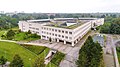 "Some shine when you read them" - Aerial photograph of the University Library of the CAU on Leibniz Street
 -
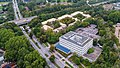 The Leibniz Institute for the Education in Natural Sciences and Mathematics at Olshausenstraße
 -
 The Center for Biochemistry and Molecular Biology (ZMB) of the CAU at the Botanical Garden
 -
 Leibniz-Straße-based institutes, the cafeteria and the university library
 -
 The Otto-Hahn-Platz and the Max-Eyth-Straße with the various chemical institutes and the Anatomical Institute
 -
 The sports facilities and the Institute of Sports Science of the CAU
 -
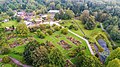 The grounds of the botanical garden of the CAU Kiel
 -
 The greenhouses of the Botanical Garden of the CAU


See also
[edit]References
[edit]- ^ "Search". Internet Archive.
- ^ a b c d "Statistische Eckdaten". Christian-Albrechts-Universität zu Kiel (in German). Archived from the original on 12 September 2025. Retrieved 7 October 2025.
- ^ Stolleis, Michael (2002). Geschichte des öffentlichen Rechts in Deutschland. Munich: C.H. Beck. p. 394. ISBN 978-3-406-48960-0.
- ^ "Ausschreibung Professur für Physikalische Ozeanographie".
- ^ "Stellungnahme zum Institut für Weltwirtschaft, Kiel (IfW)" (PDF). Archived (PDF) from the original on 11 December 2024. Retrieved 23 November 2025.
- ^ a b c d "350 Jahre Uni Kiel: Vom Kloster zum Campus". NDR (in German). 21 May 2015. Archived from the original on 23 May 2024. Retrieved 23 May 2024.
- ^ "Christian-Albrechts-Universität – Gesellschaft für Schleswig-Holsteinische Geschichte". geschichte-s-h.de. Archived from the original on 23 May 2024. Retrieved 23 May 2024.
- ^ "Faculties & joint facilities". Uni Kiel. 20 July 2023. Archived from the original on 20 July 2023. Retrieved 20 July 2023.
- ^ "Central units & Affiliated institutes". Uni Kiel. 23 November 2025. Archived from the original on 19 December 2025. Retrieved 23 November 2025.
- ^ "Molecular Imaging North Competence Center (MOIN CC) in Kiel, Germany". www.moincc.de. Archived from the original on 8 June 2023. Retrieved 23 November 2025.
- ^ "Zentrum für Biochemie und Molekularbiologie".
- ^ "Gustav-Radbruch-Netzwerk". Archived from the original on 13 December 2025. Retrieved 23 November 2025.
- ^ "Chinazentrum an der Uni Kiel feiert Jubiläum". Archived from the original on 21 December 2022. Retrieved 23 November 2025.
- ^ "Gemeinsame Jobmesse der CAU und FH Kiel". Talent Transfair (in German). Archived from the original on 9 November 2025. Retrieved 23 November 2025.
- ^ "Research projects". Uni Kiel. 23 November 2025. Archived from the original on 9 December 2025. Retrieved 23 November 2025.
- ^ "Research projects". Uni Kiel. 23 November 2025. Archived from the original on 9 December 2025. Retrieved 23 November 2025.
- ^ "SwRI Radiation Assessment Detector (RAD) Homepage". Southwest Research Institute. Archived from the original on 22 April 2022. Retrieved 19 January 2011.
- ^ "Mareile Höppner". 321kochen.tv. Archived from the original on 9 July 2021. Retrieved 9 July 2021.
- ^ Leopoldina – Nationale Akademie der Wissenschaften. "Lebenslauf von Gehard Domagk" (PDF). Archived (PDF) from the original on 4 May 2024. Retrieved 30 October 2017.
- ^ Leopoldina – Nationale Akademie der Wissenschaften. "Lebenslauf von Walter Rudolf Hess" (PDF). Archived (PDF) from the original on 25 May 2024. Retrieved 30 October 2017.
- ^ Leopoldina – Nationale Akademie der Wissenschaften. "Lebenslauf von Günter Blobel" (PDF). Archived (PDF) from the original on 3 September 2021. Retrieved 30 October 2017.
- ^ a b "QS World University Rankings 2024". QS World University Rankings. Archived from the original on 29 September 2023. Retrieved 16 July 2023.
- ^ a b "World University Rankings 2024". Times Higher Education World University Rankings. 27 September 2023. Archived from the original on 27 September 2023. Retrieved 27 September 2023.
- ^ a b "2023 Academic Ranking of World Universities". Academic Ranking of World Universities. Archived from the original on 29 September 2023. Retrieved 15 August 2023.
- ^ a b "EAZ – Ethnographisch-Archaeologische Zeitschrift". www.eaz-journal.org. Archived from the original on 7 July 2023. Retrieved 1 August 2023.
- ^ Ethnographisch-Archäologische Zeitschrift. Band 1, Nr. 1, 1960 (eaz-journal.org [retrieved 12 June 2023]).
- ^ a b Steffen, Jan (2023). "A forum for human diversity: New start for the "Ethnographisch-Archaeologische Zeitschrift" at Kiel University". Archived from the original on 7 July 2023. Retrieved 6 July 2023.
- ^ Piezonka, Henny; Angelbeck, Bill; Cunningham, Jerimy; Furholt, Martin; Schneeweiß, Jens; Wunderlich, Maria; Müller-Scheeßel, Nils (30 March 2023). "Editorial: A Space for Difference". Ethnographisch-Archaeologische Zeitschrift. 57 (1). doi:10.54799/RXJR3581. ISSN 2751-7233. Archived from the original on 6 June 2023. Retrieved 1 August 2023.
- ^ a b Otto, Karl-Heinz (1960). "Editorial". EAZ – Ethnographisch-Archäologische Zeitschrift (in German). 1 (1): 2.
- ^ Veit, Ulrich (24 March 2010). "Editorial". Ethnographisch-Archaeologische Zeitschrift (in German). 51 (1/2): 5–6. doi:10.54799/TSHX5119. ISSN 2751-7233. S2CID 257800027. Archived from the original on 6 June 2023. Retrieved 1 August 2023.
- ^ "Holsteiner Studienpreis 2023/2024 » Chronik". www.studienpreis.net. Archived from the original on 7 August 2020. Retrieved 10 September 2020.
- ^ "Uni Kiel – Preise und Stipendien". Archived from the original on 26 October 2020. Retrieved 10 September 2020.
- ^ "Holsteiner Studienpreis 2023/2024 » Kriterien". www.studienpreis.net. Archived from the original on 7 August 2020. Retrieved 10 September 2020.
- ^ "Holsteiner Studienpreis 2023/2024 » Merkblatt". www.studienpreis.net. Archived from the original on 7 August 2020. Retrieved 10 September 2020.
- ^ "Holsteiner Studienpreis 2023/2024 » Kuratorium". www.studienpreis.net. Archived from the original on 7 August 2020. Retrieved 10 September 2020.
External links
[edit]
- Official website (in English and German)
- Kiel University International Affairs
- Students' Association at Kiel University (in German)
| International | |
|---|---|
| National | |
| Academics | |
| Artists | |
| Other | |
