| KLIA Transit | ||||||||||||||||||||||||||||||||||||||||||||||||||||||||||||||||||||||||||||||||||||||||||||||||||||||||||||||||||||||||||||||||||||||||||||||||||||||||||||||||||||||||||||||||||
|---|---|---|---|---|---|---|---|---|---|---|---|---|---|---|---|---|---|---|---|---|---|---|---|---|---|---|---|---|---|---|---|---|---|---|---|---|---|---|---|---|---|---|---|---|---|---|---|---|---|---|---|---|---|---|---|---|---|---|---|---|---|---|---|---|---|---|---|---|---|---|---|---|---|---|---|---|---|---|---|---|---|---|---|---|---|---|---|---|---|---|---|---|---|---|---|---|---|---|---|---|---|---|---|---|---|---|---|---|---|---|---|---|---|---|---|---|---|---|---|---|---|---|---|---|---|---|---|---|---|---|---|---|---|---|---|---|---|---|---|---|---|---|---|---|---|---|---|---|---|---|---|---|---|---|---|---|---|---|---|---|---|---|---|---|---|---|---|---|---|---|---|---|---|---|---|---|---|---|
 | ||||||||||||||||||||||||||||||||||||||||||||||||||||||||||||||||||||||||||||||||||||||||||||||||||||||||||||||||||||||||||||||||||||||||||||||||||||||||||||||||||||||||||||||||||
 A KLIA Transit trainset. | ||||||||||||||||||||||||||||||||||||||||||||||||||||||||||||||||||||||||||||||||||||||||||||||||||||||||||||||||||||||||||||||||||||||||||||||||||||||||||||||||||||||||||||||||||
| Overview | ||||||||||||||||||||||||||||||||||||||||||||||||||||||||||||||||||||||||||||||||||||||||||||||||||||||||||||||||||||||||||||||||||||||||||||||||||||||||||||||||||||||||||||||||||
| Native name | ERL Laluan KLIA Transit | |||||||||||||||||||||||||||||||||||||||||||||||||||||||||||||||||||||||||||||||||||||||||||||||||||||||||||||||||||||||||||||||||||||||||||||||||||||||||||||||||||||||||||||||||
| Owner | Express Rail Link | |||||||||||||||||||||||||||||||||||||||||||||||||||||||||||||||||||||||||||||||||||||||||||||||||||||||||||||||||||||||||||||||||||||||||||||||||||||||||||||||||||||||||||||||||
| Line number | 7 (teal) | |||||||||||||||||||||||||||||||||||||||||||||||||||||||||||||||||||||||||||||||||||||||||||||||||||||||||||||||||||||||||||||||||||||||||||||||||||||||||||||||||||||||||||||||||
| Locale | Kuala Lumpur - Bandar Tasik Selatan - Putrajaya - Salak Tinggi - KLIA | |||||||||||||||||||||||||||||||||||||||||||||||||||||||||||||||||||||||||||||||||||||||||||||||||||||||||||||||||||||||||||||||||||||||||||||||||||||||||||||||||||||||||||||||||
| Termini |
| |||||||||||||||||||||||||||||||||||||||||||||||||||||||||||||||||||||||||||||||||||||||||||||||||||||||||||||||||||||||||||||||||||||||||||||||||||||||||||||||||||||||||||||||||
| Stations | 6 | |||||||||||||||||||||||||||||||||||||||||||||||||||||||||||||||||||||||||||||||||||||||||||||||||||||||||||||||||||||||||||||||||||||||||||||||||||||||||||||||||||||||||||||||||
| Service | ||||||||||||||||||||||||||||||||||||||||||||||||||||||||||||||||||||||||||||||||||||||||||||||||||||||||||||||||||||||||||||||||||||||||||||||||||||||||||||||||||||||||||||||||||
| Type | Commuter rail (Airport rail link) | |||||||||||||||||||||||||||||||||||||||||||||||||||||||||||||||||||||||||||||||||||||||||||||||||||||||||||||||||||||||||||||||||||||||||||||||||||||||||||||||||||||||||||||||||
| System |  ERL ERL Klang Valley Integrated Transit System | |||||||||||||||||||||||||||||||||||||||||||||||||||||||||||||||||||||||||||||||||||||||||||||||||||||||||||||||||||||||||||||||||||||||||||||||||||||||||||||||||||||||||||||||||
| Operator(s) | Express Rail Link | |||||||||||||||||||||||||||||||||||||||||||||||||||||||||||||||||||||||||||||||||||||||||||||||||||||||||||||||||||||||||||||||||||||||||||||||||||||||||||||||||||||||||||||||||
| Rolling stock | 4 4-car Desiro ET 425 M Articulated EMU 4 4-car CRRC Changchun Articulated EMU | |||||||||||||||||||||||||||||||||||||||||||||||||||||||||||||||||||||||||||||||||||||||||||||||||||||||||||||||||||||||||||||||||||||||||||||||||||||||||||||||||||||||||||||||||
| Daily ridership | 21,156 (Q3 2025)[1] | |||||||||||||||||||||||||||||||||||||||||||||||||||||||||||||||||||||||||||||||||||||||||||||||||||||||||||||||||||||||||||||||||||||||||||||||||||||||||||||||||||||||||||||||||
| Ridership | 6.14 million (2024)[2] (  19.5%) 19.5%) | |||||||||||||||||||||||||||||||||||||||||||||||||||||||||||||||||||||||||||||||||||||||||||||||||||||||||||||||||||||||||||||||||||||||||||||||||||||||||||||||||||||||||||||||||
| History | ||||||||||||||||||||||||||||||||||||||||||||||||||||||||||||||||||||||||||||||||||||||||||||||||||||||||||||||||||||||||||||||||||||||||||||||||||||||||||||||||||||||||||||||||||
| Opened | KL Sentral - KLIA Terminal 1 14 April 2002 | |||||||||||||||||||||||||||||||||||||||||||||||||||||||||||||||||||||||||||||||||||||||||||||||||||||||||||||||||||||||||||||||||||||||||||||||||||||||||||||||||||||||||||||||||
| Last extension | KLIA Terminal 1 - KLIA Terminal 2 1 May 2014 | |||||||||||||||||||||||||||||||||||||||||||||||||||||||||||||||||||||||||||||||||||||||||||||||||||||||||||||||||||||||||||||||||||||||||||||||||||||||||||||||||||||||||||||||||
| Technical | ||||||||||||||||||||||||||||||||||||||||||||||||||||||||||||||||||||||||||||||||||||||||||||||||||||||||||||||||||||||||||||||||||||||||||||||||||||||||||||||||||||||||||||||||||
| Line length | 57 km (35 mi) | |||||||||||||||||||||||||||||||||||||||||||||||||||||||||||||||||||||||||||||||||||||||||||||||||||||||||||||||||||||||||||||||||||||||||||||||||||||||||||||||||||||||||||||||||
| Character | Mostly subsurface Surface (Bandar Tasik Selatan - Salak Tinggi) | |||||||||||||||||||||||||||||||||||||||||||||||||||||||||||||||||||||||||||||||||||||||||||||||||||||||||||||||||||||||||||||||||||||||||||||||||||||||||||||||||||||||||||||||||
| Track gauge | 1,435 mm (4 ft 8+1⁄2 in) standard gauge | |||||||||||||||||||||||||||||||||||||||||||||||||||||||||||||||||||||||||||||||||||||||||||||||||||||||||||||||||||||||||||||||||||||||||||||||||||||||||||||||||||||||||||||||||
| Electrification | 25 kV 50 Hz AC catenary | |||||||||||||||||||||||||||||||||||||||||||||||||||||||||||||||||||||||||||||||||||||||||||||||||||||||||||||||||||||||||||||||||||||||||||||||||||||||||||||||||||||||||||||||||
| Conduction system | With driver | |||||||||||||||||||||||||||||||||||||||||||||||||||||||||||||||||||||||||||||||||||||||||||||||||||||||||||||||||||||||||||||||||||||||||||||||||||||||||||||||||||||||||||||||||
| ||||||||||||||||||||||||||||||||||||||||||||||||||||||||||||||||||||||||||||||||||||||||||||||||||||||||||||||||||||||||||||||||||||||||||||||||||||||||||||||||||||||||||||||||||


The ERL KLIA Transit is a commuter rail service which serves as an airport rail link to the Kuala Lumpur International Airport (KLIA) in Malaysia. It runs from KL Sentral, the main railway station of Kuala Lumpur to KLIA's Terminal 1 and Terminal 2.[3] The line is one of the two services on the Express Rail Link (ERL) system, sharing the same tracks as the KLIA Ekspres. KLIA Transit stops at all stations along the line, whereas KLIA Ekspres runs an express, non-stop service between KL Sentral and the airport. The line is operated by Express Rail Link Sdn. Bhd. (ERL).
The line is one of the components of the Klang Valley Integrated Transit System. It is numbered 7 and coloured teal on official transit maps.
Line information
[edit]Stations
[edit]There are six stations served by KLIA Transit. They are, from north to south:
| Station code | Station name | Images | Platform type | Interchange station/Notes |
|---|---|---|---|---|
| KT1 | KL Sentral | 
|
Terminus (Island) | Northern terminus.
Common station with KE1 ERL KLIA Ekspres. Connecting station, without paid-area integration, to:
|
| KT2 | Bandar Tasik Selatan | ,_Klang_Valley.jpg)
|
Side | Connecting station, without paid-area integration, to:
Feeder bus T410 to KG26 Taman Connaught for the MRT Kajang Line. |
| KT3 | Putrajaya & Cyberjaya | _02.jpg)
|
Connecting station, without paid-area integration, to PY41 Putrajaya Sentral for MRT Putrajaya Line.
Planned interchange to Putrajaya Monorail | |
| KT4 | Salak Tinggi | 
|
||
| KT5 | KLIA T1 | _01.jpg)
|
Island | Common station with KE2 ERL KLIA Ekspres. |
| KT6 | KLIA T2 | _01.jpg)
|
Terminus (Island) | Southern terminus.
Common station with KE3 ERL KLIA Ekspres. |
At KL Sentral, the two platforms of the ERL are accessed from different parts of the station. The KLIA Ekspres side platforms are accessed from the KL City Air Terminal (KL CAT) while the KLIA Transit island platform is accessed from the main Transit Concourse at Level 1. At KLIA Terminal 1 and 2, both KLIA Ekspres and KLIA Transit use the same island platform, with each service serving only one side of the platform.[citation needed]
At KLIA Terminal 1 station, KLIA Transit uses the same platform for Terminal 2- or city-bound trains. Displays are installed at the platform to indicate the travelling direction of the approaching train.
History
[edit]KLIA Transit began operations on 20 June 2002. Since then there has only been one major accident.
Accidents
[edit]On 24 August 2010, Express Rail Link suffered their first reported accident in which 3 passengers were injured. Two ERL trains collided at Kuala Lumpur Sentral. One of the trains involved was about to depart at 9.45pm for Kuala Lumpur International Airport while the other train, which was empty, ran into it from behind.[4][5]
Suspensions
[edit]On 4 April 2020, due to the Malaysian movement control order, which resulted in a significant reduction in ridership, all ERL rail services were temporarily suspended.[6] Limited ERL services recommenced on 4 May 2020.[7]
On 4 June 2021, due to the total lockdown phase of the Malaysian movement control order, all ERL rail services were temporarily suspended again.[8] ERL services resumed on 10 September 2021.[9]
Operations
[edit]Trains run between 05:00 and midnight at frequencies of 15 minutes (peak) or 30 minutes (off-peak and weekends).
Ticketing and Fares
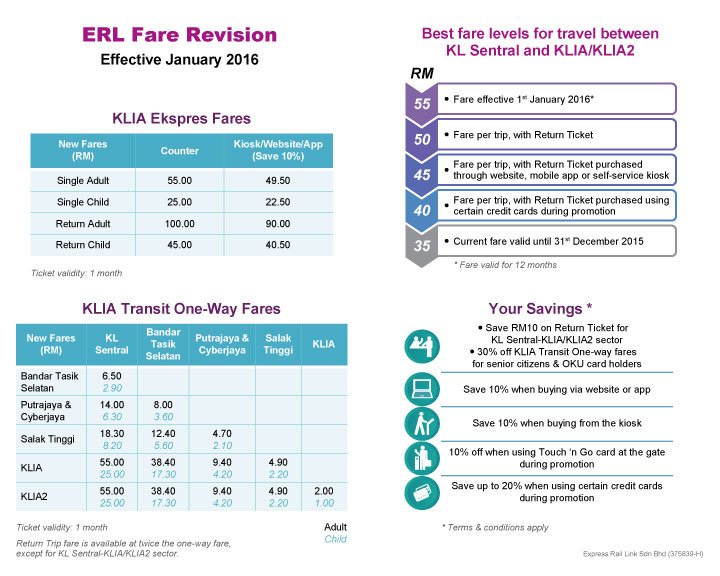
[edit]One-way fares with effect from January 2016:[10]
| Sector | KL Sentral | Bandar Tasik Selatan |
Putrajaya & Cyberjaya |
Salak Tinggi |
KLIA |
|---|---|---|---|---|---|
| Bandar Tasik Selatan |
RM6.50 RM2.90 |
||||
| Putrajaya & Cyberjaya |
RM14.00 RM6.30 |
RM8.00 RM3.60 |
|||
| Salak Tinggi | RM18.30 RM8.20 |
RM12.40 RM5.60 |
RM4.70 RM2.10 |
||
| KLIA Terminal 1 | RM55.00 RM25.00 |
RM38.40 RM17.30 |
RM9.40 RM4.20 |
RM4.90 RM2.20 |
|
| KLIA Terminal 2 | RM2.00 RM1.00 |
One-way and return tickets may be purchased from the ticketing office, at the automated ticketing kioks, from KLIA Ekspres website or via the KLIA Ekspres mobile app.
Passengers holding AMEX, JCB, Mastercard, Visa, UnionPay contactless cards and Touch 'n Go cards may pay directly at the fare gates without the need to purchase a separate ticket. Touch 'n Go cards require a minimum balance of RM20.
Weekly or monthly travel passes (TravelCard) linked to MyKad can be purchased at the ticketing office or via KLIA Ekspres website. TravelCards allow unlimited travels between two stations for seven or thirty days.
There is no free travel between KLIA Terminals 1 and 2. Passengers transferring between the terminals via KLIA Transit require a valid ticket.
Connection to Subang Airport
[edit]The KLIA Transit (and KLIA Ekspres) interchanges with KTM's Skypark Link at KL Sentral, an airport-rail link serving the Sultan Abdul Aziz Shah Airport (Subang Airport). This allows for a rail connection between KLIA Terminal 1, Terminal 2 and Subang Airport.
As of August 2024, SkyPark Link services are suspended.
Ridership
[edit]| KLIA Transit Ridership[11] | |||
|---|---|---|---|
| Year | Ridership | Change (%) | Remarks |
| 2025 | 5,224,623 |  -15 -15
|
As of September 2025 |
| 2024 | 6,143,917 | 19.5
|
|
| 2023 | 5,143,373 | 52.4
|
|
| 2022 | 3,375,314 | 365.5
|
|
| 2021 | 724,997 | -66.9
|
Total lockdown |
| 2020 | 2,189,136 | -67.8
|
COVID-19 pandemic |
| 2019 | 6,788,122 | 3.8
|
Highest on record |
| 2018 | 6,540,177 | 1.5
|
|
| 2017 | 6,443,667 | -0.6
|
|
| 2016 | 6,485,272 | -0.2
|
|
| 2015 | 6,496,617 | 3
|
|
| 2014 | 6,310,323 | 44.3
|
|
| 2013 | 4,374,220 | 17.5
|
|
| 2012 | 3,723,536 | 15
|
|
| 2011 | 3,236,795 | 23.3
|
|
| 2010 | 2,626,121 | 46.4
|
|
| 2009 | 1,794,080 | -28.5
|
|
| 2008 | 2,508,886 | 2.4
|
|
| 2007 | 2,449,842 | 3.4
|
|
| 2006 | 2,369,763 | 29.6
|
|
| 2005 | 1,829,224 | 5.5
|
|
| 2004 | 1,734,614 | 78.7
|
|
| 2003 | 970,598 | 416.7
|
|
| 2002 | 187,848 | - | Operations began on 20 June 2002 |
Gallery
[edit]-
 The Putrajaya & Cyberjaya ERL Station platform at night.
 -
 Interior of Siemens Desiro train.
 -
 CRRC Equator EMU at Putrajaya/Cyberjaya station
 -
 KLIA Transit Desiro ET 425 M EMU Train at Bandar Tasik Selatan Station
 -
 KLIA Transit Equator EMU Train at Bandar Tasik Selatan Station

.jpg)


See also
[edit]References
[edit]- ^ "Daily Rail Ridership in Peninsular Malaysia". Daily Rail Ridership. Land Public Transport Agency (APAD). 27 October 2025. Archived from the original on 7 January 2026. Retrieved 7 January 2026.
- ^ "Number of Passengers for Rail Transport Services, 2024" (PDF) (in Malay and English). Ministry of Transport, Malaysia. Archived (PDF) from the original on 4 March 2025. Retrieved 4 March 2025.
- ^ "Our Services". Express Rail Link Sdn Bhd. Archived from the original on 3 July 2017. Retrieved 12 June 2014.
- ^ "2 ERLs crash at KL Sentral". Archived from the original on 26 September 2010.
- ^ "2 ERLs crash at KL Sentral, 3 hurt".
- ^ "MCO: ERL to suspend its services from April 4 | The Star Online". www.thestar.com.my.
- ^ Chua, Eddie (1 May 2020). "ERL to resume limited services starting May 4". The Star. Retrieved 12 February 2022.
- ^ "KLIA Ekspres, Transit to stop operating from June 4 - paultan.org". Paul Tan's Automotive News. 3 June 2021. Retrieved 12 February 2022.
- ^ "ERL to resume train services from Sept 13". The Star. 9 September 2021. Retrieved 12 February 2022.
- ^ ERL Fare Revision January 2016
- ^ "Statistic of Rail Transport". Ministry of Transport (Malaysia). Archived from the original on 9 January 2022. Retrieved 12 February 2022.
External links
[edit]
- The KLIA Transit at the official KLIA Ekspres website.
Route maps
[edit]- Route search - Interactive transport guide of Kuala Lumpur public transport system
- Route Map from malaysiaexpat.com
- Route Map from ktmb.com.my
- Route Map from prasarana.com.my
- Route Map from stesensentral.com
| Overview |
| ||||||||||||||||||||||||||
|---|---|---|---|---|---|---|---|---|---|---|---|---|---|---|---|---|---|---|---|---|---|---|---|---|---|---|---|
| Major Operators | |||||||||||||||||||||||||||
| Inter-city rail |
| ||||||||||||||||||||||||||
| Commuter rail |
| ||||||||||||||||||||||||||
| Metro rail |
| ||||||||||||||||||||||||||
| Border link |
| ||||||||||||||||||||||||||
| Other rail |
| ||||||||||||||||||||||||||
| Rolling stock & manufacturers |
| ||||||||||||||||||||||||||
| Depots | |||||||||||||||||||||||||||
| Related articles | |||||||||||||||||||||||||||


| Annual Riderships by cities |
| ||||||||||||||
|---|---|---|---|---|---|---|---|---|---|---|---|---|---|---|---|
| |||||||||||||||
Note: Under construction & planned lines are in Italics | |||||||||||||||