
Joel Emmons Whitney Jr. | |
|---|---|
 Whitney in 1875 | |
| Born | May 18, 1822 Phillips, Maine, United States |
| Died | January 20, 1886 (aged 63) |
| Resting place | Oakland Cemetery, Saint Paul, Minnesota |
| Known for | Photographing famous people of Minnesota |
| Style | Tintype and daguerreotype |
| Movement | Early photography |
Joel Emmons Whitney Jr. (May 18, 1822 – January 20, 1886) was an early American photographer who became known in Minnesota for his wet plate tintype and daguerreotype photographs. From 1851 to 1871 he was the proprietor of "Whitney's Gallery" in Saint Paul, Minnesota where he primarily produced tintype, and later daguerreotype photographs, especially during the American Civil War.[1][2]
According to historian Bonnie G. Wilson of the Minnesota Historical Society, Whitney is often regarded as being the first professional photographer of Saint Paul, Minnesota.[3]
Early life
[edit]Joel Emmons Whitney was born on May 18, 1822 in Phillips, Maine. He was the son of Joel Emmons Whitney Sr. (1787–1852) and Sally Dyer/ Dyar (1797–1834). Whitney was the grandson of Micah Whitney (1752–1832),[4] a revolutionary War soldier, as well as the great-grandson of Elizabeth Nichols Dyar, one of the few women to take part in the Boston Tea Party.[5][6]
Whitney and his father first arrived in Saint Paul in Minnesota Territory in 1850, at the time Whitney knew nothing about photography or daguerreotypes.[7] Whitney made the acquaintance of Alexander Hesler, a professional photographer with four years of experience in Galena, Illinois, and had recently traveled to Minnesota Territory to take photographs for Harper's Weekly. The two eventually became inseparable business partners and friends.[7]
Photography career
[edit]In his early career Whitney was Hesler's pupil and apprentice from 1850 to 1852 travelling through the Minnesota countryside near Minneapolis–Saint Paul and photographing a variety of people and places such as Minnehaha Falls. Whitney eventually created his own photography studio in Saint Paul called Whitney's Daguerrean Gallery located at Third and Cedar Streets.[3][7][8] Whitney's art gallery was situated above the business storefront of Charles D. Elfelt's from roughly 1851 to 1867.[3][9] Elfelt was a Jewish textile trader and actor in Saint Paul.[10] Local newspapers from the time often refer to Whitney as being the first photographer of St. Paul.[8][9]
 Charles Alfred Zimmerman, one of Whitney's apprentices and coworkers with a tripod and stereo lens c.1860
Whitney was the employer of Charles Alfred Zimmerman (1844–1909), a notable photographer of Saint Paul.[citation needed] Whitney and Zimmerman had known each other since Zimmerman was a child. Zimmerman was first employed as Whitney's apprentice before they formally partnered with one another in 1870, Zimmerman later purchased Whitney's business in 1871.[11]
Following the Dakota War of 1862 there was a great demand in Minnesota and the United States for photographs of various Indigenous peoples from the Midwest who had participated in the war.[11] Whitney fulfilled this by taking massive amounts of photographs of various people including: Little Crow, Hole in the Day, John Other Day, Gabriel Renville, Azayamankawin, and Shakopee III, among others.[12]
During his career from 1851 to 1871 Whitney is credited with photographing many prominent figures of early Minnesota history as well including: Governor of Minnesota Henry Hastings Sibley, Governor Alexander Ramsey, General Judson Wade Bishop, Colonel William J. Colvill, activist Jane Swisshelm, and fur trader Joseph R. Brown. Other famous patrons of Whitney's career include: Minnesota Territorial Governor Willis A. Gorman, Senator Henry M. Rice, educator Edward Duffield Neill, Senator Morton S. Wilkinson, the wife of General George B. McClellan.[3]
Later life and personal life
[edit]Whitney was married to Elsie Parish Ayer (1832–1876), together they Whitney's had two daughters, Mabel whitney (1866–1866) and Joella Joy (1873–1953). Whitney died in Saint Paul on January 20, 1886 at the age of 63. He is buried in Oakland Cemetery in Saint Paul. Many of Whitney's original gallery tintypes, daguerreotypes, and photographs are held by Minnesota Historical Society.
Gallery
[edit]-
 Fond-du-Lac Chief Naw-gaw-nab
 -
 Indian Agent Rev. Moses N. Adams
 -
 Colonel William Crooks of hte 6th Minnesota Infantry Regiment
 -
 George H. Spencer Jr., one of the hostages taken during the Attack at the Lower Sioux Agency
 -

-
 Jane Swisshelm c.1865.
 -
 Mdewakanton Dakota Chief Shakopee III
 -
 "Sioux Brave" c.1870-1875
 -
 Colonel Josiah Fay Marsh of the 9th Minnesota Infantry Regiment
 -
 Captain Asgrim Knutson Skaro of the 2nd Minnesota Infantry Regiment
 -
 Qui-Wi-Sain-Shish (Bad Boy) of the Mississippi River Band of Chippewa Indians
 -
 Chief Hole in the Day of the Pillager Band of Chippewa Indians
 -
 Chief Na-bah-nay-aush (One-Sided Winner), Leech Lake, ca. 1865.
 -
 Dakota Native Americans and Dr. Thomas Smith Williamson near the Upper Sioux Agency, Minnesota c.1862
 -
 Minnehaha Falls in the winter c.1865
 -
 View of Trempealeau c.1865
 -
 Colonel Hans Mattson of the 3rd Minnesota Infantry Regiment
 -
 Colonel Samuel McPhail of the 1st Minnesota Cavalry Regiment
 -
 Lieutenant Lyman S. Kidder
 -

-
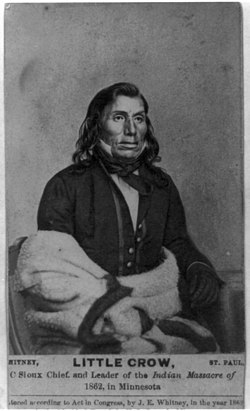 Mdewakanton Chief Little Crow c.1862


.jpg)


.jpg)
,_1822-1886.png)
,_1822-1886.png)


References
[edit]- ^ "Collections Online | British Museum". www.britishmuseum.org. Archived from the original on 2021-04-16. Retrieved 2025-11-21.
- ^ "Joel E. Whitney | Smithsonian American Art Museum". americanart.si.edu. Retrieved 2025-11-21.
- ^ a b c d Wilson, Bonnie G. "Working the Light: Nineteenth-Century Professional Photographers in Minnesota.” Minnesota History 52, no. 2 (1990): 42–60. http://www.jstor.org/stable/20179202.
- ^ "DAR Genealogical Research Databases". services.dar.org. Retrieved 2025-11-21.
- ^ "Record |". www.americanancestors.org. Retrieved 2025-11-21.
- ^ "Elizabeth Nichols Dyar Memorial". Daughters of the American Revolution. Retrieved 2025-11-21.
- ^ a b c Newhall, Beaumont (1954). "Minnesota Daguerreotypes" (PDF). Minnesota History. 34 (1): 28–33 – via Minnesota Historical Society.
- ^ a b The weekly Minnesotian. (Saint Paul, MN), Oct. 22 1853. https://www.loc.gov/item/sn83016750/1853-10-22/ed-1/.
- ^ a b "Whitney's Gallery, 3rd Street and Cedar Avenue, Saint Paul, Minnesota (Razed) – Placeography". www.placeography.net. Retrieved 2025-11-21.
- ^ "The Elfelt Brothers: Edwin, Charles & Abram, Early Jewish Pioneer Merchants of St. Paul Minnesota – JMAW – Jewish Museum of the American West". www.jmaw.org. Retrieved 2025-11-21.
- ^ a b Harris, Leo J. (2015). "Long-Ago Snapshots: When Sitting Bull was Photographed in St. Paul" (PDF). Ramsey County History. 50 (2): 13–18 – via Ramsey County Historical Society.
- ^ "Joel E. Whitney". www.cartermuseum.org. Retrieved 2025-11-21.
