
| Iga Railway Iga Line | |||
|---|---|---|---|
 Iga Railway Line 200 series | |||
| Overview | |||
| Other name | Ninja Line | ||
| Native name | 伊賀鉄道伊賀線 | ||
| Owner | Iga City | ||
| Locale | Mie | ||
| Termini | |||
| Stations | 15 | ||
| Service | |||
| Type | Regional rail | ||
| Operator(s) | Iga Railway | ||
| Technical | |||
| Line length | 16.6 km (10.3 mi) | ||
| Track gauge | 1,067 mm (3 ft 6 in) | ||
| Electrification | 1,500 V DC overhead catenary | ||
| Operating speed | 65 km/h (40 mph) | ||
| |||

The Iga Line (伊賀線, Iga-sen) is a railway line in Iga, Mie, Japan, operated by the third-sector railway operator Iga Railway Co., Ltd. (伊賀鉄道株式会社, Iga-tetsudō kabushiki-gaisha).[1] The line connects Iga-Ueno Station with Iga-Kambe Station. The track and trains are owned by Iga City (as a Category 3 railway operator), while the trains are operated by Iga Railway (as a Category 2 railway operator).[1] The line is also referred to as the Ninja Line (忍者線), with trains featuring a ninja-style livery.
Prior to 1 October 2007, the Iga Line was owned and operated by Kintetsu Railway. On 1 October 2007, operation of the line was transferred to Iga Railway, with Kintetsu Railway retaining ownership of the line.[2] On 4 April 2017, the Iga Line became a third-sector railway with Iga City replacing Kintetsu Railway as the Category 3 railway operator.[3][4]
Stations
[edit]All stations are in Iga, Mie.
| Station name | Japanese | Distance (km between stations) | Distance (km) | Transfers |
|---|---|---|---|---|
| Iga-Ueno | 伊賀上野 | - | 0.0 | Kansai Main Line |
| Nii | 新居 | 0.8 | 0.8 | |
| Nishi-Ōte | 西大手 | 2.5 | 3.3 | |
| Uenoshi (Ninja City) | 上野市(忍者市) | 0.6 | 3.9 | |
| Hirokōji | 広小路 | 0.5 | 4.4 | |
| Kayamachi | 茅町 | 0.6 | 5.0 | |
| Kuwamachi | 桑町 | 0.8 | 5.8 | |
| Shijuku | 四十九 | 0.7 | 6.5 | |
| Idamichi | 猪田道 | 1.5 | 8.0 | |
| Ichibe | 市部 | 1.2 | 9.2 | |
| Inako | 依那古 | 1.4 | 10.6 | |
| Maruyama | 丸山 | 1.3 | 11.9 | |
| Uebayashi | 上林 | 1.1 | 13.0 | |
| Hido | 比土 | 2.6 | 15.6 | |
| Iga-Kambe | 伊賀神戸 | 1.0 | 16.6 | Kintetsu Osaka Line |
Rolling stock
[edit]Current
[edit]- 200 series 2-car EMUs (ex-Tokyu 1000 series), since 24 December 2009[5]
Iga Railway operates five 2-car 200 series EMUs formed from ten former Tokyu 1000 series cars purchased between 2009 and 2012.[6]
Formations
[edit]| Designation | Mc | Tc |
|---|---|---|
| Numbering | Mo 20x | Ku 10x |
Car identities
[edit]The former identities of the fleet are as shown below.[6]
| Set No. | Car No. | Tokyu numbering |
|---|---|---|
| 201 | Mo 201 | DeHa 1311 |
| Ku 101 | KuHa 1010 | |
| 202 | Mo 202 | DeHa 1310 |
| Ku 102 | KuHa 1011 | |
| 203 | Mo 203 | DeHa 1406 |
| Ku 103 | KuHa 1106 | |
| 204 | Mo 204 | DeHa 1206 |
| Ku 104 | KuHa 1006 | |
| 205 | Mo 205 | DeHa 1306 |
| Ku 105 | DeHa 1356 |
-
 Iga Railway 200 series 2-car set 201 in December 2009, with original Tokyu cab and offset gangway door
 -
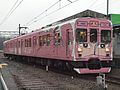 Iga Railway 200 series 2-car set 202 in December 2010, with original Tokyu cab and central gangway door
 -
 Iga Railway 200 series 2-car set 204 in December 2010, with retro-fitted cab end


Former
[edit]- Kintetsu Railway 860 series 2-car EMUs
History
[edit]The original Iga Railway opened the 26 km 1,067 mm gauge line between Iga-Ueno on the Kansai Main Line and Nishi-Nabari on 18 July 1922.[2] The line was electrified at 600 V DC on 25 May 1926.[2] The company merged with the Osaka Electric Railway on 31 March 1929.[2]
The Iga-Kambe to Nishi-Nabari section closed in 1964.[2]
Prior to 1 October 2007, the Iga Line was owned and operated by Kintetsu Railway.
Operation of the line was transferred to the (new) Iga Railway on 1 October 2007. Kintetsu Railway retained ownership of the line.[2]
In March 2015, it was announced that Kintetsu Railway, Iga City and Iga Railway had agreed to transition the Iga Line to a third-sector railway.[3] This was implemented on 4 April 2017 with Iga City replacing Kintetsu Railway as the Category 3 railway operator.[4]
From 9 March 2024, ICOCA and all other Nationwide Mutual Usage Service IC cards can be used at all stations on the Iga Line.[7]
References
[edit]This article incorporates material from the corresponding article in the Japanese Wikipedia.
- ^ a b "会社情報 – 伊賀鉄道株式会社". igatetsu.co.jp (in Japanese). Retrieved 2025-11-03.
- ^ a b c d e f Terada, Hirokazu (19 January 2013). データブック日本の私鉄 [Databook: Japan's Private Railways] (in Japanese). Japan: Neko Publishing. p. 125. ISBN 978-4-7770-1336-4.
- ^ a b "igasenikou.pdf" (PDF). kintetsu.co.jp (in Japanese). Retrieved 2025-11-03.
- ^ a b 産経新聞 (2017-04-04). "伊賀鉄道伊賀線「公有民営」記念列車が発車 地元高校生ら出発式". 産経新聞:産経ニュース (in Japanese). Retrieved 2025-11-03.
- ^ 東急電鉄1000系が伊賀鉄道に入線 [Tokyu 1000 series arrive on Iga Railway]. Japan Railfan Magazine (in Japanese). Vol. 50, no. 585. Japan: Koyusha Co., Ltd. January 2010. p. 66.
- ^ a b Kubo, Toshi (July 2017). 東京メトロ日比谷線-4 [Tokyo Metro Hibiya Line - 4]. Japan Railfan Magazine (in Japanese). Vol. 57, no. 675. Japan: Koyusha Co., Ltd. pp. 125–126.
- ^ "240206_00_igatetsudo_ICOCA.pdf" (PDF). westjr.co.jp (in Japanese). Retrieved 2025-11-03.
External links
[edit]- Official website (in Japanese)
| Routes (Lines) |
| ||||||||||||||||||||
|---|---|---|---|---|---|---|---|---|---|---|---|---|---|---|---|---|---|---|---|---|---|
| |||||||||||||||||||||
