
 World map of countries or territories by HDI scores in increments of 0.050 (based on 2023 data, published in 2025)
 - ≥ 0.950
- 0.900–0.950
- 0.850–0.899
- 0.800–0.849
- 0.750–0.799
- 0.700–0.749
- 0.650–0.699
- 0.600–0.649
- 0.550–0.599
- 0.500–0.549
- 0.450–0.499
- 0.400–0.449
- ≤ 0.399
- Data unavailable
The Human Development Index (HDI) is a statistical composite index of life expectancy, education (mean years of schooling completed and expected years of schooling upon entering the education system), and per capita income indicators, which is used to rank countries into four tiers of human development. A country scores a higher level of HDI when the lifespan is higher, the education level is higher, and the gross national income GNI (PPP) per capita is higher. It was developed by Pakistani economist Mahbub ul-Haq and was further used to measure a country's development by the United Nations Development Programme (UNDP)'s Human Development Report Office.[1][2][3][4]
The 2010 Human Development Report introduced an inequality-adjusted Human Development Index (IHDI). While the simple HDI remains useful, it stated that "the IHDI is the actual level of human development (accounting for this inequality), while the HDI can be viewed as an index of 'potential' human development (or the maximum level of HDI) that could be achieved if there was no inequality."[5]
The index is based on the human development approach, developed by Mahbub ul-Haq, anchored in Amartya Sen's work on human capabilities, and often framed in terms of whether people are able to "be" and "do" desirable things in life. Examples include — being: well-fed, sheltered, and healthy; doing: work, education, voting, participating in community life. The freedom of choice is considered central — someone choosing to be hungry (e.g. when fasting for religious reasons) is considered different from someone who is hungry because they cannot afford to buy food, or because the country is going through a famine.[6]
The index does not take into account several factors, such as the net wealth per capita or the relative quality of goods in a country. This situation tends to lower the ranking of some of the most developed countries, such as the G7 members and others.[7]
Origins
[edit]The origins of the HDI are found in the annual Human Development Reports produced by the Human Development Report Office of the United Nations Development Programme (UNDP). These annual reports were devised and launched by Pakistani economist Mahbub ul-Haq in 1990, and had the explicit purpose "to shift the focus of development economics from national income accounting to people-centered policies". He believed that a simple composite measure of human development was needed to convince the public, academics and politicians that they can, and should, evaluate development not only by economic advances but also improvements in human well-being.
 The underlying principle behind the Human Development Index[6]
Dimensions and calculation
[edit]New method (2010 HDI onwards)
[edit] HDI trends between 1990 and 2021
 | OECD countries | Developing countries: East Asia and the Pacific |
Published on 4 November 2010 (and updated on 10 June 2011), the 2010 Human Development Report calculated the HDI combining three dimensions:[8][9]
- A long and healthy life: Life expectancy at birth
- Education: Mean years of schooling and expected years of schooling
- A decent standard of living: GNI per capita (PPP international dollars)
In its 2010 Human Development Report, the UNDP began using a new method of calculating the HDI. The following three indices are used:
1. Life Expectancy Index (LEI)
LEI is equal to 1 when life expectancy at birth is 85 years, and 0 when life expectancy at birth is 20 years.
2. Education Index (EI) [10]
2.1 Mean Years of Schooling Index (MYSI) [11] Fifteen is the projected maximum of this indicator for 2025. 2.2 Expected Years of Schooling Index (EYSI) [12] Eighteen is equivalent to achieving a master's degree in most countries.


3. Income Index (II)
II is 1 when GNI per capita is $75,000 and 0 when GNI per capita is $100.
Finally, the HDI is the geometric mean of the previous three normalized indices:
![{\displaystyle {\textrm {HDI}}={\sqrt[{3}]{{\textrm {LEI}}\cdot {\textrm {EI}}\cdot {\textrm {II}}}}.}](https://wikimedia.org/api/rest_v1/media/math/render/svg/364ecd910bf260a13250cde6a9d25e08d9633fe8)
LE: Life expectancy at birth
MYS: Mean years of schooling (i.e. years that a person aged 25 or older has spent in formal education)
EYS: Expected years of schooling (i.e. total expected years of schooling for children under 18 years of age, incl. young men and women aged 13–17)
GNIpc: Gross national income at purchasing power parity per capita
Old method (HDI before 2010)
[edit]The HDI combined three dimensions last used in its 2009 report:
- Life expectancy at birth, as an index of population health and longevity to HDI
- Knowledge and education, as measured by the adult literacy rate (with two-thirds weighting) and the combined primary, secondary, and tertiary gross enrollment ratio (with one-third weighting).
- Standard of living, as indicated by the natural logarithm of gross domestic product per capita at purchasing power parity.
 HDI trends between 1975 and 2004
 This methodology was used by the UNDP until their 2011 report.
The formula defining the HDI is promulgated by the United Nations Development Programme (UNDP).[13] In general, to transform a raw variable, say , into a unit-free index between 0 and 1 (which allows different indices to be added together), the following formula is used:

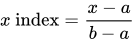
where and are the lowest and highest values the variable can attain, respectively.


The Human Development Index (HDI) then represents the uniformly weighted sum with 1⁄3 contributed by each of the following factor indices:


2023 Human Development Index (2025 report)
[edit] Average annual HDI growth from 2010 to 2023 (published in 2025)
- ≥ 1.4%
- 1.2%…1.4%
- 1%…1.2%
- 0.8%…1%
- 0.6%…0.8%
- 0.4%…0.6%
- 0.2%…0.4%
- 0%…0.2%
- −0.5%…0%
- −1%…−0.5%
- < −1%
- No data
This article is sourced from Wikipedia. Content is available under the Creative Commons Attribution-ShareAlike License.