
 Depiction of a group homomorphism (h) from G (left) to H (right). The oval inside H is the image of h. N is the kernel of h and aN is a coset of N.
| Algebraic structure → Group theory Group theory |
|---|
 |
|
|

In mathematics, given two groups, (G,∗) and (H, ·), a group homomorphism from (G,∗) to (H, ·) is a function h : G → H such that for all u and v in G it holds that

where the group operation on the left side of the equation is that of G and on the right side that of H.
From this property, one can deduce that h maps the identity element eG of G to the identity element eH of H,

and it also maps inverses to inverses in the sense that

Hence one can say that h "is compatible with the group structure".
In areas of mathematics where one considers groups endowed with additional structure, a homomorphism sometimes means a map that respects not only the group structure (as above) but also the extra structure. For example, a homomorphism of topological groups is often required to be continuous.
Properties
[edit]Let be the identity element of the group (H, ·) and , then


Now by multiplying by the inverse of (or applying the cancellation rule) we obtain


Similarly,

Therefore by the uniqueness of the inverse: .

Types
[edit]Image and kernel
[edit]We define the kernel of h to be the set of elements in G that are mapped to the identity in H

and the image of h to be

The kernel and image of a homomorphism can be interpreted as measuring how close it is to being an isomorphism. The first isomorphism theorem states that the image of a group homomorphism, h(G) is isomorphic to the quotient group G/ker h.
The kernel of h is a normal subgroup of G. Assume and show for arbitrary :


The image of h is a subgroup of H.
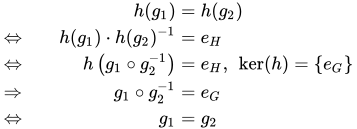
The homomorphism, h, is a group monomorphism; i.e., h is injective (one-to-one) if and only if ker(h) = {eG}. Injectivity directly gives that there is a unique element in the kernel, and, conversely, a unique element in the kernel gives injectivity:
Examples
[edit]- Consider the cyclic group Z3 = (Z/3Z, +) = ({0, 1, 2}, +) and the group of integers (Z, +). The map h : Z → Z/3Z with h(u) = u mod 3 is a group homomorphism. It is surjective and its kernel consists of all integers that are divisible by 3.
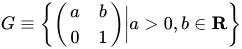
- The set
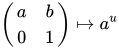
forms a group under matrix multiplication. For any complex number u, the function fu : G → C* defined by
is a group homomorphism. - Consider a multiplicative group of positive real numbers (R+, ⋅). For any complex number u, the function fu : R+ → C* defined by is a group homomorphism.

- The exponential map yields a group homomorphism from the group of real numbers R with addition to the group of non-zero real numbers R* with multiplication. The kernel is {0} and the image consists of the positive real numbers.
- The exponential map also yields a group homomorphism from the group of complex numbers C with addition to the group of non-zero complex numbers C* with multiplication. This map is surjective and has the kernel , as can be seen from Euler's formula. Fields like R and C that have homomorphisms from their additive group to their multiplicative group are thus called exponential fields.
- The function , defined by is a homomorphism.
- Consider the two groups and , represented respectively by and , where is the positive real numbers. Then, the function defined by the logarithm function is a homomorphism.

![{\displaystyle \Phi (x)={\sqrt[{}]{2}}x}](https://wikimedia.org/api/rest_v1/media/math/render/svg/d48bfca15815808b381b168dddbc7991921afb54)


Category of groups
[edit]If h : G → H and k : H → K are group homomorphisms, then so is k ∘ h : G → K. This shows that the class of all groups, together with group homomorphisms as morphisms, forms a category (specifically the category of groups).
Homomorphisms of abelian groups
[edit]If G and H are abelian (i.e., commutative) groups, then the set Hom(G, H) of all group homomorphisms from G to H is itself an abelian group: the sum h + k of two homomorphisms is defined by
(h + k)(u) = h(u) + k(u) for all u in G.The commutativity of H is needed to prove that h + k is again a group homomorphism.
The addition of homomorphisms is compatible with the composition of homomorphisms in the following sense: if f is in Hom(K, G), h, k are elements of Hom(G, H), and g is in Hom(H, L), then
(h + k) ∘ f = (h ∘ f) + (k ∘ f) and g ∘ (h + k) = (g ∘ h) + (g ∘ k).Since the composition is associative, this shows that the set End(G) of all endomorphisms of an abelian group forms a ring, the endomorphism ring of G. For example, the endomorphism ring of the abelian group consisting of the direct sum of m copies of Z/nZ is isomorphic to the ring of m-by-m matrices with entries in Z/nZ. The above compatibility also shows that the category of all abelian groups with group homomorphisms forms a preadditive category; the existence of direct sums and well-behaved kernels makes this category the prototypical example of an abelian category.
See also
[edit]References
[edit]- Dummit, D. S.; Foote, R. (2004). Abstract Algebra (3rd ed.). Wiley. pp. 71–72. ISBN 978-0-471-43334-7.
- Lang, Serge (2002), Algebra, Graduate Texts in Mathematics, vol. 211 (Revised third ed.), New York: Springer-Verlag, ISBN 978-0-387-95385-4, MR 1878556, Zbl 0984.00001
External links
[edit]- Rowland, Todd & Weisstein, Eric W. "Group Homomorphism". MathWorld.