
Faneuil Hall | |
.jpg) The east side of Faneuil Hall in 2011 | |
    | |
| Location | Boston, Massachusetts |
|---|---|
| Coordinates | 42°21′36″N 71°03′22″W / 42.36000°N 71.05611°W |
| Built | 1742 |
| Architect | John Smibert; Charles Bulfinch |
| Architectural style | Georgian |
| NRHP reference No. | 66000368[1] |
| Significant dates | |
| Added to NRHP | October 15, 1966 |
| Designated NHL | October 9, 1960 |
Faneuil Hall (/ˈfænəl/, /ˈfʌnəl/, or /ˈfænjəl/) is a historic building near Government Center in Boston, Massachusetts, United States. Opened in 1742, the building was designed by artist John Smibert as a marketplace and meeting hall. Faneuil Hall is sometimes referred to as "the Cradle of Liberty", having been the site of many speeches, debates, and other events over its history. Over the years, the building, and especially its Great Hall meeting room, has received commentary for its symbolism. Faneuil Hall is part of Boston National Historical Park and is designated as a National Historic Landmark. It is owned by the Boston government and operated as part of the Faneuil Hall Marketplace.
Faneuil Hall hosted regular events and speeches before the American Revolutionary War, along with a marketplace at ground level. The original building burned down in 1761 and was rebuilt over the next decade. Faneuil Hall was remodeled and expanded by Charles Bulfinch in 1806, and it was renovated again in 1827 after the nearby Quincy Market opened. The interiors were rebuilt of noncombustible materials in 1898–1899, and Cram and Ferguson oversaw another renovation between 1923 and 1925. Further modifications took place throughout the 20th century, including several cleaning, fireproofing, restoration, and accessibility projects. The building was renovated again in the 21st century.
Faneuil Hall measures four stories high (including the attic) and is made of red brick, divided vertically into several bays. There are entrances and arched sash windows on the first floor, and additional windows on the other stories, each separated by pilasters of varying designs. The slate gable roof has a cupola and a grasshopper-shaped weathervane. Inside, the basement is used for offices and education, while the first floor contains a market area measuring 76 by 100 feet (23 by 30 m) across. A stair from the main eastern entrance ascends through the building. On the second and third floors is the Great Hall, measuring 28 feet (8.5 m) high and 76 by 76 feet (23 by 23 m) across with various pieces of artwork. There are also small offices on the second floor. The fourth-story attic houses the Ancient and Honorable Artillery Company of Massachusetts, and there is a commandery room just beneath the cupola.
Site
[edit]Faneuil Hall is located at Merchants Row in Downtown Boston, Massachusetts, United States,[2] on the east side of Congress Street between North Street to the north and State Street to the south.[3] It occupies filled land that had been underwater until 1732.[4] The building is accessed by plazas that surround it.[5] The open spaces flanking Faneuil Hall to the north, south, and west are known as Faneuil Hall Square;[6] the western space was historically part of Dock Square.[7] Across Congress Street is Boston City Hall within Government Center,[3][8] while to the east is the Quincy Market and the adjoining North and South Market buildings.[3][9] Faneuil Hall is a stop on the Freedom Trail, a path connecting historic sites in Boston.[10][11] Until the early 18th century, the site of Faneuil Hall adjoined Town Cove, a cove in Boston Harbor.[12]
Exterior artwork
[edit] Samuel Adams, described on the 1880 statue by Anne Whitney at Faneuil Hall as "A Statesman: Incorruptible and Fearless"
West of the building is an 1880 sculpture of Samuel Adams.[13][14] Created by Anne Whitney, the Adams sculpture is cast in bronze[13][15] and is a replica of a similar sculpture at the United States Capitol.[14] This sculpture sits on a Quincy granite pedestal with polished and unpolished sections.[5]
As part of Ross Miller's artwork A Once and Future Shoreline, the granite plaza surface is marked for 850 feet (260 m) with the approximate location of the early colonial shoreline c. 1630.[16][5] The work comprises etched silhouettes of seaweed, sea grass, fish, shells and other materials found along a high tide line. The street layout and building plot plan designations from an 1820 map are shown by etched dashed lines and changes from pink granite to grey granite paving slabs.[16] The rest of the western plaza has brick and granite pavement.[5]
History
[edit]A public marketplace in the town (later city) of Boston was first organized in 1658, during the American colonial period, at the Old State House's future site.[4][17] The market was effectively banned in 1695,[18] and several attempts to establish a public market over the next several decades were unsuccessful.[19] Northern, central, and southern markets were established in 1734,[4][19] but the central market was demolished by rioters three years later.[4][20][21]
18th century
[edit]First Faneuil Hall
[edit]In 1740, colonial merchant and slave trader Peter Faneuil offered to donate a building "for a market for the sole use, benefit, and advantage of the town", provided the town's selectmen voted in favor.[22][23] Faneuil's offer also required that the market be regulated and continually used as such.[24] The selectmen voted 367–360 to accept the offer on July 14, 1740;[24][25][26] one observer later noted that, had four supporters changed their votes, the building would never have been constructed.[27] As it was, the vote was controversial, and citizens challenged its validity.[24][28] The selectmen identified a 100-by-40-foot (30 by 12 m) site in Merchants Row, which had been occupied by the 1734 central market,[24][25] and approved its acquisition at a meeting on September 2, 1740.[28][29][30] Funded in part by profits from slave trading,[31][32] the building was designed by artist John Smibert in the style of an English country market.[33][20][34] It was built primarily by mason Joshua Blanchard and carpenter Samuel Ruggles;[20][34] a cornerstone with Blanchard's initials was placed outside the original building.[35] Faneuil Hall was originally envisioned as a single-story market house before a second story for the town government was added to the plans.[36][37]
The building was substantially completed in August 1742[20][38] and opened on September 10 of that year.[38][39][40] After some debate, the building was named Faneuil Hall for its donor,[41] and the selectmen began hosting meetings there on October 13.[20][39][42] The original Faneuil Hall bore similarities to 17th-century English marketplaces, along with other American colonial structures such as the Philadelphia County Courthouse and Boston's Old State House.[40] The two-story building, clad in brick,[26][39][42] was designed in the early Georgian style.[20][40] It had an arcaded market and offices at ground level; an assembly hall and selectmen's chamber on the second story; and an armory and assessor's office in the attic.[39][43] The assembly hall could fit 1,000 people.[37][43] In addition to the selectmen's chamber, the town government had offices in at least three additional rooms.[39][44] The roof had protruding dormers[37] and a steeple.[40] After Faneuil's death in 1743, the town displayed his coat of arms at Faneuil Hall in his honor.[45][46]
The marketplace struggled to attract customers or merchants,[47][48] and the very idea of a marketplace remained controversial.[49] The first merchant, dry goods salesman Anthony Hodgson, leased a stall there in December 1742,[45][50] but the next merchant did not sign a lease for about a year.[50][51] Most activity took place in the Great Hall, which was used for town meetings,[52][36] public celebrations, and military drills.[47] Social events also took place there,[53] including a celebration in 1744 and weekly concerts starting in 1747.[47][54] Some of Boston's early slave auctions took place near Faneuil Hall.[33] The Ancient and Honorable Artillery Company of Massachusetts (colloquially the Ancients) moved into the building's attic in 1746,[47][55] and the Massachusetts Governor's Council briefly moved to Faneuil Hall the next year after State House burned down.[47][56] The Governor's Council moved out in 1748 once repairs to the State House were completed.[56] Due to low patronage, the ground-floor market experienced several extended closures in 1747–1748, 1752–1753, and 1759.[47][49] The building survived an earthquake in 1753,[57] though the weathervane was damaged.[58][59] The first floor had a notary public and a naval office by 1761.[44]
Reconstruction and pre-Revolutionary activity
[edit]On January 13, 1761, the first Faneuil Hall was destroyed by fire.[20][60][61] Many of the documents were saved;[62] however, with nothing but the brick walls remaining,[63] the selectmen temporarily met in any building that could accommodate them.[60][61] The selectmen voted to repair Faneuil Hall that March,[61][64][65] and the Massachusetts General Court, the legislature of the Massachusetts Bay Colony, approved a lottery to raise funds for the building.[47][62][66] Onesiphorus Tileston and several other contractors were hired to conduct repairs,[61][58] which were underway by late 1761.[64] The selectmen moved back in during October 1762, as repairs continued.[64] The lawyer James Otis Jr. rededicated Faneuil Hall to the "Cause of Liberty" on March 14, 1763,[a] though interior work continued through early 1768.[71] The new Faneuil Hall had the same dimensions as the original structure and could fit 1,000 occupants.[72] It had less woodwork than the original structure[62][65] and had a rooftop cupola rather than a steeple.[58] Though the original hall had contained a bell, it was not reproduced, likely due to a lack of money.[73][74]
After its rededication, Faneuil Hall regularly hosted speeches from pro-independence Patriots, such as Otis and Samuel Adams,[75] and was nicknamed the "Cradle of Liberty".[46][76] The selectmen allowed both Patriots and pro-British Loyalists to host events there, even while banning the British Armed Forces and the British Board of Customs from using it.[77] In the years before the American Revolutionary War, the building was a frequent location for debates and protests against Great Britain;[47][78] for instance, residents protested taxes there in the 1760s.[78][79] Because of its large capacity, Faneuil Hall also began hosting sessions of the General Court of Massachusetts in 1764,[80] and it also hosted meetings of the Massachusetts Convention.[81][82] Other modifications continued throughout the decade; for example, the interior was illuminated in 1767.[58] The original weathervane was restored and installed atop the cupola next year.[58][59] The market at the ground floor gained popularity, being used for the sale of produce, meat, dairy, and seafood.[67]
During the 1768 occupation of Boston, the British Armed Forces quartered their 14th Regiment there after local residents protested the Quartering Acts by forbidding British soldiers in their houses.[77][83][79] Faneuil Hall continued to host meetings and events in the meantime,[83] and the troops were ultimately relocated in late 1770.[79] Events in the 1770s included the Boston Tea Party protests of 1773,[78][84] along with regular town meetings and a concert in 1774.[85] Following the Siege of Boston in 1775, British troops hosted theatrical shows at Faneuil Hall, and they stored munitions and weapons there.[86][81] The marketplace was closed during the occupation.[87] The British evacuated Boston in March 1776, plundering some portraits.[9][81][88] The troops had left the building in disrepair,[58] and the Puritans of Boston, who disapproved of the concept of public theatre, took offense that the building had been used as a theater.[81][89]
Post-Revolutionary use
[edit] Faneuil Hall in 1776
Town meetings and gatherings at Faneuil Hall did not resume until about 1777, the year after the U.S. declared independence.[88] The building was sometimes used for celebrations honoring dignitaries and figures allied with the Continental Army, including Count Charles Henri Hector of Estaing, Marquis de Lafayette, George Washington, and French troops.[89][90] The building was also used for state lotteries and banquets.[74] The market underneath also saw increased use, being designated as the town's produce and meat market in 1783.[91] The selectmen awarded several contracts for repairs to Faneuil Hall during the early 1780s, including new seats, upgraded windows, and repainting. Doors were removed from the first-floor marketplace, and portraits and busts were commissioned for the upper floors.[92] Exterior repairs also took place during that decade, although a plan to add a bell in the cupola was not carried out.[73] Further modifications were contemplated in the 1790s, including roof repairs and interior repainting,[93] as well as the 1791 construction of the Shambles, a rudimentary marketplace annex with extra stalls.[94]
Though Faneuil Hall remained in use primarily as a town hall and market,[89][95] it found additional uses in the late 18th century; for example, cadets were granted permission to conduct military exercises in 1785.[73] Black residents of Boston were also allowed to worship there starting in 1789,[89][73] and the Massachusetts Historical Society convened there briefly in the early 1790s.[96][97] French residents were allowed to use the building for New Year's parties starting in 1795.[73] The ground-floor market continued to attract merchants from all over the Boston area,[97][98] growing in popularity after the opening of the West Boston Bridge in 1793.[99] Many merchants participated in Faneuil Hall's events, sometimes marching in honor of events taking place there.[100] The market was overcrowded by the end of the century, prompting the selectmen to study the feasibility of excavating a cellar in 1799.[98][101] Architect Charles Bulfinch was hired to conduct this study in conjunction with Thomas Tileston–the son of the 1761 reconstruction contractor, Onesiphorus Tileston[101]—but nothing was done at the time.[102] The town meetings were also becoming overcrowded and sometimes had to be moved to the Old South Church.[95][98]
19th century
[edit]1800s to 1820s
[edit]The roof was leaking by 1802, and the marketplace stalls were extended the next year.[101] Bulfinch was selected as the chairman of the board of selectmen in March 1805,[101] and the selectmen formed a committee to evaluate alternatives for the building.[103][104] That May, he presented plans for an expansion of Faneuil Hall.[104][105][106] Bulfinch, who had experience designing other buildings such as the new State House, was selected to design the expansion,[98][107] with Jonathan Hunnewell as the master mason.[102][105] Bulfinch added a third floor and attic, and he doubled the north–south width,[98][108][109] extending Smibert's existing design northward.[107][102] The third-story facade was decorated with pilasters and entablatures, complementing similar decorations in the stories below, and a new gable roof was built.[110][111] The open arcades on the ground story were enclosed,[110][111][112] and the cupola was moved to the east end of the new roof.[110][113] Inside, a gallery was built above the assembly hall,[107][112] providing seating for women, who could not vote on town matters.[114] A new headquarters for the Ancients was built on the fourth floor.[106][110] The final design contains several deviations from Bulfinch's plans, including the placement of entrances and interior spaces.[115] The work was completed in March 1806.[106][111] The project had cost $56,692 (equivalent to $1,140,000 in 2024),[57][111] and the debt was not repaid for several years.[113] Faneuil Hall largely retained its original design for most of the century.[57][116]
The expanded building had cellars available for rent; a market on the first story; and offices for the selectmen, assessors, the Boston Board of Health, and the treasurer.[113][117] The selectmen met on the second floor, and meetings were hosted in the expanded assembly room, the Great Hall.[118][119] Faneuil Hall shortly began accommodating a variety of events, including anti-British protests before and during the War of 1812, along with parties and Independence Day celebrations.[120] The Great Hall originally had benches, which were lent to the Third Baptist Church in 1811 and not apparently returned. The clerk of Faneuil Hall's market was given his own office in 1813, and a residents' patrol group was allowed to convene there starting in 1816.[119] During the late 1810s and early 1820s, the selectmen authorized the removal of an interior partition wall, the repainting of the fourth-floor drill hall, the addition of gutters on the roof, and the refurbishment of the selectmen's room.[121] A bust of President John Adams was installed in the Great Hall in 1818, and a stone eagle was installed there in 1824.[122] Meanwhile, the marketplace had again become overcrowded,[118] and conditions in the marketplace had become unsanitary.[94] An early-1820s proposal to extend the building eastward was never carried out,[94][121] and plans for further refurbishments in 1821 were delayed.[123]
Faneuil Hall was used for town meetings until 1822,[118][124] when Boston became a city and the board of selectmen was replaced by the Boston City Council.[125][126] The newly established city charter prevented Faneuil Hall from being sold or leased,[70] instead preserving it for "the free use of the people".[118][127] Mayor Josiah Quincy III advocated the construction of an entirely new marketplace to the east, Quincy Market (officially known as the Faneuil Hall Market[128][129]) which was constructed between 1824 and 1826.[9][84] The old building's name remained unchanged, despite the similarity in name.[129] All of Faneuil Hall's merchants were subsequently relocated to the new marketplace in 1827.[98][130] The same year, Alexander Parris, who had built the Quincy Market buildings, was hired to renovate Faneuil Hall.[131] Parris's plans included renovating the first floor and basement; he also planned a westward extension of the building, which was never built due to financial issues.[131] As part of these modifications, the first floor was subdivided into eight storefronts,[98][130] and the exterior was repainted.[132]
1830s to early 1890s
[edit] 1839 engraving of Faneuil Hall
Following the 1820s renovations, the building's tenants included goods stores, a poorhouse, and (on the upper floors) military groups.[132] Although Faneuil Hall was no longer used as a marketplace or a town meetinghouse, it was still a popular place for speeches and other events.[98][118] Any event could use the Great Hall if 50 registered voters signed a petition supporting it.[127] Speeches were originally limited to local matters but were gradually expanded to cover a wider range of topics;[127] during the mid-19th century, speeches on abolition were particularly prominent.[133] Notable speakers there included John Quincy Adams, Jefferson Davis, Frederick Douglass, and William Lloyd Garrison.[75] The building also hosted balls, eulogies, military drills, and receptions.[127][134] Parties at Faneuil Hall were hosted for such figures as President Andrew Jackson; François d'Orléans, Prince of Joinville; and Baron Ashburton of Britain.[134][135] Faneuil Hall was a popular meeting place for mechanics' groups,[132] with the Massachusetts Charitable Mechanic Association holding fairs there from 1837 onward.[134][136] A footbridge connected Faneuil Hall to Quincy Market, allowing events to be held across both buildings,[132][134] though the two structures both contained rooms known as the "Great Hall", creating confusion.[137] Faneuil Hall also sometimes served as an emergency accommodation for displaced people or agencies.[135]
With Faneuil Hall being increasingly busy, Parris's protege Gridley J. F. Bryant proposed upgrading the Great Hall in the 1840s, and a rostrum of his design was subsequently installed there.[133] In addition, a clock was added to the Great Hall in 1850,[138][139] and George Healy's painting of the Webster–Hayne debate was mounted there around that time.[138][140] Portraits were installed in that room, possibly at Bryant's direction.[141] The Great Hall had been illuminated by a single chandelier until the early 1850s, when sconces were installed at gallery level. Bryant also proposed expanding the Great Hall into the attic space; this was not carried out, although several rooms were repaired for the Ancients' use.[142] A stair to the rostrum was built as well.[141] When market operations at the original Faneuil Hall resumed in 1858, it was called the New Faneuil Hall Market to distinguish it from Quincy Market, but this ended up creating confusion.[127][134] Meat merchants became the primary tenants of the original Faneuil Hall,[134] a situation that continued until the 1970s.[127]
A new bell was installed in Faneuil Hall's cupola in 1867.[139][143] The bell was directly connected to a Boston Fire Department station, and a fire lookout rang the bell whenever there was a fire north of Boylston Street.[144] Other modifications may have been made in the 1870s. The building was repainted early that decade, and a new rostrum and candelabras were likely installed in the Great Hall around that time.[145] Faneuil Hall had been identified as a fire hazard as early as 1875, though nothing happened for two decades other than the relocation of some paintings.[146] The cupola was leaning by 1894,[146][147] and Boston's fire commissioner had directed that the fire lookout stop ringing Faneuil Hall's bell.[144] The old plaster and wood were decaying as well.[116] The city's building commissioner John Damrell said in July 1894 that Faneuil Hall needed to be fireproofed (but that the cupola was "strong and not decaying"),[148] and Damrell wrote in a report the next year that the building was vulnerable to fire.[149]
1890s fireproofing
[edit]By 1898, the building commissioner's office had condemned the property as a "fire trap" four times in fourteen years. Although an appropriation to fix the property had been pending since 1892, the City Council had not approved it.[150] The attic was also sagging, despite efforts to shore it up.[32][151] The Ancients, which were forced to relocate elsewhere within the building,[151] expressed concerns about the flammable meat storage and the lack of emergency exits.[152] Historical societies and other local organizations advocated for Faneuil Hall's renovation, citing the building's historical significance.[153][154] The idea of rebuilding Faneuil Hall was finally taken seriously after the fatal Merrimac Street fire of 1898.[155] The City Council allocated $80,000 for reconstructing Faneuil Hall with fireproof material (equivalent to $3,024,000 in 2024); the allocation was ultimately increased to $103,000 (equivalent to $3,893,000 in 2024).[116][156][b] Chief architect Frank W. Howard and consultant F. W. Chandler were hired to oversee the redesign.[156][157]
A contract to rebuild Faneuil Hall was awarded in July 1898 to the firm of Woodbury & Leighton.[116][156][157] This process involved replacing combustible wooden design details with iron, steel, and stone replicas;[143][158] the old woodwork was placed into storage after its removal.[159] The foundations, which rested on mud, were rebuilt,[32][160] and the old walls and floors were removed.[161] Steel columns were built through the first floor to support the new structure,[160] the main stair was rebuilt, the lamps outside the entrance were electrified,[157][162] and new heating and ventilation systems were added.[163] Inside, the Great Hall's columns, rostrum, stairs, and decorations were replaced, and fireplace mantels were replaced in two other rooms.[164][165] A restroom[166] and a matron's room were constructed, and the attic was raised slightly to provide space for steel girders.[160] The cupola was reconstructed;[160][167] the weathervane was regilded;[168] and the roof was replaced, necessitating the construction of a temporary membrane.[169] Bulfinch's wooden doors were retained, as the contractors deemed their replacement unnecessary.[157][162] A mechanical plant and electrical lighting were also installed.[163][170] All of the woodwork had been replaced by June 1899,[161] and the building was ready for occupancy again by October.[143][169] The Ancients moved back in during January 1900.[171]
20th century
[edit]1900s to 1920s
[edit] Faneuil Hall in 1903
Despite its reconstruction, the building required additional upgrades in the early 20th century.[172] The Sons of the Revolution's Massachusetts chapter dedicated a tablet at Faneuil Hall in 1908, commemorating the structure's history.[173] A controversy emerged two years later when, following the death of abolitionist Julia Ward Howe, the city's art commission refused to display her portrait at Faneuil Hall,[174] citing a lack of space.[175][176] The portrait was rejected again on appeal, as the commission wished to honor only long-deceased subjects.[176]
Due to the lack of interior staircases, Boston's building department mandated the installation of exterior fire escapes in 1911.[172][177] Repairs were underway by later that year, and some portraits in the Great Hall were temporarily removed;[178] there were plans to downsize Healy's Webster–Hayne painting as well, but it was ultimately retained with a smaller frame.[179][180] Following opposition to the original fire-escape proposal, Mayor James M. Curley directed the Boston Society of Architects to devise an alternate plan costing $50,000.[172][181] The plan, drawn up by the society's president Ralph A. Cram, were approved in 1916;[182][183] they entailed constructing two stairways, installing fireproof partitions inside, and cleaning the exterior.[183][184] The City Council authorized the city to raise $68,000 in 1917.[185] Due to a shortage of coal, the building was not heated for several years during the late 1910s,[186] prompting city officials to study adding an oil boiler.[186][187] A tablet commemorating the Boston city government's centennial was installed at Faneuil Hall in 1922.[188]
The renovation began in January 1923,[70][189] when Cram's firm Cram & Ferguson was hired to conduct the repairs.[70][179] Merchants within Faneuil Hall were temporarily relocated, and the interior was renovated in phases.[190] In addition to new partitions and stairways, the project included adding sprinklers, constructing a concrete floor under the market level, and repainting the exterior.[70][191] Existing exterior paint was removed from the brick facade, and the stonework decorations were removed and replicated.[192][193] A spiral stair behind the Great Hall's rostrum, descending to street level,[177] was removed as well.[191][194] The Ancients proposed installing an elevator, but the public opposed the idea as ahistorical.[195] Cram wanted to remove Healy's painting, which he felt was out of scale,[180][196] but the Boston Art Commission refused the request following protests.[197] Ultimately, only one stair was installed, and a proposed entrance to the basement was not built.[194] U.S. Army general John J. Pershing rededicated the building on April 19, 1925.[198][199] As part of another project to beautify the approach to Faneuil Hall, adjacent buildings in Dock Square were demolished in the late 1920s.[7]
1930s to 1960s
[edit]The building attracted many tourists by the 1930s,[200] and the surrounding area was seeing increased traffic congestion.[201][87] Farmers repeatedly threatened to relocate from Faneuil Hall's marketplace,[202] and some merchants actually did relocate.[87] The heating system was upgraded and an elevator added between 1935 and 1936, after which the building remained structurally unchanged for three decades.[203] At Faneuil Hall's 200th anniversary, it remained in use as a meeting hall and marketplace,[36] though the footbridge to Quincy Market had long since been removed.[204] The building was still open daily in the mid-20th century.[205][206] The marketplace continued to sell produce and meat,[206][11] and the Great Hall upstairs hosted events (except for banned events such as banquets, movie screenings, or dances).[205] The Great Hall's gallery level had been closed, and progressively fewer people were giving speeches or hosting meetings there.[205]
The cupola and weathervane were restored in 1946,[207][208] and the Great Hall's portraits were cleaned the next year.[209] During the late 1940s, there were calls to clear the surrounding buildings[210] and to relocate the ground-floor marketplace.[211][212] At the time, there were approximately 75 tenants.[211] The state's Market Authority, in 1949, recommended relocating the marketplaces at Faneuil Hall and Quincy Market;[87][213] by then, several roads and highways were being planned for the area.[214] The idea of relocating the marketplace was set aside for several years,[215] and much of the area was razed in the early 1950s for the Central Artery highway.[204][216] Faneuil Hall itself escaped demolition,[216][217] though there were continued calls to relocate the marketplace.[100][217] In 1951, the Office of Price Stabilization opened an office at Faneuil Hall,[218] and the Ancients donated a public piano;[219] the weathervane was restored the next year.[220] A set of chimes, donated by merchant Harry J. Blake,[221][222] was installed in 1953,[221][223] and organ recitals began two years later after an organ was installed.[224]
A relocation of the marketplace was again suggested in the 1950s as part of efforts to preserve Faneuil Hall,[215] and Mayor John Hynes established a committee in 1958 to suggest future uses for the building.[225] Several proposals were put forth, although historical societies opposed plans to change it to a visitor center or tourist trap.[100][226] There was substantial disagreement over whether the marketplace merited preservation in itself or whether these activities should be relocated.[215][226] By then, the building had 40,000 annual visitors.[226][227] Following a 1959 report by the National Fire Protection Association, which found several fire hazards in the building,[228] local groups raised $10,000 for restoration.[229] Workers repainted the building and installed fire-safety equipment in 1961,[230] and the feasibility of constructing additional staircases and removing Healy's painting was also studied.[231] The Boston government turned over operation of Faneuil Hall to the United States government c. 1961.[228] The merchants still had not been relocated by the mid-1960s,[232] while city planners debated restoring the Faneuil Hall area.[233] Following a preservation study, the Boston government announced plans in 1968 to restore the Faneuil Hall area for $10 million.[234][235] The next year, the United States Department of Housing and Urban Development awarded a $100,000 grant for the restoration of Faneuil Hall's facade.[236]
1970s to 1990s
[edit]The Hollis Drug Co. pharmacy moved to Faneuil Hall in 1970, making it the building's first-ever non-food tenant;[237] the food merchants had moved to larger, more modern facilities.[84] The Boston Redevelopment Authority awarded a contract to convert Faneuil Hall and the neighboring market buildings into the Faneuil Hall Marketplace, a festival marketplace, in 1971.[238][239] A gift shop subsequently opened on Faneuil Hall's first floor, while silversmith Jamie Goodchild renovated the cellar and opened a store there.[240] During the same decade, the canopies outside the building were removed.[203] The weathervane was stolen in January 1974[241][242] but was recovered and restored that July.[243] The marketplace opened in 1976,[244][245] with The Rouse Company taking over the three adjacent market buildings.[246][247] The Hollis pharmacy's operators were thinking of selling their store by then,[248] and the pharmacy was replaced in 1977 by a restaurant and a bakery, which took up all the ground-floor space.[249] The firm of Oldham, Soforenki & Priestly Inc. devised a master plan for the building.[250] The ground floor and basement were renovated in 1979,[251] and the BosTix booth, selling live performance tickets, opened that August.[252]
During the late 20th century, Faneuil Hall continued to host events such as political speeches[253] and music performances.[254] The building housed a museum about the marketplace, in addition to some shops.[255] It had nine vendors by the mid-1980s,[256] who donated $1 million for a future renovation in exchange for reduced rents.[257] By then, the building was in poor shape compared with the Quincy, North, and South Market buildings;[258][259] the utility systems were outdated,[260] and the interiors had leaks, cracks, and rotting beams.[261] The National Park Service (NPS) was conducting minor repairs by 1985, and the city and the Ancients were planning a fundraising drive.[258] That April, U.S. Representative Joe Moakley requested federal funds for further renovations.[258][262] A three-year accessibility upgrade was completed that December and included a hydraulic lift, call buttons for disabled patrons, and an audio induction loop.[263] Ultimately, Congress proposed a combined $8.6 million for Faneuil Hall and the Old State House,[260] allocating $600,000 for design.[264] Design work was still underway by 1988, when tenants were told to prepare for a sudden lease termination,[257] and Congress allocated $5 million that year for Faneuil Hall's renovation.[265] A campaign to raise another $5 million commenced in 1989.[261]
The NPS evicted the tenants in August 1990 in advance of an $8 million renovation.[266] The next month, the building closed for a renovation[267] overseen by Goody, Clancy & Associates.[193] During the project, archeologists found evidence of an old garbage dump under the building.[268] The building reopened in 1992,[247][269] and the storefronts on the ground floor were completed two years later.[270] The lower stories had souvenir shops; the second-floor meeting hall remained intact,[271][272] though it was scarcely used except for naturalization ceremonies and concerts. The Ancients continued to occupy their third-floor space, which was open for public tours.[272] Business declined in the 1990s because of the opening of upscale restaurants elsewhere, as well as the nearby Big Dig project to replace the Central Artery highway.[273][271]
21st century
[edit] The building's eastern elevation, seen in 2020
By the early 2000s, the marketplace as a whole attracted 15 million visitors,[274] of which 45,000 visited the Ancients' headquarters on Faneuil Hall's fourth floor.[275] To attract more visitors, Mayor Thomas Menino announced in 2003 that some of the ground-floor retail space would be replaced with a visitor center.[276] The city government also proposed increasing the Great Hall's rental fees in the late 2000s to raise money.[277] Plans for the visitor center were delayed until 2010, when the NPS announced that the ground floor would be renovated to accommodate the center;[278][279] work began that November, funded with $6 million from the city and federal governments.[280] The project included exhibit areas, a bookstore, and a film screening area,[279] and the site underwent archeological excavations during the renovation.[12] The visitor center was completed in May 2012;[281][282] the Grand Hall, which did not need repairs, remained unchanged.[280]
At the end of 2017, the city government announced that Faneuil Hall would temporarily close for renovations,[283][284] which were to cost about $4 million.[284][285] The modifications included repairing water damage, upgrading mechanical systems, and restoring woodwork,[286] as well as upgrading the elevator and wheelchair lift.[285] The building reopened in May 2018.[286][287] Following calls to rename the building due to Peter Faneuil's slavery ties (see Faneuil Hall § Name), Mayor Marty Walsh supported a proposal by Steve Locke to design a memorial to slaves outside the building, but Locke withdrew the plan.[288][289] Business at the Faneuil Hall Marketplace suffered during the COVID-19 pandemic in 2020,[290] and visitation took years to recover.[291] A permanent exhibit on slavery opened within Faneuil Hall in 2023,[292][293] and the BosTix discount-ticket booth reopened in 2024 after a four-year pandemic-related closure.[294][295]
Architecture
[edit]The original building was designed by artist John Smibert[20][34] and was the only building he ever designed, as Smibert generally specialized in paintings.[37] The current configuration dates to an 1806 renovation designed by architect Charles Bulfinch,[109][113] who expanded the footprint to 80 by 102 feet (24 by 31 m) across.[296] The exterior form remains largely unchanged from Bulfinch's expansion.[113] The only remaining portions of Smibert's original design are parts of the eastern and southern walls and an old safe that survived the 1761 fire.[109] As expanded by Bulfinch in 1806, Faneuil Hall measures four stories high, including the attic.[296][297]
Exterior
[edit].jpg) The western elevation
The western elevation
Facade
[edit]The northern and southern elevations of the brick facade are divided vertically into nine bays, while the western and eastern elevations are divided into seven bays.[102][297] The window and door openings on each elevation are symmetrical.[297] The brickwork is red and is laid in Flemish bond.[296] The original 1742 walls, which are partially extant on the southern side of the present building, are slightly darker and rougher than the later brickwork.[110][296][167] Other decorations are painted a cream color. There is a commemorative plaque, dated 1930, on the eastern elevation near the southwestern corner.[298]
The first-story openings are arched[167][298] and contain sash windows from Bulfinch's expansion, when the formerly-outdoor marketplace was placed indoors.[298] The springers of the arches originally had impost blocks, but the imposts were removed from alternating windows in the 1827 renovation.[167] On the primary or eastern elevation, all except the outermost bays have paneled doors; the second-outermost bays have doors leading to the first floor, while the three center bays lead to the grand staircase. On the western elevation facing Congress Street, the entrances are in the second-outermost bays and the middle bay.[299][300] As built, the entrances were flanked by lanterns on wrought iron brackets.[163][162] Another entrance, on the southern elevation,[298] provides disability access.[301] There are some windows and doorways under the first floor, which overlook the basement. The upper stories contain sash windows. On the second story, and the western and eastern elevations of the third story, the tops of the windows bear round arches with limestone keystones.[296][298] The keystones have been described as carved busts of English variety star Dolly Bidwell.[163][302] The northern and southern elevations have rectangular sash windows, topped by detached semicircular lunettes.[296]
Each bay is separated by a single pilaster, while the extreme ends of each elevation have two pilasters each.[297] The Tuscan-style pilasters on the first story and the Doric pilasters on the second story are part of Smibert's original design and were emulated in Bulfinch's annex. The third story has Ionic pilasters, which are entirely of Bulfinch's design.[297][303] The entablatures above each story are designed in the same style as the pilasters below them; the entablatures above the first-floor windows are made of brownstone, while the second- and third-story entablatures are made of wood. The second-story Doric entablature has triglyphs, and the Ionic entablature has modillions.[297] The entablatures are topped by protruding limestone cornices.[296] Atop the western and eastern elevations are tympana with an architrave containing a lunette, along with a cornice decorated with modillions.[299][304] These lunettes are flanked by porthole-like bullseye windows[299] (sometimes described as ox-eye windows).[304]
Roof
[edit]_(11061765625).jpg) The cupola, with weathervane atop it
The cupola, with weathervane atop itThe gable roof is oriented west–east and is clad in slate shingles, which slope downward to the north and south.[296][167] There are dormer windows protruding from the gable on both sides; each gable is surrounded by a cornice with limestone dentils.[296] Each dormer has an ox-eye window.[296] There are also two chimneys, dating from Bulfinch's expansion.[113] In addition, the building had a 8-by-10-foot (2.4 by 3.0 m) U.S. flag, which in the 20th century was the largest such flag at a public building in Boston.[305]
Above the roof is a cupola, which was originally located at the center of the roof before being moved to the eastern end during the 1806 renovation.[110][113] The original wooden cupola was rebuilt in steel during the late 1890s renovation.[159][160] The lower part of the cupola is a square tower with louvers on its western elevation and windows on its other elevations.[297] The upper part of the cupola is a belfry, which contains a bell dating from 1867.[139][143][297][c] The bell's clapper ceased to function at the end of World War II in 1945 (though it had been manually rung several times after that with a mallet). The bell began ringing again in 2007 when the stuck clapper was freed and lubricated and new bellrope attached to the bell.[306]
There is a gilded weathervane, shaped like a grasshopper, atop the belfry's dome.[297][307] The vane, created by Shem Drowne in 1742,[307][59] weighs 25 pounds (11 kg).[225] The reason for the grasshopper shape is not agreed on.[48][308][309] One theory is that the vane was modeled after that of the London Royal Exchange, itself based upon the family crest of Thomas Gresham,[296][310] while another possible origin is that Drowne had chased grasshoppers when he was younger.[309][311] Other, more apocryphal etymologies claim that the Faneuil family's coat of arms had a grasshopper or that merchants liked the insect.[309] The vane contains a time capsule with artifacts such as newspapers and currency,[312] which rattled around inside until 1952.[220][313] The vane was described by Historic Preservation magazine as "one of America's best-known weathervanes",[242] and people often called the surrounding area "Grasshopper Market".[307] According to legend, knowledge of the vane (or lack thereof) has been used to identify enemy spies in the War of 1812[313] and to pick out people who falsely claimed to be Boston citizens.[308][314]
Interior
[edit]Inside Faneuil Hall are many paintings and sculpture busts of Revolutionary War activists, pre–Civil War abolitionists, and political leaders.[315] The building's Great Hall contains a series of portraits and a George Healy painting from 1850; the portraits are generally replicas of works held by the Museum of Fine Arts, while Healy's original painting remains in situ.[316][140] Throughout the building, floors are generally made of marble and cement, and stair columns are made of steel and cement.[162] The interior spaces are connected by an elevator, making the public spaces disability-accessible.[301] During the 1890s, a heating coil and a fan were installed, supplying air throughout the building.[163][170]
Lower stories and staircase
[edit]The basement level is surrounded by a stone foundation wall, which has been covered with plaster in many places. Cold storage rooms are situated outside the wall at each corner.[300] The rest of the basement is used for offices and education.[298][300]
The first (ground) floor contains the market area, a space measuring 76 by 100 feet (23 by 30 m) across. This space has a concrete floor covered with terrazzo tiles, brick walls; cast-iron and concrete supports, dating from two modifications in the 19th century; and a ceiling of brick vaults. The north and south walls each have a west–east array of concrete piers, flanking three west–east arrays of cast iron columns, which divide the space into bays. There are stalls at the center and the north and south walls, creating an H-shaped floor plan; the stalls were added in 1994 and are separated by partitions. The west and east walls have Colonial Revival-style entrances.[317] The southeast corner has a glass-and-wood booth or stall decorated in the Colonial Revival style.[317][318] In the late 20th century, the market area retained some vestiges of its original use, including meat hooks and signage.[318]
From the eastern entrance, a wide granite staircase rises to the Great Hall's second-story entrance,[163][162] with two intermediate landings.[300] Above that, the staircase continues to the fourth story, with landings stacked atop each other. The staircase is illuminated by lamps attached to cast-iron support columns.[317][300] The staircase's current cast-iron construction dates to the 1898–1899 renovation.[317][318] Most of the doorways leading off the staircases are designed in the Greek Revival style and date from the 1820s renovation, except the doors to the Great Hall and the Ancients' anterooms, which were added by Bulfinch. The top of the stairs has fanlights designed by Bulfinch.[317]
Great Hall
[edit] The Great Hall, view toward the west
The second floor is primarily occupied by the lower level of the neoclassical-style Great Hall,[300] measuring 28 feet (8.5 m) high and 76 by 76 feet (23 by 23 m) across.[105][303][140] This space, fitting 856 occupants,[274] is accessed from the main stairway via a set of paneled doors designed by Bulfinch.[317][300] There is a rostrum on the west wall, while the room's other three sides are surrounded by a third-floor gallery.[140] The original columns supporting the galleries were in the Doric style.[117][316] These were replaced in the 1890s by concrete and steel Doric columns supporting an entablature;[140][300] the current columns are replicas of Bulfinch's originals.[316] Beneath the gallery, the pilasters on the second floor's outer walls are paneled[140] and are designed in the Ionic order.[164][300] Between the pilasters are the sash windows of the facade.[140]
The Great Hall's lower level has a wooden floor dating from the 1890s renovation.[300] The Great Hall has folding seats that flank a central aisle, facing the rostrum.[140] Additional seating is located on the northern and southern sides of the second floor;[300][140] sources from Faneuil Hall's 1806 reconstruction cite the seating as being amphitheater-like.[105][117] The rostrum itself has a wooden stage and oak podium dating from the 1870s.[300] It is flanked by a pair of staircases at the northwest and southeast corners of the room, which lead to the gallery[140][300] and have perforated risers for easier ventilation.[164][166] From 1840 until the 1890s renovation, the rostrum had extensions linking directly to these staircases.[302] The wall behind the rostrum is decorated with George Healy's oil painting,[319][d] which measures 16 by 30 feet (4.9 by 9.1 m) and depicts the Webster–Hayne debate and 130 notable American figures.[140][321] On either side, the wall has decorations such as swag motifs, busts, and niches.[300] The western wall also has deep openings with terracotta block infill (which once contained windows), in addition to portraits.[140] There are also arches with keystones carved by Daniel Reynert in the shape of cherub heads.[300]
The gallery has more seats overlooking the rostrum.[300][140] The columns from the lower level continue through the gallery, supporting an entablature on the ceiling; a paneled balustrade runs between these columns.[140] At the rear (east) end of the Great Hall, the balustrade contains a stone eagle installed in 1824, which formerly adorned the First Bank of the United States' now-demolished Boston branch.[322][323][324] Next to the eagle is a clock from 1850, manufactured by Howard & Davis Co.[323][325][326] The clock was donated by the children of Boston; their names were enclosed in a box that was to be opened on the clock's 100th anniversary, but went missing before that.[327] There are sconces mounted onto the cornice,[140] along with light fixtures hanging from a lotus blossom–shaped escutcheon in the middle of the ceiling.[140][164]
Other upper-story spaces
[edit]Portraits of diplomat Anson Burlingame and U.S. Vice President Henry Wilson, a plaque, and a commemorative tablet are displayed on the second floor.[317] There are also small offices on the second floor, leading off the Great Hall and the stair landing.[300] These include the superintendent's office (also known as the custodian's room[328][329]) at the northeast corner, which measures 20 by 20 feet (6.1 by 6.1 m) across.[325] The superintendent's office bears Colonial Revival decorations, including a fireplace mantel and chimney piece.[325][328] There is another room on the southeast corner, across the staircase landing.[316] Known as the Boston Art Commission and Park Service Room, it has decorations dating from the late 1890s,[316] including a smaller brick mantel.[329] These mantelpieces date from the 1890s renovation.[164][166] Restrooms for men and women on the second and third floors, respectively, also date from that renovation.[166]
 The Ancient and Honorable Artillery Company's central hall
The fourth floor, or attic, is the headquarters of the Ancient and Honorable Artillery Company of Massachusetts.[330][331] The center of this floor has a hall measuring 48 by 76 feet (15 by 23 m) across.[119][332] The space measured 30 by 76 feet (9.1 by 23.2 m) across,[105][117] but, to accommodate new roof trusses, was expanded by 18 feet (5.5 m) during the 1890s renovation.[302] The walls are made of plaster. The northern and southern walls each have seven doors, which originally led to barrel-vaulted artillery storage rooms;[332] Bulfinch's plans showed ten such rooms.[119] The western wall has a lunette window and, below that, a 5-by-7-foot (1.5 by 2.1 m) rendering of the Great Seal of Massachusetts.[325] There are benches at the middle of the room,[325] which are made of iron and wood.[330] An ornate, gilded frieze with military decorations runs atop the walls.[330][332] The ceiling is made of plaster, with raised moldings creating a grid; the intersections of these moldings contain circles with light bulbs. Four dormer windows each to the north and south, embedded in the roof, also illuminate the space.[333]
East of the Ancient and Honorable Assembly Company's hall, a staircase ascends to a commandery room just below Faneuil Hall's cupola.[330][333] The 13 risers in this staircase have embedded plaques with the names of the Thirteen Colonies.[333][334] The commandery room itself measures 48 by 14 feet (14.6 by 4.3 m) and is illuminated by elliptical windows in the coved ceiling and by a lunette and bullseye windows from the east.[333] On the commandery room's perimeter are pairs of Ionic columns, which support the coved ceiling.[330][333]
Name
[edit]Peter Faneuil was of French Huguenot descent.[53][335] Faneuil is pronounced /ˈfænəl/ (FAN-el, rhyming with "panel"); /ˈfʌnəl/ (FUN-el, "funnel");[205] or /ˈfænjəl/ (FAN-yel, rhyming with "Daniel").[336] Faneuil himself preferred the FAN-el pronunciation,[21] but residents often pronounced it as three syllables (/ˈfænjuwəl/ FAN-u-el; similar to "Fan-you'll").[21][205] The New York Times wrote in 1923 that "Wendell Phillips and other Brahmins called it Funel Hall. The uninitiated favor Fannel Hall. The first would seem to be right."[189] In his 1825 novel Lionel Lincoln, James Fenimore Cooper used eye dialect for Bostonian characters to indicate that they pronounced it Funnel Hall.[337]
Faneuil Hall is distinct from the Faneuil Hall Marketplace, which covers not only Faneuil Hall but also the Quincy, North, and South Market buildings.[274] The term "Faneuil Hall" is sometimes used to refer to the three other buildings; the original building is not always included in this categorization.[338] As such, some visitors have associated the name "Faneuil Hall" exclusively with the other three buildings.[264] Over the years, both Faneuil Hall's market and Quincy Market have been referred to as "Faneuil Hall Market".[339] To distinguish from Quincy Market, the name "New Faneuil Hall Market" was used for the original Faneuil Hall's market when it reopened in the 1850s.[128][129] The original Faneuil Hall has also been called the "New Faneuil Hall"[87] and nicknamed "the Cradle of Liberty".[46][76][206]
Although the Faneuil family had sided with the Loyalists during the American Revolutionary War, the name was not changed at that time.[95] In August 2017, amid heightened media coverage of the removal of Confederate monuments and memorials, the activist group New Democracy Coalition proposed that Faneuil Hall's name be changed because of Faneuil's participation in the American slave trade.[340] The next year, activists suggested naming the building for Boston Massacre victim Crispus Attucks,[336][341] but Mayor Marty Walsh opposed a renaming.[288][342] Additional name change protests followed in the 2020s, which involved activists chaining themselves to the front door and a sit-in.[343][344] Although the City Council voted in 2023 to endorse a potential renaming, The Economist wrote that, because Faneuil Hall was a significant site in the American independence and abolitionist movements, there was not as clear a case to rename it, compared with Confederate namesakes.[345]
Usage and operation
[edit]Faneuil Hall is owned by the Boston government, which also owns the Quincy, North, and South Market buildings immediately to the east.[346][271] All four structures are part of the Faneuil Hall Marketplace,[274][347][348] of which only Faneuil Hall is also operated by the city.[346] The original Faneuil Hall is part of the Boston National Historical Park,[264][349] and there is a visitor center for the national park within the building.[350] The NPS operates the visitor center, except for a gift shop, which is privately operated.[351] The first floor is used as a market, and the second floor still hosts meetings and other events.[10][274] Rooms in Faneuil Hall are rented out to local groups and nonprofit organizations.[347] The Great Hall hosts free talks by NPS rangers every half hour during the daytime.[2][352] It also regularly hosts naturalization ceremonies for new U.S. citizens,[353][354] which are open to the general public.[274] The Ancient and Honorable Artillery Company of Massachusetts' headquarters displays artifacts such as bricks, medals, and weapons.[274][275] The Ancients' headquarters, which also includes a library,[275] was described in the 1970s as the country's oldest continuously-used military armory and museum space.[355]
Notable events
[edit]Over the years, Faneuil Hall has been used for a wide variety of events, such as debates, speeches, campaign events,[84] jury trials,[314] celebrations, commemorations, receptions, and balls.[127][134] Topics such as slavery, suffrage, labor unions, and international relations have been discussed there.[127][314] One newspaper wrote in 1923 that "practically every distinguished American has spoken there",[70] while another said in 1964 that "every issue of great importance has been debated" in the building's halls.[314] Faneuil Hall did not grant absolute free speech; for example, several speeches were forcibly ended early in the 19th century.[135] Some events have been denied permission to use Faneuil Hall, including an 1851 speech by Daniel Webster[356] and a 1929 meeting commemorating the execution of anarchist duo Sacco and Vanzetti.[357]
The Great Hall has traditionally hosted speeches from notable orators on Independence Day, July 4.[133][358] From 1783 to 1809, the Boston Massacre was also commemorated there every March 5.[358] The Ford Hall Forum also took place at the building until the 1980s,[354] and it hosted the Gay and Lesbian Town Meeting from 1977 to c. 1996.[359] Boston's mayor ordinarily gives their annual State of the City address at the Great Hall.[280] Other notable events over the years have included:
| Date | Event type | Description |
|---|---|---|
| March 14, 1743 | Commemoration | The building's first oration, a eulogy for Peter Faneuil, takes place.[69] This is cited as America's first recorded town meeting.[360] |
| October 10, 1744 | Celebration | One of the first celebrations at Faneuil Hall takes place.[360] |
| August 27, 1765 | Protest | Protest against Stamp Act 1765 takes place at Faneuil Hall.[78] |
| October 28, 1767 | Meeting | Petition to boycott imported goods is signed at Faneuil Hall.[361] |
| March 1770 | Commemoration | Bodies of Boston Massacre victims Crispus Attucks and James Caldwell lie in state at Faneuil Hall.[362] |
| 1770 | Trial | Trial of officers involved in the Boston Massacre takes place at Faneuil Hall.[363] |
| 1773 | Protest | Boston Tea Party: Meeting at Faneuil Hall about tea from British ships turns into a protest,[364][365] |
| September 5, 1812 | Celebration | The expanded Faneuil Hall holds its first major banquet.[366] |
| August 2, 1826 | Commemoration | Daniel Webster eulogizes John Adams and Thomas Jefferson at Faneuil Hall.[367] |
| July 11, 1831 | Speech | Timothy Fuller speaks "at the request of the Suffolk Anti-Masonic Committee" at Faneuil Hall.[368] |
| September 6, 1834 | Commemoration | Edward Everett eulogizes Lafayette at Faneuil Hall.[369] |
| 1837 | Speech | Wendell Phillips, speaking at Faneuil Hall, gives his first speech in favor of abolition.[125][370] |
| 1839 | Campaign | Peleg Sprague stumps for candidate William Henry Harrison at Faneuil Hall.[371] |
| July 4, 1843 | Speech | Charles Francis Adams Sr. speaks at Faneuil Hall.[372] |
| April 15, 1848 | Commemoration | Edward Everett eulogizes John Quincy Adams at Faneuil Hall.[373] |
| October 1850 | Meeting | Abolitionists meet at Faneuil Hall, forming the Committee of Vigilance and Safety.[374] |
| 1852 | Speech | Hungarian statesman Lajos Kossuth gives a series of speeches at Faneuil Hall, advocating for liberty.[375] |
| May 26, 1854 | Meeting | After arrest of Anthony Burns, a public meeting is held at Faneuil Hall "to secure justice for a man claimed as a slave by a Virginia kidnapper, and imprisoned in Boston Court House, in defiance of the laws of Massachusetts."[376] |
| April 18, 1863 | Speech | Texas politician Andrew Jackson Hamilton speaks "at the war meeting" at Faneuil Hall.[377] |
| January 9, 1865 | Speech | Edward Everett speaks on "the relief of the suffering people of Savannah" at Faneuil Hall.[378] |
| December 15, 1873 | Meeting | The New England Woman Suffrage Association marks the Boston Tea Party's centennial at Faneuil Hall.[379] |
| June 7, 1876 | Meeting | Meeting "in favor of public parks" at Faneuil Hall; Oliver Wendell Holmes Sr. and others speak.[380] |
| August 1, 1878 | Meeting | "Indignation meeting ... to protest against the injury done to the freedom of the press by the conviction and imprisonment of Ezra H. Heywood" at Faneuil Hall.[381] |
| October 29, 1887 | Speech | Eben Norton Horsford speaks at Faneuil Hall on occasion of the unveiling of Anne Whitney's Leif Ericson statue (installed on Commonwealth Ave.).[382] |
| August 1890 | Speech | Julius Caesar Chappelle, Republican legislator of Boston (1883–1886) and one of the first black legislators in the United States, makes a speech in support of the Lodge Bill that would help give Black people the right to vote.[383] |
| June 15, 1898 | Founding | The American Anti-Imperialist League was founded at Faneuil Hall,[384] |
| March 4, 1903 | Speech | Frederic J. Stimson debates James F. Carey at Faneuil Hall.[385] |
| March 19, 1903 | Protest | Protest "against the suppression of truth about the Philippines" takes place at Faneuil Hall.[386] |
| February 7, 1910 | Inauguration | John F. Fitzgerald is inaugurated as Mayor of Boston at Faneuil Hall,[387] marking the first mayoral inauguration there since Boston became a city.[388] |
| March 5, 1912 | Meeting | The Woman Suffrage Party holds a convention at Faneuil Hall.[389] |
| January 14, 1917 | Speech | Irish suffragette Hanna Sheehy-Skeffington gives a speech to 5,000 people at Faneuil Hall.[390] |
| October 1937 | Ceremony | American Legion officers are appointed at Faneuil Hall for the first time.[391] |
| November 29, 1937 | Meeting | The modern Boston City Council has its first-ever meeting at Faneuil Hall.[392] |
| January 1, 1968 | Inauguration | Kevin Hagan White is the first Boston mayor in 50 years (following Andrew J. Peters in 1917) to be inaugurated at Faneuil Hall.[393] |
| November 7, 1979 | Speech | Senator Edward M. Kennedy declares his candidacy for president at Faneuil Hall.[394][395] |
| November 3, 2004 | Speech | Senator John Kerry concedes the 2004 presidential election at Faneuil Hall.[396] |
| April 11, 2006 | Legislation | Governor Mitt Romney signs Massachusetts' health care bill into law at Faneuil Hall.[397] |
| October 30, 2013 | Speech | President Barack Obama delivers a defense of the Affordable Care Act at Faneuil Hall.[398] |
| November 2, 2014 | Commemoration | Boston Mayor Thomas Menino lay in state in Faneuil Hall following his death.[399][400] |
Impact
[edit]Reception
[edit]The Great Hall has been praised over the years for its symbolism, even while the first-floor marketplace was criticized or ignored.[139] A writer in 1826 said that "there is no place more distinguished for powerful eloquence than Faneuil Hall", while a writer in 1881 said that "nothing which has profoundly agitated Boston for more than a hundred years has found the old hall silent".[139] The New York Times wrote in 1923 that "Faneuil Hall is dear to the Boston heart" and that the building had become synonymous with lively debate.[189] The Springfield Union called the building's relics "of inestimable value in perpetuating the local color and traditions" of Boston,[184] and a writer for the Christian Science Monitor said Faneuil Hall had served as "a forum for concerned Bostonians and their leaders" from the outset.[240] During the United States Semiquincentennial, Smithsonian magazine wrote that the structure was "a symbol for the tradition of public debate itself".[84]
The building itself was also the subject of commentary. In his 1900 history of the building, Abram English Brown wrote that the building was "conspicuous for its simplicity, and disappointing to tourists", although he felt that the enclosure of the first-floor arcade detracted from the overall design.[111] The Boston Globe said in 1964 that Faneuil Hall and the adjoining market buildings formed "one of the finest urban spaces in America".[233] In 1977, the Christian Science Monitor wrote that Faneuil Hall its "multi-tiered, humanly tiered character" allowed visitors to get actual food at ground level and "food for thought" on the second story.[245] A writer for Change Over Time said in 2012 that Faneuil Hall and the other market buildings were "an important contribution to the canon of great American architecture".[401]
A commentator for The Youth's Companion in 1910 described Faneuil Hall as one of three old buildings that Bostonians were most proud of, aside from the Old South Meeting House and Old State House.[402] Faneuil Hall was rated number 4 in "America's 25 Most Visited Tourist Sites" by Forbes Traveler in 2008.[403] Along with Quincy Market, Faneuil Hall was described in The Republican as a tourist trap (similar to Times Square, Chicago's The Bean, or the Hollywood Sign),[338] and online reviews often complained of overcrowding.[404]
Landmark designations
[edit]The building was designated a National Historic Landmark on October 9, 1960.[405] It was added to the National Register of Historic Places on October 15, 1966,[405] the day the National Historic Preservation Act of 1966 went into effect.[406] Faneuil Hall is one of eight sites in the 43-acre (17 ha) Boston National Historical Park,[350] which was designated in 1974.[264] The building was designated a local Boston Landmark by the Boston Landmarks Commission in 1994.[251]
Gallery
[edit]-
 Survivors of the SS Atlantic (1870) wreck are given breakfast at Faneuil Hall, 1873 engraving
 -
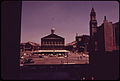 Faneuil Hall and Congress St., 1973
 -
 Faneuil Hall (bottom left) during the construction of Government Center
 -
 1981 view of Faneuil Hall from the steps of Boston City Hall
 -
 The Great Hall
 -
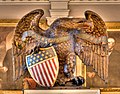 Eagle statue in the Great Hall
 -
 Museum of the Ancient and Honorable Artillery Company of Massachusetts


See also
[edit]- List of National Historic Landmarks in Boston
- National Register of Historic Places listings in northern Boston, Massachusetts
- Market House (Fayetteville, North Carolina), a functionally similar National Historic Landmark
- City Market (Charleston, South Carolina), a functionally similar National Historic Landmark
References
[edit]Notes
[edit]- ^ The 1763 date is given by multiple sources.[67][68][69][70] Some sources give a different rededication date of March 14, 1764.[47][65]
- ^ Sources disagree on whether $1,500 (equivalent to $57,000 in 2024)[116] or $15,000 (equivalent to $567,000 in 2024) was spent on furnishings.[156]
- ^ One source cites the bell as dating from 1866,[306] which is the year it was cast.[143]
- ^ The name of Healy's painting is variously cited as Webster Replying to Hayne,[140] Webster's Reply to Hayne,[320] or Liberty and Union, Now and Forever.[319][108]
Citations
[edit]- ^ "National Register Information System". National Register of Historic Places. National Park Service. January 23, 2007.
- ^ a b Glassman-Jaffe, Marcia (2004). Massachusetts – Fun with the Family: Hundreds of Ideas for Day Trips with the Kids. Globe Pequot Press. p. 145. ISBN 978-0-7627-2831-2. Retrieved January 24, 2026.
- ^ a b c "Map Viewer". boston.maps.arcgis.com. Retrieved July 3, 2025.
- ^ a b c d Amadon 1970, p. B4.
- ^ a b c d "Faneuil Hall". TCLF. September 12, 2020. Retrieved January 31, 2026.
- ^ Boston (Mass ) Street Laying-Out Department (1902). A Record of the Streets, Alleys, Places, Etc. in the City of Boston: With an Appendix Containing a Description of the Boundary, Wards and Aldermanic Districts of the City and a Codification by the Corporation Counsel of the Legislative Acts Force January 1, 1902, Authorizing the Laying Out and Construction of Public Works, in the City of Boston, and the Making of Assessments Therefor. Municipal Print. Office. p. 146. Retrieved January 28, 2026.
- ^ a b "Widening of Dock Square Opens New Vista of Faneuil Hall: New Dock Square as Seen From the Custom House Tower". Boston Daily Globe. August 2, 1927. p. 5B. ISSN 0743-1791. ProQuest 512232004.
- ^ Fitch, James Marston (June 1, 1970). "City Hall Boston". The Architectural Review. Vol. 147, no. 880. p. 401. ProQuest 1366913502.
- ^ a b c Quincy 2003, p. 28.
- ^ a b Pietrzyk, Cindi D. (September 1, 2011). Boston's Freedom Trail: Trace the Path of American History. Simon and Schuster. p. 68. ISBN 978-0-7627-6849-3. Retrieved January 29, 2026.
- ^ a b Broudy, Jack (May 29, 1960). "Through Boston in the Footsteps of History". The New York Times. ISSN 0362-4331. Retrieved February 1, 2026.
- ^ a b MacQuarrie, Brian (September 19, 2010). "Digging into city's past: Faneuil Hall excavation paves way for visitors center". Boston Daily Globe. p. B1. ISSN 0743-1791. ProQuest 751430843.
- ^ a b "Samuel Adams Statue at Faneuil Hall Boston". Boston Travel and Tourism Guide. Retrieved January 31, 2026.
- ^ a b Kennon, Donald R.; Somma, Thomas P. (2004). American Pantheon: Sculptural and Artistic Decoration of the United States Capitol. U.S. Capitol Historical Society. p. 244. ISBN 978-0-8214-1442-2. Retrieved January 31, 2026.
- ^ Heller, Jules; Heller, Nancy G. (December 19, 2013). North American Women Artists of the Twentieth Century: A Biographical Dictionary. Routledge. p. 577. ISBN 978-1-135-63882-5. Retrieved January 31, 2026.
- ^ a b "CultureNOW – A Once and Future Shoreline (orignal [sic] shoreline c. 1630): Ross Miller, Boston Art Commission and Boston Landmarks Commission". culturenow.org. Retrieved May 30, 2018.
- ^ Quincy 2003, pp. 6–7.
- ^ Quincy 2003, p. 7.
- ^ a b Boston Landmarks Commission 1994, pp. 9–10.
- ^ a b c d e f g h National Park Service 1966, p. 3.
- ^ a b c Quincy 2003, p. 12.
- ^ Brown 1900, p. 80.
- ^ Boston Landmarks Commission 1994, p. 9.
- ^ a b c d Boston Landmarks Commission 1994, p. 10.
- ^ a b Brown 1900, p. 82.
- ^ a b Pula, James S. (1975). The French in America, 1488–1974: A Chronology & Factbook. Oceana Publications. p. 45. ISBN 978-0-379-00515-8.
- ^ "Change of Four Votes and We'd Have No Faneuil Hall". Boston Daily Globe. January 22, 1940. p. 13. ISSN 0743-1791. Retrieved January 31, 2026 – via newspapers.com.
- ^ a b Quincy 2003, p. 14.
- ^ Boston Landmarks Commission 1994, pp. 10–11.
- ^ Brown 1900, p. 83.
- ^ "Was Faneuil Hall Built with Slave Money?". March 13, 2012. Retrieved May 30, 2018.
- ^ a b c "A New Faneuil Hall: The Cradle of Liberty is Being Rebuilt". San Francisco Chronicle. March 26, 1899. p. 9. ProQuest 576009702.
- ^ a b "Unearthing Boston's Past – The Daily Free Press". dailyfreepress.com. October 5, 2010. Retrieved May 30, 2018.
- ^ a b c Brown 1900, p. 87.
- ^ "Who Built Faneuil Hall?". Boston Daily Globe. December 15, 1895. p. 17. ISSN 0743-1791. Retrieved January 30, 2026 – via newspapers.com.
- ^ a b c "Faneuil Hall, 200 Years Old, Shines in American History: He Knew His Way Around Enlarged in 1805". The Christian Science Monitor. August 24, 1942. p. 2. ISSN 0882-7729. ProQuest 514004301.
- ^ a b c d Amadon 1970, p. B6.
- ^ a b Brown 1900, p. 84.
- ^ a b c d e Boston Landmarks Commission 1994, p. 11.
- ^ a b c d Detwiller 1977, p. 7.
- ^ Brown 1900, pp. 85–86.
- ^ a b Brown 1900, p. 86.
- ^ a b Quincy 2003, pp. 17–18.
- ^ a b Detwiller 1977, p. 9.
- ^ a b Detwiller 1977, p. 8.
- ^ a b c Stark, J.H. (1907). The Loyalists of Massachusetts and the Other Side of the American Revolution. J.H. Stark. p. 231. ISBN 978-0-7222-7679-2. Retrieved January 26, 2026.
}: ISBN / Date incompatibility (help) - ^ a b c d e f g h i Boston Landmarks Commission 1994, p. 12.
- ^ a b Amadon 1970, p. B7.
- ^ a b Quincy 2003, p. 20.
- ^ a b Boston Landmarks Commission 1994, pp. 11–12.
- ^ Brown 1900, p. 92.
- ^ Amadon 1970, p. B7.
- ^ a b "Faneuil Hall; Its History and the Romance of the Family.*". The New York Times. June 8, 1901. ISSN 0362-4331. Retrieved January 24, 2026.
- ^ Brown 1900, p. 89.
- ^ The National Magazine. Bostonian Publishing Company. 1930. p. 259. Retrieved January 24, 2026.
- ^ a b Detwiller 1977, p. 10.
- ^ a b c "Curing Faneuil Hall". The Boston Globe. January 8, 1899. p. 17. ISSN 0743-1791. Retrieved January 29, 2026 – via newspapers.com.
- ^ a b c d e f Detwiller 1977, p. 15.
- ^ a b c Brown 1900, p. 137.
- ^ a b Detwiller 1977, p. 12.
- ^ a b c d Brown 1900, p. 96.
- ^ a b c Quincy 2003, p. 21.
- ^ One or more of the preceding sentences incorporates text from a publication now in the public domain: Wilson, J. G.; Fiske, J., eds. (1900). . Appletons' Cyclopædia of American Biography. New York: D. Appleton.
- ^ a b c Detwiller 1977, p. 13.
- ^ a b c Amadon 1970, p. B10.
- ^ Brown 1900, p. 97.
- ^ a b Quincy 2003, p. 22.
- ^ "5 Things You Didn't Know About Faneuil Hall". CBS Boston. July 12, 2013. Retrieved January 26, 2026.
- ^ a b Stark, James Henry (1901). Stark's Antiqve Views of Ye Towne of Boston. J.H. Stark. p. 105. Retrieved January 26, 2026.
- ^ a b c d e f "Repairs for Faneuil Hall". Springfield Weekly Republican. January 25, 1923. p. 7. Retrieved January 30, 2026 – via newspapers.com.
- ^ Detwiller 1977, p. 14.
- ^ National Park Service 1966, pp. 3, 5.
- ^ a b c d e Detwiller 1977, p. 17.
- ^ a b Brown 1900, p. 133.
- ^ a b Maloy, Mark (February 2, 2026). "Faneuil Hall". American Battlefield Trust. Retrieved February 2, 2026.
- ^ a b Brown 1900, p. 124.
- ^ a b Boston Landmarks Commission 1994, pp. 12–13.
- ^ a b c d National Park Service 1966, p. 5.
- ^ a b c Quincy 2003, p. 23.
- ^ Brown 1900, p. 124.
- ^ a b c d Amadon 1970, p. B11.
- ^ Quincy 2003, p. 26.
- ^ a b Brown 1900, p. 127.
- ^ a b c d e Snyder, Michael (March 21, 2025). "Why Faneuil Hall Is the Perfect Metaphor for the American Revolution's Complicated Definition of Liberty". Smithsonian Magazine. Retrieved January 24, 2026.
- ^ Brown 1900, pp. 130–131.
- ^ Brown 1900, p. 131.
- ^ a b c d e Harvey, Joseph M. (July 10, 1949). "Old Faneuil Hall Market is Doomed". The Boston Globe. pp. 1, 26. ISSN 0743-1791. Retrieved January 31, 2026 – via newspapers.com.
- ^ a b Brown 1900, p. 132.
- ^ a b c d Boston Landmarks Commission 1994, p. 13.
- ^ Quincy 2003, pp. 28–29.
- ^ Brown 1900, pp. 149–150.
- ^ Detwiller 1977, p. 16.
- ^ Detwiller 1977, p. 18.
- ^ a b c Quincy 2003, p. 38.
- ^ a b c Quincy 2003, p. 29.
- ^ Brown 1900, p. 134.
- ^ a b Amadon 1970, p. B12.
- ^ a b c d e f g h Boston Landmarks Commission 1994, p. 14.
- ^ Brown 1900, p. 151.
- ^ a b c "Beef Before Baubles". Historic Preservation. Vol. 10, no. 1. January 1, 1958. pp. 26–28. ProQuest 2493356849.
- ^ a b c d Detwiller 1977, p. 19.
- ^ a b c d Quincy 2003, p. 30.
- ^ Amadon 1970, p. B14.
- ^ a b Brown 1900, p. 153.
- ^ a b c d e Detwiller 1977, p. 22.
- ^ a b c Place 1925, p. 124.
- ^ a b c Brown 1900, p. 154.
- ^ a b Alper, M. Victor (1976). America's Freedom Trail: A Tour Guide to Historical Sites of the Colonial and Revolutionary War Period. Collier Books. p. 53. ISBN 978-0-02-097150-4. Retrieved January 25, 2026.
- ^ a b c Place 1925, p. 122.
- ^ a b c d e f Amadon 1970, p. B15.
- ^ a b c d e Brown 1900, p. 155.
- ^ a b National Park Service 1966, p. 6.
- ^ a b c d e f g Detwiller 1977, p. 23.
- ^ Quincy 2003, p. 31.
- ^ Detwiller 1977, pp. 23–25.
- ^ a b c d e Brown 1900, p. 165.
- ^ a b c d "Description of Faneuil Hall". The Literary Magazine, and American Register. Vol. 6, no. 36. September 1806. p. 205. ProQuest 89453144.
- ^ a b c d e Amadon 1970, p. B16.
- ^ a b c d Detwiller 1977, p. 25.
- ^ Brown 1900, pp. 155–157.
- ^ a b Detwiller 1977, p. 26.
- ^ Detwiller 1977, pp. 27–28.
- ^ Detwiller 1977, p. 28.
- ^ "Faneuil Hall History | Boston Freedom Trail History". Boston Tea Party Ships. September 20, 2019. Retrieved November 1, 2021.
- ^ a b Brown 1900, p. 158.
- ^ Quincy 2003, pp. 34–35.
- ^ a b c d e f g h Boston Landmarks Commission 1994, p. 15.
- ^ a b Bostonian Society 1907, p. 44.
- ^ a b c Quincy 2003, p. 111.
- ^ a b Amadon 1970, p. B17.
- ^ a b Detwiller 1977, p. 23.
- ^ a b c d Detwiller 1977, p. 30.
- ^ a b c Detwiller 1977, p. 31.
- ^ a b c d e f g Amadon 1970, p. B18.
- ^ a b c Brown 1900, p. 159.
- ^ Bostonian Society (1963). Proceedings of the Bostonian Society, Annual Meeting. Bostonian Society. p. 46. Retrieved January 27, 2026.
- ^ Quincy 2003, pp. 120–121.
- ^ a b Detwiller 1977, pp. 31–32.
- ^ a b c d e Amadon 1970, p. B19.
- ^ a b c d e f g h i j k l m n o p q Boston Landmarks Commission 1994, p. 5.
- ^ a b Detwiller 1977, p. 33.
- ^ Detwiller 1977, p. 32.
- ^ a b c d e Brown 1900, p. 166.
- ^ a b Detwiller 1977, p. 40.
- ^ Detwiller 1977, p. 34.
- ^ a b Detwiller 1977, p. 39.
- ^ "Leaning Cupola of Faneuil Hall". The Boston Globe. September 18, 1894. p. 4. ISSN 0743-1791. Retrieved January 30, 2026 – via newspapers.com.
- ^ "Condition of Faneuil Hall". Boston Daily Globe. July 6, 1894. p. 10. ISSN 0743-1791. ProQuest 497882800.
- ^ Detwiller 1977, p. 41.
- ^ "Faneuil Hall a "Fire Trap."; Agitation in Boston for Needed Changes to the Historical Building". The New York Times. February 13, 1898. ISSN 0362-4331. Retrieved January 27, 2026.
- ^ a b Detwiller 1977, p. 35.
- ^ "Want Faneuil Hall Fireproof". Boston Evening Transcript. December 29, 1896. p. 3. Retrieved January 27, 2026 – via newspapers.com.
- ^ "Preservation of Faneuil Hall". Boston Daily Globe. April 17, 1897. p. 8. ISSN 0743-1791. Retrieved January 29, 2026 – via newspapers.com.
- ^ "Patriotic-Historic Orders". Boston Evening Transcript. April 21, 1897. p. 11. Retrieved January 29, 2026 – via newspapers.com.
- ^ "Passed the $31,000 Mark". Boston Evening Transcript. February 11, 1898. p. 7. Retrieved January 29, 2026 – via newspapers.com.
- ^ a b c d Detwiller 1977, p. 43.
- ^ a b c d Amadon 1970, p. B25.
- ^ Place 1925, p. 125.
- ^ a b "Repairing Faneuil Hall". Boston Evening Transcript. November 5, 1898. p. 6. Retrieved January 29, 2026 – via newspapers.com.
- ^ a b c d e "Will Be Fireproof". The Boston Globe. November 4, 1898. p. 6. ISSN 0743-1791. Retrieved January 29, 2026 – via newspapers.com.
- ^ a b "Faneuil Hall Fireproof; Every Column and Rafter of Wood Has Been Removed". The Boston Globe. June 2, 1899. p. 2. ISSN 0743-1791. Retrieved January 27, 2026 – via newspapers.com.
- ^ a b c d e Brown 1900, p. 167.
- ^ a b c d e f "How Faneuil Hall Now Looks Inside". The Boston Globe. September 17, 1899. p. 31. ISSN 0743-1791. Retrieved January 29, 2026 – via newspapers.com.
- ^ a b c d e Amadon 1970, p. B26.
- ^ Detwiller 1977, pp. 45–46.
- ^ a b c d Detwiller 1977, p. 45.
- ^ a b c d e Detwiller 1977, p. 60.
- ^ "Weather Vane: On Faneuil Hall Has Been Keeping Tab on "Old Prob" for 156 Years". Courier-Journal. November 8, 1898. p. 2. ProQuest 1036697990.
- ^ a b Detwiller 1977, p. 44.
- ^ a b Detwiller 1977, p. 47.
- ^ "Back in Faneuil Hall". Boston Daily Globe. January 24, 1900. p. 5. ISSN 0743-1791. Retrieved January 30, 2026 – via newspapers.com.
- ^ a b c Detwiller 1977, p. 49.
- ^ "School Chorus Will Sing". Boston Daily Globe. April 13, 1908. p. 14. ISSN 0743-1791. Retrieved January 30, 2026 – via newspapers.com.
- ^ "Mrs. Howe's Portrait". The Boston Globe. January 2, 1911. p. 2. ISSN 0743-1791. Retrieved January 30, 2026 – via newspapers.com.
- ^ "No Room in Faneuil Hall; That Is the Reason Why Mrs. Howe's Portrait Is Barred". The New York Times. December 30, 1910. ISSN 0362-4331. Retrieved January 30, 2026.
- ^ a b "Will Not Hang in Faneuil Hall". The Boston Globe. January 24, 1911. p. 2. ISSN 0743-1791. Retrieved January 30, 2026 – via newspapers.com.
- ^ a b "Faneuil Hall As Fire-Trap". Brooklyn Daily Eagle. April 18, 1911. p. 4. Retrieved January 30, 2026 – via newspapers.com.
- ^ "All For Frothingham". Boston Evening Transcript. November 6, 1911. pp. 1, 3. Retrieved January 30, 2026 – via newspapers.com.
- ^ a b Detwiller 1977, p. 50.
- ^ a b "A Proposed Rearrangement in Faneuil Hall". The American Architect and the Architectural Review. Vol. 125, no. 2443. April 9, 1924. p. 370. ProQuest 124689678.
- ^ "Plans of Faneuil Hall Estimated". The Christian Science Monitor. January 15, 1915. p. 5. ISSN 0882-7729. ProQuest 509291296.
- ^ "Differences on Faneuil Hall Restoration Ended". Boston Daily Globe. January 18, 1916. p. 14. ISSN 0743-1791. Retrieved January 30, 2026 – via newspapers.com.
- ^ a b "Restoration of Faneuil Hall is Outlined: Chairman Cram of City Planning Board Prepares Scheme for Historic Building". The Christian Science Monitor. February 1, 1916. p. 5. ISSN 0882-7729. ProQuest 509596609.
- ^ a b "To Make Faneuil Hall Fireproof". The Morning Union. June 17, 1917. p. 10. Retrieved January 30, 2026 – via newspapers.com.
- ^ "Ancients Must Clean Up House". Boston Daily Globe. May 29, 1917. p. 10. ISSN 0743-1791. Retrieved January 30, 2026 – via newspapers.com.
- ^ a b "'Cradle of Liberty' Chilled; Coal Scarcity Causes Oil Heat to Be Proposed for Faneuil Hall". The New York Times. November 18, 1920. ISSN 0362-4331. Retrieved January 30, 2026.
- ^ "Inquiry Into Plan to Heat Faneuil Hall". The Boston Globe. November 18, 1920. p. 14. ISSN 0743-1791. Retrieved January 30, 2026 – via newspapers.com.
- ^ "Unveil Tablet in Faneuil Hall". Boston Daily Globe. May 2, 1922. p. 12. ISSN 0743-1791. Retrieved January 30, 2026 – via newspapers.com.
- ^ a b c "Faneuil Hall". The New York Times. January 7, 1923. ISSN 0362-4331. Retrieved January 24, 2026.
- ^ "Faneuil Hall Men Face Heavy Losses". Boston Daily Globe. November 20, 1923. p. 17. ISSN 0743-1791. Retrieved January 30, 2026 – via newspapers.com.
- ^ a b "Faneuil Hall, In Its New Dress, Most Attractice [sic] in Appearance". Boston Daily Globe. March 17, 1925. p. 8. ISSN 0743-1791. Retrieved January 30, 2026 – via newspapers.com.
- ^ "Faneuil Hall as It Was in '76: Removal of Paint Shows by Difference in Color for Brick Lines of the Original Building". Boston Daily Globe. April 27, 1924. p. 36. ISSN 0743-1791. ProQuest 497706518.
- ^ a b Boston Landmarks Commission 1994, p. 22.
- ^ a b Detwiller 1977, p. 54.
- ^ "Faneuil Hall to Continue Without an Elevator". The Boston Globe. June 1, 1923. p. 32. ISSN 0743-1791. Retrieved January 30, 2026 – via newspapers.com.
- ^ "Proposes Removal of Webster Picture from Faneuil Hall". The Boston Globe. March 24, 1924. p. 12. ISSN 0743-1791. Retrieved January 30, 2026 – via newspapers.com.
- ^ "Not Approved by Commission". Boston Daily Globe. March 27, 1924. p. 22. ISSN 0743-1791. Retrieved January 30, 2026 – via newspapers.com.
- ^ "Gen. Pershing Gives Medal to Boy Hero". The Boston Globe. April 20, 1925. pp. 1, 15. ISSN 0743-1791. Retrieved January 30, 2026 – via newspapers.com.
- ^ "Calls on Americans to Fulfill Obligations". The Springfield Daily Republican. April 20, 1925. p. 2. Retrieved January 30, 2026 – via newspapers.com.
- ^ Sibley, Frank P. (October 20, 1930). "City's Outstanding Historic Spot? Faneuil Hall and Common Lead". Boston Daily Globe. p. 13. ISSN 0743-1791. Retrieved January 31, 2026 – via newspapers.com.
- ^ "Faneuil Hall's Traffic Snarls Speed New Mart in Cambridge: New Cambridge Site Trains Cut Profits". The Christian Science Monitor. July 19, 1935. p. 3. ISSN 0882-7729. ProQuest 513788857.
- ^ "Farmers Tell Ely They Don't Want New Market Place: Prefer Old Faneuil Hall to South Boston Site, Delegation Says". The Christian Science Monitor. April 7, 1934. p. 2. ISSN 0882-7729. ProQuest 513520571.
- ^ a b Detwiller 1977, p. 55.
- ^ a b "Forgotten Date Bobs Up In Faneuil Hall District: Called 'Quincy's Folly'". The Christian Science Monitor. August 21, 1953. p. 5. ISSN 0882-7729. ProQuest 508830165.
- ^ a b c d e McPartlin, Joan (October 10, 1953). "Grasshopper Landmark Famous as Hall Itself". The Boston Globe. p. 4. ISSN 0743-1791. Retrieved January 31, 2026 – via newspapers.com.
- ^ a b c "Boston's Faneuil Hall Historic U.S. Shrine". The Washington Post, Times Herald. March 31, 1963. p. E8. ISSN 0190-8286. ProQuest 141814249.
- ^ Johansson, Bertram B. (September 20, 1946). "Faneuil Hall's Grasshopper Hops Back to Its Lofty Perch: Historic Grasshopper Dons Its Suit of Gleaming Gold". The Christian Science Monitor. p. 2. ISSN 0882-7729. ProQuest 515803566.
- ^ "Mr. Grasshopper Missing From Faneuil Hall". Boston Daily Globe. August 23, 1946. p. 12. ISSN 0743-1791. Retrieved January 31, 2026 – via newspapers.com.
- ^ "Faneuil Hall Portraits Are Cleaned and Rehung". The Christian Science Monitor. December 26, 1947. p. 2. ISSN 0882-7729. ProQuest 516145171.
- ^ Harvey, W. Clifford (November 12, 1946). "Boston Urged to Beautify Area Around Faneuil Hall: Will History Bow to Automobile Parking?". The Christian Science Monitor. p. 4. ISSN 0882-7729. ProQuest 515978882.
- ^ a b Kluckhohn, Frank L. (October 19, 1947). "New England; Talk of Ending Old Market Threatens Controversy". The New York Times. ISSN 0362-4331. Retrieved January 31, 2026.
- ^ "Curley Acts to Oust Markets at Faneuil Hall". The Boston Globe. February 27, 1948. p. 9. ISSN 0743-1791. Retrieved January 31, 2026 – via newspapers.com.
- ^ "Boston May Move Market District; $10,000,000 Quarters Planned to Replace Present Area Around Faneuil Hall". The New York Times. July 4, 1949. ISSN 0362-4331. Retrieved January 31, 2026.
- ^ "Packers Urged to Work for New Market". The Boston Globe. June 30, 1949. p. 7. ISSN 0743-1791. Retrieved January 31, 2026 – via newspapers.com.
- ^ a b c Donofrio 2012, p. 116.
- ^ a b "Old Boston Bows to Superhighway; $40,000,000 Central Artery Levels Ancient Buildings, but Faneuil Hall Stands". The New York Times. February 28, 1954. ISSN 0362-4331. Retrieved January 31, 2026.
- ^ a b Smith, Everett M. (July 17, 1951). "South Bay Market Studied For Faneuil Hall Evictees: One of Six Sites Portable Buildings? South Bay Eyed Buildings Razed". The Christian Science Monitor. p. 1. ISSN 0882-7729. ProQuest 508403001.
- ^ "OPS Advisory Office Opens in Faneuil Hall". The Christian Science Monitor. November 29, 1951. p. 21. ISSN 0882-7729. ProQuest 508453714.
- ^ "Ancients Donate New Piano to City for Faneuil Hall". The Boston Globe. November 5, 1951. p. 4. ISSN 0743-1791. Retrieved January 31, 2026 – via newspapers.com.
- ^ a b "Faneuil Hall Grasshopper Repaired: Faneuil Hall Hopper Tells 'Inside' Story Jangling Noise Inside Placed Atop Hall in 1742". The Christian Science Monitor. July 22, 1952. p. 2. ISSN 0882-7729. ProQuest 508581121.
- ^ a b "Chimes Dedication Set at Faneuil Hall". The Christian Science Monitor. July 24, 1953. p. 2. ISSN 0882-7729. ProQuest 508834402.
- ^ "Harry J. Blake Donates Chimes for Faneuil Hall". Boston Daily Globe. March 24, 1953. p. 18. ISSN 0743-1791. Retrieved January 31, 2026 – via newspapers.com.
- ^ "Faneuil Hall Chimes Await Gifts to Supply Amplifiers". The Boston Globe. July 23, 1953. p. 2. ISSN 0743-1791. Retrieved January 31, 2026 – via newspapers.com.
- ^ "Faneuil Hall Organ Recitals Starting Today". Boston Daily Globe. July 1, 1955. p. 4. ISSN 0743-1791. ProQuest 843241206.
- ^ a b "Boston Ponders Faneuil Future; Gradual Shift of Produce District Raises Question of Status of Hall". The New York Times. March 16, 1958. ISSN 0362-4331. Retrieved February 1, 2026.
- ^ a b c Dodd, Ora (June 4, 1958). "Faneuil Hall Fate Stirs Hot Debate: Disorder Called 'Shock' Historians Allied Started in 1741 Not the First Argument". The Christian Science Monitor. p. 1. ISSN 0882-7729. ProQuest 509734007.
- ^ Donofrio 2012, pp. 116–117.
- ^ a b "Tear Down Faneuil Hall? Never! It Will Be U.S. Shrine". The Boston Globe. May 23, 1961. p. 1. ISSN 0743-1791. ProQuest 250961036.
- ^ "$10,000 Facial Next Month for Faneuil Hall". The Boston Globe. July 23, 1960. p. 2. ISSN 0743-1791. Retrieved February 1, 2026 – via newspapers.com.
- ^ "Faneuil Hall, Quincy Market Get Face-Lift". The Boston Globe. August 6, 1961. p. 21. ISSN 0743-1791. Retrieved February 1, 2026 – via newspapers.com.
- ^ "Aldrich to Check Sprucing Needed At Faneuil Hall". The Boston Globe. May 29, 1961. p. 11. ISSN 0743-1791. Retrieved February 1, 2026 – via newspapers.com.
- ^ Yudis, Anthony J. (October 23, 1964). "'Monument or Tombstone?': Faneuil Hall Market—Where Will It Go?". The Boston Globe. p. 30. ISSN 0743-1791. Retrieved February 1, 2026 – via newspapers.com.
- ^ a b Yudis, Anthony J. (March 14, 1964). "Emphasis on Restoration". The Boston Globe. p. 8. ISSN 0743-1791. Retrieved February 1, 2026 – via newspapers.com.
- ^ "Boston to Renew Area Around Faneuil Hall: Old Boston In Renewal". The New York Times. December 8, 1968. p. 558. ISSN 0362-4331. ProQuest 118455947.
- ^ Yudis, Anthony (December 1, 1968). "Finest urban 'pedestrian path' in country: Restoration of Faneuil Hall hardly a pipe dream". The Boston Globe. p. B37. ISSN 0743-1791. ProQuest 366512888.
- ^ "Faneuil Hall Restoration". Hartford Courant. November 16, 1969. p. 119. Retrieved February 1, 2026 – via newspapers.com.
- ^ Cobb, Nathan (November 15, 1970). "Historical apothecary moves to Faneuil Hall: Nearly home after 150 years". The Boston Globe. p. B1. ISSN 0743-1791. ProQuest 655915501.
- ^ Yudis, Anthony J. (July 2, 1971). "Faneuil Hall renovation contracted". The Boston Globe. p. 3. ISSN 0743-1791. Retrieved January 25, 2026 – via newspapers.com.
- ^ "Restoration Program Approved For Historic Section in Boston". The New York Times. July 4, 1971. ISSN 0362-4331. Retrieved February 1, 2026.
- ^ a b Grilley, Virginia (May 15, 1975). "Faneuil Hall: craftsman's joy". The Christian Science Monitor. p. 25. ISSN 0882-7729. ProQuest 511746198.
- ^ "Grasshopper Weather Vane on Faneuil Hall Is Stolen". The New York Times. January 6, 1974. p. 54. ISSN 0362-4331. Retrieved October 11, 2025.
- ^ a b Spiess, Philip D, II (April 1974). "Weather Vanes: The History, Design, and Manufacture of an American Folk Art". Historic Preservation. Vol. 26, no. 2. pp. 45–46. ProQuest 2283837937.
}: CS1 maint: multiple names: authors list (link) - ^ "Grasshopper Restored To Faneuil Hall Tower". The New York Times. July 28, 1974. ISSN 0362-4331. Retrieved January 25, 2026.
- ^ Campbell, Robert (December 8, 1991). "Marketplace architect picked for gold medal". The Boston Globe. p. 40. ISSN 0743-1791. ProQuest 2745309766.
- ^ a b Marlin, William (September 24, 1976). "Boston restores its old market: Faneuil Hall shops: hopefully more than souvenir emporiums No building is an island Quincy Market Urban reform pressed Something going right Leavening influence hoped Blue collars, too". The Christian Science Monitor. p. 19. ISSN 0882-7729. ProQuest 511967377.
- ^ Yudis, Anthony J. (March 10, 1974). "Faneuil Hall sites ready for Rouse Co". The Boston Globe. p. 165. ISSN 0743-1791. Retrieved January 25, 2026 – via newspapers.com.
- ^ a b Cantor, George (1995). Pop Culture Landmarks. Gale Research. p. 16. ISBN 978-0-8103-9399-8. Retrieved January 24, 2026.
- ^ Yudis, Tony (December 4, 1976). "Faneuil Hall ice cream parlor? Brothers may sell old drugstore". The Boston Globe. p. 26. ISSN 0743-1791. Retrieved February 2, 2026 – via newspapers.com.
- ^ Yudis, Anthony J. (July 10, 1977). "Brigham's, Montilio's to be Faneuil Hall building tenants". The Boston Globe. p. 133. ISSN 0743-1791. Retrieved January 30, 2026 – via newspapers.com.
- ^ Yudis, Anthony (October 9, 1977). "British are coming (and 3 US firms) to redo Faneuil Hall". The Boston Globe. p. C1. ISSN 0743-1791. ProQuest 747355079.
- ^ a b Boston Landmarks Commission. Faneuil Hall (PDF) (Report). Archived from the original (PDF) on December 28, 2017. Retrieved December 27, 2017.
- ^ "Ribbons cut for ticket plan". Daily Evening Item. August 27, 1979. p. 2. Retrieved February 2, 2026 – via newspapers.com.
- ^ "Around the Nation: Boston Firemen Protect Faneuil Hall From Blaze Oil From Burning Tanker Reaches Galveston Island 3 Are Missing as a Fire Caves In a Missouri Hotel Safety Program for Pilots Scheduled to Cut Accidents Hundreds Rally in Baltimore Against Atomic Waste Plan". The New York Times. November 19, 1979. p. A18. ISSN 0362-4331. ProQuest 123925380.
- ^ St. George, David (May 23, 1980). "Review / Music; ; Classical Orchestra Makes Its Debut in Faneuil Hall". The Boston Globe. p. 1. ISSN 0743-1791. ProQuest 293977784.
- ^ "Reconstructing the Past". Building Design. No. 451. June 22, 1979. pp. 28–31. ProQuest 2307688080.
- ^ "City Considers Hike in Faneuil Hall Rents". The Boston Globe. December 18, 1984. p. 84. ISSN 0743-1791. Retrieved February 2, 2026 – via newspapers.com.
- ^ a b Marantz, Steven (August 14, 1988). "Faneuil Hall Merchants Fear Renovation". The Boston Globe. p. 26. ISSN 0743-1791. Retrieved February 2, 2026 – via newspapers.com.
- ^ a b c Wilson, Elizabeth (May 26, 1985). "Boston's historic Faneuil Hall showing its age". The Boston Globe. p. 97. ISSN 0743-1791. Retrieved February 2, 2026 – via newspapers.com.
- ^ "Faneuil Hall in Boston Found In Desperate Need of Repair". The New York Times. United Press International. June 2, 1985. ISSN 0362-4331. Retrieved February 2, 2026.
- ^ a b Quill, Ed (September 29, 1985). "Historic sites in Hub seriously neglected, study says". The Boston Globe. pp. 25, 38. ISSN 0743-1791. Retrieved February 2, 2026 – via newspapers.com.
- ^ a b Thomas, Jack (July 10, 1989). "Boston's Soul Will Be Rebuilt". The Boston Globe. p. 10. ISSN 0743-1791. Retrieved February 2, 2026 – via newspapers.com.
- ^ "Congressmen seek preservation cash". The Morning Union. United Press International. April 19, 1985. p. 5. Retrieved February 2, 2026 – via newspapers.com.
- ^ Pearson, Carol (December 3, 1985). "Facilities for the Disabled Inaugurated at Faneuil Hall by Ex-football Players". The Boston Globe. p. 27. ISSN 0743-1791. Retrieved February 2, 2026 – via newspapers.com.
- ^ a b c d Richard, Ray (May 10, 1987). "Aid Sought to Restore Historic Sites". The Boston Globe. pp. 33, 40. ISSN 0743-1791. Retrieved February 2, 2026 – via newspapers.com.
- ^ Kranish, Michael (August 11, 1988). "Congress Passes Renovation Funds for Faneuil Hall, Old State House". The Boston Globe. p. 8. ISSN 0743-1791. Retrieved February 2, 2026 – via newspapers.com.
- ^ "Faneuil Hall update forces out tenants". The Boston Globe. August 14, 1990. p. 29. ISSN 0743-1791. ProQuest 2576142284.
- ^ "Faneuil Hall Closes for a Restoration". The Boston Globe. September 16, 1990. p. 32. ISSN 0743-1791. ProQuest 294553444.
- ^ "Faneuil Hall's Treasure Dump". The Washington Post. Associated Press. January 17, 1991. ISSN 0190-8286. Retrieved January 24, 2026.
- ^ Stanmar, Greg (September 20, 1992). "Boston History Lessons Abound on the Freedom Trail". Pantagraph. p. B1. ProQuest 251953919.
- ^ "Faneuil Hall's first floor reopens". The Boston Globe. July 2, 1994. p. 23. ISSN 0743-1791. Retrieved January 24, 2026 – via newspapers.com.
- ^ a b c Goldman, Henry (December 24, 1997). "The Charm Has Worn Off: In 1976, Boston's Faneuil Hall Marketplace Was a Revelation. Today, Sales Are Down". Philadelphia Inquirer. pp. D1, D2. ProQuest 1842062513. Retrieved January 23, 2026 – via newspapers.com.
- ^ a b "Historic Faneuil Hall has it all for shoppers Stormy debates on the second floor earned Faneuil Hall the nickname 'Cradle of Liberty'". Bangor Daily News. December 7, 1996. p. 1. ProQuest 413862007.
- ^ Allen, Robin Lee (August 28, 2000). "Boston restaurateurs enjoy Faneuil Hall revival". Nation's Restaurant News. Vol. 34, no. 35. pp. 8, 83. ProQuest 229310219.
- ^ a b c d e f g Massari, Paul (November 30, 2000). "Is It Safe to Go Back to the Market?: Where Bostonians Fear to Tread; Faneuil Hall for the Locals; Faneuil Hall a Guide for the Non-tourist". The Boston Globe. pp. 12–15. ISSN 0743-1791. ProQuest 3144306975.
- ^ a b c Lipman, Lisa (December 1, 2001). "Museum by mistake Boston's Faneuil Hall is home to wealth of U.S. military history". The Record. p. G11. ProQuest 266966786.
- ^ Slack, Donovan (December 2, 2003). "Public Marketing: Faneuil Hall Makeover Would Oust Some Merchants". The Boston Globe. pp. B1, B5. ISSN 0743-1791. Retrieved February 2, 2026 – via newspapers.com.
- ^ Drake, John C. (April 17, 2008). "What price history?". The Boston Globe. pp. B1, B4. ISSN 0743-1791. Retrieved February 3, 2026 – via newspapers.com.
- ^ "Boston visitors centre relocated to Faneuil Hall". The Record. June 11, 2010. Retrieved February 3, 2026.
- ^ a b Nicas, Jack (June 12, 2010). "Faneuil Hall to get new tourist center: Construction to begin in fall, 10 vendors out". The Boston Globe. pp. B1, B11. ISSN 0743-1791. ProQuest 366832883. Retrieved February 2, 2026 – via newspapers.com.
- ^ a b c Matos, Alejandra (May 25, 2012). "Hub of history: Faneuil Hall renovation ready for unveiling". The Boston Globe. pp. B1, B5. ISSN 0743-1791. Retrieved February 3, 2026 – via newspapers.com.
- ^ "Historic Faneuil Hall re-opens with modern technology". WCVB. May 25, 2012. Retrieved January 24, 2026.
- ^ Swasey, Benjamin (May 25, 2012). "Renovated Faneuil Hall Gets A New Visitor Center". WBUR News. Retrieved January 24, 2026.
- ^ "Boston's Faneuil Hall closing for renovations". The Providence Journal. Associated Press. December 31, 2017. Retrieved January 29, 2026.
- ^ a b "One of Boston's most historic buildings to close for months". WCVB. December 10, 2025. Retrieved February 3, 2026.
- ^ a b Allen, Evan (December 30, 2017). "Historic Faneuil Hall building closes for renovations". The Boston Globe. ISSN 0743-1791. Retrieved February 3, 2026.
- ^ a b Rice, Justin (May 22, 2018). "Sleuthing Required to Revamp Historic Hall". ENR. Retrieved January 25, 2026.
- ^ "Boston National Historical Park". U.S. National Park Service. January 2, 2025. Retrieved February 3, 2026.
- ^ a b Campbell, Jerome (July 17, 2019). "Artist Withdraws Proposed Faneuil Hall Slave Memorial After Boston NAACP Says It Will Oppose It". WBUR News. Retrieved February 3, 2026.
- ^ Gavin, Christopher (July 18, 2019). "The NAACP said it opposes a Faneuil Hall memorial for slave trade victims. Now, the artist says he'll take it out of Boston". The Boston Globe. ISSN 0743-1791. Retrieved February 3, 2026.
- ^ Chesto, Jon (August 31, 2020). "'It's never been this bad': One-fourth of Faneuil Hall businesses haven't reopened due to the COVID-19 pandemic". The Boston Globe. ISSN 0743-1791. Retrieved February 3, 2026.
- ^ Ruckstuhl, Laney (March 24, 2022). "Faneuil Hall merchants try to make up for 2 lost years as patrons return". WBUR News. Retrieved February 4, 2026.
- ^ Sacchetti, Sharman (December 10, 2025). "Boston unveils slavery exhibit inside historic building". WCVB. Retrieved February 5, 2026.
- ^ Coetzee, Samantha; Cole, Katie (June 16, 2023). "Exhibit detailing the history of slavery in Boston opens in Faneuil Hall". WBUR News. Retrieved February 4, 2026.
- ^ "BosTix Booth Reopens In Faneuil Hall Ahead Of "The Queen Of Versailles"". WBZ NewsRadio 1030. July 10, 2024. Retrieved February 2, 2026.
- ^ Palma, Kristi (July 8, 2024). "Discounted theater ticket booth returning to Faneuil Hall this week". The Boston Globe. ISSN 0743-1791. Retrieved February 3, 2026.
- ^ a b c d e f g h i j k National Park Service 1974, p. 7.32.
- ^ a b c d e f g h i Boston Landmarks Commission 1994, p. 2.
- ^ a b c d e f Boston Landmarks Commission 1994, p. 3.
- ^ a b c Boston Landmarks Commission 1994, pp. 2–3.
- ^ a b c d e f g h i j k l m n o p q National Park Service 1974, p. 7.33.
- ^ a b "Visit Historic Faneuil Hall (U.S. National Park Service)". NPS.gov Homepage (U.S. National Park Service). January 17, 2026. Retrieved January 29, 2026.
- ^ a b c Detwiller 1977, p. 46.
- ^ a b Place 1925, p. 123.
- ^ a b National Park Service 1974, pp. 7.32–7.33.
- ^ "Tattered Flag Above Faneuil Can't Be Helped". Boston Daily Globe. July 16, 1959. p. 4. ISSN 0743-1791. ProQuest 843241206.
- ^ a b Viser, Matt (May 4, 2007). "It tolls for the city". The Boston Globe. ISSN 0743-1791. Archived from the original on June 14, 2007. Retrieved January 25, 2026.
- ^ a b c Bostonian Society 1907, p. 45.
- ^ a b "Did You Ever Wonder: Why a Gilded Grasshopper Surmounts the Famous Faneuil Hall?". The Christian Science Monitor. February 24, 1942. p. 21. ISSN 0882-7729. ProQuest 513891521.
- ^ a b c Weston, George F. (Spring 1957). "The Vanes of Boston". New York Folklore Quarterly. Vol. 13, no. 1. p. 301. ProQuest 1290747737.
- ^ Unsworth, Tania (February 25, 1996). "Playing Tourist At Home". The New York Times. ISSN 0362-4331. Retrieved January 26, 2026.
- ^ "Did You Ever Wonder: Why a Gilded Grasshopper Surmounts the Famous Faneuil Hall?". The Christian Science Monitor. February 24, 1942. p. 21. ISSN 0882-7729. ProQuest 513891521.
- ^ Enwemeka, Zeninjor (October 9, 2014). "A Lion, A Grasshopper And Other Boston Time Capsules". WBUR News. Retrieved February 4, 2026.
- ^ a b Taylor, Jerry (January 5, 1974). "80-pound copper figure 'priceless': 1742 grasshopper weather vane snatched from atop Faneuil Hall". The Boston Globe. p. 1. ISSN 0743-1791. ProQuest 612936158.
- ^ a b c d "Faneuil Hall: Where History Unfolds". The Boston Globe. May 24, 1964. p. 192. ISSN 0743-1791. Retrieved February 1, 2026 – via newspapers.com.
- ^ "Art in Faneuil Hall, Boston National Historical Park Brochure" (PDF). Archived from the original (PDF) on September 11, 2010. Retrieved May 30, 2018.
- ^ a b c d e Detwiller 1977, p. 65.
- ^ a b c d e f g Boston Landmarks Commission 1994, p. 4.
- ^ a b c Detwiller 1977, p. 64.
- ^ a b Demeter, Richard (1997). Irish America: The Historical Travel Guide. Cranford Press. p. 175. ISBN 978-0-9648253-3-8. Retrieved January 25, 2026.
- ^ Berg, Albert Ellery (1884). The Drama, Painting, Poetry, and Song: Embracing a Complete History of the Stage; an Exhaustive Treatise on Pictorial Art; a Choice Collection of Favorite Poems, and Popular Songs of All Nations. P.F. Collier. p. 548. Retrieved January 25, 2026.
- ^ The diplomatic and official papers of Daniel Webster, while Secretary. Harper. 1930. p. 375. Retrieved January 25, 2026.
- ^ Boston Landmarks Commission 1994, pp. 5–6.
- ^ a b National Park Service 1974, pp. 7.33–7.34.
- ^ Detwiller 1977, p. 92.
- ^ a b c d e Boston Landmarks Commission 1994, p. 6.
- ^ Detwiller 1977, p. 94.
- ^ "Ask the Globe". The Boston Globe. September 28, 1980. p. 282. ISSN 0743-1791. Retrieved February 2, 2026 – via newspapers.com.
- ^ a b Detwiller 1977, pp. 64–65.
- ^ a b Brown 1900, p. 168.
- ^ a b c d e National Park Service 1974, p. 7.34.
- ^ New England Ancestors: Newsmagazine of the New England Historic Genealogical Society. New England Historic Genealogical Society. 2002. p. 34. Retrieved January 25, 2026.
- ^ a b c Boston Landmarks Commission 1994, pp. 6–7.
- ^ a b c d e Boston Landmarks Commission 1994, p. 7.
- ^ Sheldon, Courtney R. (October 8, 1947). "Faneuil Hall Offers Graphic View of History: Steps to Freedom". The Christian Science Monitor. p. 2. ISSN 0882-7729. ProQuest 516039758.
- ^ Pratt, Mark (June 18, 2018). "Some Seek Faneuil Hall Name Change Because of Slavery Ties". NBC Boston. Retrieved January 24, 2026.
- ^ a b Seelye, Katharine Q. (June 6, 2018). "Boston Grapples With Faneuil Hall, Named for a Slaveholder". The New York Times. ISSN 0362-4331. Retrieved February 3, 2026.
- ^ Cooper, James Fenimore. "Lionel Lincoln : or, The leaguer of Boston". New York : Lovell, Coryell. Retrieved May 30, 2018 – via Internet Archive.
- ^ a b O'Malley, Nick (January 14, 2026). "Boston's Faneuil Hall Marketplace: Tourist trap, or bad rap?". masslive. Retrieved January 30, 2026.
- ^ "'Quincy Market' 100 Years Old Today". Boston Daily Globe. August 26, 1926. p. 10. ISSN 0743-1791. Retrieved January 30, 2026 – via newspapers.com.
- ^ Gere, Michelle (August 17, 2017). "Group calls for Faneuil Hall to be renamed". WPRI. Retrieved May 30, 2018.
- ^ "Faneuil Hall: Boston landmark named after slaveowner faces boycott". The Guardian. Associated Press. July 31, 2018. Retrieved January 31, 2026.
- ^ "Marty Walsh has a confession to make". The Boston Globe. ISSN 0743-1791. Retrieved August 1, 2018.
- ^ Mason, Amelia (October 19, 2022). "Activists chain themselves to Faneuil Hall in protest of its slaveholding namesake". WBUR News. Retrieved February 4, 2026.
- ^ McDonald, Danny (January 12, 2023). "At City Hall, a sit-in to protest the name of a Boston landmark". The Boston Globe. ISSN 0743-1791. Retrieved February 4, 2026.
- ^ "Boston's "cradle of liberty" was paid for with slavery profits". The Economist. November 9, 2023. ProQuest 2887653522. Retrieved February 4, 2026.
- ^ a b Abelson, Jenn (June 24, 2009). "Merchants seek local control of Faneuil Hall". The Boston Globe. pp. B5, B8. ISSN 0743-1791. Retrieved February 3, 2026 – via newspapers.com.
- ^ a b Nowik, Bonnie (June 22, 1990). "Faneuil Hall offers history and shopping". The Daily Item. p. 70. Retrieved January 24, 2026 – via newspapers.com.
- ^ "Ben and Jane Thompson Faneuil Hall Marketplace Records, 1969–2010". Massachusetts Historical Society. August 26, 1976. Retrieved February 1, 2026.
- ^ Murfin, James V. (1989). The National Parks of America. Gallery Books. p. 131. ISBN 978-0-8317-6328-2. Retrieved January 24, 2026.
- ^ a b "Boston National Historical Park". TCLF. September 12, 2020. Retrieved January 24, 2026.
- ^ Seelye, Katharine Q. (October 1, 2013). "Missing Out on History in Boston". The New York Times. ISSN 0362-4331. Retrieved February 3, 2026.
- ^ "Historic Faneuil Hall". Faneuil Hall Marketplace. Retrieved January 24, 2026.
- ^ "Hundreds of new citizens sworn in at Boston's Faneuil Hall". WWLP. Associated Press. April 2, 2015. Retrieved January 30, 2026.
- ^ a b Boston Landmarks Commission 1994, p. 16.
- ^ Amadon 1970, pp. B7–B8.
- ^ "When Faneuil Hall Was Closed to Daniel Webster". Boston Daily Globe. November 6, 1910. p. 59. ISSN 0743-1791. Retrieved January 30, 2026 – via newspapers.com.
- ^ "Refused Faneuil Hall, Group Threatens Suit; Sacco-Vanzetti Committee Is Backed by Civil Liberties Union, Officers Assert". The New York Times. August 3, 1929. ISSN 0362-4331. Retrieved January 30, 2026.
- ^ a b Brown 1900, p. 157.
- ^ "Gay and Lesbian Town Meeting". NU.S. National Park Service. Archived from the original on September 11, 2022. Retrieved February 4, 2026.
- ^ a b Quincy 2003, p. 19.
- ^ "Houghton Library Blog". Harvard University. July 11, 2013. Archived from the original on November 8, 2015. Retrieved May 13, 2015.
- ^ Ottley, Roi (1949). Black Odyssey: The Story of the Negro in America. J. Murray. p. 60. Retrieved January 30, 2026.
- ^ Quincy 2003, p. 25.
- ^ Snow. History of Boston. 1828; p.293-294
- ^ Quincy 2003, pp. 25–26.
- ^ Quincy 2003, p. 32.
- ^ Daniel Webster. A discourse in commemoration of the lives and services of John Adams and Thomas Jefferson, delivered in Faneuil Hall, Boston, August 2, 1826. Boston: Cummings, Hilliard, and Company, 1826
- ^ Timothy Fuller. An oration, delivered at Faneuil Hall, Boston, July 11, 1831: at the request of the Suffolk Anti-Masonic Committee. 1831
- ^ Edward Everett. Eulogy on Lafayette: delivered in Faneuil hall, at the request of the young men of Boston, September 6, 1834. Boston: N. Hale, 1834
- ^ The freedom speech of Wendell Phillips: Faneuil Hall, December 8, 1837, with descriptive letters from eye witnesses. Boston: Wendell Phillips Hall Association, 1890
- ^ Remarks of the Hon. Peleg Sprague at Faneuil Hall: before the citizens of Boston and its vicinity, upon the character and services of Gen. William Henry Harrison, of Ohio, the Whig candidate for the presidency of the United States. Boston: Whig Republican Assoc., 1839
- ^ Charles Francis Adams. An oration, delivered before the City Council and citizens of Boston, in Faneuil Hall, on the sixty-seventh anniversary of the Declaration of Independence: July 4, 1843. Boston: J. H. Eastburn, City printer, 1843
- ^ Edward Everett. A eulogy on the life and character of John Quincy Adams: delivered at the request of the legislature of Massachusetts, in Faneuil hall, April 15, 1848. Boston: Dutton and Wentworth, state printers, 1848
- ^ "Faneuil Hall, the Underground Railroad, and the Boston Vigilance Committees (U.S. National Park Service)". NPS.gov Homepage (U.S. National Park Service). January 5, 2026. Retrieved January 27, 2026.
- ^ Sherwood, Peter (2021). "MARGINALIA: 'You should have heard him in Hungarian': Aspects of Lajos Kossuth's English Oratory". The Slavonic and East European Review. 99 (2): 317–334. doi:10.5699/slaveasteurorev2.99.2.0317. ISSN 0037-6795.
- ^ Boston slave riot, and trial of Anthony Burns: Containing the report of the Faneuil Hall meeting, the murder of Batchelder, Theodore Parker's Lesson for the day, speeches of counsel on both sides, corrected by themselves, a verbatim report of Judge Loring's decision, and detailed account of the embarkation. Boston: Fetridge and Co., 1854
- ^ Speech of Gen. A. J. Hamilton, of Texas, at the war meeting at Faneuil hall, Saturday evening, April 18, 1863. Boston: Press of T. R. Marvin & son, 1863
- ^ Savannah and Boston: account of the supplies sent to Savannah; with the Last appeal of Edward Everett in Faneuil Hall; The letter to the mayor of Savannah; and, The proceedings of the citizens, and letter of the mayor of Savannah. Boston: J. Wilson, 1865
- ^ Douglass, Frederick; Blassingame, John W.; McKivigan, John R. (1979). The Frederick Douglass Papers: 1864–80. Yale University Press. p. 395. ISBN 978-0-300-04672-4.
- ^ Parks for the people: Proceedings of a public meeting held at Faneuil hall, June 7, 1876. Boston: Franklin press: Rand, Avery, & co., 1876
- ^ Proceedings of the indignation meeting held in Faneuil Hall, Thursday evening, August 1, 1878: to protest against the injury done to the freedom of the press by the conviction and imprisonment of Ezra H. Heywood. B.R. Tucker, 1878
- ^ Eben Norton Horsford. Discovery of America by Northmen: address at the unveiling of the statue of Leif Eriksen, delivered in Faneuil Hall, October 29, 1887. Boston: Houghton, Mifflin and Co., 1888
- ^ "At the Cradle of Liberty," The New York Age, front page, Saturday, August 9, 1890.
- ^ McLaughlin, Andrew Cunningham; Hart, Albert Bushnell (1914). Cyclopedia of American Government. D. Appleton. p. 48. Retrieved January 26, 2026.
- ^ Socialism: a speech delivered in Faneuil hall, February 7, 1903, by Frederic J. Stimson ... in joint debate with James F. Carey. Boston: The Old Corner Book Store, Inc., 1903
- ^ Mass meetings of protest against the suppression of truth about the Philippines, Faneuil hall, Thursday, March 19, 1903.
- ^ "Boston's New Mayor Outlines His Policy; Plans Protection of Public Health, Improvement of Rapid Transit, and Pensions for Employes". The New York Times. February 8, 1910. ISSN 0362-4331. Retrieved January 30, 2026.
- ^ "Ready for Boston Inaugural: Faneuil Hall Ceremony on Monday Will Be Innovation". The Christian Science Monitor. February 5, 1910. p. 1. ISSN 0882-7729. ProQuest 508069509.
- ^ Blatch, Harriot Stanton; Stanton, Elizabeth Cady; Anthony, Susan B.; Gage, Matilda; Harper, Ida H. (January 15, 2024). THE HISTORY OF WOMEN'S SUFFRAGE – Complete 6 Volumes (Illustrated): Enriched edition. A Monumental Anthology of the Women's Suffrage Movement. Good Press. Retrieved January 30, 2026.
- ^ "Widow of Irish Patriot Who Lectures in Hibernian Hall Friday Night". Springfield Daily News. January 17, 1917. p. 6. Retrieved January 31, 2026 – via newspapers.com.
- ^ "Military and Naval: First Legion Installation to Be Held in Faneuil Hall". Boston Daily Globe. October 3, 1937. p. A55. ISSN 0743-1791. ProQuest 819576541.
- ^ "Council Meets in Faneuil Hall: Driven From City Hall by Falling Plaster". Boston Daily Globe. November 30, 1937. pp. 1, 7. ISSN 0743-1791. ProQuest 819688043.
- ^ Friedman, Elliot (January 2, 1968). "White Promises Boston 'What We Can Realize'". The Boston Globe. p. 1. ISSN 0743-1791. ProQuest 276619383.
- ^ "PBS Carter Administration Timelilne". PBS. Archived from the original on February 22, 2017. Retrieved May 30, 2018.
- ^ Lewis, Anthony (November 8, 1979). "Abroad at Home Policy and Person". The New York Times. p. A23. ISSN 0362-4331. ProQuest 123939033.
- ^ Finnegan, Michael; Ganga, Maria L. La (November 4, 2004). "Crowd Reacts With Tears as Campaign Ends". Los Angeles Times. Retrieved January 26, 2026.
- ^ Belluck, Pam; Zezima, Katie (April 13, 2006). "Massachusetts Legislation on Insurance Becomes Law". The New York Times. ISSN 0362-4331. Retrieved February 2, 2026.
- ^ "President Obama heading to Boston on Wednesday for health care speech". The Boston Globe. ISSN 0743-1791. Archived from the original on August 25, 2018. Retrieved May 30, 2018.
- ^ "Thousands say goodbye to Menino". The Boston Globe. ISSN 0743-1791. Retrieved May 30, 2018.
- ^ Seelye, Katharine Q. (November 4, 2014). "Bells Tolling for Miles, Boston Offers a Goodbye to Former Mayor". The New York Times. ISSN 0362-4331. Retrieved January 25, 2026.
- ^ Donofrio 2012, p. 115.
- ^ Bickford, C A (September 29, 1910). "The Old State-house Restored". The Youth's Companion. Vol. 84, no. 39. p. III. ProQuest 127148057.
- ^ Baedeker, Rob (May 5, 2008). "America's 25 Most Visited Tourist Sites". Forbes Traveler. Archived from the original on August 31, 2009. Retrieved May 14, 2008.
- ^ Messier, Catherine (June 13, 2025). "Boston's Faneuil Hall named most crowded attraction in North America. See why". The Patriot Ledger. Retrieved January 30, 2026.
- ^ a b National Park Service (n.d.). Listing of National Historic Landmarks by State (PDF). Archived from the original (PDF) on November 4, 2012. Retrieved December 6, 2010 – via nps.gov.
- ^ United States. National Park Service; Preservation Press (1991). The National Register of Historic Places. National Park Service. p. 9. ISBN 978-0-942063-21-9.
Sources
[edit]- Amadon, Elizabeth Reed (1970). Architectural – Historical and Engineering Assessment and Report on Old State House, Faneuil Hall, Dillaway House, Parkman House, 46 Joy Street for the Public Facilities Department, City of Boston. Boston Public Facilities Department.
- Beagle, Jonathan McClellan (September 2003). "The cradle of liberty": Faneuil Hall and the political culture of eighteenth-century Boston (PDF). University of New Hampshire Scholars Repository (Thesis).
- Boston National Historical Park (PDF) (Report). National Register of Historic Places, National Park Service. October 26, 1974.
- Bostonian Society (1907). Proceedings of the Bostonian Society, Annual Meeting. Bostonian Society.
- Brown, Abram English (1900). Faneuil Hall and Faneuil Hall Market: Or, Peter Faneuil and His Gift. Lee and Shepard.
- Detwiller, Frederic C. (1977). Historic Structure Report: Faneuil Hall (PDF) (Report). Society for the Preservation of New England Antiquities.
- Donofrio, Gregory (2012). "Preservation by Adaptation: Is It Sustainable?". Change Over Time. 2 (2): 106–131. doi:10.1353/cot.2012.0015. ISSN 2153-0548. ProQuest 1113359694.
- Faneuil Hall; Boston Landmarks Commission Study Report (PDF) (Report). Boston Landmarks Commission. September 2, 1994.
- Faneuil Hall (Report). National Register of Historic Places, National Park Service. October 15, 1966.
- Place, Charles Alpheus (1925). Charles Bulfinch, Architect and Citizen. Houghton Mifflin.
 This article incorporates text from this source, which is in the public domain.
 - Quincy, John (2003). Quincy's Market : a Boston landmark. Boston: Northeastern University Press. ISBN 978-1-55553-552-0.

External links
[edit]
- Faneuil Hall Marketplace
- Faneuil Hall (City of Boston)
- Faneuil Hall (National Park Service)
- Historic American Buildings Survey, Library of Congress. Includes 1937 photos.
| ||||||||||||||||||||||||||||||||


| Authority control databases: Geographic |
|---|
