
In mathematics, specifically in category theory, an extranatural transformation[1] is a generalization of the notion of natural transformation.
Definition
[edit]Let
F
:
A
×
B
o
p
×
B
→
D
}\times B\rightarrow D}



-
η
(
−
,
b
,
c
)
{\displaystyle \eta (-,b,c)}
is a natural transformation (in the usual sense).
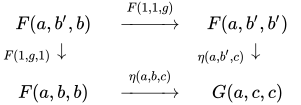
- (extranaturality in b)
∀
(
g
:
b
→
b
′
)
∈
M
o
r
B
)\in \mathrm {Mor} \,B}
, ∀ a ∈ A {\displaystyle \forall a\in A}
, ∀ c ∈ C {\displaystyle \forall c\in C}
the following diagram commutes
- (extranaturality in c)
∀
(
h
:
c
→
c
′
)
∈
M
o
r
C
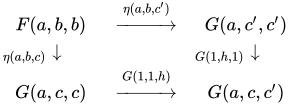
)\in \mathrm {Mor} \,C}
, ∀ a ∈ A {\displaystyle \forall a\in A}
the following diagram commutes
Properties
[edit]Extranatural transformations can be used to define wedges and thereby ends[2] (dually co-wedges and co-ends), by setting
F
{\displaystyle F}


Extranatural transformations can be defined in terms of dinatural transformations, of which they are a special case.[2]
See also
[edit]References
[edit]External links
[edit]- extranatural+transformation at the nLab