Study of dimension in algebraic geometry
In mathematics, dimension theory is the study in terms of commutative algebra of the notion of dimension of an algebraic variety (and by extension that of a scheme). The need of a theory for such an apparently simple notion results from the existence of many definitions of dimension that are equivalent only in the most regular cases (see Dimension of an algebraic variety). A large part of dimension theory consists in studying the conditions under which several dimensions are equal, and many important classes of commutative rings may be defined as the rings such that two dimensions are equal; for example, a regular ring is a commutative ring such that the homological dimension is equal to the Krull dimension.
The theory is simpler for commutative rings that are finitely generated algebras over a field, which are also quotient rings of polynomial rings in a finite number of indeterminates over a field. In this case, which is the algebraic counterpart of the case of affine algebraic sets, most of the definitions of the dimension are equivalent. For general commutative rings, the lack of geometric interpretation is an obstacle to the development of the theory; in particular, very little is known for non-Noetherian rings. (Kaplansky's Commutative rings gives a good account of the non-Noetherian case.)
Throughout the article,
dim
{\displaystyle \dim }
 denotes Krull dimension of a ring and
ht
{\displaystyle \operatorname {ht} }
denotes Krull dimension of a ring and
ht
{\displaystyle \operatorname {ht} }
 the height of a prime ideal (i.e., the Krull dimension of the localization at that prime ideal). Rings are assumed to be commutative except in the last section on dimensions of non-commutative rings.
Let
R
{\displaystyle R}
 be a Noetherian ring or a valuation ring. Then
dim
R
[
x
]
=
dim
R
+
1.
{\displaystyle \dim R[x]=\dim R+1.}
be a Noetherian ring or a valuation ring. Then
dim
R
[
x
]
=
dim
R
+
1.
{\displaystyle \dim R[x]=\dim R+1.}
![{\displaystyle \dim R[x]=\dim R+1.}](https://wikimedia.org/api/rest_v1/media/math/render/svg/bc8731bed55ff5634e9387ccbfd5b5258a71700a) If
R
{\displaystyle R}
is noetherian, this follows from the fundamental theorem below (in particular, Krull's principal ideal theorem), but it is also a consequence of a more precise result. For any prime ideal
p
{\displaystyle {\mathfrak {p}}}
If
R
{\displaystyle R}
is noetherian, this follows from the fundamental theorem below (in particular, Krull's principal ideal theorem), but it is also a consequence of a more precise result. For any prime ideal
p
{\displaystyle {\mathfrak {p}}}
 in
R
{\displaystyle R}
,
ht
(
p
R
[
x
]
)
=
ht
(
p
)
.
{\displaystyle \operatorname {ht} ({\mathfrak {p}}R[x])=\operatorname {ht} ({\mathfrak {p}}).}
in
R
{\displaystyle R}
,
ht
(
p
R
[
x
]
)
=
ht
(
p
)
.
{\displaystyle \operatorname {ht} ({\mathfrak {p}}R[x])=\operatorname {ht} ({\mathfrak {p}}).}
![{\displaystyle \operatorname {ht} ({\mathfrak {p}}R[x])=\operatorname {ht} ({\mathfrak {p}}).}](https://wikimedia.org/api/rest_v1/media/math/render/svg/2ff24f5b2ba0dcd12858ccbf6f54d2f070e17639) ht
(
q
)
=
ht
(
p
)
+
1
{\displaystyle \operatorname {ht} ({\mathfrak {q}})=\operatorname {ht} ({\mathfrak {p}})+1}
ht
(
q
)
=
ht
(
p
)
+
1
{\displaystyle \operatorname {ht} ({\mathfrak {q}})=\operatorname {ht} ({\mathfrak {p}})+1}
 for any prime ideal
q
⊋
p
R
[
x
]
{\displaystyle {\mathfrak {q}}\supsetneq {\mathfrak {p}}R[x]}
for any prime ideal
q
⊋
p
R
[
x
]
{\displaystyle {\mathfrak {q}}\supsetneq {\mathfrak {p}}R[x]}
![{\displaystyle {\mathfrak {q}}\supsetneq {\mathfrak {p}}R[x]}](https://wikimedia.org/api/rest_v1/media/math/render/svg/f768b3644a5b9bcc80ac7d859822561e638d8382) in
R
[
x
]
{\displaystyle R[x]}
in
R
[
x
]
{\displaystyle R[x]}
![{\displaystyle R[x]}](https://wikimedia.org/api/rest_v1/media/math/render/svg/0ce54622cb380383ab3a42441b056626ea0d2440) that contracts to
p
{\displaystyle {\mathfrak {p}}}
.
This can be shown within basic ring theory (cf. Kaplansky, commutative rings). In addition, in each fiber of
Spec
R
[
x
]
→
Spec
R
{\displaystyle \operatorname {Spec} R[x]\to \operatorname {Spec} R}
that contracts to
p
{\displaystyle {\mathfrak {p}}}
.
This can be shown within basic ring theory (cf. Kaplansky, commutative rings). In addition, in each fiber of
Spec
R
[
x
]
→
Spec
R
{\displaystyle \operatorname {Spec} R[x]\to \operatorname {Spec} R}
![{\displaystyle \operatorname {Spec} R[x]\to \operatorname {Spec} R}](https://wikimedia.org/api/rest_v1/media/math/render/svg/1776a7a09b7bf700c8afeb3881807bbe1ae0021b) , one cannot have a chain of primes ideals of length
≥
2
{\displaystyle \geq 2}
, one cannot have a chain of primes ideals of length
≥
2
{\displaystyle \geq 2}
 .
.
Since an Artinian ring (e.g., a field) has dimension zero, by induction one gets a formula: for an artinian ring
R
{\displaystyle R}
,
dim
R
[
x
1
,
…
,
x
n
]
=
n
.
{\displaystyle \dim R[x_{1},\dots ,x_{n}]=n.}
![{\displaystyle \dim R[x_{1},\dots ,x_{n}]=n.}](https://wikimedia.org/api/rest_v1/media/math/render/svg/ee2cf5088d47d16e51051149d1a8b6a582a3e712)
Fundamental theorem
[edit]Let
(
R
,
m
)
{\displaystyle (R,{\mathfrak {m}})}
 be a Noetherian local ring and
I
{\displaystyle I}
be a Noetherian local ring and
I
{\displaystyle I}
 a
m
{\displaystyle {\mathfrak {m}}}
a
m
{\displaystyle {\mathfrak {m}}}
 -primary ideal (i.e., it sits between some power of
m
{\displaystyle {\mathfrak {m}}}
and
m
{\displaystyle {\mathfrak {m}}}
). Let
F
(
t
)
{\displaystyle F(t)}
-primary ideal (i.e., it sits between some power of
m
{\displaystyle {\mathfrak {m}}}
and
m
{\displaystyle {\mathfrak {m}}}
). Let
F
(
t
)
{\displaystyle F(t)}
 be the Poincaré series of the associated graded ring
gr
I
R
=
⨁
0
∞
I
n
/
I
n
+
1
{\textstyle \operatorname {gr} _{I}R=\bigoplus _{0}^{\infty }I^{n}/I^{n+1}}
be the Poincaré series of the associated graded ring
gr
I
R
=
⨁
0
∞
I
n
/
I
n
+
1
{\textstyle \operatorname {gr} _{I}R=\bigoplus _{0}^{\infty }I^{n}/I^{n+1}}
 . That is,
F
(
t
)
=
∑
0
∞
ℓ
(
I
n
/
I
n
+
1
)
t
n
{\displaystyle F(t)=\sum _{0}^{\infty }\ell (I^{n}/I^{n+1})t^{n}}
. That is,
F
(
t
)
=
∑
0
∞
ℓ
(
I
n
/
I
n
+
1
)
t
n
{\displaystyle F(t)=\sum _{0}^{\infty }\ell (I^{n}/I^{n+1})t^{n}}
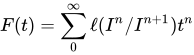 where
ℓ
{\displaystyle \ell }
where
ℓ
{\displaystyle \ell }
 refers to the length of a module (over an Artinian ring
(
gr
I
R
)
0
=
R
/
I
{\displaystyle (\operatorname {gr} _{I}R)_{0}=R/I}
refers to the length of a module (over an Artinian ring
(
gr
I
R
)
0
=
R
/
I
{\displaystyle (\operatorname {gr} _{I}R)_{0}=R/I}
 ). If
x
1
,
…
,
x
s
{\displaystyle x_{1},\dots ,x_{s}}
). If
x
1
,
…
,
x
s
{\displaystyle x_{1},\dots ,x_{s}}
 generate
I
{\displaystyle I}
, then their image in
I
/
I
2
{\displaystyle I/I^{2}}
generate
I
{\displaystyle I}
, then their image in
I
/
I
2
{\displaystyle I/I^{2}}
 have degree 1 and generate
gr
I
R
{\displaystyle \operatorname {gr} _{I}R}
have degree 1 and generate
gr
I
R
{\displaystyle \operatorname {gr} _{I}R}
 as
R
/
I
{\displaystyle R/I}
as
R
/
I
{\displaystyle R/I}
 -algebra. By the Hilbert–Serre theorem,
F
{\displaystyle F}
-algebra. By the Hilbert–Serre theorem,
F
{\displaystyle F}
 is a rational function with exactly one pole at
t
=
1
{\displaystyle t=1}
is a rational function with exactly one pole at
t
=
1
{\displaystyle t=1}
 of order
d
≤
s
{\displaystyle d\leq s}
of order
d
≤
s
{\displaystyle d\leq s}
 . Since
(
1
−
t
)
−
d
=
∑
0
∞
(
d
−
1
+
j
d
−
1
)
t
j
,
{\displaystyle (1-t)^{-d}=\sum _{0}^{\infty }{\binom {d-1+j}{d-1}}t^{j},}
. Since
(
1
−
t
)
−
d
=
∑
0
∞
(
d
−
1
+
j
d
−
1
)
t
j
,
{\displaystyle (1-t)^{-d}=\sum _{0}^{\infty }{\binom {d-1+j}{d-1}}t^{j},}
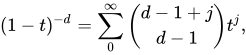 we find that the coefficient of
t
n
{\displaystyle t^{n}}
we find that the coefficient of
t
n
{\displaystyle t^{n}}
 in
F
(
t
)
=
(
1
−
t
)
d
F
(
t
)
(
1
−
t
)
−
d
{\displaystyle F(t)=(1-t)^{d}F(t)(1-t)^{-d}}
in
F
(
t
)
=
(
1
−
t
)
d
F
(
t
)
(
1
−
t
)
−
d
{\displaystyle F(t)=(1-t)^{d}F(t)(1-t)^{-d}}
 is of the form
∑
0
N
a
k
(
d
−
1
+
n
−
k
d
−
1
)
=
(
1
−
t
)
d
F
(
t
)
|
t
=
1
n
d
−
1
d
−
1
!
+
O
(
n
d
−
2
)
.
{\displaystyle \sum _{0}^{N}a_{k}{\binom {d-1+n-k}{d-1}}=(1-t)^{d}F(t){\big |}_{t=1}{n^{d-1} \over {d-1}!}+O(n^{d-2}).}
is of the form
∑
0
N
a
k
(
d
−
1
+
n
−
k
d
−
1
)
=
(
1
−
t
)
d
F
(
t
)
|
t
=
1
n
d
−
1
d
−
1
!
+
O
(
n
d
−
2
)
.
{\displaystyle \sum _{0}^{N}a_{k}{\binom {d-1+n-k}{d-1}}=(1-t)^{d}F(t){\big |}_{t=1}{n^{d-1} \over {d-1}!}+O(n^{d-2}).}
 That is to say,
ℓ
(
I
n
/
I
n
+
1
)
{\displaystyle \ell (I^{n}/I^{n+1})}
That is to say,
ℓ
(
I
n
/
I
n
+
1
)
{\displaystyle \ell (I^{n}/I^{n+1})}
 is a polynomial
P
{\displaystyle P}
is a polynomial
P
{\displaystyle P}
 in
n
{\displaystyle n}
in
n
{\displaystyle n}
 of degree
d
−
1
{\displaystyle d-1}
of degree
d
−
1
{\displaystyle d-1}
 .
P
{\displaystyle P}
is called the Hilbert polynomial of
gr
I
R
{\displaystyle \operatorname {gr} _{I}R}
.
.
P
{\displaystyle P}
is called the Hilbert polynomial of
gr
I
R
{\displaystyle \operatorname {gr} _{I}R}
.
We set
d
(
R
)
=
d
{\displaystyle d(R)=d}
 . We also set
δ
(
R
)
{\displaystyle \delta (R)}
. We also set
δ
(
R
)
{\displaystyle \delta (R)}
 to be the minimum number of elements of
R
{\displaystyle R}
that can generate an
m
{\displaystyle {\mathfrak {m}}}
-primary ideal of
R
{\displaystyle R}
. Our ambition is to prove the fundamental theorem:
δ
(
R
)
=
d
(
R
)
=
dim
R
.
{\displaystyle \delta (R)=d(R)=\dim R.}
to be the minimum number of elements of
R
{\displaystyle R}
that can generate an
m
{\displaystyle {\mathfrak {m}}}
-primary ideal of
R
{\displaystyle R}
. Our ambition is to prove the fundamental theorem:
δ
(
R
)
=
d
(
R
)
=
dim
R
.
{\displaystyle \delta (R)=d(R)=\dim R.}
 Since we can take
s
{\displaystyle s}
Since we can take
s
{\displaystyle s}
 to be
δ
(
R
)
{\displaystyle \delta (R)}
, we already have
δ
(
R
)
≥
d
(
R
)
{\displaystyle \delta (R)\geq d(R)}
to be
δ
(
R
)
{\displaystyle \delta (R)}
, we already have
δ
(
R
)
≥
d
(
R
)
{\displaystyle \delta (R)\geq d(R)}
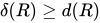 from the above. Next we prove
d
(
R
)
≥
dim
R
{\displaystyle d(R)\geq \dim R}
from the above. Next we prove
d
(
R
)
≥
dim
R
{\displaystyle d(R)\geq \dim R}
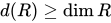 by induction on
d
(
R
)
{\displaystyle d(R)}
by induction on
d
(
R
)
{\displaystyle d(R)}
 . Let
p
0
⊊
⋯
⊊
p
m
{\displaystyle {\mathfrak {p}}_{0}\subsetneq \cdots \subsetneq {\mathfrak {p}}_{m}}
. Let
p
0
⊊
⋯
⊊
p
m
{\displaystyle {\mathfrak {p}}_{0}\subsetneq \cdots \subsetneq {\mathfrak {p}}_{m}}
 be a chain of prime ideals in
R
{\displaystyle R}
. Let
D
=
R
/
p
0
{\displaystyle D=R/{\mathfrak {p}}_{0}}
be a chain of prime ideals in
R
{\displaystyle R}
. Let
D
=
R
/
p
0
{\displaystyle D=R/{\mathfrak {p}}_{0}}
 and
x
{\displaystyle x}
and
x
{\displaystyle x}
 a nonzero nonunit element in
D
{\displaystyle D}
a nonzero nonunit element in
D
{\displaystyle D}
 . Since
x
{\displaystyle x}
is not a zero-divisor, we have the exact sequence
0
→
D
→
x
D
→
D
/
x
D
→
0.
{\displaystyle 0\to D{\overset {x}{\to }}D\to D/xD\to 0.}
. Since
x
{\displaystyle x}
is not a zero-divisor, we have the exact sequence
0
→
D
→
x
D
→
D
/
x
D
→
0.
{\displaystyle 0\to D{\overset {x}{\to }}D\to D/xD\to 0.}
 The degree bound of the Hilbert-Samuel polynomial now implies that
d
(
D
)
>
d
(
D
/
x
D
)
≥
d
(
R
/
p
1
)
{\displaystyle d(D)>d(D/xD)\geq d(R/{\mathfrak {p}}_{1})}
The degree bound of the Hilbert-Samuel polynomial now implies that
d
(
D
)
>
d
(
D
/
x
D
)
≥
d
(
R
/
p
1
)
{\displaystyle d(D)>d(D/xD)\geq d(R/{\mathfrak {p}}_{1})}
 . (This essentially follows from the Artin–Rees lemma; see Hilbert–Samuel function for the statement and the proof.) In
R
/
p
1
{\displaystyle R/{\mathfrak {p}}_{1}}
. (This essentially follows from the Artin–Rees lemma; see Hilbert–Samuel function for the statement and the proof.) In
R
/
p
1
{\displaystyle R/{\mathfrak {p}}_{1}}
 , the chain
p
i
{\displaystyle {\mathfrak {p}}_{i}}
, the chain
p
i
{\displaystyle {\mathfrak {p}}_{i}}
 becomes a chain of length
m
−
1
{\displaystyle m-1}
becomes a chain of length
m
−
1
{\displaystyle m-1}
 and so, by inductive hypothesis and again by the degree estimate,
m
−
1
≤
dim
(
R
/
p
1
)
≤
d
(
R
/
p
1
)
≤
d
(
D
)
−
1
≤
d
(
R
)
−
1.
{\displaystyle m-1\leq \dim(R/{\mathfrak {p}}_{1})\leq d(R/{\mathfrak {p}}_{1})\leq d(D)-1\leq d(R)-1.}
and so, by inductive hypothesis and again by the degree estimate,
m
−
1
≤
dim
(
R
/
p
1
)
≤
d
(
R
/
p
1
)
≤
d
(
D
)
−
1
≤
d
(
R
)
−
1.
{\displaystyle m-1\leq \dim(R/{\mathfrak {p}}_{1})\leq d(R/{\mathfrak {p}}_{1})\leq d(D)-1\leq d(R)-1.}
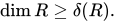
 The claim follows. It now remains to show
dim
R
≥
δ
(
R
)
.
{\displaystyle \dim R\geq \delta (R).}
The claim follows. It now remains to show
dim
R
≥
δ
(
R
)
.
{\displaystyle \dim R\geq \delta (R).}
 More precisely, we shall show:
Lemma—The maximal ideal
m
{\displaystyle {\mathfrak {m}}}
contains elements
x
1
,
…
,
x
d
{\displaystyle x_{1},\dots ,x_{d}}
 ,
d
{\displaystyle d}
,
d
{\displaystyle d}
 = Krull dimension of
R
{\displaystyle R}
, such that, for any
i
{\displaystyle i}
= Krull dimension of
R
{\displaystyle R}
, such that, for any
i
{\displaystyle i}
 , any prime ideal containing
(
x
1
,
…
,
x
i
)
{\displaystyle (x_{1},\dots ,x_{i})}
, any prime ideal containing
(
x
1
,
…
,
x
i
)
{\displaystyle (x_{1},\dots ,x_{i})}
 has height
≥
i
{\displaystyle \geq i}
has height
≥
i
{\displaystyle \geq i}
 .
.
(Notice:
(
x
1
,
…
,
x
d
)
{\displaystyle (x_{1},\dots ,x_{d})}
 is then
m
{\displaystyle {\mathfrak {m}}}
-primary.) The proof is omitted. It appears, for example, in Atiyah–MacDonald. But it can also be supplied privately; the idea is to use prime avoidance.
is then
m
{\displaystyle {\mathfrak {m}}}
-primary.) The proof is omitted. It appears, for example, in Atiyah–MacDonald. But it can also be supplied privately; the idea is to use prime avoidance.
Consequences of the fundamental theorem
[edit]Let
(
R
,
m
)
{\displaystyle (R,{\mathfrak {m}})}
be a noetherian local ring and put
k
=
R
/
m
{\displaystyle k=R/{\mathfrak {m}}}
 . Then
-
dim
R
≤
dim
k
m
/
m
2
{\displaystyle \dim R\leq \dim _{k}{\mathfrak {m}}/{\mathfrak {m}}^{2}}
 , since a basis of
m
/
m
2
{\displaystyle {\mathfrak {m}}/{\mathfrak {m}}^{2}}
, since a basis of
m
/
m
2
{\displaystyle {\mathfrak {m}}/{\mathfrak {m}}^{2}}
 lifts to a generating set of
m
{\displaystyle {\mathfrak {m}}}
by Nakayama. If the equality holds, then
R
{\displaystyle R}
is called a regular local ring.
lifts to a generating set of
m
{\displaystyle {\mathfrak {m}}}
by Nakayama. If the equality holds, then
R
{\displaystyle R}
is called a regular local ring.
-
dim
R
^
=
dim
R
{\displaystyle \dim {\widehat {R}}=\dim R}
 , since
gr
R
=
gr
R
^
{\displaystyle \operatorname {gr} R=\operatorname {gr} {\widehat {R}}}
, since
gr
R
=
gr
R
^
{\displaystyle \operatorname {gr} R=\operatorname {gr} {\widehat {R}}}
 .
.
- (Krull's principal ideal theorem) The height of the ideal generated by elements
x
1
,
…
,
x
s
{\displaystyle x_{1},\dots ,x_{s}}
in a Noetherian ring is at most
s
{\displaystyle s}
. Conversely, a prime ideal of height
s
{\displaystyle s}
is minimal over an ideal generated by
s
{\displaystyle s}
elements. (Proof: Let
p
{\displaystyle {\mathfrak {p}}}
be a prime ideal minimal over such an ideal. Then
s
≥
dim
R
p
=
ht
p
{\displaystyle s\geq \dim R_{\mathfrak {p}}=\operatorname {ht} {\mathfrak {p}}}
 . The converse was shown in the course of the proof of the fundamental theorem.)
Proof: Let
x
1
,
…
,
x
n
{\displaystyle x_{1},\dots ,x_{n}}
 generate a
m
A
{\displaystyle {\mathfrak {m}}_{A}}
generate a
m
A
{\displaystyle {\mathfrak {m}}_{A}}
 -primary ideal and
y
1
,
…
,
y
m
{\displaystyle y_{1},\dots ,y_{m}}
-primary ideal and
y
1
,
…
,
y
m
{\displaystyle y_{1},\dots ,y_{m}}
 be such that their images generate a
m
B
/
m
A
B
{\displaystyle {\mathfrak {m}}_{B}/{\mathfrak {m}}_{A}B}
be such that their images generate a
m
B
/
m
A
B
{\displaystyle {\mathfrak {m}}_{B}/{\mathfrak {m}}_{A}B}
 -primary ideal. Then
m
B
s
⊂
(
y
1
,
…
,
y
m
)
+
m
A
B
{\displaystyle {{\mathfrak {m}}_{B}}^{s}\subset (y_{1},\dots ,y_{m})+{\mathfrak {m}}_{A}B}
-primary ideal. Then
m
B
s
⊂
(
y
1
,
…
,
y
m
)
+
m
A
B
{\displaystyle {{\mathfrak {m}}_{B}}^{s}\subset (y_{1},\dots ,y_{m})+{\mathfrak {m}}_{A}B}
 for some
s
{\displaystyle s}
. Raising both sides to higher powers, we see some power of
m
B
{\displaystyle {\mathfrak {m}}_{B}}
for some
s
{\displaystyle s}
. Raising both sides to higher powers, we see some power of
m
B
{\displaystyle {\mathfrak {m}}_{B}}
 is contained in
(
y
1
,
…
,
y
m
,
x
1
,
…
,
x
n
)
{\displaystyle (y_{1},\dots ,y_{m},x_{1},\dots ,x_{n})}
is contained in
(
y
1
,
…
,
y
m
,
x
1
,
…
,
x
n
)
{\displaystyle (y_{1},\dots ,y_{m},x_{1},\dots ,x_{n})}
 ; i.e., the latter ideal is
m
B
{\displaystyle {\mathfrak {m}}_{B}}
-primary; thus,
m
+
n
≥
dim
B
{\displaystyle m+n\geq \dim B}
; i.e., the latter ideal is
m
B
{\displaystyle {\mathfrak {m}}_{B}}
-primary; thus,
m
+
n
≥
dim
B
{\displaystyle m+n\geq \dim B}
 . The equality is a straightforward application of the going-down property. Q.E.D.
Proposition—If
R
{\displaystyle R}
is a noetherian ring, then
dim
R
+
1
=
dim
R
[
x
]
=
dim
R
[
[
x
]
]
.
{\displaystyle \dim R+1=\dim R[x]=\dim R[\![x]\!].}
![{\displaystyle \dim R+1=\dim R[x]=\dim R[\![x]\!].}](https://wikimedia.org/api/rest_v1/media/math/render/svg/31693f5655c167d598b35c210ccb13560e4b6541)
Proof: If
p
0
⊊
p
1
⊊
⋯
⊊
p
n
{\displaystyle {\mathfrak {p}}_{0}\subsetneq {\mathfrak {p}}_{1}\subsetneq \cdots \subsetneq {\mathfrak {p}}_{n}}
 are a chain of prime ideals in
R
{\displaystyle R}
, then
p
i
R
[
x
]
{\displaystyle {\mathfrak {p}}_{i}R[x]}
are a chain of prime ideals in
R
{\displaystyle R}
, then
p
i
R
[
x
]
{\displaystyle {\mathfrak {p}}_{i}R[x]}
![{\displaystyle {\mathfrak {p}}_{i}R[x]}](https://wikimedia.org/api/rest_v1/media/math/render/svg/946f23a57a9bd350b63f6e95494c2c0a59ca8c01) are a chain of prime ideals in
R
[
x
]
{\displaystyle R[x]}
while
p
n
R
[
x
]
{\displaystyle {\mathfrak {p}}_{n}R[x]}
are a chain of prime ideals in
R
[
x
]
{\displaystyle R[x]}
while
p
n
R
[
x
]
{\displaystyle {\mathfrak {p}}_{n}R[x]}
![{\displaystyle {\mathfrak {p}}_{n}R[x]}](https://wikimedia.org/api/rest_v1/media/math/render/svg/c20c5323b5556b3f51c275ba6f43a588c37de5eb) is not a maximal ideal. Thus,
dim
R
+
1
≤
dim
R
[
x
]
{\displaystyle \dim R+1\leq \dim R[x]}
is not a maximal ideal. Thus,
dim
R
+
1
≤
dim
R
[
x
]
{\displaystyle \dim R+1\leq \dim R[x]}
![{\displaystyle \dim R+1\leq \dim R[x]}](https://wikimedia.org/api/rest_v1/media/math/render/svg/c09d3b76c6cc074fd1e0fd55934a5781ad9f16ce) . For the reverse inequality, let
m
{\displaystyle {\mathfrak {m}}}
be a maximal ideal of
R
[
x
]
{\displaystyle R[x]}
and
p
=
R
∩
m
{\displaystyle {\mathfrak {p}}=R\cap {\mathfrak {m}}}
. For the reverse inequality, let
m
{\displaystyle {\mathfrak {m}}}
be a maximal ideal of
R
[
x
]
{\displaystyle R[x]}
and
p
=
R
∩
m
{\displaystyle {\mathfrak {p}}=R\cap {\mathfrak {m}}}
 . Clearly,
R
[
x
]
m
=
R
p
[
x
]
m
{\displaystyle R[x]_{\mathfrak {m}}=R_{\mathfrak {p}}[x]_{\mathfrak {m}}}
. Clearly,
R
[
x
]
m
=
R
p
[
x
]
m
{\displaystyle R[x]_{\mathfrak {m}}=R_{\mathfrak {p}}[x]_{\mathfrak {m}}}
![{\displaystyle R[x]_{\mathfrak {m}}=R_{\mathfrak {p}}[x]_{\mathfrak {m}}}](https://wikimedia.org/api/rest_v1/media/math/render/svg/0aa68e6801069a282c926e2ce3618e7e8d3c518b) .
Since
R
[
x
]
m
/
p
R
p
R
[
x
]
m
=
(
R
p
/
p
R
p
)
[
x
]
m
{\displaystyle R[x]_{\mathfrak {m}}/{\mathfrak {p}}R_{\mathfrak {p}}R[x]_{\mathfrak {m}}=(R_{\mathfrak {p}}/{\mathfrak {p}}R_{\mathfrak {p}})[x]_{\mathfrak {m}}}
.
Since
R
[
x
]
m
/
p
R
p
R
[
x
]
m
=
(
R
p
/
p
R
p
)
[
x
]
m
{\displaystyle R[x]_{\mathfrak {m}}/{\mathfrak {p}}R_{\mathfrak {p}}R[x]_{\mathfrak {m}}=(R_{\mathfrak {p}}/{\mathfrak {p}}R_{\mathfrak {p}})[x]_{\mathfrak {m}}}
![{\displaystyle R[x]_{\mathfrak {m}}/{\mathfrak {p}}R_{\mathfrak {p}}R[x]_{\mathfrak {m}}=(R_{\mathfrak {p}}/{\mathfrak {p}}R_{\mathfrak {p}})[x]_{\mathfrak {m}}}](https://wikimedia.org/api/rest_v1/media/math/render/svg/68411687ca035a3736e334129a10415673516c2a) is then a localization of a principal ideal domain and has dimension at most one, we get
1
+
dim
R
≥
1
+
dim
R
p
≥
dim
R
[
x
]
m
{\displaystyle 1+\dim R\geq 1+\dim R_{\mathfrak {p}}\geq \dim R[x]_{\mathfrak {m}}}
is then a localization of a principal ideal domain and has dimension at most one, we get
1
+
dim
R
≥
1
+
dim
R
p
≥
dim
R
[
x
]
m
{\displaystyle 1+\dim R\geq 1+\dim R_{\mathfrak {p}}\geq \dim R[x]_{\mathfrak {m}}}
![{\displaystyle 1+\dim R\geq 1+\dim R_{\mathfrak {p}}\geq \dim R[x]_{\mathfrak {m}}}](https://wikimedia.org/api/rest_v1/media/math/render/svg/ecb51712ad5d46efd0535460720eb24bb85f71f7) by the previous inequality. Since
m
{\displaystyle {\mathfrak {m}}}
is arbitrary, it follows
1
+
dim
R
≥
dim
R
[
x
]
{\displaystyle 1+\dim R\geq \dim R[x]}
by the previous inequality. Since
m
{\displaystyle {\mathfrak {m}}}
is arbitrary, it follows
1
+
dim
R
≥
dim
R
[
x
]
{\displaystyle 1+\dim R\geq \dim R[x]}
![{\displaystyle 1+\dim R\geq \dim R[x]}](https://wikimedia.org/api/rest_v1/media/math/render/svg/aa3336414e5ccbb983b3fac7bad2decb1a8ef530) . Q.E.D.
. Q.E.D.
Proof:[2] First suppose
R
′
{\displaystyle R'}
 is a polynomial ring. By induction on the number of variables, it is enough to consider the case
R
′
=
R
[
x
]
{\displaystyle R'=R[x]}
is a polynomial ring. By induction on the number of variables, it is enough to consider the case
R
′
=
R
[
x
]
{\displaystyle R'=R[x]}
![{\displaystyle R'=R[x]}](https://wikimedia.org/api/rest_v1/media/math/render/svg/a40c96d961f5aee3f1258654c6babf8341c95800) . Since
R
′
{\displaystyle R'}
is flat over
R
{\displaystyle R}
,
dim
R
p
′
′
=
dim
R
p
+
dim
κ
(
p
)
⊗
R
R
′
p
′
.
{\displaystyle \dim R'_{\mathfrak {p'}}=\dim R_{\mathfrak {p}}+\dim \kappa ({\mathfrak {p}})\otimes _{R}{R'}_{{\mathfrak {p}}'}.}
. Since
R
′
{\displaystyle R'}
is flat over
R
{\displaystyle R}
,
dim
R
p
′
′
=
dim
R
p
+
dim
κ
(
p
)
⊗
R
R
′
p
′
.
{\displaystyle \dim R'_{\mathfrak {p'}}=\dim R_{\mathfrak {p}}+\dim \kappa ({\mathfrak {p}})\otimes _{R}{R'}_{{\mathfrak {p}}'}.}
 By Noether's normalization lemma, the second term on the right side is:
dim
κ
(
p
)
⊗
R
R
′
−
dim
κ
(
p
)
⊗
R
R
′
/
p
′
=
1
−
t
r
.
d
e
g
κ
(
p
)
κ
(
p
′
)
=
t
r
.
d
e
g
R
R
′
−
t
r
.
d
e
g
κ
(
p
′
)
.
{\displaystyle \dim \kappa ({\mathfrak {p}})\otimes _{R}R'-\dim \kappa ({\mathfrak {p}})\otimes _{R}R'/{\mathfrak {p}}'=1-\operatorname {tr.deg} _{\kappa ({\mathfrak {p}})}\kappa ({\mathfrak {p}}')=\operatorname {tr.deg} _{R}R'-\operatorname {tr.deg} \kappa ({\mathfrak {p}}').}
By Noether's normalization lemma, the second term on the right side is:
dim
κ
(
p
)
⊗
R
R
′
−
dim
κ
(
p
)
⊗
R
R
′
/
p
′
=
1
−
t
r
.
d
e
g
κ
(
p
)
κ
(
p
′
)
=
t
r
.
d
e
g
R
R
′
−
t
r
.
d
e
g
κ
(
p
′
)
.
{\displaystyle \dim \kappa ({\mathfrak {p}})\otimes _{R}R'-\dim \kappa ({\mathfrak {p}})\otimes _{R}R'/{\mathfrak {p}}'=1-\operatorname {tr.deg} _{\kappa ({\mathfrak {p}})}\kappa ({\mathfrak {p}}')=\operatorname {tr.deg} _{R}R'-\operatorname {tr.deg} \kappa ({\mathfrak {p}}').}
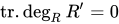
 Next, suppose
R
′
{\displaystyle R'}
is generated by a single element; thus,
R
′
=
R
[
x
]
/
I
{\displaystyle R'=R[x]/I}
Next, suppose
R
′
{\displaystyle R'}
is generated by a single element; thus,
R
′
=
R
[
x
]
/
I
{\displaystyle R'=R[x]/I}
![{\displaystyle R'=R[x]/I}](https://wikimedia.org/api/rest_v1/media/math/render/svg/91ffa223010a6b994a5ee1cdc5060b4361dc6571) . If
I
{\displaystyle I}
= 0, then we are already done. Suppose not. Then
R
′
{\displaystyle R'}
is algebraic over
R
{\displaystyle R}
and so
t
r
.
d
e
g
R
R
′
=
0
{\displaystyle \operatorname {tr.deg} _{R}R'=0}
. If
I
{\displaystyle I}
= 0, then we are already done. Suppose not. Then
R
′
{\displaystyle R'}
is algebraic over
R
{\displaystyle R}
and so
t
r
.
d
e
g
R
R
′
=
0
{\displaystyle \operatorname {tr.deg} _{R}R'=0}
 . Since
R
{\displaystyle R}
is a subring of
R
′
{\displaystyle R'}
,
I
∩
R
=
0
{\displaystyle I\cap R=0}
. Since
R
{\displaystyle R}
is a subring of
R
′
{\displaystyle R'}
,
I
∩
R
=
0
{\displaystyle I\cap R=0}
 and so
ht
I
=
dim
R
[
x
]
I
=
dim
Q
(
R
)
[
x
]
I
=
1
−
t
r
.
d
e
g
Q
(
R
)
κ
(
I
)
=
1
{\displaystyle \operatorname {ht} I=\dim R[x]_{I}=\dim Q(R)[x]_{I}=1-\operatorname {tr.deg} _{Q(R)}\kappa (I)=1}
and so
ht
I
=
dim
R
[
x
]
I
=
dim
Q
(
R
)
[
x
]
I
=
1
−
t
r
.
d
e
g
Q
(
R
)
κ
(
I
)
=
1
{\displaystyle \operatorname {ht} I=\dim R[x]_{I}=\dim Q(R)[x]_{I}=1-\operatorname {tr.deg} _{Q(R)}\kappa (I)=1}
![{\displaystyle \operatorname {ht} I=\dim R[x]_{I}=\dim Q(R)[x]_{I}=1-\operatorname {tr.deg} _{Q(R)}\kappa (I)=1}](https://wikimedia.org/api/rest_v1/media/math/render/svg/1ff325ede2c2b087c8905e2bd6eafc6452f77f10) since
κ
(
I
)
=
Q
(
R
′
)
{\displaystyle \kappa (I)=Q(R')}
since
κ
(
I
)
=
Q
(
R
′
)
{\displaystyle \kappa (I)=Q(R')}
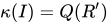 is algebraic over
Q
(
R
)
{\displaystyle Q(R)}
is algebraic over
Q
(
R
)
{\displaystyle Q(R)}
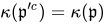
 . Let
p
′
c
{\displaystyle {\mathfrak {p}}^{\prime c}}
. Let
p
′
c
{\displaystyle {\mathfrak {p}}^{\prime c}}
 denote the pre-image in
R
[
x
]
{\displaystyle R[x]}
of
p
′
{\displaystyle {\mathfrak {p}}'}
denote the pre-image in
R
[
x
]
{\displaystyle R[x]}
of
p
′
{\displaystyle {\mathfrak {p}}'}
 . Then, as
κ
(
p
′
c
)
=
κ
(
p
)
{\displaystyle \kappa ({\mathfrak {p}}^{\prime c})=\kappa ({\mathfrak {p}})}
. Then, as
κ
(
p
′
c
)
=
κ
(
p
)
{\displaystyle \kappa ({\mathfrak {p}}^{\prime c})=\kappa ({\mathfrak {p}})}
 , by the polynomial case,
ht
p
′
=
ht
p
′
c
/
I
≤
ht
p
′
c
−
ht
I
=
dim
R
p
−
t
r
.
d
e
g
κ
(
p
)
κ
(
p
′
)
.
{\displaystyle \operatorname {ht} {{\mathfrak {p}}'}=\operatorname {ht} {{\mathfrak {p}}^{\prime c}/I}\leq \operatorname {ht} {{\mathfrak {p}}^{\prime c}}-\operatorname {ht} {I}=\dim R_{\mathfrak {p}}-\operatorname {tr.deg} _{\kappa ({\mathfrak {p}})}\kappa ({\mathfrak {p}}').}
, by the polynomial case,
ht
p
′
=
ht
p
′
c
/
I
≤
ht
p
′
c
−
ht
I
=
dim
R
p
−
t
r
.
d
e
g
κ
(
p
)
κ
(
p
′
)
.
{\displaystyle \operatorname {ht} {{\mathfrak {p}}'}=\operatorname {ht} {{\mathfrak {p}}^{\prime c}/I}\leq \operatorname {ht} {{\mathfrak {p}}^{\prime c}}-\operatorname {ht} {I}=\dim R_{\mathfrak {p}}-\operatorname {tr.deg} _{\kappa ({\mathfrak {p}})}\kappa ({\mathfrak {p}}').}
 Here, note that the inequality is the equality if
R
′
{\displaystyle R'}
is catenary. Finally, working with a chain of prime ideals, it is straightforward to reduce the general case to the above case. Q.E.D.
Here, note that the inequality is the equality if
R
′
{\displaystyle R'}
is catenary. Finally, working with a chain of prime ideals, it is straightforward to reduce the general case to the above case. Q.E.D.
Homological methods
[edit]Let
R
{\displaystyle R}
be a noetherian ring. The projective dimension of a finite
R
{\displaystyle R}
-module
M
{\displaystyle M}
 is the shortest length of any projective resolution of
M
{\displaystyle M}
(possibly infinite) and is denoted by
pd
R
M
{\displaystyle \operatorname {pd} _{R}M}
is the shortest length of any projective resolution of
M
{\displaystyle M}
(possibly infinite) and is denoted by
pd
R
M
{\displaystyle \operatorname {pd} _{R}M}
 . We set
g
l
.
d
i
m
R
=
sup
{
pd
R
M
∣
M
is a finite module
}
{\displaystyle \operatorname {gl.dim} R=\sup\{\operatorname {pd} _{R}M\mid M{\text{ is a finite module}}\}}
. We set
g
l
.
d
i
m
R
=
sup
{
pd
R
M
∣
M
is a finite module
}
{\displaystyle \operatorname {gl.dim} R=\sup\{\operatorname {pd} _{R}M\mid M{\text{ is a finite module}}\}}
 ; it is called the global dimension of
R
{\displaystyle R}
.
; it is called the global dimension of
R
{\displaystyle R}
.
Assume
R
{\displaystyle R}
is local with residue field
k
{\displaystyle k}
 .
.
Lemma—
pd
R
k
=
g
l
.
d
i
m
R
{\displaystyle \operatorname {pd} _{R}k=\operatorname {gl.dim} R}
 (possibly infinite).
Proof: We claim: for any finite
R
{\displaystyle R}
-module
M
{\displaystyle M}
,
pd
R
M
≤
n
⇔
Tor
n
+
1
R
(
M
,
k
)
=
0.
{\displaystyle \operatorname {pd} _{R}M\leq n\Leftrightarrow \operatorname {Tor} _{n+1}^{R}(M,k)=0.}
 By dimension shifting (cf. the proof of Theorem of Serre below), it is enough to prove this for
n
=
0
{\displaystyle n=0}
By dimension shifting (cf. the proof of Theorem of Serre below), it is enough to prove this for
n
=
0
{\displaystyle n=0}
 . But then, by the local criterion for flatness,
Tor
1
R
(
M
,
k
)
=
0
⇒
M
flat
⇒
M
free
⇒
pd
R
(
M
)
≤
0.
{\displaystyle \operatorname {Tor} _{1}^{R}(M,k)=0\Rightarrow M{\text{ flat }}\Rightarrow M{\text{ free }}\Rightarrow \operatorname {pd} _{R}(M)\leq 0.}
. But then, by the local criterion for flatness,
Tor
1
R
(
M
,
k
)
=
0
⇒
M
flat
⇒
M
free
⇒
pd
R
(
M
)
≤
0.
{\displaystyle \operatorname {Tor} _{1}^{R}(M,k)=0\Rightarrow M{\text{ flat }}\Rightarrow M{\text{ free }}\Rightarrow \operatorname {pd} _{R}(M)\leq 0.}
 Now,
g
l
.
d
i
m
R
≤
n
⇒
pd
R
k
≤
n
⇒
Tor
n
+
1
R
(
−
,
k
)
=
0
⇒
pd
R
−
≤
n
⇒
g
l
.
d
i
m
R
≤
n
,
{\displaystyle \operatorname {gl.dim} R\leq n\Rightarrow \operatorname {pd} _{R}k\leq n\Rightarrow \operatorname {Tor} _{n+1}^{R}(-,k)=0\Rightarrow \operatorname {pd} _{R}-\leq n\Rightarrow \operatorname {gl.dim} R\leq n,}
Now,
g
l
.
d
i
m
R
≤
n
⇒
pd
R
k
≤
n
⇒
Tor
n
+
1
R
(
−
,
k
)
=
0
⇒
pd
R
−
≤
n
⇒
g
l
.
d
i
m
R
≤
n
,
{\displaystyle \operatorname {gl.dim} R\leq n\Rightarrow \operatorname {pd} _{R}k\leq n\Rightarrow \operatorname {Tor} _{n+1}^{R}(-,k)=0\Rightarrow \operatorname {pd} _{R}-\leq n\Rightarrow \operatorname {gl.dim} R\leq n,}
 completing the proof. Q.E.D.
Remark: The proof also shows that
pd
R
K
=
pd
R
M
−
1
{\displaystyle \operatorname {pd} _{R}K=\operatorname {pd} _{R}M-1}
 if
M
{\displaystyle M}
is not free and
K
{\displaystyle K}
if
M
{\displaystyle M}
is not free and
K
{\displaystyle K}
 is the kernel of some surjection from a free module to
M
{\displaystyle M}
.
is the kernel of some surjection from a free module to
M
{\displaystyle M}
.
Proof: If
pd
R
M
=
0
{\displaystyle \operatorname {pd} _{R}M=0}
 , then
M
{\displaystyle M}
is
R
{\displaystyle R}
-free and thus
M
⊗
R
1
{\displaystyle M\otimes R_{1}}
, then
M
{\displaystyle M}
is
R
{\displaystyle R}
-free and thus
M
⊗
R
1
{\displaystyle M\otimes R_{1}}
 is
R
1
{\displaystyle R_{1}}
is
R
1
{\displaystyle R_{1}}
 -free. Next suppose
pd
R
M
>
0
{\displaystyle \operatorname {pd} _{R}M>0}
-free. Next suppose
pd
R
M
>
0
{\displaystyle \operatorname {pd} _{R}M>0}
 . Then we have:
pd
R
K
=
pd
R
M
−
1
{\displaystyle \operatorname {pd} _{R}K=\operatorname {pd} _{R}M-1}
as in the remark above. Thus, by induction, it is enough to consider the case
pd
R
M
=
1
{\displaystyle \operatorname {pd} _{R}M=1}
. Then we have:
pd
R
K
=
pd
R
M
−
1
{\displaystyle \operatorname {pd} _{R}K=\operatorname {pd} _{R}M-1}
as in the remark above. Thus, by induction, it is enough to consider the case
pd
R
M
=
1
{\displaystyle \operatorname {pd} _{R}M=1}
 . Then there is a projective resolution:
0
→
P
1
→
P
0
→
M
→
0
{\displaystyle 0\to P_{1}\to P_{0}\to M\to 0}
. Then there is a projective resolution:
0
→
P
1
→
P
0
→
M
→
0
{\displaystyle 0\to P_{1}\to P_{0}\to M\to 0}
 , which gives:
Tor
1
R
(
M
,
R
1
)
→
P
1
⊗
R
1
→
P
0
⊗
R
1
→
M
⊗
R
1
→
0.
{\displaystyle \operatorname {Tor} _{1}^{R}(M,R_{1})\to P_{1}\otimes R_{1}\to P_{0}\otimes R_{1}\to M\otimes R_{1}\to 0.}
, which gives:
Tor
1
R
(
M
,
R
1
)
→
P
1
⊗
R
1
→
P
0
⊗
R
1
→
M
⊗
R
1
→
0.
{\displaystyle \operatorname {Tor} _{1}^{R}(M,R_{1})\to P_{1}\otimes R_{1}\to P_{0}\otimes R_{1}\to M\otimes R_{1}\to 0.}
 But
Tor
1
R
(
M
,
R
1
)
=
f
M
=
{
m
∈
M
∣
f
m
=
0
}
=
0.
{\displaystyle \operatorname {Tor} _{1}^{R}(M,R_{1})={}_{f}M=\{m\in M\mid fm=0\}=0.}
But
Tor
1
R
(
M
,
R
1
)
=
f
M
=
{
m
∈
M
∣
f
m
=
0
}
=
0.
{\displaystyle \operatorname {Tor} _{1}^{R}(M,R_{1})={}_{f}M=\{m\in M\mid fm=0\}=0.}
 Hence,
pd
R
(
M
⊗
R
1
)
{\displaystyle \operatorname {pd} _{R}(M\otimes R_{1})}
Hence,
pd
R
(
M
⊗
R
1
)
{\displaystyle \operatorname {pd} _{R}(M\otimes R_{1})}
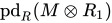 is at most 1. Q.E.D.
Theorem of Serre—
R
{\displaystyle R}
regular
⇔
g
l
.
d
i
m
R
<
∞
⇔
g
l
.
d
i
m
R
=
dim
R
.
{\displaystyle \Leftrightarrow \operatorname {gl.dim} R<\infty \Leftrightarrow \operatorname {gl.dim} R=\dim R.}

Proof:[3] If
R
{\displaystyle R}
is regular, we can write
k
=
R
/
(
f
1
,
…
,
f
n
)
{\displaystyle k=R/(f_{1},\dots ,f_{n})}
 ,
f
i
{\displaystyle f_{i}}
,
f
i
{\displaystyle f_{i}}
 a regular system of parameters. An exact sequence
0
→
M
→
f
M
→
M
1
→
0
{\displaystyle 0\to M{\overset {f}{\to }}M\to M_{1}\to 0}
a regular system of parameters. An exact sequence
0
→
M
→
f
M
→
M
1
→
0
{\displaystyle 0\to M{\overset {f}{\to }}M\to M_{1}\to 0}
 , some
f
{\displaystyle f}
, some
f
{\displaystyle f}
 in the maximal ideal, of finite modules,
pd
R
M
<
∞
{\displaystyle \operatorname {pd} _{R}M<\infty }
in the maximal ideal, of finite modules,
pd
R
M
<
∞
{\displaystyle \operatorname {pd} _{R}M<\infty }
 , gives us:
0
=
Tor
i
+
1
R
(
M
,
k
)
→
Tor
i
+
1
R
(
M
1
,
k
)
→
Tor
i
R
(
M
,
k
)
→
f
Tor
i
R
(
M
,
k
)
,
i
≥
pd
R
M
.
{\displaystyle 0=\operatorname {Tor} _{i+1}^{R}(M,k)\to \operatorname {Tor} _{i+1}^{R}(M_{1},k)\to \operatorname {Tor} _{i}^{R}(M,k){\overset {f}{\to }}\operatorname {Tor} _{i}^{R}(M,k),\quad i\geq \operatorname {pd} _{R}M.}
, gives us:
0
=
Tor
i
+
1
R
(
M
,
k
)
→
Tor
i
+
1
R
(
M
1
,
k
)
→
Tor
i
R
(
M
,
k
)
→
f
Tor
i
R
(
M
,
k
)
,
i
≥
pd
R
M
.
{\displaystyle 0=\operatorname {Tor} _{i+1}^{R}(M,k)\to \operatorname {Tor} _{i+1}^{R}(M_{1},k)\to \operatorname {Tor} _{i}^{R}(M,k){\overset {f}{\to }}\operatorname {Tor} _{i}^{R}(M,k),\quad i\geq \operatorname {pd} _{R}M.}
 But
f
{\displaystyle f}
here is zero since it kills
k
{\displaystyle k}
. Thus,
Tor
i
+
1
R
(
M
1
,
k
)
≃
Tor
i
R
(
M
,
k
)
{\displaystyle \operatorname {Tor} _{i+1}^{R}(M_{1},k)\simeq \operatorname {Tor} _{i}^{R}(M,k)}
But
f
{\displaystyle f}
here is zero since it kills
k
{\displaystyle k}
. Thus,
Tor
i
+
1
R
(
M
1
,
k
)
≃
Tor
i
R
(
M
,
k
)
{\displaystyle \operatorname {Tor} _{i+1}^{R}(M_{1},k)\simeq \operatorname {Tor} _{i}^{R}(M,k)}
 and consequently
pd
R
M
1
=
1
+
pd
R
M
{\displaystyle \operatorname {pd} _{R}M_{1}=1+\operatorname {pd} _{R}M}
and consequently
pd
R
M
1
=
1
+
pd
R
M
{\displaystyle \operatorname {pd} _{R}M_{1}=1+\operatorname {pd} _{R}M}
 . Using this, we get:
pd
R
k
=
1
+
pd
R
(
R
/
(
f
1
,
…
,
f
n
−
1
)
)
=
⋯
=
n
.
{\displaystyle \operatorname {pd} _{R}k=1+\operatorname {pd} _{R}(R/(f_{1},\dots ,f_{n-1}))=\cdots =n.}
. Using this, we get:
pd
R
k
=
1
+
pd
R
(
R
/
(
f
1
,
…
,
f
n
−
1
)
)
=
⋯
=
n
.
{\displaystyle \operatorname {pd} _{R}k=1+\operatorname {pd} _{R}(R/(f_{1},\dots ,f_{n-1}))=\cdots =n.}
 The proof of the converse is by induction on
dim
R
{\displaystyle \dim R}
The proof of the converse is by induction on
dim
R
{\displaystyle \dim R}
 . We begin with the inductive step. Set
R
1
=
R
/
f
1
R
{\displaystyle R_{1}=R/f_{1}R}
. We begin with the inductive step. Set
R
1
=
R
/
f
1
R
{\displaystyle R_{1}=R/f_{1}R}
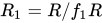 ,
f
1
{\displaystyle f_{1}}
,
f
1
{\displaystyle f_{1}}
 among a system of parameters. To show
R
{\displaystyle R}
is regular, it is enough to show
R
1
{\displaystyle R_{1}}
is regular. But, since
dim
R
1
<
dim
R
{\displaystyle \dim R_{1}<\dim R}
among a system of parameters. To show
R
{\displaystyle R}
is regular, it is enough to show
R
1
{\displaystyle R_{1}}
is regular. But, since
dim
R
1
<
dim
R
{\displaystyle \dim R_{1}<\dim R}
 , by inductive hypothesis and the preceding lemma with
M
=
m
{\displaystyle M={\mathfrak {m}}}
, by inductive hypothesis and the preceding lemma with
M
=
m
{\displaystyle M={\mathfrak {m}}}
 ,
g
l
.
d
i
m
R
<
∞
⇒
g
l
.
d
i
m
R
1
=
pd
R
1
k
≤
pd
R
1
m
/
f
1
m
<
∞
⇒
R
1
regular
.
{\displaystyle \operatorname {gl.dim} R<\infty \Rightarrow \operatorname {gl.dim} R_{1}=\operatorname {pd} _{R_{1}}k\leq \operatorname {pd} _{R_{1}}{\mathfrak {m}}/f_{1}{\mathfrak {m}}<\infty \Rightarrow R_{1}{\text{ regular}}.}
,
g
l
.
d
i
m
R
<
∞
⇒
g
l
.
d
i
m
R
1
=
pd
R
1
k
≤
pd
R
1
m
/
f
1
m
<
∞
⇒
R
1
regular
.
{\displaystyle \operatorname {gl.dim} R<\infty \Rightarrow \operatorname {gl.dim} R_{1}=\operatorname {pd} _{R_{1}}k\leq \operatorname {pd} _{R_{1}}{\mathfrak {m}}/f_{1}{\mathfrak {m}}<\infty \Rightarrow R_{1}{\text{ regular}}.}

The basic step remains. Suppose
dim
R
=
0
{\displaystyle \dim R=0}
 . We claim
g
l
.
d
i
m
R
=
0
{\displaystyle \operatorname {gl.dim} R=0}
. We claim
g
l
.
d
i
m
R
=
0
{\displaystyle \operatorname {gl.dim} R=0}
 if it is finite. (This would imply that
R
{\displaystyle R}
is a semisimple local ring; i.e., a field.) If that is not the case, then there is some finite module
M
{\displaystyle M}
with
0
<
pd
R
M
<
∞
{\displaystyle 0<\operatorname {pd} _{R}M<\infty }
if it is finite. (This would imply that
R
{\displaystyle R}
is a semisimple local ring; i.e., a field.) If that is not the case, then there is some finite module
M
{\displaystyle M}
with
0
<
pd
R
M
<
∞
{\displaystyle 0<\operatorname {pd} _{R}M<\infty }
 and thus in fact we can find
M
{\displaystyle M}
with
pd
R
M
=
1
{\displaystyle \operatorname {pd} _{R}M=1}
. By Nakayama's lemma, there is a surjection
F
→
M
{\displaystyle F\to M}
and thus in fact we can find
M
{\displaystyle M}
with
pd
R
M
=
1
{\displaystyle \operatorname {pd} _{R}M=1}
. By Nakayama's lemma, there is a surjection
F
→
M
{\displaystyle F\to M}
 from a free module
F
{\displaystyle F}
to
M
{\displaystyle M}
whose kernel
K
{\displaystyle K}
is contained in
m
F
{\displaystyle {\mathfrak {m}}F}
from a free module
F
{\displaystyle F}
to
M
{\displaystyle M}
whose kernel
K
{\displaystyle K}
is contained in
m
F
{\displaystyle {\mathfrak {m}}F}
 . Since
dim
R
=
0
{\displaystyle \dim R=0}
, the maximal ideal
m
{\displaystyle {\mathfrak {m}}}
is an associated prime of
R
{\displaystyle R}
; i.e.,
m
=
ann
(
s
)
{\displaystyle {\mathfrak {m}}=\operatorname {ann} (s)}
. Since
dim
R
=
0
{\displaystyle \dim R=0}
, the maximal ideal
m
{\displaystyle {\mathfrak {m}}}
is an associated prime of
R
{\displaystyle R}
; i.e.,
m
=
ann
(
s
)
{\displaystyle {\mathfrak {m}}=\operatorname {ann} (s)}
 for some nonzero
s
{\displaystyle s}
in
R
{\displaystyle R}
. Since
K
⊂
m
F
{\displaystyle K\subset {\mathfrak {m}}F}
for some nonzero
s
{\displaystyle s}
in
R
{\displaystyle R}
. Since
K
⊂
m
F
{\displaystyle K\subset {\mathfrak {m}}F}
 ,
s
K
=
0
{\displaystyle sK=0}
,
s
K
=
0
{\displaystyle sK=0}
 . Since
K
{\displaystyle K}
is not zero and is free, this implies
s
=
0
{\displaystyle s=0}
. Since
K
{\displaystyle K}
is not zero and is free, this implies
s
=
0
{\displaystyle s=0}
 , which is absurd. Q.E.D.
Corollary—A regular local ring is a unique factorization domain.
Proof: Let
R
{\displaystyle R}
be a regular local ring. Then
gr
R
≃
k
[
x
1
,
…
,
x
d
]
{\displaystyle \operatorname {gr} R\simeq k[x_{1},\dots ,x_{d}]}
![{\displaystyle \operatorname {gr} R\simeq k[x_{1},\dots ,x_{d}]}](https://wikimedia.org/api/rest_v1/media/math/render/svg/a220c15c74a8d2dae806bd61aab74b003f8ecc61) , which is an integrally closed domain. It is a standard algebra exercise to show this implies that
R
{\displaystyle R}
is an integrally closed domain. Now, we need to show every divisorial ideal is principal; i.e., the divisor class group of
R
{\displaystyle R}
vanishes. But, according to Bourbaki, Algèbre commutative, chapitre 7, §. 4. Corollary 2 to Proposition 16, a divisorial ideal is principal if it admits a finite free resolution, which is indeed the case by the theorem. Q.E.D.
, which is an integrally closed domain. It is a standard algebra exercise to show this implies that
R
{\displaystyle R}
is an integrally closed domain. Now, we need to show every divisorial ideal is principal; i.e., the divisor class group of
R
{\displaystyle R}
vanishes. But, according to Bourbaki, Algèbre commutative, chapitre 7, §. 4. Corollary 2 to Proposition 16, a divisorial ideal is principal if it admits a finite free resolution, which is indeed the case by the theorem. Q.E.D.
Theorem—Let
R
{\displaystyle R}
be a ring. Then
g
l
.
d
i
m
R
[
x
1
,
…
,
x
n
]
=
g
l
.
d
i
m
R
+
n
.
{\displaystyle \operatorname {gl.dim} R[x_{1},\dots ,x_{n}]=\operatorname {gl.dim} R+n.}
![{\displaystyle \operatorname {gl.dim} R[x_{1},\dots ,x_{n}]=\operatorname {gl.dim} R+n.}](https://wikimedia.org/api/rest_v1/media/math/render/svg/502a613f07277eaf940a355871a1bbf3f5edb0af)
Let
R
{\displaystyle R}
be a ring and
M
{\displaystyle M}
a module over it. A sequence of elements
x
1
,
…
,
x
n
{\displaystyle x_{1},\dots ,x_{n}}
in
R
{\displaystyle R}
is called an
M
{\displaystyle M}
-regular sequence if
x
1
{\displaystyle x_{1}}
 is not a zero-divisor on
M
{\displaystyle M}
and
x
i
{\displaystyle x_{i}}
is not a zero-divisor on
M
{\displaystyle M}
and
x
i
{\displaystyle x_{i}}
 is not a zero divisor on
M
/
(
x
1
,
…
,
x
i
−
1
)
M
{\displaystyle M/(x_{1},\dots ,x_{i-1})M}
is not a zero divisor on
M
/
(
x
1
,
…
,
x
i
−
1
)
M
{\displaystyle M/(x_{1},\dots ,x_{i-1})M}
 for each
i
=
2
,
…
,
n
{\displaystyle i=2,\dots ,n}
for each
i
=
2
,
…
,
n
{\displaystyle i=2,\dots ,n}
 . A priori, it is not obvious whether any permutation of a regular sequence is still regular (see the section below for some positive answer).
Let
R
{\displaystyle R}
be a local Noetherian ring with maximal ideal
m
{\displaystyle {\mathfrak {m}}}
and put
k
=
R
/
m
{\displaystyle k=R/{\mathfrak {m}}}
. Then, by definition, the depth of a finite
R
{\displaystyle R}
-module
M
{\displaystyle M}
is the supremum of the lengths of all
M
{\displaystyle M}
-regular sequences in
m
{\displaystyle {\mathfrak {m}}}
. For example, we have
depth
M
=
0
⇔
m
{\displaystyle \operatorname {depth} M=0\Leftrightarrow {\mathfrak {m}}}
 consists of zerodivisors on
M
{\displaystyle M}
⇔
m
{\displaystyle \Leftrightarrow {\mathfrak {m}}}
consists of zerodivisors on
M
{\displaystyle M}
⇔
m
{\displaystyle \Leftrightarrow {\mathfrak {m}}}
 is associated with
M
{\displaystyle M}
. By induction, we find
depth
M
≤
dim
R
/
p
{\displaystyle \operatorname {depth} M\leq \dim R/{\mathfrak {p}}}
is associated with
M
{\displaystyle M}
. By induction, we find
depth
M
≤
dim
R
/
p
{\displaystyle \operatorname {depth} M\leq \dim R/{\mathfrak {p}}}
 for any associated primes
p
{\displaystyle {\mathfrak {p}}}
of
M
{\displaystyle M}
. In particular,
depth
M
≤
dim
M
{\displaystyle \operatorname {depth} M\leq \dim M}
for any associated primes
p
{\displaystyle {\mathfrak {p}}}
of
M
{\displaystyle M}
. In particular,
depth
M
≤
dim
M
{\displaystyle \operatorname {depth} M\leq \dim M}
 . If the equality holds for
M
{\displaystyle M}
=
R
{\displaystyle R}
,
R
{\displaystyle R}
is called a Cohen–Macaulay ring.
. If the equality holds for
M
{\displaystyle M}
=
R
{\displaystyle R}
,
R
{\displaystyle R}
is called a Cohen–Macaulay ring.
Example: A regular Noetherian local ring is Cohen–Macaulay (since a regular system of parameters is an
R
{\displaystyle R}
-regular sequence).
In general, a Noetherian ring is called a Cohen–Macaulay ring if the localizations at all maximal ideals are Cohen–Macaulay. We note that a Cohen–Macaulay ring is universally catenary. This implies for example that a polynomial ring
k
[
x
1
,
…
,
x
d
]
{\displaystyle k[x_{1},\dots ,x_{d}]}
![{\displaystyle k[x_{1},\dots ,x_{d}]}](https://wikimedia.org/api/rest_v1/media/math/render/svg/3c0664c2330440b86479200a0018b2160cbedc13) is universally catenary since it is regular and thus Cohen–Macaulay.
is universally catenary since it is regular and thus Cohen–Macaulay.
Proposition (Rees)—Let
M
{\displaystyle M}
be a finite
R
{\displaystyle R}
-module. Then the Ext functor satisfies
depth
M
=
sup
{
n
∣
Ext
R
i
(
k
,
M
)
=
0
,
i
<
n
}
{\displaystyle \operatorname {depth} M=\sup\{n\mid \operatorname {Ext} _{R}^{i}(k,M)=0,i<n\}}
 .
.
More generally, for any finite
R
{\displaystyle R}
-module
N
{\displaystyle N}
 whose support is exactly
{
m
}
{\displaystyle \{{\mathfrak {m}}\}}
whose support is exactly
{
m
}
{\displaystyle \{{\mathfrak {m}}\}}
 ,
depth
M
=
sup
{
n
∣
Ext
R
i
(
N
,
M
)
=
0
,
i
<
n
}
.
{\displaystyle \operatorname {depth} M=\sup\{n\mid \operatorname {Ext} _{R}^{i}(N,M)=0,i<n\}.}
,
depth
M
=
sup
{
n
∣
Ext
R
i
(
N
,
M
)
=
0
,
i
<
n
}
.
{\displaystyle \operatorname {depth} M=\sup\{n\mid \operatorname {Ext} _{R}^{i}(N,M)=0,i<n\}.}

Proof: We first prove by induction on
n
{\displaystyle n}
the following statement: for every
R
{\displaystyle R}
-module
M
{\displaystyle M}
and every
M
{\displaystyle M}
-regular sequence
x
1
,
…
,
x
n
{\displaystyle x_{1},\dots ,x_{n}}
in
m
{\displaystyle {\mathfrak {m}}}
,
Ext
R
n
(
N
,
M
)
≃
Hom
R
(
N
,
M
/
(
x
1
,
…
,
x
n
)
M
)
.
{\displaystyle \operatorname {Ext} _{R}^{n}(N,M)\simeq \operatorname {Hom} _{R}(N,M/(x_{1},\dots ,x_{n})M).}
 | | ⁎ |
The basic step
n
{\displaystyle n}
= 0 is trivial. Next, by inductive hypothesis,
Ext
R
n
−
1
(
N
,
M
)
≃
Hom
R
(
N
,
M
/
(
x
1
,
…
,
x
n
−
1
)
M
)
{\displaystyle \operatorname {Ext} _{R}^{n-1}(N,M)\simeq \operatorname {Hom} _{R}(N,M/(x_{1},\dots ,x_{n-1})M)}
 . But the latter is zero since the annihilator of
N
{\displaystyle N}
contains some power of
x
n
{\displaystyle x_{n}}
. But the latter is zero since the annihilator of
N
{\displaystyle N}
contains some power of
x
n
{\displaystyle x_{n}}
 . Thus, from the exact sequence
0
→
M
→
x
1
M
→
M
1
→
0
{\displaystyle 0\to M{\overset {x_{1}}{\to }}M\to M_{1}\to 0}
. Thus, from the exact sequence
0
→
M
→
x
1
M
→
M
1
→
0
{\displaystyle 0\to M{\overset {x_{1}}{\to }}M\to M_{1}\to 0}
 and the fact that
x
1
{\displaystyle x_{1}}
kills
N
{\displaystyle N}
, using the inductive hypothesis again, we get
Ext
R
n
(
N
,
M
)
≃
Ext
R
n
−
1
(
N
,
M
/
x
1
M
)
≃
Hom
R
(
N
,
M
/
(
x
1
,
…
,
x
n
)
M
)
,
{\displaystyle \operatorname {Ext} _{R}^{n}(N,M)\simeq \operatorname {Ext} _{R}^{n-1}(N,M/x_{1}M)\simeq \operatorname {Hom} _{R}(N,M/(x_{1},\dots ,x_{n})M),}
and the fact that
x
1
{\displaystyle x_{1}}
kills
N
{\displaystyle N}
, using the inductive hypothesis again, we get
Ext
R
n
(
N
,
M
)
≃
Ext
R
n
−
1
(
N
,
M
/
x
1
M
)
≃
Hom
R
(
N
,
M
/
(
x
1
,
…
,
x
n
)
M
)
,
{\displaystyle \operatorname {Ext} _{R}^{n}(N,M)\simeq \operatorname {Ext} _{R}^{n-1}(N,M/x_{1}M)\simeq \operatorname {Hom} _{R}(N,M/(x_{1},\dots ,x_{n})M),}
 proving (⁎). Now, if
n
<
depth
M
{\displaystyle n<\operatorname {depth} M}
proving (⁎). Now, if
n
<
depth
M
{\displaystyle n<\operatorname {depth} M}
 , then we can find an
M
{\displaystyle M}
-regular sequence of length more than
n
{\displaystyle n}
and so by (⁎) we see
Ext
R
n
(
N
,
M
)
=
0
{\displaystyle \operatorname {Ext} _{R}^{n}(N,M)=0}
, then we can find an
M
{\displaystyle M}
-regular sequence of length more than
n
{\displaystyle n}
and so by (⁎) we see
Ext
R
n
(
N
,
M
)
=
0
{\displaystyle \operatorname {Ext} _{R}^{n}(N,M)=0}
 . It remains to show
Ext
R
n
(
N
,
M
)
≠
0
{\displaystyle \operatorname {Ext} _{R}^{n}(N,M)\neq 0}
. It remains to show
Ext
R
n
(
N
,
M
)
≠
0
{\displaystyle \operatorname {Ext} _{R}^{n}(N,M)\neq 0}
 if
n
=
depth
M
{\displaystyle n=\operatorname {depth} M}
if
n
=
depth
M
{\displaystyle n=\operatorname {depth} M}
 . By (⁎) we can assume
n
{\displaystyle n}
= 0. Then
m
{\displaystyle {\mathfrak {m}}}
is associated with
M
{\displaystyle M}
; thus is in the support of
M
{\displaystyle M}
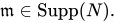
. On the other hand,
m
∈
Supp
(
N
)
.
{\displaystyle {\mathfrak {m}}\in \operatorname {Supp} (N).}
. By (⁎) we can assume
n
{\displaystyle n}
= 0. Then
m
{\displaystyle {\mathfrak {m}}}
is associated with
M
{\displaystyle M}
; thus is in the support of
M
{\displaystyle M}
. On the other hand,
m
∈
Supp
(
N
)
.
{\displaystyle {\mathfrak {m}}\in \operatorname {Supp} (N).}
 It follows by linear algebra that there is a nonzero homomorphism from
N
{\displaystyle N}
to
M
{\displaystyle M}
modulo
m
{\displaystyle {\mathfrak {m}}}
; hence, one from
N
{\displaystyle N}
to
M
{\displaystyle M}
by Nakayama's lemma. Q.E.D.
It follows by linear algebra that there is a nonzero homomorphism from
N
{\displaystyle N}
to
M
{\displaystyle M}
modulo
m
{\displaystyle {\mathfrak {m}}}
; hence, one from
N
{\displaystyle N}
to
M
{\displaystyle M}
by Nakayama's lemma. Q.E.D.
The Auslander–Buchsbaum formula relates depth and projective dimension.
Proof: We argue by induction on
pd
R
M
{\displaystyle \operatorname {pd} _{R}M}
, the basic case (i.e.,
M
{\displaystyle M}
free) being trivial. By Nakayama's lemma, we have the exact sequence
0
→
K
→
f
F
→
M
→
0
{\displaystyle 0\to K{\overset {f}{\to }}F\to M\to 0}
 where
F
{\displaystyle F}
is free and the image of
f
{\displaystyle f}
is contained in
m
F
{\displaystyle {\mathfrak {m}}F}
. Since
pd
R
K
=
pd
R
M
−
1
,
{\displaystyle \operatorname {pd} _{R}K=\operatorname {pd} _{R}M-1,}
where
F
{\displaystyle F}
is free and the image of
f
{\displaystyle f}
is contained in
m
F
{\displaystyle {\mathfrak {m}}F}
. Since
pd
R
K
=
pd
R
M
−
1
,
{\displaystyle \operatorname {pd} _{R}K=\operatorname {pd} _{R}M-1,}
 what we need to show is
depth
K
=
depth
M
+
1
{\displaystyle \operatorname {depth} K=\operatorname {depth} M+1}
what we need to show is
depth
K
=
depth
M
+
1
{\displaystyle \operatorname {depth} K=\operatorname {depth} M+1}
 .
Since
f
{\displaystyle f}
kills
k
{\displaystyle k}
, the exact sequence yields: for any
i
{\displaystyle i}
,
Ext
R
i
(
k
,
F
)
→
Ext
R
i
(
k
,
M
)
→
Ext
R
i
+
1
(
k
,
K
)
→
0.
{\displaystyle \operatorname {Ext} _{R}^{i}(k,F)\to \operatorname {Ext} _{R}^{i}(k,M)\to \operatorname {Ext} _{R}^{i+1}(k,K)\to 0.}
.
Since
f
{\displaystyle f}
kills
k
{\displaystyle k}
, the exact sequence yields: for any
i
{\displaystyle i}
,
Ext
R
i
(
k
,
F
)
→
Ext
R
i
(
k
,
M
)
→
Ext
R
i
+
1
(
k
,
K
)
→
0.
{\displaystyle \operatorname {Ext} _{R}^{i}(k,F)\to \operatorname {Ext} _{R}^{i}(k,M)\to \operatorname {Ext} _{R}^{i+1}(k,K)\to 0.}
 Note the left-most term is zero if
i
<
depth
R
{\displaystyle i<\operatorname {depth} R}
Note the left-most term is zero if
i
<
depth
R
{\displaystyle i<\operatorname {depth} R}
 . If
i
<
depth
K
−
1
{\displaystyle i<\operatorname {depth} K-1}
. If
i
<
depth
K
−
1
{\displaystyle i<\operatorname {depth} K-1}
 , then since
depth
K
≤
depth
R
{\displaystyle \operatorname {depth} K\leq \operatorname {depth} R}
, then since
depth
K
≤
depth
R
{\displaystyle \operatorname {depth} K\leq \operatorname {depth} R}
 by inductive hypothesis, we see
Ext
R
i
(
k
,
M
)
=
0.
{\displaystyle \operatorname {Ext} _{R}^{i}(k,M)=0.}
by inductive hypothesis, we see
Ext
R
i
(
k
,
M
)
=
0.
{\displaystyle \operatorname {Ext} _{R}^{i}(k,M)=0.}
 If
i
=
depth
K
−
1
{\displaystyle i=\operatorname {depth} K-1}
If
i
=
depth
K
−
1
{\displaystyle i=\operatorname {depth} K-1}
 , then
Ext
R
i
+
1
(
k
,
K
)
≠
0
{\displaystyle \operatorname {Ext} _{R}^{i+1}(k,K)\neq 0}
, then
Ext
R
i
+
1
(
k
,
K
)
≠
0
{\displaystyle \operatorname {Ext} _{R}^{i+1}(k,K)\neq 0}
 and it must be
Ext
R
i
(
k
,
M
)
≠
0.
{\displaystyle \operatorname {Ext} _{R}^{i}(k,M)\neq 0.}
and it must be
Ext
R
i
(
k
,
M
)
≠
0.
{\displaystyle \operatorname {Ext} _{R}^{i}(k,M)\neq 0.}
 Q.E.D.
As a matter of notation, for any
R
{\displaystyle R}
-module
M
{\displaystyle M}
, we let
Γ
m
(
M
)
=
{
s
∈
M
∣
supp
(
s
)
⊂
{
m
}
}
=
{
s
∈
M
∣
m
j
s
=
0
for some
j
}
.
{\displaystyle \Gamma _{\mathfrak {m}}(M)=\{s\in M\mid \operatorname {supp} (s)\subset \{{\mathfrak {m}}\}\}=\{s\in M\mid {\mathfrak {m}}^{j}s=0{\text{ for some }}j\}.}
 One sees without difficulty that
Γ
m
{\displaystyle \Gamma _{\mathfrak {m}}}
One sees without difficulty that
Γ
m
{\displaystyle \Gamma _{\mathfrak {m}}}
 is a left-exact functor and then let
H
m
j
=
R
j
Γ
m
{\displaystyle H_{\mathfrak {m}}^{j}=R^{j}\Gamma _{\mathfrak {m}}}
is a left-exact functor and then let
H
m
j
=
R
j
Γ
m
{\displaystyle H_{\mathfrak {m}}^{j}=R^{j}\Gamma _{\mathfrak {m}}}
 be its
j
{\displaystyle j}
be its
j
{\displaystyle j}
 -th right derived functor, called the local cohomology of
R
{\displaystyle R}
. Since
Γ
m
(
M
)
=
lim
→
Hom
R
(
R
/
m
j
,
M
)
{\displaystyle \Gamma _{\mathfrak {m}}(M)=\varinjlim \operatorname {Hom} _{R}(R/{\mathfrak {m}}^{j},M)}
-th right derived functor, called the local cohomology of
R
{\displaystyle R}
. Since
Γ
m
(
M
)
=
lim
→
Hom
R
(
R
/
m
j
,
M
)
{\displaystyle \Gamma _{\mathfrak {m}}(M)=\varinjlim \operatorname {Hom} _{R}(R/{\mathfrak {m}}^{j},M)}
 , via abstract nonsense,
H
m
i
(
M
)
=
lim
→
Ext
R
i
(
R
/
m
j
,
M
)
.
{\displaystyle H_{\mathfrak {m}}^{i}(M)=\varinjlim \operatorname {Ext} _{R}^{i}(R/{\mathfrak {m}}^{j},M).}
, via abstract nonsense,
H
m
i
(
M
)
=
lim
→
Ext
R
i
(
R
/
m
j
,
M
)
.
{\displaystyle H_{\mathfrak {m}}^{i}(M)=\varinjlim \operatorname {Ext} _{R}^{i}(R/{\mathfrak {m}}^{j},M).}
 This observation proves the first part of the theorem below.
Proof: 1. is already noted (except to show the nonvanishing at the degree equal to the depth of
M
{\displaystyle M}
; use induction to see this) and 3. is a general fact by abstract nonsense. 2. is a consequence of an explicit computation of a local cohomology by means of Koszul complexes (see below).
◻
{\displaystyle \square }

Let
R
{\displaystyle R}
be a ring and
x
{\displaystyle x}
an element in it. We form the chain complex
K
{\displaystyle K}
(
x
{\displaystyle x}
) given by
K
(
x
)
i
=
R
{\displaystyle K(x)_{i}=R}
 for
i
{\displaystyle i}
= 0, 1 and
K
(
x
)
i
=
0
{\displaystyle K(x)_{i}=0}
for
i
{\displaystyle i}
= 0, 1 and
K
(
x
)
i
=
0
{\displaystyle K(x)_{i}=0}
 for any other
i
{\displaystyle i}
with the differential
d
:
K
1
(
R
)
→
K
0
(
R
)
,
r
↦
x
r
.
(R)\to K_{0}(R),\,r\mapsto xr.}
for any other
i
{\displaystyle i}
with the differential
d
:
K
1
(
R
)
→
K
0
(
R
)
,
r
↦
x
r
.
(R)\to K_{0}(R),\,r\mapsto xr.}
 For any
R
{\displaystyle R}
-module
M
{\displaystyle M}
, we then get the complex
K
(
x
,
M
)
=
K
(
x
)
⊗
R
M
{\displaystyle K(x,M)=K(x)\otimes _{R}M}
For any
R
{\displaystyle R}
-module
M
{\displaystyle M}
, we then get the complex
K
(
x
,
M
)
=
K
(
x
)
⊗
R
M
{\displaystyle K(x,M)=K(x)\otimes _{R}M}
 with the differential
d
⊗
1
{\displaystyle d\otimes 1}
with the differential
d
⊗
1
{\displaystyle d\otimes 1}
 and let
H
∗
(
x
,
M
)
=
H
∗
(
K
(
x
,
M
)
)
{\displaystyle \operatorname {H} _{*}(x,M)=\operatorname {H} _{*}(K(x,M))}
and let
H
∗
(
x
,
M
)
=
H
∗
(
K
(
x
,
M
)
)
{\displaystyle \operatorname {H} _{*}(x,M)=\operatorname {H} _{*}(K(x,M))}
 be its homology. Note:
H
0
(
x
,
M
)
=
M
/
x
M
,
{\displaystyle \operatorname {H} _{0}(x,M)=M/xM,}
be its homology. Note:
H
0
(
x
,
M
)
=
M
/
x
M
,
{\displaystyle \operatorname {H} _{0}(x,M)=M/xM,}
 H
1
(
x
,
M
)
=
x
M
=
{
m
∈
M
∣
x
m
=
0
}
.
{\displaystyle \operatorname {H} _{1}(x,M)={}_{x}M=\{m\in M\mid xm=0\}.}
H
1
(
x
,
M
)
=
x
M
=
{
m
∈
M
∣
x
m
=
0
}
.
{\displaystyle \operatorname {H} _{1}(x,M)={}_{x}M=\{m\in M\mid xm=0\}.}

More generally, given a finite sequence
x
1
,
…
,
x
n
{\displaystyle x_{1},\dots ,x_{n}}
of elements in a ring
R
{\displaystyle R}
, we form the tensor product of complexes:
K
(
x
1
,
…
,
x
n
)
=
K
(
x
1
)
⊗
⋯
⊗
K
(
x
n
)
{\displaystyle K(x_{1},\dots ,x_{n})=K(x_{1})\otimes \dots \otimes K(x_{n})}
 and let
H
∗
(
x
1
,
…
,
x
n
,
M
)
=
H
∗
(
K
(
x
1
,
…
,
x
n
,
M
)
)
{\displaystyle \operatorname {H} _{*}(x_{1},\dots ,x_{n},M)=\operatorname {H} _{*}(K(x_{1},\dots ,x_{n},M))}
and let
H
∗
(
x
1
,
…
,
x
n
,
M
)
=
H
∗
(
K
(
x
1
,
…
,
x
n
,
M
)
)
{\displaystyle \operatorname {H} _{*}(x_{1},\dots ,x_{n},M)=\operatorname {H} _{*}(K(x_{1},\dots ,x_{n},M))}
 its homology. As before,
H
0
(
x
_
,
M
)
=
M
/
(
x
1
,
…
,
x
n
)
M
,
{\displaystyle \operatorname {H} _{0}({\underline {x}},M)=M/(x_{1},\dots ,x_{n})M,}
its homology. As before,
H
0
(
x
_
,
M
)
=
M
/
(
x
1
,
…
,
x
n
)
M
,
{\displaystyle \operatorname {H} _{0}({\underline {x}},M)=M/(x_{1},\dots ,x_{n})M,}
 H
n
(
x
_
,
M
)
=
Ann
M
(
(
x
1
,
…
,
x
n
)
)
.
{\displaystyle \operatorname {H} _{n}({\underline {x}},M)=\operatorname {Ann} _{M}((x_{1},\dots ,x_{n})).}
H
n
(
x
_
,
M
)
=
Ann
M
(
(
x
1
,
…
,
x
n
)
)
.
{\displaystyle \operatorname {H} _{n}({\underline {x}},M)=\operatorname {Ann} _{M}((x_{1},\dots ,x_{n})).}

We now have the homological characterization of a regular sequence.
Corollary—The sequence
x
i
{\displaystyle x_{i}}
is
M
{\displaystyle M}
-regular if and only if any of its permutations is so.
A Koszul complex is a powerful computational tool. For instance, it follows from the theorem and the corollary
H
m
i
(
M
)
≃
lim
→
H
i
(
K
(
x
1
j
,
…
,
x
n
j
;
M
)
)
{\displaystyle \operatorname {H} _{\mathfrak {m}}^{i}(M)\simeq \varinjlim \operatorname {H} ^{i}(K(x_{1}^{j},\dots ,x_{n}^{j};M))}
 (Here, one uses the self-duality of a Koszul complex; see Proposition 17.15. of Eisenbud, Commutative Algebra with a View Toward Algebraic Geometry.)
Another instance would be
Remark: The theorem can be used to give a second quick proof of Serre's theorem, that
R
{\displaystyle R}
is regular if and only if it has finite global dimension. Indeed, by the above theorem,
Tor
s
R
(
k
,
k
)
≠
0
{\displaystyle \operatorname {Tor} _{s}^{R}(k,k)\neq 0}
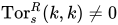 and thus
g
l
.
d
i
m
R
≥
s
{\displaystyle \operatorname {gl.dim} R\geq s}
and thus
g
l
.
d
i
m
R
≥
s
{\displaystyle \operatorname {gl.dim} R\geq s}
 . On the other hand, as
g
l
.
d
i
m
R
=
pd
R
k
{\displaystyle \operatorname {gl.dim} R=\operatorname {pd} _{R}k}
. On the other hand, as
g
l
.
d
i
m
R
=
pd
R
k
{\displaystyle \operatorname {gl.dim} R=\operatorname {pd} _{R}k}
 , the Auslander–Buchsbaum formula gives
g
l
.
d
i
m
R
=
dim
R
{\displaystyle \operatorname {gl.dim} R=\dim R}
, the Auslander–Buchsbaum formula gives
g
l
.
d
i
m
R
=
dim
R
{\displaystyle \operatorname {gl.dim} R=\dim R}
 . Hence,
dim
R
≤
s
≤
g
l
.
d
i
m
R
=
dim
R
{\displaystyle \dim R\leq s\leq \operatorname {gl.dim} R=\dim R}
. Hence,
dim
R
≤
s
≤
g
l
.
d
i
m
R
=
dim
R
{\displaystyle \dim R\leq s\leq \operatorname {gl.dim} R=\dim R}
 .
.
We next use a Koszul homology to define and study complete intersection rings. Let
R
{\displaystyle R}
be a Noetherian local ring. By definition, the first deviation of
R
{\displaystyle R}
is the vector space dimension
ϵ
1
(
R
)
=
dim
k
H
1
(
x
_
)
{\displaystyle \epsilon _{1}(R)=\dim _{k}\operatorname {H} _{1}({\underline {x}})}
 where
x
_
=
(
x
1
,
…
,
x
d
)
{\displaystyle {\underline {x}}=(x_{1},\dots ,x_{d})}
where
x
_
=
(
x
1
,
…
,
x
d
)
{\displaystyle {\underline {x}}=(x_{1},\dots ,x_{d})}
 is a system of parameters. By definition,
R
{\displaystyle R}
is a complete intersection ring if
dim
R
+
ϵ
1
(
R
)
{\displaystyle \dim R+\epsilon _{1}(R)}
is a system of parameters. By definition,
R
{\displaystyle R}
is a complete intersection ring if
dim
R
+
ϵ
1
(
R
)
{\displaystyle \dim R+\epsilon _{1}(R)}
 is the dimension of the tangent space. (See Hartshorne for a geometric meaning.)
Theorem—
R
{\displaystyle R}
is a complete intersection ring if and only if its Koszul algebra is an exterior algebra.
Injective dimension and Tor dimensions
[edit]Let
R
{\displaystyle R}
be a ring. The injective dimension of an
R
{\displaystyle R}
-module
M
{\displaystyle M}
denoted by
id
R
M
{\displaystyle \operatorname {id} _{R}M}
 is defined just like a projective dimension: it is the minimal length of an injective resolution of
M
{\displaystyle M}
. Let
Mod
R
{\displaystyle \operatorname {Mod} _{R}}
is defined just like a projective dimension: it is the minimal length of an injective resolution of
M
{\displaystyle M}
. Let
Mod
R
{\displaystyle \operatorname {Mod} _{R}}
 be the category of
R
{\displaystyle R}
-modules.
be the category of
R
{\displaystyle R}
-modules.
Theorem—For any ring
R
{\displaystyle R}
,
g
l
.
d
i
m
R
=
sup
{
id
R
M
∣
M
∈
Mod
R
}
=
inf
{
n
∣
Ext
R
i
(
M
,
N
)
=
0
,
i
>
n
,
M
,
N
∈
Mod
R
}
{\displaystyle {\begin{aligned}\operatorname {gl.dim} R\,&=\operatorname {sup} \{\operatorname {id} _{R}M\mid M\in \operatorname {Mod} _{R}\}\\&=\inf\{n\mid \operatorname {Ext} _{R}^{i}(M,N)=0,\,i>n,M,N\in \operatorname {Mod} _{R}\}\end{aligned}}}

Proof: Suppose
g
l
.
d
i
m
R
≤
n
{\displaystyle \operatorname {gl.dim} R\leq n}
 . Let
M
{\displaystyle M}
be an
R
{\displaystyle R}
-module and consider a resolution
0
→
M
→
I
0
→
ϕ
0
I
1
→
⋯
→
I
n
−
1
→
ϕ
n
−
1
N
→
0
{\displaystyle 0\to M\to I_{0}{\overset {\phi _{0}}{\to }}I_{1}\to \dots \to I_{n-1}{\overset {\phi _{n-1}}{\to }}N\to 0}
. Let
M
{\displaystyle M}
be an
R
{\displaystyle R}
-module and consider a resolution
0
→
M
→
I
0
→
ϕ
0
I
1
→
⋯
→
I
n
−
1
→
ϕ
n
−
1
N
→
0
{\displaystyle 0\to M\to I_{0}{\overset {\phi _{0}}{\to }}I_{1}\to \dots \to I_{n-1}{\overset {\phi _{n-1}}{\to }}N\to 0}
 where
I
i
{\displaystyle I_{i}}
where
I
i
{\displaystyle I_{i}}
 are injective modules. For any ideal
I
{\displaystyle I}
,
Ext
R
1
(
R
/
I
,
N
)
≃
Ext
R
2
(
R
/
I
,
ker
(
ϕ
n
−
1
)
)
≃
⋯
≃
Ext
R
n
+
1
(
R
/
I
,
M
)
,
{\displaystyle \operatorname {Ext} _{R}^{1}(R/I,N)\simeq \operatorname {Ext} _{R}^{2}(R/I,\operatorname {ker} (\phi _{n-1}))\simeq \dots \simeq \operatorname {Ext} _{R}^{n+1}(R/I,M),}
are injective modules. For any ideal
I
{\displaystyle I}
,
Ext
R
1
(
R
/
I
,
N
)
≃
Ext
R
2
(
R
/
I
,
ker
(
ϕ
n
−
1
)
)
≃
⋯
≃
Ext
R
n
+
1
(
R
/
I
,
M
)
,
{\displaystyle \operatorname {Ext} _{R}^{1}(R/I,N)\simeq \operatorname {Ext} _{R}^{2}(R/I,\operatorname {ker} (\phi _{n-1}))\simeq \dots \simeq \operatorname {Ext} _{R}^{n+1}(R/I,M),}
 which is zero since
Ext
R
n
+
1
(
R
/
I
,
−
)
{\displaystyle \operatorname {Ext} _{R}^{n+1}(R/I,-)}
which is zero since
Ext
R
n
+
1
(
R
/
I
,
−
)
{\displaystyle \operatorname {Ext} _{R}^{n+1}(R/I,-)}
 is computed via a projective resolution of
R
/
I
{\displaystyle R/I}
. Thus, by Baer's criterion,
N
{\displaystyle N}
is injective. We conclude that
sup
{
id
R
M
|
M
}
≤
n
{\displaystyle \sup\{\operatorname {id} _{R}M|M\}\leq n}
is computed via a projective resolution of
R
/
I
{\displaystyle R/I}
. Thus, by Baer's criterion,
N
{\displaystyle N}
is injective. We conclude that
sup
{
id
R
M
|
M
}
≤
n
{\displaystyle \sup\{\operatorname {id} _{R}M|M\}\leq n}
 . Essentially by reversing the arrows, one can also prove the implication in the other way. Q.E.D.
The theorem suggests that we consider a sort of a dual of a global dimension:
w
.
g
l
.
d
i
m
=
inf
{
n
∣
Tor
i
R
(
M
,
N
)
=
0
,
i
>
n
,
M
,
N
∈
Mod
R
}
.
{\displaystyle \operatorname {w.gl.dim} =\inf\{n\mid \operatorname {Tor} _{i}^{R}(M,N)=0,\,i>n,M,N\in \operatorname {Mod} _{R}\}.}
 It was originally called the weak global dimension of
R
{\displaystyle R}
but today it is more commonly called the Tor dimension of
R
{\displaystyle R}
.
It was originally called the weak global dimension of
R
{\displaystyle R}
but today it is more commonly called the Tor dimension of
R
{\displaystyle R}
.
Remark: for any ring
R
{\displaystyle R}
,
w
.
g
l
.
d
i
m
R
≤
g
l
.
d
i
m
R
{\displaystyle \operatorname {w.gl.dim} R\leq \operatorname {gl.dim} R}
 .
.
Dimensions of non-commutative rings
[edit]Let
A
{\displaystyle A}
 be a graded algebra over a field
k
{\displaystyle k}
. If
V
{\displaystyle V}
be a graded algebra over a field
k
{\displaystyle k}
. If
V
{\displaystyle V}
 is a finite-dimensional generating subspace of
A
{\displaystyle A}
, then we let
f
(
n
)
=
dim
k
V
n
{\displaystyle f(n)=\dim _{k}V^{n}}
is a finite-dimensional generating subspace of
A
{\displaystyle A}
, then we let
f
(
n
)
=
dim
k
V
n
{\displaystyle f(n)=\dim _{k}V^{n}}
 and then put
gk
(
A
)
=
lim sup
n
→
∞
log
f
(
n
)
log
n
.
{\displaystyle \operatorname {gk} (A)=\limsup _{n\to \infty }{\log f(n) \over \log n}.}
and then put
gk
(
A
)
=
lim sup
n
→
∞
log
f
(
n
)
log
n
.
{\displaystyle \operatorname {gk} (A)=\limsup _{n\to \infty }{\log f(n) \over \log n}.}
 It is called the Gelfand–Kirillov dimension of
A
{\displaystyle A}
. It is easy to show
gk
(
A
)
{\displaystyle \operatorname {gk} (A)}
It is called the Gelfand–Kirillov dimension of
A
{\displaystyle A}
. It is easy to show
gk
(
A
)
{\displaystyle \operatorname {gk} (A)}
 is independent of a choice of
V
{\displaystyle V}
. Given a graded right (or left) module
M
{\displaystyle M}
over
A
{\displaystyle A}
one may similarly define the Gelfand-Kirillov dimension
g
k
(
M
)
{\displaystyle {gk}(M)}
is independent of a choice of
V
{\displaystyle V}
. Given a graded right (or left) module
M
{\displaystyle M}
over
A
{\displaystyle A}
one may similarly define the Gelfand-Kirillov dimension
g
k
(
M
)
{\displaystyle {gk}(M)}
 of
M
{\displaystyle M}
.
of
M
{\displaystyle M}
.
Example: If
A
{\displaystyle A}
is finite-dimensional, then gk(
A
{\displaystyle A}
) = 0. If
A
{\displaystyle A}
is an affine ring, then gk(
A
{\displaystyle A}
) = Krull dimension of
A
{\displaystyle A}
.
Bernstein's inequality—See [1]
Example: If
A
n
=
k
[
x
1
,
.
.
.
,
x
n
,
∂
1
,
.
.
.
,
∂
n
]
{\displaystyle A_{n}=k[x_{1},...,x_{n},\partial _{1},...,\partial _{n}]}
![{\displaystyle A_{n}=k[x_{1},...,x_{n},\partial _{1},...,\partial _{n}]}](https://wikimedia.org/api/rest_v1/media/math/render/svg/b97408eb29547e8656d9fb8b06f2d5cfff65c729) is the n-th Weyl algebra then
gk
(
A
n
)
=
2
n
.
{\displaystyle \operatorname {gk} (A_{n})=2n.}
is the n-th Weyl algebra then
gk
(
A
n
)
=
2
n
.
{\displaystyle \operatorname {gk} (A_{n})=2n.}
- Bruns, Winfried; Herzog, Jürgen (1993), Cohen-Macaulay rings, Cambridge Studies in Advanced Mathematics, vol. 39, Cambridge University Press, ISBN 978-0-521-41068-7, MR 1251956
- Part II of Eisenbud, David (1995), Commutative algebra. With a view toward algebraic geometry, Graduate Texts in Mathematics, vol. 150, New York: Springer-Verlag, ISBN 0-387-94268-8, MR 1322960.
- Chapter 10 of Atiyah, Michael Francis; Macdonald, I.G. (1969), Introduction to Commutative Algebra, Westview Press, ISBN 978-0-201-40751-8.
- Kaplansky, Irving, Commutative rings, Allyn and Bacon, 1970.
- Matsumura, H. (1987). Commutative Ring Theory. Cambridge Studies in Advanced Mathematics. Vol. 8. Translated by M. Reid. Cambridge University Press. doi:10.1017/CBO9781139171762. ISBN 978-0-521-36764-6.
- Serre, Jean-Pierre (1975), Algèbre locale. Multiplicités, Cours au Collège de France, 1957–1958, rédigé par Pierre Gabriel. Troisième édition, 1975. Lecture Notes in Mathematics (in French), vol. 11, Berlin, New York: Springer-Verlag
- Weibel, Charles A. (1995). An Introduction to Homological Algebra. Cambridge University Press.
















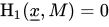


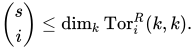
![[icon]](/wiki/File:Wiki_letter_w_cropped.svg)