
 Adolf Brand in a 1924 engraving
Der Eigene ([deːɐ̯ ˈʔaɪ̯ɡənə], lit. 'The Own') was the first gay journal in the world,[1][2][3][4] published from 1896 to 1932 by Adolf Brand in Berlin. Brand contributed many poems and articles; other contributors included writers Benedict Friedlaender, Hanns Heinz Ewers, Erich Mühsam, Kurt Hiller, Ernst Burchard, John Henry Mackay, Theodor Lessing, Klaus Mann, and Thomas Mann, as well as artists Wilhelm von Gloeden, Fidus, and Sascha Schneider.[5] The journal may have had an average of around 1500 subscribers per issue during its run, but the exact numbers are uncertain.
History
[edit]The title of the journal, Der Eigene (no exact English equivalent but has been translated as The Self-Possessed),[5] refers to the classic anarchist work Der Einzige und sein Eigentum (1844) by Max Stirner. Early issues reflected the philosophy of Stirner, as well as other views on the politics of anarchism. By the second year of its focus, it settled into a focus on homosexuality.[5] In the 1920s the journal shifted to support the liberal democracy of the Weimar Republic and the Social Democratic Party of Germany. Der Eigene interwove cultural, artistic, and political material, including lyric poetry, prose, political manifestos and nude photography.
The publisher of Der Eigene had to fight against government censorship, particularly in retaliation against its depictions of nude figures.[5] Brand's home was searched by the police many times.[5] He was arrested for the magazine's provocative content in 1903.[5]
In 1903, the publishing of the poem "Die Freundschaft" (Friendship) by Friedrich Schiller provoked a lawsuit against the magazine, which the magazine won.[citation needed]
The formation of the advocacy group Gemeinschaft der Eigenen allowed Brand to evade censorship by categorizing Der Eigene as a manuscript issued privately to subscribers rather than as a publicly sold magazine.[5] The number of subscribers is estimated at 1500 or fewer.[5]
In 1933, when Adolf Hitler rose to power, Adolf Brand's house was searched and all the materials needed to produce the magazine were seized and given to Ernst Röhm.[6]
In 2020, the Humboldt University of Berlin made the complete set of the magazine available on its website,[7] with censorship in form of pixelation applied to several pages containing artistic photographs and paintings.
Gallery
[edit]-
 Der Eigene, vol. 1 (1896), no. 1 - ten issues in this format - an anarchist journal with no gay content in this volume
 -
 Der Eigene, vol. 2 (1898), no. 1 - two issues in this format - here, the opening page of a gay short story, the journal's first gay text
 -
 Der Eigene, "New Series" vol. 1 (= vol. 3, the first entirely gay volume) (1898), no. 1 - ten issues in this format
 -
 Der Eigene, vol. 4 (or "New Series" vol. 2) (1903), no. 1 - six issues in this format
 -
 Der Eigene, vol. 5 (or "New Series" vol. 3) (1905), no. 1 - six issues in this format
 -
 Der Eigene, vol. 6 (1906) - the only hardback issue, an annual
 -
 Der Eigene, vol. 7 (1919–20), no. 3 - eleven issues in this format
 -
 Der Eigene, vol. 8 (1920), no. 9 - fourteen issues in this format
 -
 Der Eigene, vol. 9 (1921-22-23), no. 3 - seven issues in this format
 -
 Der Eigene, vol. 10 (1924-25), no. 4 - twelve issues in this format
 -
 Der Eigene, vol. 11 (1926), no. 1 - ten issues in this format
 -
 Der Eigene, vol. 12 (1929), no. 5 - five issues in this format
 -
 Der Eigene, vol. 13 (1930–32), no. 1 - nine issues in this format
 -
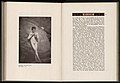 Der Eigene, vol. 6 (1906) - original uncensored page 158
 -
 Censored page containing a painting by Léonard Sarluis, from the Humboldt University of Berlin's scan project


.jpg)
.jpg)


_p._158.jpg)
_p.45_PAINTING_BY_LEONARD_SARLUIS_CENSORED_BY_HUMBOLDT_UNIVERSITY_BERLIN.png)
See also
[edit]References
[edit]- ^ Ross, Alex (19 January 2015). "Berlin Story: The Gay Capital of the Nineteenth Century". The New Yorker.
- ^ Stewart, Andrew (2019). "A Journal for Manly Culture: An Exploration of the World's First Gay Periodical". Papers of the Bibliographical Society of Canada. 57: 85–105. doi:10.33137/pbsc.v57i0.32971. ISSN 2562-8941.
- ^ Bahlmann, Nana (14 December 2015). "Homosexuality Is a German Invention". Los Angeles County Museum of Art.
- ^ Panhuis, Erwin in het (4 February 2024). "Schwules Leben vor 100 Jahren: Die Zeitschriften der Szene". queer.de (in German).
- ^ a b c d e f g h Beachy, Robert (2014). Gay Berlin. United States: Alfred A. Knopf. pp. 101–103. ISBN 9780307272102.
- ^ Stewart, Andrew (2019). "A Journal for Manly Culture: An Exploration of the World's First Gay Periodical". Papers of the Bibliographical Society of Canada. 57: 85–105. doi:10.33137/pbsc.v57i0.32971. ISSN 2562-8941.
- ^ "Digitization the Magazine Der Eigene (Our Own)". Institut für deutsche Literatur. Retrieved 2025-11-21.
Further reading
[edit]- Reprint: Der Eigene. Ein Blatt für männliche Kultur. Ein Querschnitt durch die erste Homosexuellenzeitschrift der Welt. With an article by Friedrich Kröhnke. Published and afterwords by Joachim S. Hohmann, Foerster Verlag, Frankfurt/Main and Berlin 1981.
- Tamagne, Florence (2004). History Of Homosexuality In Europe. Algora Publishing. pp. 69–70.
External links
[edit]
- Homodok.nl Full text scan (pdf) 1896-1900 and 1903 at IHLIA LGBT Heritage.
- Schillers "Die Freundschaft" (in German)
- Part of a letter by Brand from 1933 about the end of the magazine Archived 2020-03-31 at the Wayback Machine. (in German)
- Complete set digitized on Humboldt University website (some pages with photographs and artworks partially censored)