
In mathematics, particularly in set theory, if is a regular uncountable cardinal then the filter of all sets containing a club subset of is a -complete filter closed under diagonal intersection called the club filter.


To see that this is a filter, note that since it is thus both closed and unbounded (see club set). If then any subset of containing is also in since and therefore anything containing it, contains a club set.


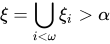
It is a -complete filter because the intersection of fewer than club sets is a club set. To see this, suppose is a sequence of club sets where Obviously is closed, since any sequence which appears in appears in every and therefore its limit is also in every To show that it is unbounded, take some Let be an increasing sequence with and for every Such a sequence can be constructed, since every is unbounded. Since and is regular, the limit of this sequence is less than We call it and define a new sequence similar to the previous sequence. We can repeat this process, getting a sequence of sequences where each element of a sequence is greater than every member of the previous sequences. Then for each is an increasing sequence contained in and all these sequences have the same limit (the limit of ). This limit is then contained in every and therefore and is greater than


To see that is closed under diagonal intersection, let be a sequence of club sets, and let To show is closed, suppose and Then for each for all Since each is closed, for all so To show is unbounded, let and define a sequence as follows: and is the minimal element of such that Such an element exists since by the above, the intersection of club sets is club. Then and since it is in each with







See also
[edit]- Clubsuit
- Filter (mathematics) – Special subset of a partially ordered set
- Stationary set – Set-theoretic concept
References
[edit]- Jech, Thomas, 2003. Set Theory: The Third Millennium Edition, Revised and Expanded. Springer. ISBN 3-540-44085-2.
This article incorporates material from club filter on PlanetMath, which is licensed under the Creative Commons Attribution/Share-Alike License.
| General | |||||||||
|---|---|---|---|---|---|---|---|---|---|
| Theorems (list), paradoxes | |||||||||
| Logics |
| ||||||||
| Set theory |
| ||||||||
| Formal systems (list), language, syntax |
| ||||||||
| Proof theory | |||||||||
| Model theory | |||||||||
| Computability theory | |||||||||
| Related | |||||||||

| Overview |  | |
|---|---|---|
| Axioms | ||
| Operations |
| |
| ||
| Set types | ||
| Theories | ||
| ||
| Set theorists | ||