
 Bicycle counter in Copenhagen, Denmark
Bicycle counters are devices that conduct a traffic count of passing bicycles.[1][2] Some counters can also detect the speed, direction, and type of bicycles.[3] Most bicycle counters consist of a discrete sensor and a computing device to record and store the data although some also have a public-facing display to show the total number of cyclists of the current day and year.[1] Such systems (with the prominent display) are sometimes referred to as bicycle barometers.[4] There are bicycle counters in hundreds of cities around the world[5]. The first bicycle barometer was installed in Odense, Denmark, in 2002[1][4] though cities had been conducting systematic counts of cyclists at least as early as 1994.[6]
Persuasive aspects
[edit]Bicycle counters are mainly installed to assist city planning with reliable data on the development of bicycle usage.[7][8][9] However the use of bicycle barometers, or prominent displays associated with the count locations, can also serve to normalize cycling as a mode of transportation, encourage more people to use their bicycles[1][2][7][10] and give cyclists acknowledgement.[4][8] There has been no representative study on the impact of bicycle counters on citizens or by-passers, but some early empirical clues that urban visualizations can "become appropriate communication media for sharing, discussing, and co-producing socially relevant data".[11]
To increase visibility, bicycle counter with displays are mostly installed at positions with high traffic volume and visibility to a range of road users.[2] They have been called urban visualizations[11] and fulfill certain criteria of ambient intelligence, such as being embedded, context-aware and adaptive.[12] Bicycle counting stations can be described as persuasive technology.[13]
"Through sensing technology, a display can act as a tool that increases the capability to capture a behavior (e.g., measuring residential energy consumption, bicycle use, etc.); through its visual imagery, it can function as a medium that provides useful information, such as behavioral statistics or cause-and-effect relationships; and through its networking ability, it can become a social actor, encouraging community-based feedback and social interaction".[13]
Technical setup
[edit]Different techniques are used for detection of bicycles, such as built in induction loops, piezoelectric strips[14], pneumatic hoses,[15] infrared sensing[5] or cameras.[2] Different setups provide different advantages such as more precise counting, battery life,[16] reduced costs or differentiation between different road users such as cyclists, pedestrians or cars.[17] Independent testing has shown that pneumatic tubes can record with over 95% accuracy[18] and piezoelectric sensors reach 99% accuracy.[16] Manufacturers state a 90% precision for induction loops.[5]
Data
[edit]Unlike manual counting or other bicycle related interventions or citizen science, where citizens manually put in data,[19] bicycle counting stations automatically generate citizen related data.[20] Automatic counting systems are said to be cheaper than manual counting by people.[9] Because of the use of communication technology in the urban context, bicycle counters can be counted as smart city technology, urban informatics or urban computing.
Criticism
[edit]There has been criticism on the precision of the counting[10][21] and on the cost of bicycle counters as a waste of tax money.[21][22][23]
See also
[edit]Cycling barometer is also the name of a ranking by the European Cyclists' Federation for the most bicycle-friendly nations in the EU.[24]
There has been creative use of the data generated by counting stations, such as an information design poster which includes number of daily cyclists, precipitation and temperature.[25]
Gallery
[edit]-
 Piezoelectric bike counter in Haarlem, the Netherlands
 -
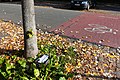 A bicycle counter in Mannheim with pneumatic hoses to detect the number of cyclists
 -
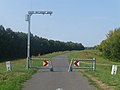 Narrowed passage at the Tisza Cycleway in Hungary with cameras to count cyclists
 -
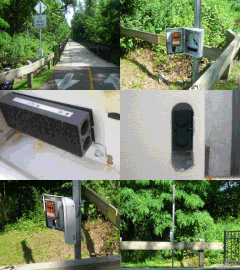 The technical equipment of a bicycle and pedestrian counter next to a cycle path, using an infrared sensor in Burlington
 -
 Ecocounter bike sensor installed in a cycle lane on Bloor Street West in Toronto


_Tiszamenti_ker%C3%A9kp%C3%A1r%C3%BAt_(EuroVelo-11)_Kisk%C3%B6re_fel%C3%A9_2018-09-09.JPG)


References
[edit]- ^ a b c d European Commission. "Bicycle barometers (bike counters)" (PDF). Archived from the original (PDF) on 2019-07-20.
- ^ a b c d Civitas initiative. "Measure Result - Integrating cycling with public transport in Malmo | CIVITAS". civitas.eu. Archived from the original on 2021-04-25. Retrieved 2020-04-27.
- ^ "Active Transport Monitoring". MetroCount. 2020-05-19. Retrieved 2020-11-25.
- ^ a b c Brooks, Karen (2014-09-22). "The magic of bike barometers". PeopleForBikes. Archived from the original on 2020-11-12. Retrieved 2020-04-24.
- ^ a b c "Products". Eco-Counter. Archived from the original on 2021-02-01. Retrieved 2020-04-24.
- ^ "Permanent Bicycle Counters". City of Toronto Open Data. 2025-01-30. Retrieved 2025-12-30.
}: CS1 maint: url-status (link) - ^ a b "Fahrradbarometer". hamburg.adfc.de (in German). Archived from the original on 2020-03-21. Retrieved 2020-04-25.
- ^ a b Magni, Marie (2012-06-06). "Cycle cities awarded bicycle counters". Cycling Embassy of Denmark. Archived from the original on 2020-07-19. Retrieved 2020-04-25.
- ^ a b Wein, Martin (29 December 2016). "Kennedybrücke in Bonn: Streit um Fahrradbarometer". GA BONN (in German). Retrieved 2020-04-25.
- ^ a b Hoeft, Antonia (2 May 2012). "Fahrradzähler bei der Wiwili-Brücke eingeweiht - Freiburg - fudder.de". fudder.de (in German). Retrieved 2020-04-25.
- ^ a b Moere, Andrew Vande; Hill, Dan (2012-04-01). "Designing for the Situated and Public Visualization of Urban Data". Journal of Urban Technology. 19 (2): 25–46. doi:10.1080/10630732.2012.698065. ISSN 1063-0732. S2CID 111348602.
- ^ Pousman, Zachary; Stasko, John (2006). "A taxonomy of ambient information systems". Proceedings of the working conference on Advanced visual interfaces - AVI '06. Venezia, Italy: ACM Press. pp. 67–74. doi:10.1145/1133265.1133277. ISBN 978-1-59593-353-9. S2CID 5297964.
- ^ a b Claes, Sandy; Slegers, Karin; Vande Moere, Andrew (2016-05-07). "The Bicycle Barometer". Proceedings of the 2016 CHI Conference on Human Factors in Computing Systems. San Jose California USA: ACM. pp. 5824–5835. doi:10.1145/2858036.2858429. ISBN 978-1-4503-3362-7. S2CID 14648321.
- ^ "RoadPod® VP". MetroCount. 2016-05-02. Retrieved 2020-11-25.
- ^ "RidePod® BT". MetroCount. 2016-09-12. Retrieved 2020-11-25.
- ^ a b "Validation of MC5720 on Albert St, East Melbourne" (PDF). Sinclaire Knight Metz.
- ^ Greene-Roesel, Ryan; Diogenes, Mara Chagas; Ragland, David R.; Lindau, Luis Antonio (2008-04-01), Effectiveness of a Commercially Available Automated Pedestrian Counting Device in Urban Environments: Comparison with Manual Counts
- ^ "Test d'un compteur à tubes pneumatiques du type MetroCount 5620" (PDF). Centre de recherches routières (Belgique).
- ^ Claes, Sandy; Slegers, Karin; Vande Moere, Andrew (2016-05-07). "The Bicycle Barometer". Proceedings of the 2016 CHI Conference on Human Factors in Computing Systems. San Jose California USA: ACM. pp. 5824–5835. doi:10.1145/2858036.2858429. ISBN 978-1-4503-3362-7. S2CID 14648321.
- ^ "Home - Automated pedestrian & bicycle counters". Eco-Counter. Archived from the original on 2020-06-28. Retrieved 2020-04-24.
- ^ a b extra 3 (15 October 2015). "Realer Irrsinn: Fahrradzählstation in Hamburg | extra 3 | NDR". YouTube.
}: CS1 maint: numeric names: authors list (link) - ^ Wein, Martin (29 December 2016). "Kennedybrücke in Bonn: Streit um Fahrradbarometer". GA BONN (in German). Retrieved 2020-04-27.
- ^ Hamburg, Hamburger Abendblatt- (2016-10-06). "Hier verschwendet Hamburg seine Steuergelder". www.abendblatt.de (in German). Retrieved 2020-04-27.
- ^ "ECF Cycling barometer | ECF". ecf.com. 20 January 2016. Retrieved 2020-04-24.
- ^ "Bicycle Barometer - Paste in Place". www.pasteinplace.com. Archived from the original on 2019-04-17. Retrieved 2020-04-24.
