
 | It has been suggested that this article be merged into History of the Jews in Kurdistan. (Discuss) Proposed since January 2026. |
| Part of a series on |
| Assyrians |
|---|
 |
| Assyrian culture |
| By country |
| Assyrian diaspora |
| Language |
| Subgroups |
| Religion |
| By location |
| Persecution |
Assyrian Jews (Hebrew: יהודים אַשּׁוּרִים, romanized: Yehudim Ashurim)[1][failed verification] first appeared in the territory of Assyria when the Israelites were exiled to Assyria in approximately 740 BCE.[2][full citation needed] Jews have been continuously living alongside the Assyrian people in the territories of Assyria since their exile, and constitute a minority within the predominantly Christian ethnic group.[3][4][5][6]
History
[edit] Assyrian Jew in Iraq (1930).
Assyrian Jews are Aramaic-speaking Mizrahi Jewish communities that lived in the geographic region of Mesopotamia, the Zagros Mountains, roughly covering parts of northwestern Iran, northern Iraq, northeastern Syria and southeastern Turkey. They lived as closed ethnic communities until they were expelled from Arab and Muslim states from the 1940s–1950s onward. Assyrian Jews are speakers of Judeo-Aramaic dialects shared with their Christian counterparts; these are considered nearly extinct, replaced by modern Hebrew in the next generation after immigration to Israel.[7][8][9][10] Many Assyrian Jews, especially the ones who hailed from larger cities of Iraq, went through a Sephardic Jewish blending during the 18th century.[11]
Speculation regarding the origins of Assyrian Jews involves two primary explanations: the descent from the Lost Tribes of Israel exiled by the Neo-Assyrian Empire and the conversion of ethnic Assyrians to Judaism, most notably the royal house of Adiabene. There is historical evidence supporting both ideas.[12][13][10]
Terminology
[edit]Due to the overwhelming presence of Kurds in northern Iraq and neighboring regions, Assyrian Jews fleeing to the new state of Israel from these areas came to be labeled “Kurdish Jews” by immigration officers, a misnomer that has persisted.[5] Genome-wide analyses indicate that those identified as "Kurdish Jews" cluster closely with Assyrian populations.[14][6]
Genetic studies indicate ancestral continuity between Georgian Jews and ethnic Assyrians, suggesting a common ancestral pool in the Neo-Assyrian and Babylonian regions. This pattern likely reflects historical population movements, including deportations and subsequent Persian-era settlements in the Caucasian Mountains, which helped preserve their distinct genetic heritage.[15][16][17]
While a vast amount of academic as well as other literature, high-quality journalism, and documentaries analyse the Iraqi-Arab Jews, few academic works consider the Jews of the Kurdish region and very little knowledge circulates in general. Publications on the Jews of Iraq subsume the Jews in Kurdistan under the overall Jewish population and hardly ever mention them by name. Kurdishness, the region, the language, living conditions or other features do not appear except in allusions.[18]
Israel
[edit]Assyrian Jews in Israel have founded The Committee for the Revival of Aramit-Ashurit Language, which sees itself as the modern Israeli ambassador to the Assyrian nation.[19]
During the establishment of the State of Israel and the subsequent decades, an estimated 25,000–30,000 Assyrian Jews immigrated to the country, though their precise motivations remain largely undocumented. Their descendants are currently estimated to number between 150,000 and 300,000 within Israel. Over successive generations, assimilation has led to varying degrees of cultural, linguistic, and social integration into the broader Israeli identity.[20][21][5][10]
Gallery
[edit]-
 Pre-1948 distribution of modern Judeo-Aramaic languages and dialects
 -
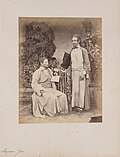 Assyrian Jews
 -
 Christian and Jewish Assyrians at the Nova music festival site demonstrating their respect and solidarity with Israelis following the 7 October attacks

.jpg)

See also
[edit]- Assyrian captivity
- Ktav Ashuri
- Ktav Ivri
- Adiabene
- Helena of Adiabene
- Jewish Babylonian Aramaic
- Jewish Palestinian Aramaic
- Judeo-Aramaic languages
- Aramaic studies
- History of the Jews in Kurdistan
References
[edit]- ^ "הארגון הארצי של יהודי כורדיסטן מבקש".
- ^ The Books of Kings and Chronicles modern view by Umberto Cassuto and Elia Samuele Artom[who?] (1981)[full citation needed]
- ^ "Historical summary of the Assyrian (Syriac) People". Assyrians.n.nu. Retrieved 28 January 2026.
- ^ Rea, Cam. The Assyrian Exile: Israel's Legacy in Captivity, p. 47 ISBN 1-60481-173-0
- ^ a b c "Interview with Dr. Yaacov Maoz, a Jewish Native Speaker of Aramaic". Chaldean Cultural Center. Retrieved 29 January 2026.
- ^ a b Maoz, Yaacov (2023). Jerusalem and Nineveh: The Renewal of Aramit-Ashurit in Israel and the Alliance between Israel and Assyria. Israel: Self-published. Retrieved 2026-01-30.
- ^ Frye, Richard N.; Driver, G. R. (1955). "Review of G. R. Driver's "Aramaic Documents of the Fifth Century B. C."". Harvard Journal of Asiatic Studies. 18 (3/4): 456–461. doi:10.2307/2718444. JSTOR 2718444. p. 457.
- ^ F. Rosenthal; J. C. Greenfield; S. Shaked (December 15, 1986), "Aramaic", Encyclopaedia Iranica, Iranica Online
- ^ Beyer 1986.
- ^ a b c Schmidinger, Thomas. End of Story? Remnants of Kurdistan’s Jews in the 21st Century. Transnational Press London. Retrieved 1 February 2026.
- ^ https://lawoffice.org.il/מגורשי-ספרד-בעיראק-הוצאת-דרכון-פורטוג/
- ^ Thomas, Michael (2020). "The Conversions of Adiabene and Edessa in Syriac Christianity and Judaism: The Relations of Jews and Christians in Northern Mesopotamia in Antiquity" (PDF). Concordia Theological Journal. 7 (1). Concordia University Wisconsin. Retrieved 1 February 2026.
- ^ "Ten Lost Tribes of Israel". Encyclopædia Britannica. Britannica. Retrieved 1 February 2026.
- ^ Behar, Doron M., et al. "The Genome-Wide Structure of the Jewish People." Nature, vol. 466, no. 7303, 2010, pp. 238–242. doi:10.1038/nature09103.
- ^ "The genome-wide structure of the Jewish people". Nature. 466 (7303): 238–242. 2010. doi:10.1038/nature09103.
- ^ "High-resolution inference of genetic relationships among Jewish populations". European Journal of Human Genetics. 28 (6): 804–814. 2020. doi:10.1038/s41431-019-0542-y.
- ^ "The Y chromosome pool of Jews as part of the genetic landscape of the Middle East". American Journal of Human Genetics. 69 (5): 1095–1112. 2001. doi:10.1086/324070.
- ^ Sevdeen, Bayar Mustafa; Schmidinger, Thomas (2019). Beyond ISIS: History and Future of Religious Minorities in Iraq. Transnational Press London. ISBN 9781912997152.
- ^ "The Model of the Prophet Jonah". Seyfo Center. Retrieved 27 January 2026.
- ^ "Kurdish Jewish Community in Israel". Jcjcr.org. Archived from the original on 2013-07-28. Retrieved 2026-01-27.
- ^ "Kurdistan". www.jewishvirtuallibrary.org. Retrieved 2026-01-27.
Works cited
[edit]- Beyer, Klaus (1986). The Aramaic Language: Its Distribution and Subdivisions. Göttingen: Vandenhoeck & Ruprecht. ISBN 9783525535738.