
Angermünde | |
|---|---|
 Market Square and Townhall | |
 Coat of arms | |
Location of Angermünde
within Uckermark district 
| |
 Location of Angermünde | |
  Angermünde  Angermünde | |
| Coordinates: 53°02′N 14°00′E / 53.033°N 14.000°E | |
| Country | Germany |
| State | Brandenburg |
| District | Uckermark |
| Subdivisions | 24 Ortsteile |
| Government | |
| • Mayor (2016–24) | Frederik Bewer[1] |
| Area | |
• Total | 324.21 km2 (125.18 sq mi) |
| Elevation | 50 m (160 ft) |
| Population (2023-12-31)[2] | |
• Total | 13,775 |
| • Density | 42.488/km2 (110.04/sq mi) |
| Time zone | UTC+01:00 (CET) |
| • Summer (DST) | UTC+02:00 (CEST) |
| Postal codes | 16278 |
| Dialling codes | 03331 |
| Vehicle registration | UM |
| Website | www.angermuende.de |
Angermünde (German pronunciation: [aŋɐˈmʏndə] ⓘ) is a town in the district of Uckermark in the state of Brandenburg, in north-eastern Germany. It is about 43 miles (69 km) northeast of Berlin, the capital of Germany.
The population is about 14,000, but has been declining since its traditional industrial base, enamel-working, has declined. An administrative sub-centre of its district, it has several Protestant churches, a former Franciscan church, a number of schools of higher learning and a recently refurbished historic marketplace with an old town hall. Located in the game-filled forests of the Uckermark, with its many lakes, it now relies heavily on tourism and the sources of revenue linked to it.
Since 2010, Angermünde is a federally declared resort town.[3]
Name
[edit] |
The name Angermünde is an abbreviation of the older town of Tangermünde, for a while the town was named New-Tangermünde (Neu-Tangermünde), until it was changed to "Angermünde", with Anger being German for a central square in a town.
Geography
[edit] | This section needs additional citations for verification. (June 2023) |
Angermünde is located in the Uckermarck region, roughly 69 km north of Berlin. It is made up of the Inner City (German: Kernstadt), and 23 adjacent districts.[citation needed] The districts are: Altkünkendorf, Biesenbrow, Bölkendorf, Bruchhagen, Crussow, Dobberzin, Frauenhagen, Gellmersdorf, Görlsdorf, Greiffenberg, Günterberg, Herzsprung, Kerkow, Mürow, Neukünkendorf, Schmargendorf, Schmiedeberg, Steinhöfel, Stolpe, Welsow, Wilmersdorf, Wolletz, and Zuchenberg.[citation needed] In addition, there are 40 registered neighborhoods (German: Wohnplätze) within the districts.[citation needed] The registered neighborhood are: Altenhof, Augustenfelde, Ausbau, Ausbau Mürower Straße, Ausbau Pinnower Weg, Ausbau Welsower Weg, Bauernsee, Blumberger Mühle, Breitenteicher Mühle, Friedrichsfelde, Gehegemühle, Glambecker Mühle, Greiffenberg Siedlung, Grumsin, Henriettenhof, Klein Frauenhagen, Leistenhof, Leopoldsthal, Linde, Lindenhof, Louisenhof, Luisenthal, Mürow-Oberdorf, Neu-Günterberg, Neuhaus, Neuhof, Peetzig, Rosinthal, Schäferei, Sonnenhof, Sternfelde, Stolper Mühle, Thekenberg, Waldfried, Waldfrieden, Wilhelmsfelde, Wilhelmshof, Ziethenmühle, und Zollende.[citation needed] With an area of around 324 km2, Angermünde was, as of 2020, Germany's 17th largest municipality.[4]
History
[edit]_(Zeno_Ansichtskarten).jpg) Postcard from c. 1900
Postcard from c. 1900
The town was the site of a 1420 victory of Frederick I of Brandenburg over the Pomeranians.[5] Since 1687, French Huguenots settled in the town, and the Holy Spirit Chapel served as the French church.[6]
From 1815 to 1947, Angermünde was part of the Prussian Province of Brandenburg. In the 19th century, the town was the seat of a Prussian circle in the Province of Brandenburg and linked to Berlin by the railway to Stettin (now Szczecin, Poland).[7] Angermünde station then served as the junction for branch lines servicing Prenzlau, Bad Freienwalde, and Schwedt.[5] During World War II, the Germans operated five forced labour subcamps of the Stalag III-C prisoner-of-war camp in the town.[8]
From 1947 to 1952, Angermünde was part of the State of Brandenburg, from 1952 to 1990 of the Bezirk Frankfurt of East Germany and since 1990 again of Brandenburg.
Climate
[edit]| Climate data for Angermünde (1991–2020 normals) | |||||||||||||
|---|---|---|---|---|---|---|---|---|---|---|---|---|---|
| Month | Jan | Feb | Mar | Apr | May | Jun | Jul | Aug | Sep | Oct | Nov | Dec | Year |
| Mean daily maximum °C (°F) | 2.8 (37.0) |
4.3 (39.7) |
8.3 (46.9) |
14.6 (58.3) |
19.1 (66.4) |
22.2 (72.0) |
24.5 (76.1) |
24.2 (75.6) |
19.4 (66.9) |
13.4 (56.1) |
7.1 (44.8) |
3.7 (38.7) |
13.6 (56.5) |
| Daily mean °C (°F) | 0.4 (32.7) |
1.3 (34.3) |
4.1 (39.4) |
9.1 (48.4) |
13.5 (56.3) |
16.8 (62.2) |
18.9 (66.0) |
18.5 (65.3) |
14.3 (57.7) |
9.3 (48.7) |
4.6 (40.3) |
1.6 (34.9) |
9.4 (48.9) |
| Mean daily minimum °C (°F) | −2.1 (28.2) |
−1.7 (28.9) |
0.3 (32.5) |
3.7 (38.7) |
7.7 (45.9) |
11.3 (52.3) |
13.5 (56.3) |
13.2 (55.8) |
9.6 (49.3) |
5.6 (42.1) |
2.0 (35.6) |
−0.7 (30.7) |
5.2 (41.4) |
| Average precipitation mm (inches) | 38.0 (1.50) |
28.9 (1.14) |
36.9 (1.45) |
27.2 (1.07) |
52.1 (2.05) |
54.2 (2.13) |
71.0 (2.80) |
57.8 (2.28) |
45.5 (1.79) |
38.0 (1.50) |
35.4 (1.39) |
37.1 (1.46) |
521.9 (20.55) |
| Average precipitation days (≥ 0.1 mm) | 15.5 | 13.4 | 13.8 | 10.7 | 12.7 | 12.9 | 13.8 | 13.2 | 11.4 | 13.8 | 14.3 | 16.3 | 161.6 |
| Average snowy days (≥ 1.0 cm) | 8.8 | 8.5 | 3.3 | 0.5 | 0 | 0 | 0 | 0 | 0 | 0.1 | 1.4 | 5.8 | 30.2 |
| Average relative humidity (%) | 87.0 | 83.0 | 78.3 | 70.7 | 71.0 | 71.1 | 71.2 | 72.8 | 78.7 | 84.6 | 89.8 | 89.1 | 79.1 |
| Mean monthly sunshine hours | 50.7 | 74.0 | 130.2 | 196.6 | 233.6 | 228.8 | 237.1 | 221.3 | 165.1 | 111.8 | 49.6 | 39.3 | 1,738.1 |
| Source: NOAA[9] | |||||||||||||
Demography
[edit]-
 Development of population since 1875 within the current Boundaries (Blue Line: Population; Dotted Line: Comparison to Population development in Brandenburg state; Grey Background: Time of Nazi Germany; Red Background: Time of communist East Germany)
 -
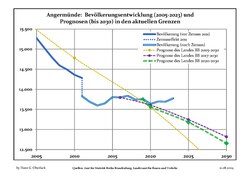 Recent Population Development and Projections (Population Development before Census 2011 (blue line); Recent Population Development according to the Census in Germany in 2011 (blue bordered line); Official projections for 2005-2030 (yellow line); for 2017-2030 (scarlet line); for 2020-2030 (green line)

Angermünde: Population development within the current boundaries (2020)[10] | ||||||||||||||||||||||||||||||||||||||||||||||||||||||||||||||||||||||||||
|
|
| ||||||||||||||||||||||||||||||||||||||||||||||||||||||||||||||||||||||||
Mayors
[edit]- 1989–1998: Wolf-Hugo Just
- 1998–2016: Wolfgang Krakow (SPD)
- since 2016: Frederik Bewer (independent)
Frederik Bewer was elected in May 2016 with 95.3% of the vote, for an eight-year term.[11]
Gallery
[edit]-
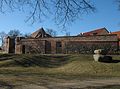 City wall
 -
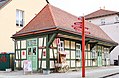 Touristinformation
 -
 The lake Mündesee in Angermünde.
 -
 Holy Spirit Chapel
 -
 Timbered house
 -
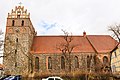 City Church St. Mary
 -
 Church in Schmiedeberg
 -
 Alcove house in Schmiedeberg
 -
 Alcove house in Schmiedeberg


- Fountain and sculptures by Christian Uhlig
-

-

-

-

-


Sons and daughters of the town
[edit] Friedrich Heinrich von der Hagen
- Friedrich Heinrich von der Hagen (1780–1856), German scholar
- Albert Manthe (1847–1928), sculptor
- Hermann Dietrich (1856–1930), born in Schmargendorf, politician (DNVP), member of Reichstag
- Ehm Welk (1884–1966), writer
- Hans-Erich Voss (1897–1969), Vice Admiral in World War II
- Günter Reimann (1904–2005), economist and journalist
- Heinrich Borgmann (1912–1945), adjutant of Adolf Hitler
- Hartmut Losch (1943–1997), athlete, European champion in discus throw
- Maik Heydeck (born 1965), boxer
- Julia Jäger (born 1970), actress
Twin cities
[edit]- Espelkamp, North Rine-Westphalia
- Lüdge, North Rine-Westphalia
- Strzelce Krajeńskie, Poland
- Zurrieq, Malta
Notes
[edit]- ^ Landkreis Uckermark Wahl der Bürgermeisterin / des Bürgermeisters, accessed 4 July 2021.
- ^ "Alle politisch selbständigen Gemeinden mit ausgewählten Merkmalen am 31.12.2023" (in German). Federal Statistical Office of Germany. 28 October 2024. Retrieved 16 November 2024.
- ^ "Stadt Angermünde ist jetzt staatlich anerkannter Erholungsort". Niederlausitz Aktuell (in German). 2010-12-13. Retrieved 2022-02-04.
- ^ Statistica Mitarbeiter (July 2020). "Gemeinden mit der größten Fläche in Deutschland". DE.Statista.com (in German). Retrieved 2023-06-25.
- ^ a b EB (1911).
- ^ Muret, Eduard (1885). Geschichte der Französischen Kolonie in Brandenburg-Preußen, unter besonderer Berücksichtigung der Berliner Gemeinde. Aus Veranlassung der Zweihundertjährigen Jubelfeier am 29. Oktober 1885 (in German). Berlin. pp. 185–186.
}: CS1 maint: location missing publisher (link) - ^ EB (1878).
- ^ "Work Camps". Retrieved 14 June 2025.
- ^ "Angermünde Climate Normals 1991–2020". National Oceanic and Atmospheric Administration. Archived from the original on 14 September 2023. Retrieved 15 September 2023.
- ^ Detailed data sources are to be found in the Wikimedia Commons.Population Projection Brandenburg at Wikimedia Commons [dead link]
- ^ "Ergebnis der Bürgermeisterstichwahl am 8. Mai 2016". Archived from the original on 2016-05-23. Retrieved 2016-12-27.
References
[edit]- Baynes, T. S., ed. (1878), , Encyclopædia Britannica, vol. 2 (9th ed.), New York: Charles Scribner's Sons, p. 29
- Chisholm, Hugh, ed. (1911), , Encyclopædia Britannica, vol. 2 (11th ed.), Cambridge University Press, p. 8
External links
[edit]
- Official Website (in German)
Towns and municipalities in Uckermark | ||
|---|---|---|
|  Coat of Arms of Uckermark district Coat of Arms of Uckermark district | |
| International | |
|---|---|
| National | |
| Geographic | |
| Other | |
